Photo Chemistry -Identifying Chemistry  In Our World Lucy Shim May 11 th , 10 Science 9
Vocabulary List Matter  Not matter  Pure substance Element Compounds Mixtures Heterogeneous Mixtures Homogenous Mixtures Mass  Volume  Density Viscosity State Conductivity 2 examples of physical change 2 examples of chemical change
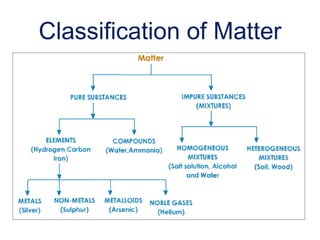
Classification of Matter
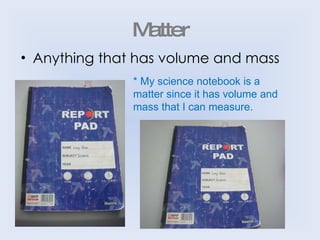
Matter Anything that has volume and mass * My science notebook is a matter since it has volume and mass that I can measure.
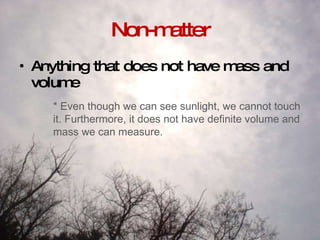
Non-matter Anything that does not have mass and volume * Even though we can see sunlight, we cannot touch it. Furthermore, it does not have definite volume and mass we can measure.
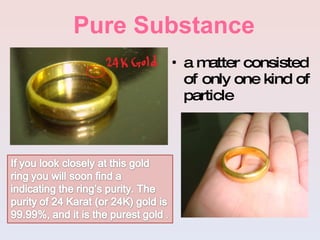
Pure Substance a matter consisted of only one kind of particle
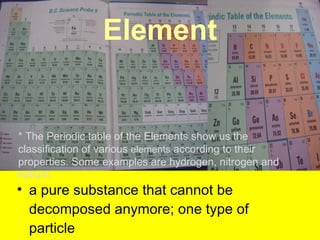
Element a pure substance that cannot be decomposed anymore; one type of particle  * The Periodic table of the Elements show us the classification of various  elements  according to their properties. Some examples are hydrogen, nitrogen and helium.
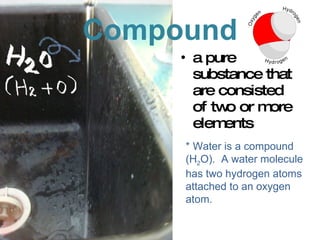
Compound a pure substance that are consisted of two or more elements * Water is a compound (H 2 O).  A water molecule has two hydrogen atoms attached to an oxygen atom.
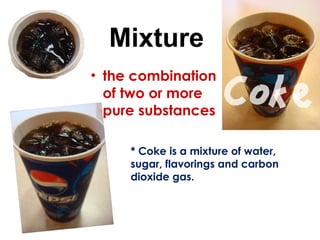
Mixture the combination of two or more pure substances   * Coke is a mixture of water, sugar, flavorings and carbon dioxide gas.
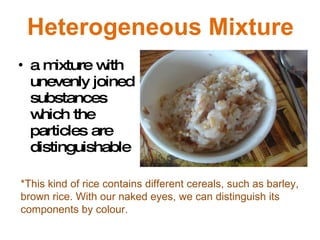
Heterogeneous Mixture a mixture with unevenly joined substances which the particles are distinguishable *This kind of rice contains different cereals, such as barley,  brown rice. With our naked eyes, we can distinguish its components by colour.
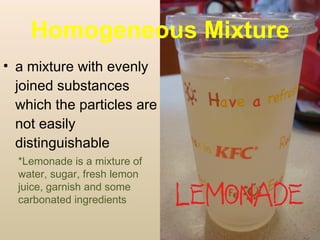
Homogeneous Mixture a mixture with evenly joined substances which the particles are not easily distinguishable *Lemonade is a mixture of water, sugar, fresh lemon juice, garnish and some carbonated ingredients
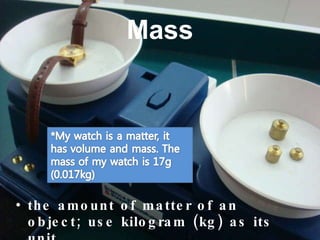
Mass the amount of matter of an object; use kilogram (kg) as its unit
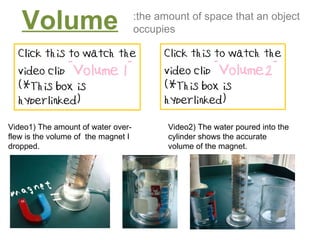
Volume :the amount of space that an object occupies Video1) The amount of water over- flew is the volume of  the magnet I dropped. Video2) The water poured into the cylinder shows the accurate volume of the magnet.
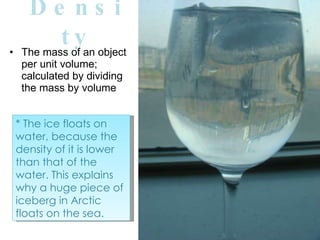
Density The mass of an object per unit volume; calculated by dividing the mass by volume * The ice floats on water, because the density of it is lower than that of the water. This explains why a huge piece of iceberg in Arctic floats on the sea.
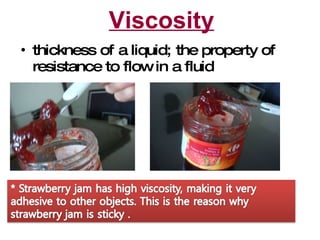
Viscosity thickness of a liquid; the property of resistance to flow in a fluid
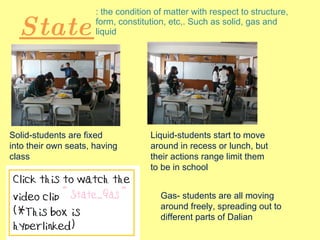
State : the condition of matter with respect to structure, form, constitution, etc,. Such as solid, gas and liquid Gas- students are all moving around freely, spreading out to different parts of Dalian Solid-students are fixed into their own seats, having class Liquid-students start to move around in recess or lunch, but their actions range limit them to be in school
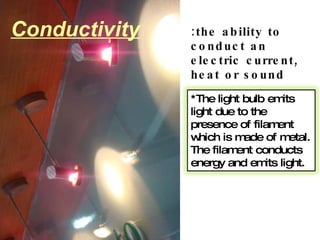
Conductivity :the ability to conduct an electric current, heat or sound *The light bulb emits light due to the presence of filament which is made of metal. The filament conducts energy and emits light.
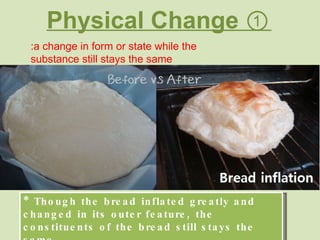
Physical Change ① :a change in form or state while the substance still stays the same * Though the bread inflated greatly and changed in its outer feature, the constituents of the bread still stays the same
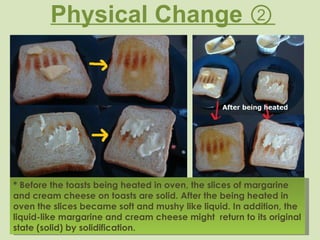
Physical Change ② * Before the toasts being heated in oven, the slices of margarine and cream cheese on toasts are solid. After the being heated in oven the slices became soft and mushy like liquid. In addition, the liquid-like margarine and cream cheese might  return to its original state (solid) by solidification.
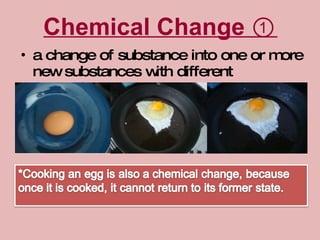
Chemical Change ① a change of substance into one or more new substances with different properties
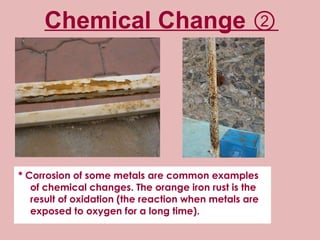
Chemical Change ② * Corrosion of some metals are common examples of chemical changes. The orange iron rust is the result of oxidation (the reaction when metals are exposed to oxygen for a long time).
Thank You! Chemistry is all around us!

Photo Chemistry Lucy S Him

  • 1.
    Photo Chemistry -IdentifyingChemistry In Our World Lucy Shim May 11 th , 10 Science 9
  • 2.
    Vocabulary List Matter Not matter Pure substance Element Compounds Mixtures Heterogeneous Mixtures Homogenous Mixtures Mass Volume Density Viscosity State Conductivity 2 examples of physical change 2 examples of chemical change
  • 3.
  • 4.
    Matter Anything thathas volume and mass * My science notebook is a matter since it has volume and mass that I can measure.
  • 5.
    Non-matter Anything thatdoes not have mass and volume * Even though we can see sunlight, we cannot touch it. Furthermore, it does not have definite volume and mass we can measure.
  • 6.
    Pure Substance amatter consisted of only one kind of particle
  • 7.
    Element a puresubstance that cannot be decomposed anymore; one type of particle * The Periodic table of the Elements show us the classification of various elements according to their properties. Some examples are hydrogen, nitrogen and helium.
  • 8.
    Compound a puresubstance that are consisted of two or more elements * Water is a compound (H 2 O). A water molecule has two hydrogen atoms attached to an oxygen atom.
  • 9.
    Mixture the combinationof two or more pure substances * Coke is a mixture of water, sugar, flavorings and carbon dioxide gas.
  • 10.
    Heterogeneous Mixture amixture with unevenly joined substances which the particles are distinguishable *This kind of rice contains different cereals, such as barley, brown rice. With our naked eyes, we can distinguish its components by colour.
  • 11.
    Homogeneous Mixture amixture with evenly joined substances which the particles are not easily distinguishable *Lemonade is a mixture of water, sugar, fresh lemon juice, garnish and some carbonated ingredients
  • 12.
    Mass the amountof matter of an object; use kilogram (kg) as its unit
  • 13.
    Volume :the amountof space that an object occupies Video1) The amount of water over- flew is the volume of the magnet I dropped. Video2) The water poured into the cylinder shows the accurate volume of the magnet.
  • 14.
    Density The massof an object per unit volume; calculated by dividing the mass by volume * The ice floats on water, because the density of it is lower than that of the water. This explains why a huge piece of iceberg in Arctic floats on the sea.
  • 15.
    Viscosity thickness ofa liquid; the property of resistance to flow in a fluid
  • 16.
    State : thecondition of matter with respect to structure, form, constitution, etc,. Such as solid, gas and liquid Gas- students are all moving around freely, spreading out to different parts of Dalian Solid-students are fixed into their own seats, having class Liquid-students start to move around in recess or lunch, but their actions range limit them to be in school
  • 17.
    Conductivity :the abilityto conduct an electric current, heat or sound *The light bulb emits light due to the presence of filament which is made of metal. The filament conducts energy and emits light.
  • 18.
    Physical Change ①:a change in form or state while the substance still stays the same * Though the bread inflated greatly and changed in its outer feature, the constituents of the bread still stays the same
  • 19.
    Physical Change ②* Before the toasts being heated in oven, the slices of margarine and cream cheese on toasts are solid. After the being heated in oven the slices became soft and mushy like liquid. In addition, the liquid-like margarine and cream cheese might return to its original state (solid) by solidification.
  • 20.
    Chemical Change ①a change of substance into one or more new substances with different properties
  • 21.
    Chemical Change ②* Corrosion of some metals are common examples of chemical changes. The orange iron rust is the result of oxidation (the reaction when metals are exposed to oxygen for a long time).
  • 22.
    Thank You! Chemistryis all around us!