Phosphorus
1. PHOSPHONIUM SALTS
2. REACTION OF PHOSPHONIUM SALTS
3. PHOSPHORUS YLIDES
4. PREPARATION OF PHOSPHORUS YLIDES
5. AROMATICITY OF PHOSPHOROUS HETEROCYCLES
• THREE MEMBERED RING
• FOUR MEMBERED RING
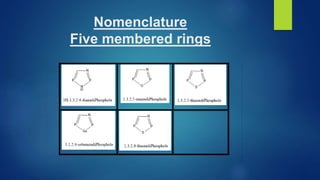
• FIVE MEMBERED RING
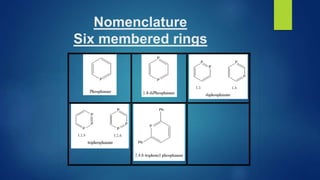
• SIX MEMBERED RING
Phosphonium salts
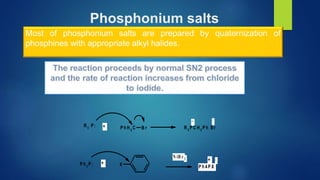
Most of phosphonium salts are prepared by quaternization of
phosphines with appropriate alkyl halides.
R3 P: P h H2 C B r R3 P C H2 P h Br
P h3 P: X
+
+ -
+
N iB r 2 -
P h 4P X
+
Reaction of phosphonium salts
 Phosphonium salts show more diverse range of reactions than the
corresponding ammonium salts due to the inability of nitrogen to form a
penta coordinate intermediate.
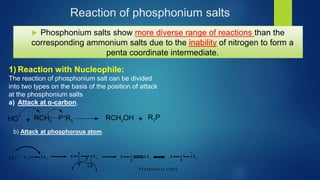
1) Reaction with Nucleophile:
The reaction of phosphonium salt can be divided
into two types on the basis of the position of attack
at the phosphonium salts
a) Attack at α-carbon.
b) Attack at phosphorous atom.
O
H -
+ RCH2 P+
R3
RCH2OH + R3P
O
H H 2 C R P R 3
C
H
P R 3
R
O
H
H
R C
H
P R 3
R C
H
P R 3
P h o s p h o s o u s y li d e s
+
+ +
Phosphorus ylides
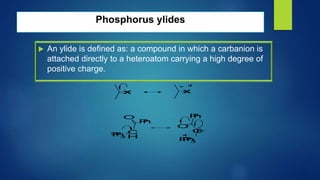
 An ylide is defined as: a compound in which a carbanion is
attached directly to a heteroatom carrying a high degree of
positive charge.
P
P
h
3
C
H
O
P
h
P
P
h
3
C
H
O
P
h
X X
-
- +
+
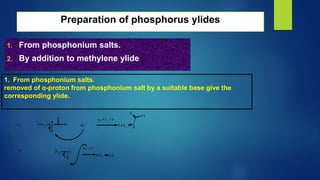
Preparation of phosphorus ylides
1. From phosphonium salts.
2. By addition to methylene ylide
1. From phosphonium salts.
removed of α-proton from phosphonium salt by a suitable base give the
corresponding ylide.
P P h 3 C
H
O
P h
H
B r P P h 3
C
H
O
P h
C H
H
P h 3 P
P P h 3 C H 2
a q . N a
2
C O
3
B u -
L i +
1 )
2 )
+
+
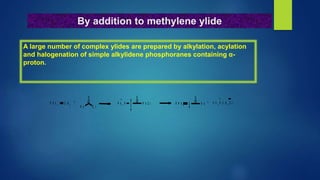
By addition to methylene ylide
A large number of complex ylides are prepared by alkylation, acylation
and halogenation of simple alkylidene phosphoranes containing α-
proton.
P P h 3 C H 2 C
H
H
P h C l
O
P h 3 P P P h 3 C
H
P h
O
P h 3 P C H 3 C l
O
C l
P h
+ +
-
+ +
Aromaticity of phosphorous heterocycles
Phosphorus is a group 15 element of periodic table, it is analogous with
nitrogen, Phosphorus has a medium electronegativity and five valance
electrons. Thus, it is able to form a large variety of covalent bonds
The P=C double bond can be part of a conjugated system like phosphinine
Phosphole is a pyrrole like with a lone pair on phosphorus atom
Contrary to pryrrole, phospholes are not planar due to the high inversion
barrier of tri coordinate phosphorous (6 Kcal/mole inversion barrier of
ammonia with the 35 Kcal/mol inversion barrier of phosphine). Therefore,
phospholes are not aromatic. Recently, phospholes can be flatted or even
fully planar, resulting in aromatic system.
Phospholes are basically not aromatic. • The reason for the non-aromatic
behavior of phospholes is not the insufficient overlap between the
phosphorous lone pair and the rest of the 𝜋- system, but the non-planarity at
the tri-coordinate phosphorous, which was recognized on the first x-ray
structure published. • Delocalized stabilization is insufficient to overcome the
significant planarization barrier of 35 Kcal/mol.
P
H
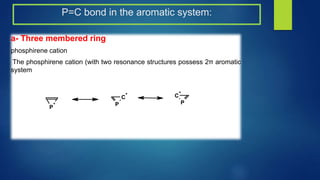
P=C bond in the aromatic system:
a- Three membered ring
phosphirene cation
The phosphirene cation (with two resonance structures possess 2π aromatic
system
P
+ P
C
+
P
C
+
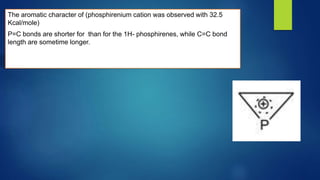
The aromatic character of (phosphirenium cation was observed with 32.5
Kcal/mole)
P=C bonds are shorter for than for the 1H- phosphirenes, while C=C bond
length are sometime longer.
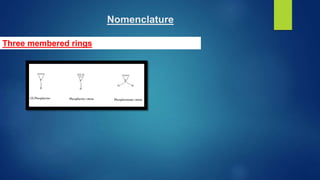
Nomenclature
Three membered rings
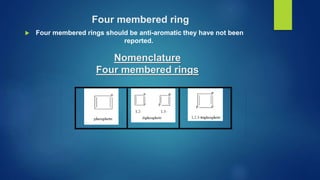
Four membered ring
 Four membered rings should be anti-aromatic they have not been
reported.
Nomenclature
Four membered rings
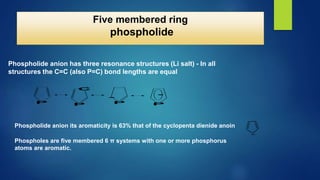
Phospholide anion has three resonance structures (Li salt) - In all
structures the C=C (also P=C) bond lengths are equal
Phospholide anion its aromaticity is 63% that of the cyclopenta dienide anoin
P
C
P P P
-
-
Phospholes are five membered 6 π systems with one or more phosphorus
atoms are aromatic.
Five membered ring
phospholide
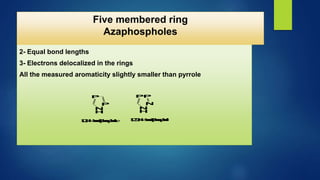
1- Planner
2- Equal bond lengths
3- Electrons delocalized in the rings
All the measured aromaticity slightly smaller than pyrrole
P
N
H
P
P
P
N
H
N
1
,
2
,
4
-
A
z
a
d
i
p
h
o
s
p
h
o
l
e 1
,
2
,
3
,
4
-
A
z
a
d
i
p
h
o
s
p
h
o
l
e
Five membered ring
Azaphospholes
Five membered ring
Oxaphospholes
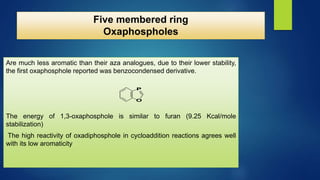
Are much less aromatic than their aza analogues, due to their lower stability,
the first oxaphosphole reported was benzocondensed derivative.
The energy of 1,3-oxaphosphole is similar to furan (9.25 Kcal/mole
stabilization)
The high reactivity of oxadiphosphole in cycloaddition reactions agrees well
with its low aromaticity
O
P
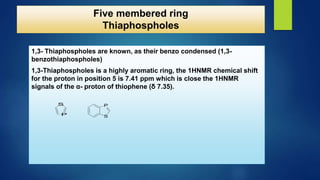
1,3- Thiaphospholes are known, as their benzo condensed (1,3-
benzothiaphospholes)
1,3-Thiaphospholes is a highly aromatic ring, the 1HNMR chemical shift
for the proton in position 5 is 7.41 ppm which is close the 1HNMR
signals of the α- proton of thiophene (δ 7.35).
S
P
S
P
Five membered ring
Thiaphospholes
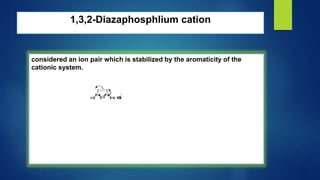
1,3,2-Diazaphosphlium cation
considered an ion pair which is stabilized by the aromaticity of the
cationic system.
N
N
P
+
R
R C
l
-
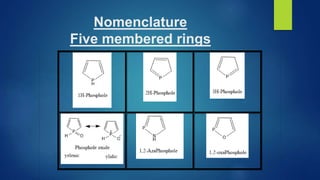
Nomenclature
Five membered rings
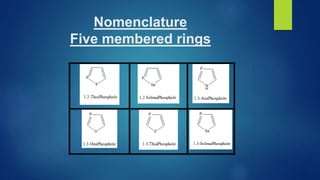
Nomenclature
Five membered rings
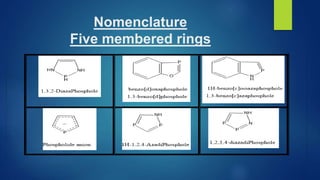
Nomenclature
Five membered rings
Nomenclature
Five membered rings
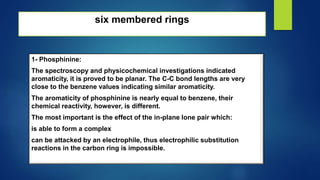
six membered rings
1- Phosphinine:
The spectroscopy and physicochemical investigations indicated
aromaticity, it is proved to be planar. The C-C bond lengths are very
close to the benzene values indicating similar aromaticity.
The aromaticity of phosphinine is nearly equal to benzene, their
chemical reactivity, however, is different.
The most important is the effect of the in-plane lone pair which:
is able to form a complex
can be attacked by an electrophile, thus electrophilic substitution
reactions in the carbon ring is impossible.
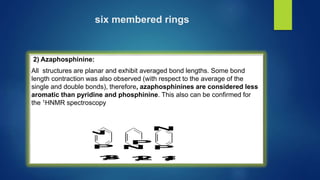
six membered rings
2) Azaphosphinine:
All structures are planar and exhibit averaged bond lengths. Some bond
length contraction was also observed (with respect to the average of the
single and double bonds), therefore, azaphosphinines are considered less
aromatic than pyridine and phosphinine. This also can be confirmed for
the 1HNMR spectroscopy
N
P
P
N
N
P
1
,
3
- 1
,
2
- 1
,
4
-
Nomenclature
Six membered rings

Phosphorus .pptx

  • 1.
    Phosphorus 1. PHOSPHONIUM SALTS 2.REACTION OF PHOSPHONIUM SALTS 3. PHOSPHORUS YLIDES 4. PREPARATION OF PHOSPHORUS YLIDES 5. AROMATICITY OF PHOSPHOROUS HETEROCYCLES • THREE MEMBERED RING • FOUR MEMBERED RING • FIVE MEMBERED RING • SIX MEMBERED RING
  • 2.
    Phosphonium salts Most ofphosphonium salts are prepared by quaternization of phosphines with appropriate alkyl halides. R3 P: P h H2 C B r R3 P C H2 P h Br P h3 P: X + + - + N iB r 2 - P h 4P X +
  • 3.
    Reaction of phosphoniumsalts  Phosphonium salts show more diverse range of reactions than the corresponding ammonium salts due to the inability of nitrogen to form a penta coordinate intermediate. 1) Reaction with Nucleophile: The reaction of phosphonium salt can be divided into two types on the basis of the position of attack at the phosphonium salts a) Attack at α-carbon. b) Attack at phosphorous atom. O H - + RCH2 P+ R3 RCH2OH + R3P O H H 2 C R P R 3 C H P R 3 R O H H R C H P R 3 R C H P R 3 P h o s p h o s o u s y li d e s + + +
  • 4.
    Phosphorus ylides  Anylide is defined as: a compound in which a carbanion is attached directly to a heteroatom carrying a high degree of positive charge. P P h 3 C H O P h P P h 3 C H O P h X X - - + +
  • 5.
    Preparation of phosphorusylides 1. From phosphonium salts. 2. By addition to methylene ylide 1. From phosphonium salts. removed of α-proton from phosphonium salt by a suitable base give the corresponding ylide. P P h 3 C H O P h H B r P P h 3 C H O P h C H H P h 3 P P P h 3 C H 2 a q . N a 2 C O 3 B u - L i + 1 ) 2 ) + +
  • 6.
    By addition tomethylene ylide A large number of complex ylides are prepared by alkylation, acylation and halogenation of simple alkylidene phosphoranes containing α- proton. P P h 3 C H 2 C H H P h C l O P h 3 P P P h 3 C H P h O P h 3 P C H 3 C l O C l P h + + - + +
  • 7.
    Aromaticity of phosphorousheterocycles Phosphorus is a group 15 element of periodic table, it is analogous with nitrogen, Phosphorus has a medium electronegativity and five valance electrons. Thus, it is able to form a large variety of covalent bonds The P=C double bond can be part of a conjugated system like phosphinine
  • 8.
    Phosphole is apyrrole like with a lone pair on phosphorus atom Contrary to pryrrole, phospholes are not planar due to the high inversion barrier of tri coordinate phosphorous (6 Kcal/mole inversion barrier of ammonia with the 35 Kcal/mol inversion barrier of phosphine). Therefore, phospholes are not aromatic. Recently, phospholes can be flatted or even fully planar, resulting in aromatic system. Phospholes are basically not aromatic. • The reason for the non-aromatic behavior of phospholes is not the insufficient overlap between the phosphorous lone pair and the rest of the 𝜋- system, but the non-planarity at the tri-coordinate phosphorous, which was recognized on the first x-ray structure published. • Delocalized stabilization is insufficient to overcome the significant planarization barrier of 35 Kcal/mol. P H
  • 9.
    P=C bond inthe aromatic system: a- Three membered ring phosphirene cation The phosphirene cation (with two resonance structures possess 2π aromatic system P + P C + P C +
  • 10.
    The aromatic characterof (phosphirenium cation was observed with 32.5 Kcal/mole) P=C bonds are shorter for than for the 1H- phosphirenes, while C=C bond length are sometime longer.
  • 11.
  • 12.
    Four membered ring Four membered rings should be anti-aromatic they have not been reported. Nomenclature Four membered rings
  • 13.
    Phospholide anion hasthree resonance structures (Li salt) - In all structures the C=C (also P=C) bond lengths are equal Phospholide anion its aromaticity is 63% that of the cyclopenta dienide anoin P C P P P - - Phospholes are five membered 6 π systems with one or more phosphorus atoms are aromatic. Five membered ring phospholide
  • 14.
    1- Planner 2- Equalbond lengths 3- Electrons delocalized in the rings All the measured aromaticity slightly smaller than pyrrole P N H P P P N H N 1 , 2 , 4 - A z a d i p h o s p h o l e 1 , 2 , 3 , 4 - A z a d i p h o s p h o l e Five membered ring Azaphospholes
  • 15.
    Five membered ring Oxaphospholes Aremuch less aromatic than their aza analogues, due to their lower stability, the first oxaphosphole reported was benzocondensed derivative. The energy of 1,3-oxaphosphole is similar to furan (9.25 Kcal/mole stabilization) The high reactivity of oxadiphosphole in cycloaddition reactions agrees well with its low aromaticity O P
  • 16.
    1,3- Thiaphospholes areknown, as their benzo condensed (1,3- benzothiaphospholes) 1,3-Thiaphospholes is a highly aromatic ring, the 1HNMR chemical shift for the proton in position 5 is 7.41 ppm which is close the 1HNMR signals of the α- proton of thiophene (δ 7.35). S P S P Five membered ring Thiaphospholes
  • 17.
    1,3,2-Diazaphosphlium cation considered anion pair which is stabilized by the aromaticity of the cationic system. N N P + R R C l -
  • 18.
  • 19.
  • 20.
  • 21.
  • 22.
    six membered rings 1-Phosphinine: The spectroscopy and physicochemical investigations indicated aromaticity, it is proved to be planar. The C-C bond lengths are very close to the benzene values indicating similar aromaticity. The aromaticity of phosphinine is nearly equal to benzene, their chemical reactivity, however, is different. The most important is the effect of the in-plane lone pair which: is able to form a complex can be attacked by an electrophile, thus electrophilic substitution reactions in the carbon ring is impossible.
  • 23.
    six membered rings 2)Azaphosphinine: All structures are planar and exhibit averaged bond lengths. Some bond length contraction was also observed (with respect to the average of the single and double bonds), therefore, azaphosphinines are considered less aromatic than pyridine and phosphinine. This also can be confirmed for the 1HNMR spectroscopy N P P N N P 1 , 3 - 1 , 2 - 1 , 4 -
  • 24.