Physiology and Ecology of
Phosphorus
PHYSIOLOGY AND
ECOLOGY OF PHOSPHORUS
PHOSPHORUS
 Phosphorus is a chemical element with Symbol P with atomic number 16
 Elemental phosphorus exist in two forms.
 White phosphorus and red phosphorus.
 Phosphorus is an essential macro-element, required for plant nutrition.
 It is one of the 17th nutrient essential for plant growth.
DISCOVERY
 Elemental phosphorus was first isolated (as white phosphorus) in 1669.
 Emitted a faint glow when exposed to oxygen – hence the name, taken
from Greek mythology, meaning "light-bearer" (Latin Lucifer), referring to
the Morning star and planet Venus.
 The glow of phosphorus is caused by oxidation of the white phosphorus.
White phosphorus exposed to air glows
in the dark
Con..
 Hennig Brand discovered phosphorus in 1669, in Hamburg, Germany, preparing
it from urine.
 (Urine naturally contains considerable quantities of dissolved phosphates.)
Brand called the substance he had discovered ‘cold fire’ because it was
luminous, glowing in the dark.
 Phosphorus is too reactive to occur in nature in the free state. Most of the
phosphorus in the earth’s crust occurs as phosphate rock
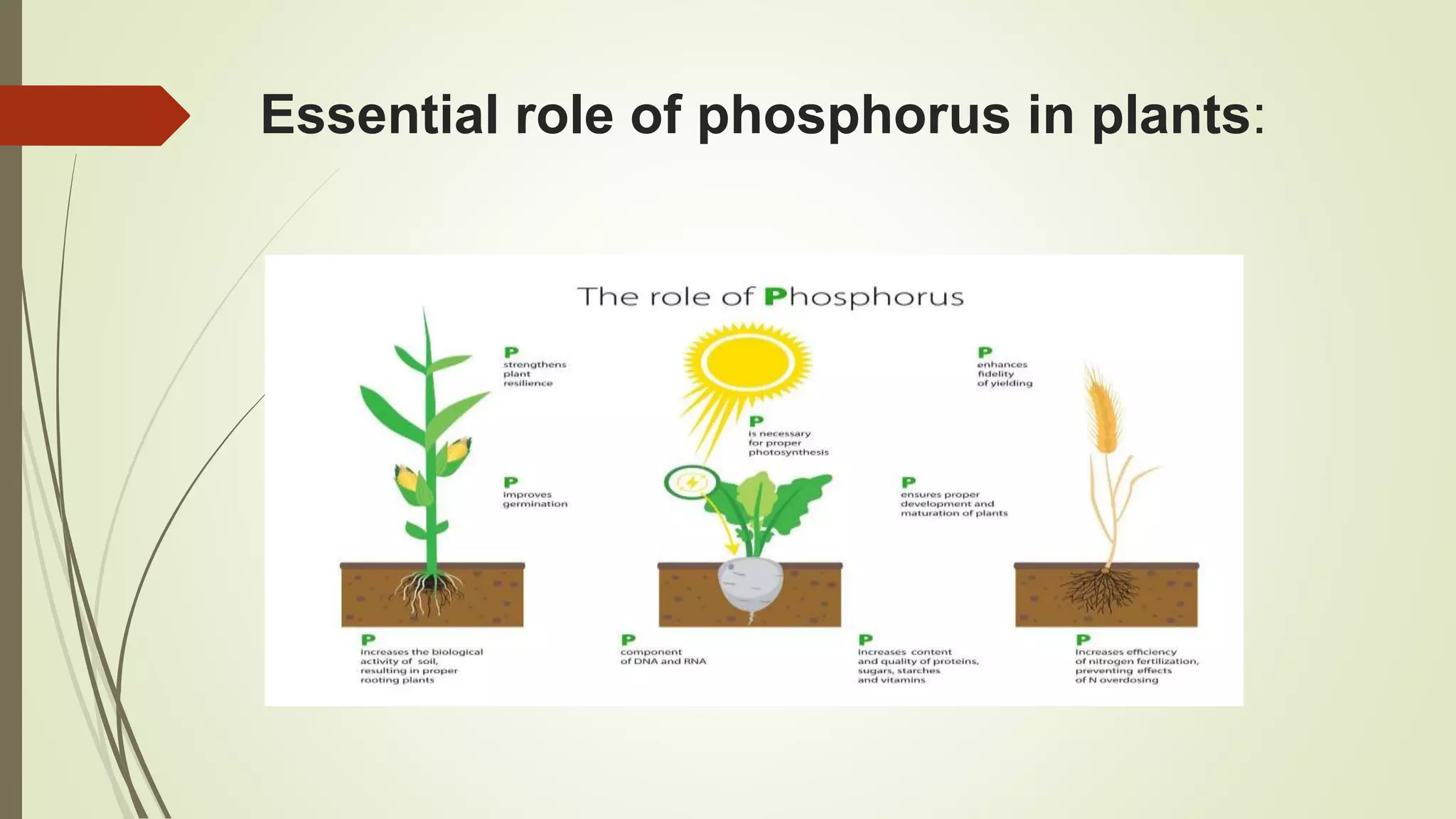
Essential role of phosphorus in plants:
 Phosphorus is an essential nutrient both as a part of several key plant structure
compounds and as a catalysis in the conversion of numerous key biochemical
reactions in plants.
 Phosphorus is noted especially for its role in capturing and converting the sun's
energy into useful plant compounds.
 Phosphorus is a vital component of DNA, the genetic "memory unit" of all living
things.
 It is also a component of RNA, the compound that reads the DNA genetic code to
build proteins and other compounds essential for plant structure, seed yield and
genetic transfer. The structures of both DNA and RNA are linked together by
phosphorus bonds.
.
Con..
 Phosphorus is a vital component of ATP, the "energy unit" of plants. ATP forms
during photosynthesis, has phosphorus in its structure, and processes from the
beginning of seedling growth through out the formation of grain and maturity.
 P are found in seeds and fruit where it is believed essential for seed formation and
development.
 Phosphorus is also a component of phytin, a major storage form of P in seeds.
 It is also component of cell membrane as phospholipid.
Essential role of phosphorus in plants:
ATP
Plant growth factor associated with P
 Stimulated root development
 Increased stalk and stem strength
 Improved flower formation and seed production
 Increased nitrogen N-fixing capacity of legumes
 Improvements in crop quality
 Increased resistance to plant diseases
 Supports development throughout entire life cycle
Phosphorus in soil
 Organic phosphorus:
• Organic phosphorus is found in plant residues, manures and
microbial tissues
• soil low in organic matter contain 3% and high in organic matter contain 50% or
more organic matter.
 Inorganic phosphorus:
• Inorganic forms of soil phosphorus consist of apatite (the original source of all
phosphorus), complexes of iron and aluminum phosphates, and phosphorus
absorbed onto clay particles.
Phosphorus uptake by plants:
 Phosphorus is found in soils both in an organic form and an un-organic (mineral) form
and its solubility in soil is low. There is equilibrium between solid phase phosphorus in
soil and the phosphorus in the soil solution.
 Plants can only take up phosphorus dissolved in the soil solution, and since most of the
soil phosphorus exists in stable chemical compounds, only a small amount of
phosphorus is available to the plant at any given time.
Con..
 Plants take up phosphorus from the soil solution as orthophosphate ion: either
HPO4-2 or H2PO4-. The proportion in which these two forms are absorbed is
determined by the soil pH, when at higher soil pH more HPO4-2 is taken up.
 The mobility of phosphorus in soil is very limited and therefore, plant roots can take
up phosphorus only from their immediate surroundings.
 Since concentration of phosphorus in the soil solution is low, plants use mostly
active uptake against the concentration gradient.
PHOSPHORUS DEFICIENCY
 Symptoms of phosphorus deficiency include stunted growth and dark purple colour
of older leaves.
 Inhibition of flowering and root system development.
 In most plants these symptoms will appear when phosphorus concentration in the
leaves is below 0.2%.
 Phosphorus deficiencies late in the growing season affect both seed development
and normal crop maturity.
 The percentage of the total amount of each nutrient taken up is higher for
phosphorus late in the growing season than for either nitrogen or potassium.
PHOSPHORUS IN EXCESS
 Increased weed growth
 Stunted plant growth
 Harms beneficial root fungi, which help the plant absorb water and nutrients
 Decreases the plant’s ability to uptake zinc (deficiency shows as bleaching of plant
tissue)
 Decreases the plant’s ability to uptake iron (deficiency shows as yellowing
between leaf veins)
 Excess of phosphorus mostly interferes with uptake of other elements, such as
iron, manganese and zinc.
What affects phosphorus levels?
 Wetlands slow down water flow and the plants nearby can absorb some of the
phosphorus moving through. When wetlands are lost, this ability to remove the
phosphorus from the system is eliminated.
 Phosphorus is often increased in streams and lakes by livestock manure, fertilizer
from lawns and gardens, pet and goose waste, wastewater flow from faulty septic
systems and impervious surface.
 Detention ponds, sand filters, and other surface water facilities can intercept or
impede phosphorus, but are generally not a complete substitute for natural system.
Ecological role of phosphorus:
 Phosphorus is a naturally occurring nutrient and under natural conditions enters
the water through the weathering of rocks and precipitation of dust
.
 Phosphorus is a limiting nutrient in the freshwater systems of the Puget Sound
lowlands area ( is a deep estuary – where saltwater and freshwater merge).
 A partly enclosed coastal body of water in which river water is mixed with seawater
is called an estuary.
 It is similar to nitrogen in marine environments in that when there is too much
or too little it can change how an ecosystem functions. Phosphorus is never
truly lost or destroyed; it moves from one system to another
Phosphorus cycle
 The process in which phosphorus travels from its main source of the rocks
through ecosystem to the living rocks.
or
 “ The phosphorus cycle is the process by which phosphorus moves through
the lithosphere, hydrosphere, and biosphere”.
 Phosphorus is essential for plant and animal growth, as well as the health
of microbes inhabiting the soil, but is gradually depleted from the soil over
time.
 The phosphorus cycle is an extremely slow process, as various weather
conditions (e.g., rain and erosion) help to wash the phosphorus found in
rocks into the soil.
 In the soil, the organic matter (e.g., plants and fungi) absorb the
phosphorus to be used for various biological processes.
Phosphorus Cycle Steps
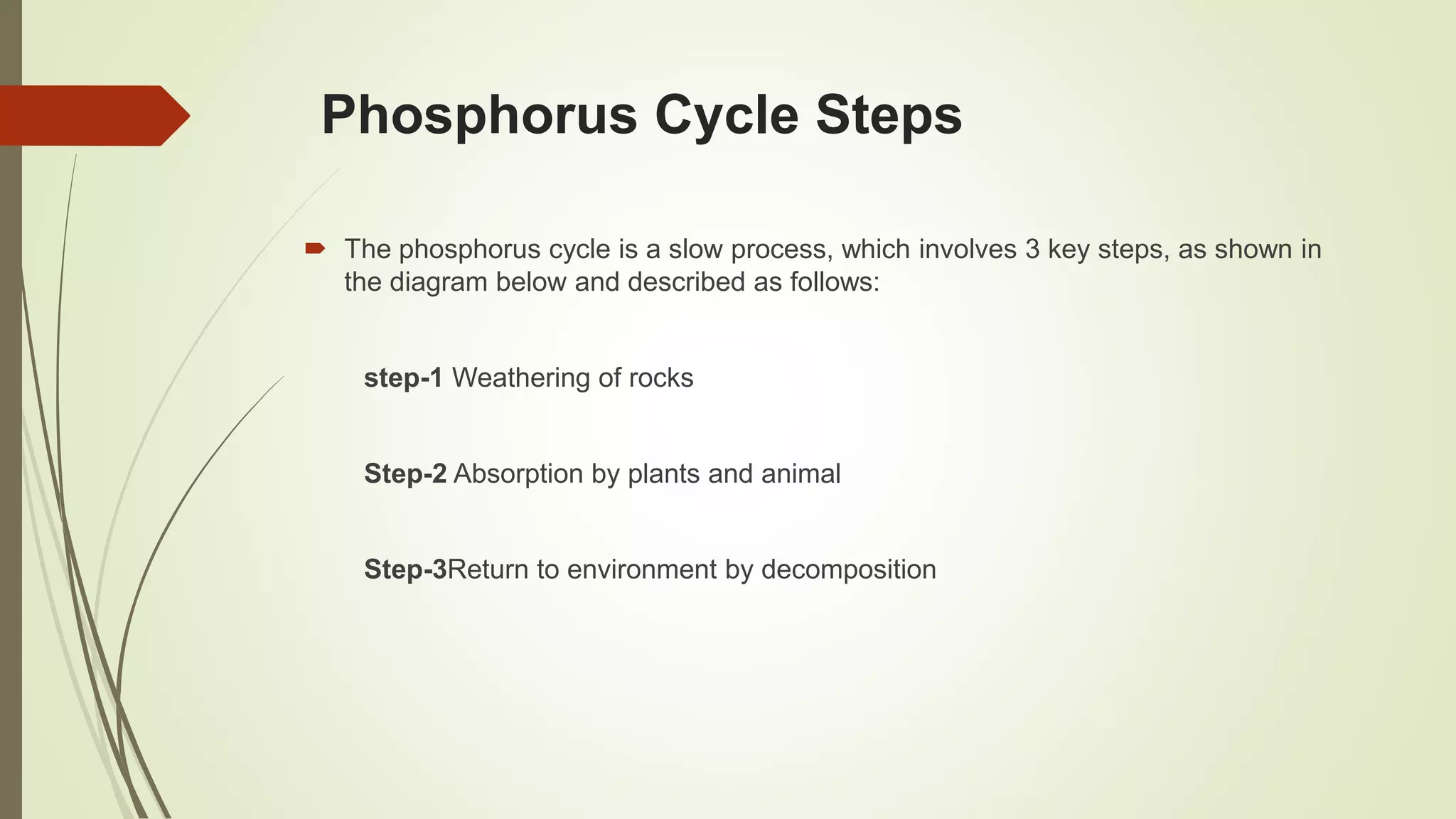
 The phosphorus cycle is a slow process, which involves 3 key steps, as shown in
the diagram below and described as follows:
step-1 Weathering of rocks
Step-2 Absorption by plants and animal
Step-3Return to environment by decomposition
Weathering
 Since the main source of phosphorus is found in rocks.
 The first step of the phosphorus cycle involves the extraction of phosphorus from
the rocks by weathering.
 Weather events, such as rain and other sources of erosion, result in phosphorus
being washed into the soil.
Absorption by Plants and Animals
 Once in the soil, plants, fungi, and microorganisms are able to absorb phosphorus
and grow.
 In addition, phosphorus can also be washed into the local water systems.
 Plants can also directly absorb phosphorus from the water and grow.
 In addition to plants, animals also obtain phosphorus from drinking water and
eating plants.
Return to the Environment via
Decomposition
 When plants and animals die, decomposition results in the return of phosphorus
back to the environment via the water or soil.
 Plants and animals in these environments can then use this phosphorus, and step
2 of the cycle is repeated.
Impact of human activities on
phosphorus cycle
 Humans have had a significant impact on the phosphorus cycle due to a variety of
human activities, such as the
 use of fertilizer,
 The distribution of food products,
 Artificial eutrophication
 Fertilizers containing phosphorus add to the phosphorus levels in the soil and are
particularly detrimental when such products are washed into local aquatic
ecosystems.
 When phosphorus is added to waters at a rate typically achieved by natural
processes, it is referred to as natural eutrophication.
Eutrophication
 A natural supply of phosphorus over time provides nutrients to the water and
serves to increase the productivity of that particular ecosystem.
 However, when foods are shipped from farms to cities, the substantial levels of
Phosphorus that is drained into the water systems is called artificial or
anthropogenic eutrophication
 When levels of phosphorus are too high, the overabundance of plant nutrients
serves to drive the excessive growth of algae. However, these algae die or form
algae blooms, which are toxic to the plants and animals in the ecosystem.
 Thus, human activities serve to harm aquatic ecosystems, whenever excess
amounts of phosphorus are leached into the water.
Eutrophication
Eutrophication
PHOSPHORUS CYCLE
p cycle

1589271661-15-physiology-and-ecology-of-phosphorus.pptx

  • 1.
  • 2.
  • 3.
    PHOSPHORUS  Phosphorus isa chemical element with Symbol P with atomic number 16  Elemental phosphorus exist in two forms.  White phosphorus and red phosphorus.  Phosphorus is an essential macro-element, required for plant nutrition.  It is one of the 17th nutrient essential for plant growth.
  • 4.
    DISCOVERY  Elemental phosphoruswas first isolated (as white phosphorus) in 1669.  Emitted a faint glow when exposed to oxygen – hence the name, taken from Greek mythology, meaning "light-bearer" (Latin Lucifer), referring to the Morning star and planet Venus.  The glow of phosphorus is caused by oxidation of the white phosphorus.
  • 5.
    White phosphorus exposedto air glows in the dark
  • 6.
    Con..  Hennig Branddiscovered phosphorus in 1669, in Hamburg, Germany, preparing it from urine.  (Urine naturally contains considerable quantities of dissolved phosphates.) Brand called the substance he had discovered ‘cold fire’ because it was luminous, glowing in the dark.  Phosphorus is too reactive to occur in nature in the free state. Most of the phosphorus in the earth’s crust occurs as phosphate rock
  • 7.
    Essential role ofphosphorus in plants:  Phosphorus is an essential nutrient both as a part of several key plant structure compounds and as a catalysis in the conversion of numerous key biochemical reactions in plants.  Phosphorus is noted especially for its role in capturing and converting the sun's energy into useful plant compounds.  Phosphorus is a vital component of DNA, the genetic "memory unit" of all living things.  It is also a component of RNA, the compound that reads the DNA genetic code to build proteins and other compounds essential for plant structure, seed yield and genetic transfer. The structures of both DNA and RNA are linked together by phosphorus bonds. .
  • 8.
    Con..  Phosphorus isa vital component of ATP, the "energy unit" of plants. ATP forms during photosynthesis, has phosphorus in its structure, and processes from the beginning of seedling growth through out the formation of grain and maturity.  P are found in seeds and fruit where it is believed essential for seed formation and development.  Phosphorus is also a component of phytin, a major storage form of P in seeds.  It is also component of cell membrane as phospholipid.
  • 9.
    Essential role ofphosphorus in plants:
  • 10.
  • 11.
    Plant growth factorassociated with P  Stimulated root development  Increased stalk and stem strength  Improved flower formation and seed production  Increased nitrogen N-fixing capacity of legumes  Improvements in crop quality  Increased resistance to plant diseases  Supports development throughout entire life cycle
  • 12.
    Phosphorus in soil Organic phosphorus: • Organic phosphorus is found in plant residues, manures and microbial tissues • soil low in organic matter contain 3% and high in organic matter contain 50% or more organic matter.  Inorganic phosphorus: • Inorganic forms of soil phosphorus consist of apatite (the original source of all phosphorus), complexes of iron and aluminum phosphates, and phosphorus absorbed onto clay particles.
  • 13.
    Phosphorus uptake byplants:  Phosphorus is found in soils both in an organic form and an un-organic (mineral) form and its solubility in soil is low. There is equilibrium between solid phase phosphorus in soil and the phosphorus in the soil solution.  Plants can only take up phosphorus dissolved in the soil solution, and since most of the soil phosphorus exists in stable chemical compounds, only a small amount of phosphorus is available to the plant at any given time.
  • 14.
    Con..  Plants takeup phosphorus from the soil solution as orthophosphate ion: either HPO4-2 or H2PO4-. The proportion in which these two forms are absorbed is determined by the soil pH, when at higher soil pH more HPO4-2 is taken up.  The mobility of phosphorus in soil is very limited and therefore, plant roots can take up phosphorus only from their immediate surroundings.  Since concentration of phosphorus in the soil solution is low, plants use mostly active uptake against the concentration gradient.
  • 15.
    PHOSPHORUS DEFICIENCY  Symptomsof phosphorus deficiency include stunted growth and dark purple colour of older leaves.  Inhibition of flowering and root system development.  In most plants these symptoms will appear when phosphorus concentration in the leaves is below 0.2%.  Phosphorus deficiencies late in the growing season affect both seed development and normal crop maturity.  The percentage of the total amount of each nutrient taken up is higher for phosphorus late in the growing season than for either nitrogen or potassium.
  • 16.
    PHOSPHORUS IN EXCESS Increased weed growth  Stunted plant growth  Harms beneficial root fungi, which help the plant absorb water and nutrients  Decreases the plant’s ability to uptake zinc (deficiency shows as bleaching of plant tissue)  Decreases the plant’s ability to uptake iron (deficiency shows as yellowing between leaf veins)  Excess of phosphorus mostly interferes with uptake of other elements, such as iron, manganese and zinc.
  • 17.
    What affects phosphoruslevels?  Wetlands slow down water flow and the plants nearby can absorb some of the phosphorus moving through. When wetlands are lost, this ability to remove the phosphorus from the system is eliminated.  Phosphorus is often increased in streams and lakes by livestock manure, fertilizer from lawns and gardens, pet and goose waste, wastewater flow from faulty septic systems and impervious surface.  Detention ponds, sand filters, and other surface water facilities can intercept or impede phosphorus, but are generally not a complete substitute for natural system.
  • 18.
    Ecological role ofphosphorus:  Phosphorus is a naturally occurring nutrient and under natural conditions enters the water through the weathering of rocks and precipitation of dust .  Phosphorus is a limiting nutrient in the freshwater systems of the Puget Sound lowlands area ( is a deep estuary – where saltwater and freshwater merge).  A partly enclosed coastal body of water in which river water is mixed with seawater is called an estuary.  It is similar to nitrogen in marine environments in that when there is too much or too little it can change how an ecosystem functions. Phosphorus is never truly lost or destroyed; it moves from one system to another
  • 19.
    Phosphorus cycle  Theprocess in which phosphorus travels from its main source of the rocks through ecosystem to the living rocks. or  “ The phosphorus cycle is the process by which phosphorus moves through the lithosphere, hydrosphere, and biosphere”.  Phosphorus is essential for plant and animal growth, as well as the health of microbes inhabiting the soil, but is gradually depleted from the soil over time.  The phosphorus cycle is an extremely slow process, as various weather conditions (e.g., rain and erosion) help to wash the phosphorus found in rocks into the soil.  In the soil, the organic matter (e.g., plants and fungi) absorb the phosphorus to be used for various biological processes.
  • 20.
    Phosphorus Cycle Steps The phosphorus cycle is a slow process, which involves 3 key steps, as shown in the diagram below and described as follows: step-1 Weathering of rocks Step-2 Absorption by plants and animal Step-3Return to environment by decomposition
  • 21.
    Weathering  Since themain source of phosphorus is found in rocks.  The first step of the phosphorus cycle involves the extraction of phosphorus from the rocks by weathering.  Weather events, such as rain and other sources of erosion, result in phosphorus being washed into the soil.
  • 22.
    Absorption by Plantsand Animals  Once in the soil, plants, fungi, and microorganisms are able to absorb phosphorus and grow.  In addition, phosphorus can also be washed into the local water systems.  Plants can also directly absorb phosphorus from the water and grow.  In addition to plants, animals also obtain phosphorus from drinking water and eating plants.
  • 23.
    Return to theEnvironment via Decomposition  When plants and animals die, decomposition results in the return of phosphorus back to the environment via the water or soil.  Plants and animals in these environments can then use this phosphorus, and step 2 of the cycle is repeated.
  • 24.
    Impact of humanactivities on phosphorus cycle  Humans have had a significant impact on the phosphorus cycle due to a variety of human activities, such as the  use of fertilizer,  The distribution of food products,  Artificial eutrophication  Fertilizers containing phosphorus add to the phosphorus levels in the soil and are particularly detrimental when such products are washed into local aquatic ecosystems.  When phosphorus is added to waters at a rate typically achieved by natural processes, it is referred to as natural eutrophication.
  • 25.
    Eutrophication  A naturalsupply of phosphorus over time provides nutrients to the water and serves to increase the productivity of that particular ecosystem.  However, when foods are shipped from farms to cities, the substantial levels of Phosphorus that is drained into the water systems is called artificial or anthropogenic eutrophication  When levels of phosphorus are too high, the overabundance of plant nutrients serves to drive the excessive growth of algae. However, these algae die or form algae blooms, which are toxic to the plants and animals in the ecosystem.  Thus, human activities serve to harm aquatic ecosystems, whenever excess amounts of phosphorus are leached into the water.
  • 26.
  • 27.
  • 28.
  • 29.