P
H
O
SPHO
R
U
S
P
H
O
SPHO
R
U
S
C
Y C L
E
C
Y C L
E
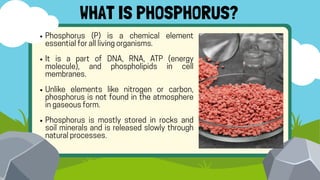
Phosphorus (P) is a chemical element
essential for all living organisms.
It is a part of DNA, RNA, ATP (energy
molecule), and phospholipids in cell
membranes.
Unlike elements like nitrogen or carbon,
phosphorus is not found in the atmosphere
in gaseous form.
Phosphorus is mostly stored in rocks and
soil minerals and is released slowly through
natural processes.
WHAT IS PHOSPHORUS?
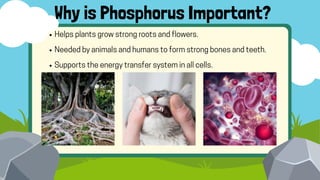
Helps plants grow strong roots and flowers.
Needed by animals and humans to form strong bones and teeth.
Supports the energy transfer system in all cells.
Why is Phosphorus Important?
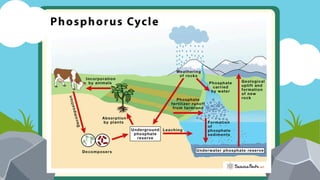
PHOSPHORUS CYCLE
ThePhosphorusCycle
describeshow
phosphorusmoves
throughEarth’s
systems:land,water,
andlivingthings.
Itisasedimentary
cycle—itdoesnot
includeagaseous
phase,whichmakesit
slowerthanthecarbon
ornitrogencycles.
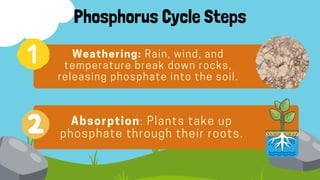
Phosphorus Cycle Steps
Weathering: Rain, wind, and
temperature break down rocks,
releasing phosphate into the soil.
Absorption: Plants take up
phosphate through their roots.
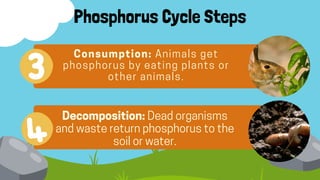
Phosphorus Cycle Steps
Consumption: Animals get
phosphorus by eating plants or
other animals.
Decomposition: Dead organisms
and waste return phosphorus to the
soil or water.
Phosphorus Cycle Steps
Sedimentation: Phosphates in
water bodies sink and form new
rocks over time.
Fertilizer Use: Excess phosphorus in
agriculture leads to runoff into rivers
and lakes.
Detergents: Some soaps release
phosphorus into water systems.
Mining: Phosphate rocks are mined
heavily, disrupting natural reserves.
Waste Disposal: Poor sewage
systems allow phosphorus to reach
ecosystems unnaturally.
Human Aspects on the Phosphorus Cycle
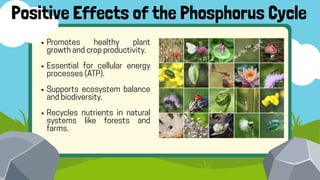
Promotes healthy plant
growth and crop productivity.
Essential for cellular energy
processes (ATP).
Supports ecosystem balance
and biodiversity.
Recycles nutrients in natural
systems like forests and
farms.
Positive Effects of the Phosphorus Cycle
Eutrophication: Nutrient pollution causes
excessive algae growth in lakes and
rivers.
Oxygen depletion: When algae die, their
decay uses up oxygen, creating dead
zones.
Waterpollution:Leadstounsafedrinking
waterandaffectsfishandaquaticlife.
Soil exhaustion: Overuse of fertilizers
changes soil structure and reduces
fertility.
Negative Effects of the Phosphorus Cycle
Forest Ecosystem: Decaying
leaves return phosphorus to the
soil naturally.
Aquatic Ecosystem: Runoff from
farmland increases phosphate
levels in lakes.
Agriculture: Bone meal and
compost provide phosphorus to
vegetable gardens.
Industry: Mining in Morocco
supplies much of the world’s
phosphate fertilizer.
Examples of Phosphorus Cycle in Real Life
ConstructedWetlands
What it is: Artificial wetlands designed to treat
agriculturalormunicipalwastewater.
How it helps: Plants and soil microbes in
wetlands absorb and filter out excess
phosphorusbeforeitreachesriversorlakes.
Technologies Used
Waste-to-FertilizerConversionTechnologies
What it is: Processing agricultural and food
wastetoextractandrecyclephosphorus
How it helps: Turns waste into valuable organic
fertilizer,closingthephosphorusloop.
Technologies Used
PHOSPHORUS CYCLE_20250712_072936_0000.pdf

PHOSPHORUS CYCLE_20250712_072936_0000.pdf

  • 1.
  • 2.
    Phosphorus (P) isa chemical element essential for all living organisms. It is a part of DNA, RNA, ATP (energy molecule), and phospholipids in cell membranes. Unlike elements like nitrogen or carbon, phosphorus is not found in the atmosphere in gaseous form. Phosphorus is mostly stored in rocks and soil minerals and is released slowly through natural processes. WHAT IS PHOSPHORUS?
  • 3.
    Helps plants growstrong roots and flowers. Needed by animals and humans to form strong bones and teeth. Supports the energy transfer system in all cells. Why is Phosphorus Important?
  • 4.
  • 6.
    Phosphorus Cycle Steps Weathering:Rain, wind, and temperature break down rocks, releasing phosphate into the soil. Absorption: Plants take up phosphate through their roots.
  • 7.
    Phosphorus Cycle Steps Consumption:Animals get phosphorus by eating plants or other animals. Decomposition: Dead organisms and waste return phosphorus to the soil or water.
  • 8.
    Phosphorus Cycle Steps Sedimentation:Phosphates in water bodies sink and form new rocks over time.
  • 9.
    Fertilizer Use: Excessphosphorus in agriculture leads to runoff into rivers and lakes. Detergents: Some soaps release phosphorus into water systems. Mining: Phosphate rocks are mined heavily, disrupting natural reserves. Waste Disposal: Poor sewage systems allow phosphorus to reach ecosystems unnaturally. Human Aspects on the Phosphorus Cycle
  • 10.
    Promotes healthy plant growthand crop productivity. Essential for cellular energy processes (ATP). Supports ecosystem balance and biodiversity. Recycles nutrients in natural systems like forests and farms. Positive Effects of the Phosphorus Cycle
  • 11.
    Eutrophication: Nutrient pollutioncauses excessive algae growth in lakes and rivers. Oxygen depletion: When algae die, their decay uses up oxygen, creating dead zones. Waterpollution:Leadstounsafedrinking waterandaffectsfishandaquaticlife. Soil exhaustion: Overuse of fertilizers changes soil structure and reduces fertility. Negative Effects of the Phosphorus Cycle
  • 12.
    Forest Ecosystem: Decaying leavesreturn phosphorus to the soil naturally. Aquatic Ecosystem: Runoff from farmland increases phosphate levels in lakes. Agriculture: Bone meal and compost provide phosphorus to vegetable gardens. Industry: Mining in Morocco supplies much of the world’s phosphate fertilizer. Examples of Phosphorus Cycle in Real Life
  • 13.
    ConstructedWetlands What it is:Artificial wetlands designed to treat agriculturalormunicipalwastewater. How it helps: Plants and soil microbes in wetlands absorb and filter out excess phosphorusbeforeitreachesriversorlakes. Technologies Used
  • 14.
    Waste-to-FertilizerConversionTechnologies What it is:Processing agricultural and food wastetoextractandrecyclephosphorus How it helps: Turns waste into valuable organic fertilizer,closingthephosphorusloop. Technologies Used