Phonology Sound System of a Language
We all have instinctual knowledge of the phonemes of our own language  It allows us to produce sounds that form meaningful utterances (even if they are new)  It allows us to recognize and understand a foreign accent
The study of the  structure  and systematic  patterns  of  sounds  in human language
It allows us to make up new words that “sound right”  It allows us to add appropriate sounds to make plurals, past tense, etc.  It allows us to know what is and what is not a sound in our own language.
Phonemics : narrow study of sounds  Ex. [p h ] in  peak , [p] in  speak Phonetics : broad study of sounds  Ex. /p/ in  speak  and  peak
Phonemes Allophones Minimal pairs Distinctive features Syllable structure Phonotactics Morphophonemics
Distinctive or  contrastive sound  (phonological segment) in the sound system of a language.  PHONE  A Phonetic Segment Occurring in Language  PHONEME  A Segment that differentiates meaning
Place of articulation Ex. /p/ VS /t/ p op VS  t op Manner of articulation Ex. /b/ VS /m/ B ob VS  m ob Voicing Ex. /s/ VS /z/  S ue VS  z oo
An Allophone is:  A predictable phonetic variant of a phoneme  It is rule-governed  An Allophone is Predictable, Nondistinctive and Redundant
An  alternative pronunciation  or a  variant  of a phoneme. Ex.  /p/  - [p h ]  p en - [p] s p y /t/ - [t h ] t op - [t] s t op - [?] bi tt en - [D] bu tt er
Aspiration in English is another example of a predictable, allophonic rule  Occurs with certain consonants at the beginning of a word (if the syllable is stressed)  Presence/Absence of Aspirated Consonant does not change the meaning of the word
A pair of words that  differ by just one phoneme  in the  same position  and have  different meanings . Ex.  s ip VS  z ip t ip VS  d ip
Phonetic properties or features that distinguish phonemes from one another
Syllabic Consonantal Sonorant Obstruent Voiced Continuant Nasal Lateral Distributed Affricate Labial Round Coronal
 
High Back Low Round Tense Lax
Study of the sound and  phoneme combinations  allowed in a given language. Phonotactic Constraints : the rules that characterize  permissible syllable structures  in a language.
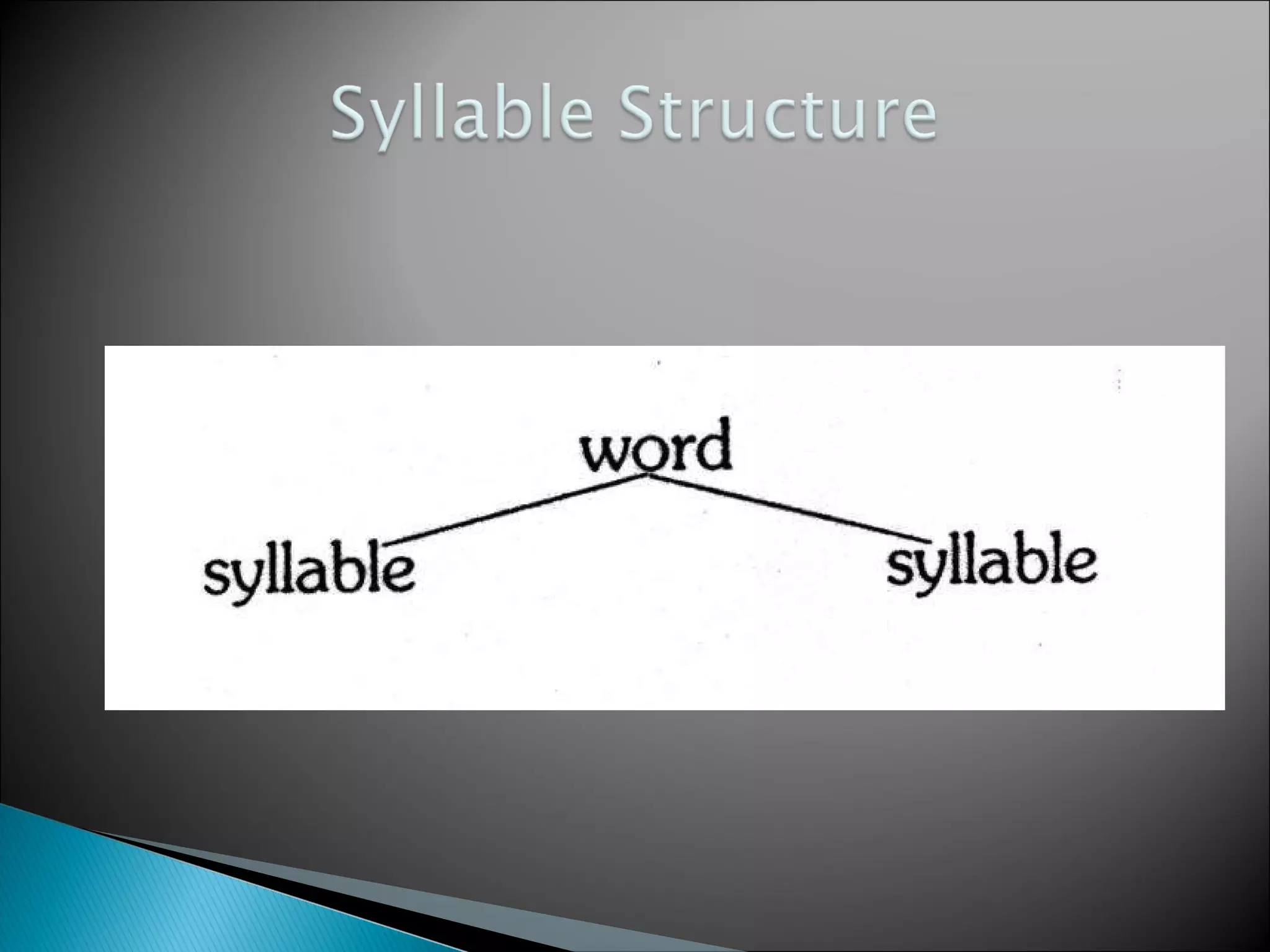
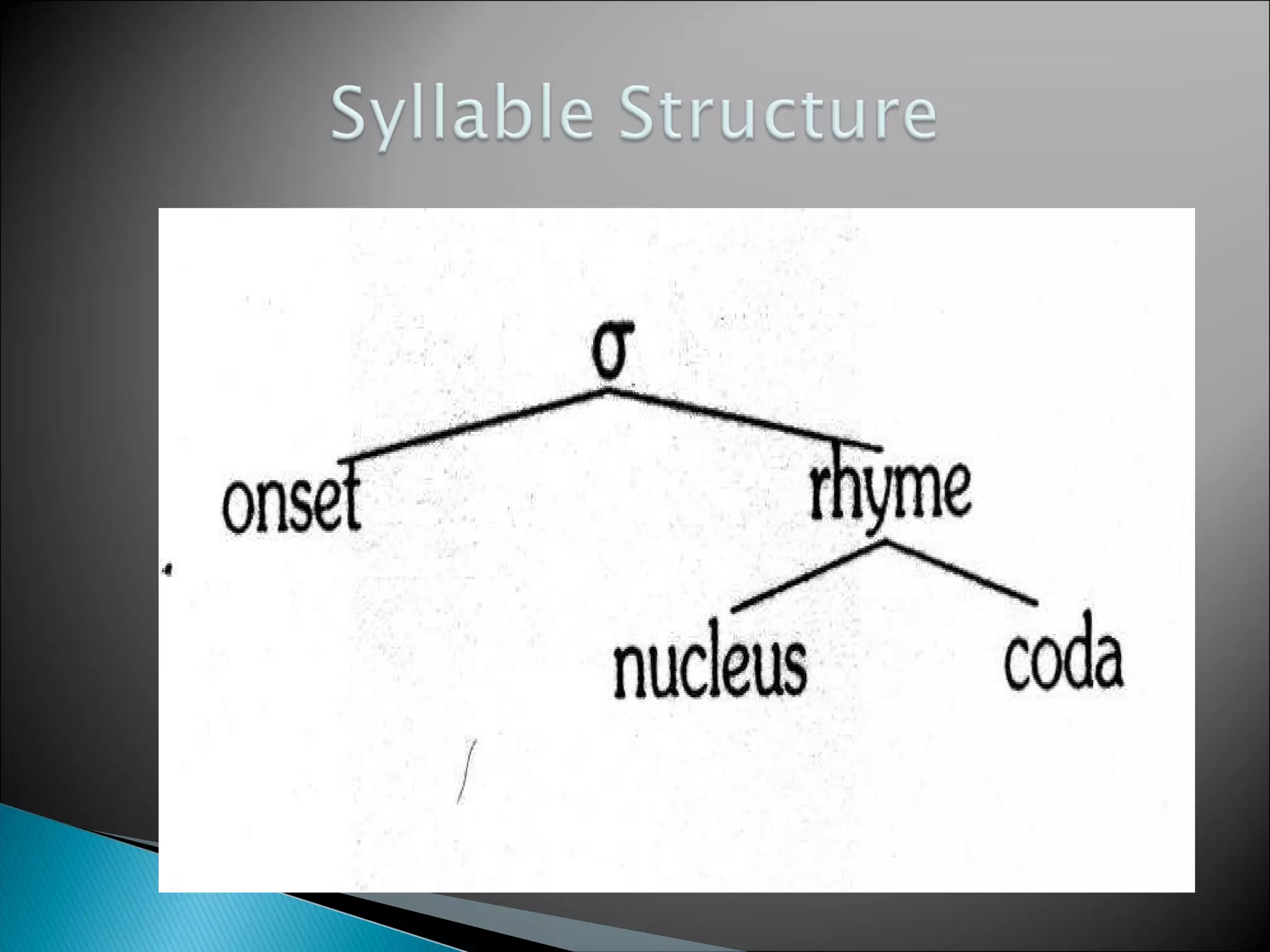
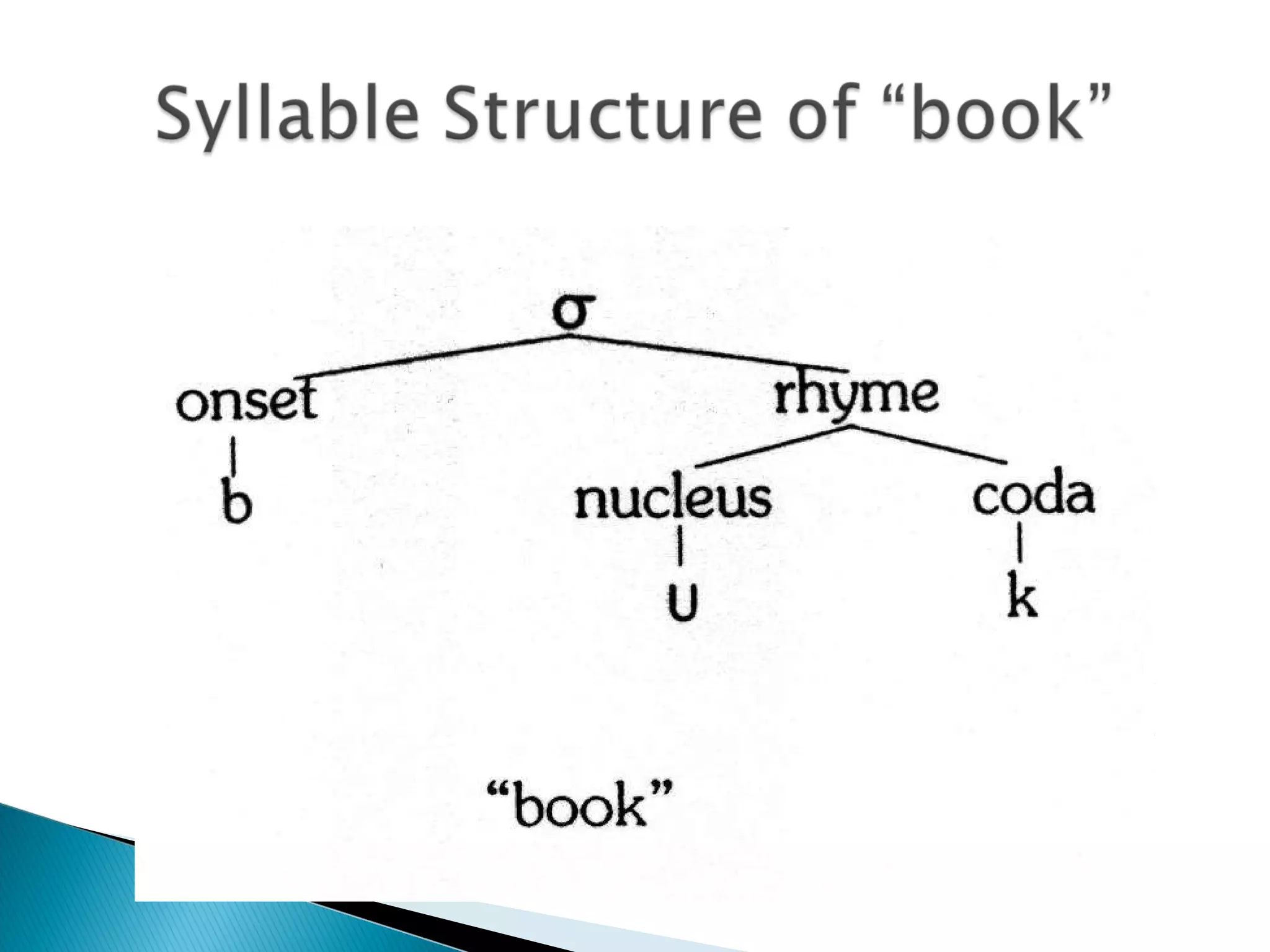
A phonological unit that is composed of one or more phonemes.
1) After Consonants like /b/, /g/, /k/, or /p/  another stop is not permitted  2) If a word begins with /l/ or /r/  Every speaker knows the next letter will be a vowel  3) If word begins with /c&/ or /j&/  The next letter will be a vowel  4) No more than three consonants Allowed  Even this restricted to the following sequence:  /s/ + /p, t, k/ + /r, l, w, y/
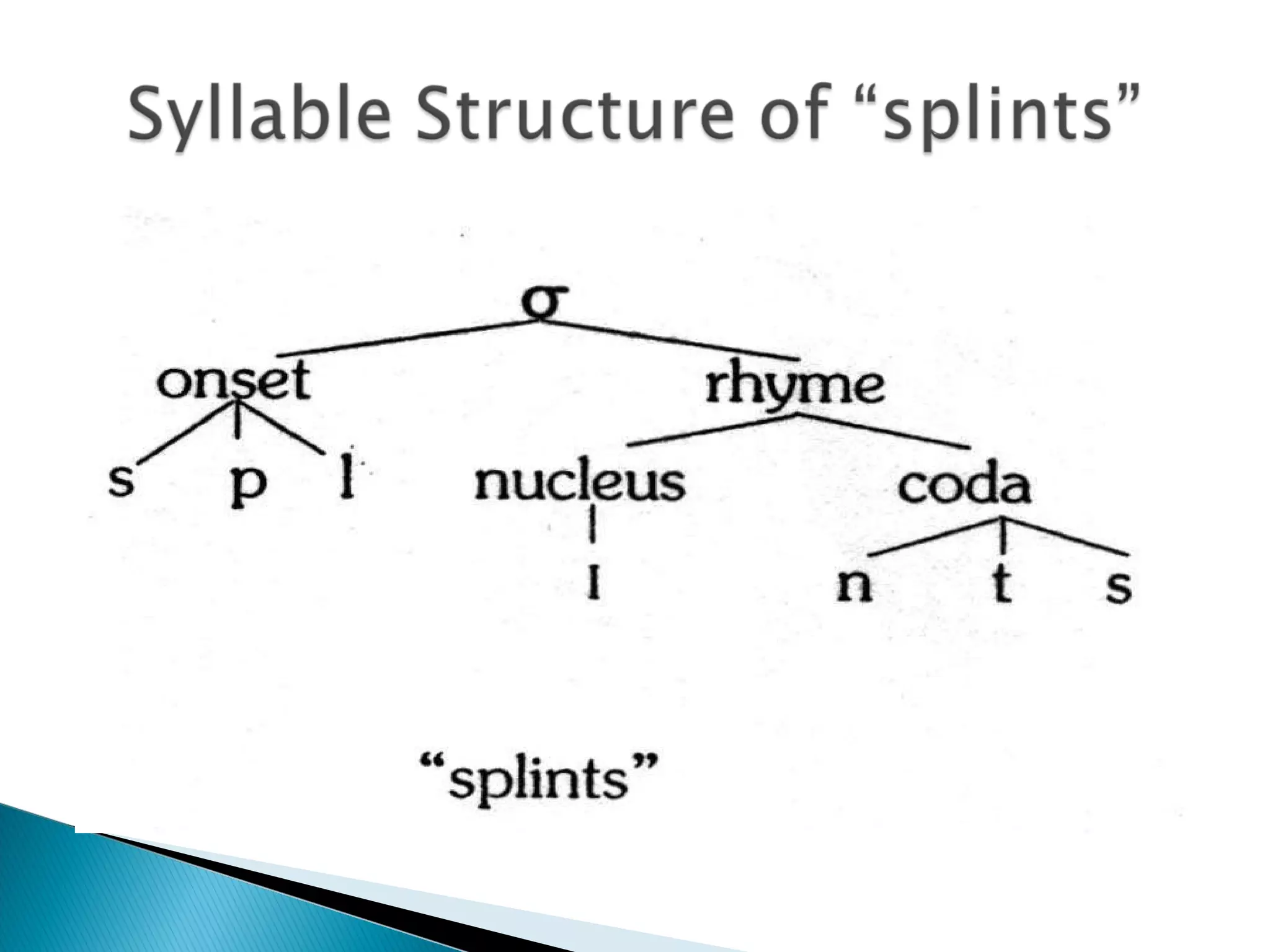
VC : on, at, out VCC : ant, oust CV : to, shoe CCV : spy, snow CVC : tin, chap CVCC : part, tenth CCVC : spin, cloud, pride CCCVC : splash, spread, split CCCVCCC : scripts, sprints


pertaining to the  alternation  or change of one  phoneme  to another in a particular environment. For example, the change of the phoneme / k / to / s / before  front  vowels, which can be seen in the words " electric " and  " electric-ity ", is morphophonemic A study of a phonemic difference among allomorphs of the same morpheme. It describes  changes in pronunciation  modified by  neighboring sounds . Morphophonemic Rule : the rule that assigns the phonetic form, determined by both  morphology  and  phonology
voiceless phonemes + [s] Ex. boo k s, ra t s, for k s voiced phonemes + [z]  Ex. jo b s, do g s, pumpki n s tense vowels, or diphthongs + [z]  Ex. toe s , z oo s, b oy s [+strident] +  [ ә z] Ex. chur ch es, gara g es, ju dg es, cour s es
[ I n] + vowels or alveolar Ex. in e xpensive, in t olerant [ I m]  +  labials Ex. im p ossible, im m ature [ I ŋ] + velars Ex. in c omparable, in c omplete

Phonology

  • 1.
  • 2.
    We all haveinstinctual knowledge of the phonemes of our own language It allows us to produce sounds that form meaningful utterances (even if they are new) It allows us to recognize and understand a foreign accent
  • 3.
    The study ofthe structure and systematic patterns of sounds in human language
  • 4.
    It allows usto make up new words that “sound right” It allows us to add appropriate sounds to make plurals, past tense, etc. It allows us to know what is and what is not a sound in our own language.
  • 5.
    Phonemics : narrowstudy of sounds Ex. [p h ] in peak , [p] in speak Phonetics : broad study of sounds Ex. /p/ in speak and peak
  • 6.
    Phonemes Allophones Minimalpairs Distinctive features Syllable structure Phonotactics Morphophonemics
  • 7.
    Distinctive or contrastive sound (phonological segment) in the sound system of a language. PHONE A Phonetic Segment Occurring in Language PHONEME A Segment that differentiates meaning
  • 8.
    Place of articulationEx. /p/ VS /t/ p op VS t op Manner of articulation Ex. /b/ VS /m/ B ob VS m ob Voicing Ex. /s/ VS /z/ S ue VS z oo
  • 9.
    An Allophone is: A predictable phonetic variant of a phoneme It is rule-governed An Allophone is Predictable, Nondistinctive and Redundant
  • 10.
    An alternativepronunciation or a variant of a phoneme. Ex. /p/ - [p h ] p en - [p] s p y /t/ - [t h ] t op - [t] s t op - [?] bi tt en - [D] bu tt er
  • 11.
    Aspiration in Englishis another example of a predictable, allophonic rule Occurs with certain consonants at the beginning of a word (if the syllable is stressed) Presence/Absence of Aspirated Consonant does not change the meaning of the word
  • 12.
    A pair ofwords that differ by just one phoneme in the same position and have different meanings . Ex. s ip VS z ip t ip VS d ip
  • 13.
    Phonetic properties orfeatures that distinguish phonemes from one another
  • 14.
    Syllabic Consonantal SonorantObstruent Voiced Continuant Nasal Lateral Distributed Affricate Labial Round Coronal
  • 15.
  • 16.
    High Back LowRound Tense Lax
  • 17.
    Study of thesound and phoneme combinations allowed in a given language. Phonotactic Constraints : the rules that characterize permissible syllable structures in a language.
  • 18.
    A phonological unitthat is composed of one or more phonemes.
  • 19.
    1) After Consonantslike /b/, /g/, /k/, or /p/ another stop is not permitted 2) If a word begins with /l/ or /r/ Every speaker knows the next letter will be a vowel 3) If word begins with /c&/ or /j&/ The next letter will be a vowel 4) No more than three consonants Allowed Even this restricted to the following sequence: /s/ + /p, t, k/ + /r, l, w, y/
  • 20.
    VC : on,at, out VCC : ant, oust CV : to, shoe CCV : spy, snow CVC : tin, chap CVCC : part, tenth CCVC : spin, cloud, pride CCCVC : splash, spread, split CCCVCCC : scripts, sprints
  • 21.
  • 22.
  • 23.
  • 24.
  • 25.
  • 26.
    pertaining to the alternation or change of one phoneme to another in a particular environment. For example, the change of the phoneme / k / to / s / before front vowels, which can be seen in the words " electric " and " electric-ity ", is morphophonemic A study of a phonemic difference among allomorphs of the same morpheme. It describes changes in pronunciation modified by neighboring sounds . Morphophonemic Rule : the rule that assigns the phonetic form, determined by both morphology and phonology
  • 27.
    voiceless phonemes +[s] Ex. boo k s, ra t s, for k s voiced phonemes + [z] Ex. jo b s, do g s, pumpki n s tense vowels, or diphthongs + [z] Ex. toe s , z oo s, b oy s [+strident] + [ ә z] Ex. chur ch es, gara g es, ju dg es, cour s es
  • 28.
    [ I n]+ vowels or alveolar Ex. in e xpensive, in t olerant [ I m] + labials Ex. im p ossible, im m ature [ I ŋ] + velars Ex. in c omparable, in c omplete