PHARYNGEAL POUCHES
TONGUE, THYROID
Dr. G.Prabavathy
Assistant Professor
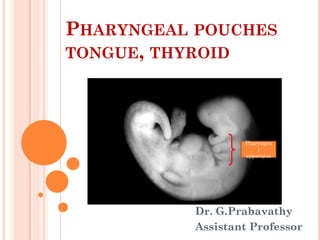
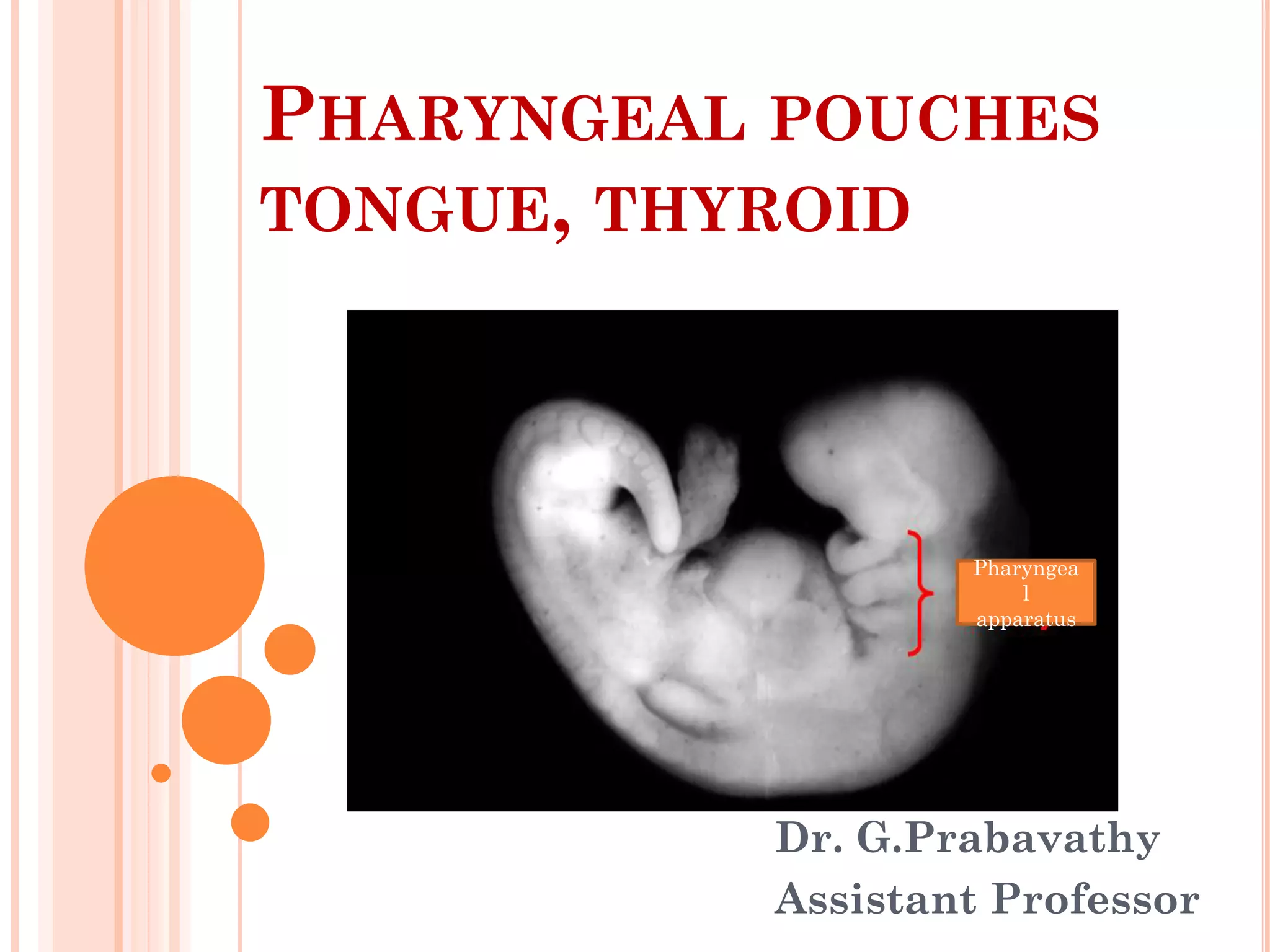
Pharyngea
l
apparatus
OBJECTIVES
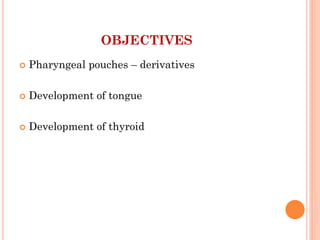
 Pharyngeal pouches – derivatives
 Development of tongue
 Development of thyroid
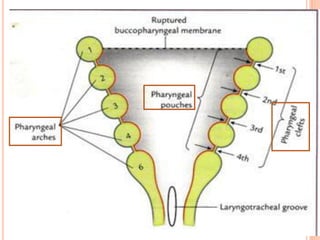
 Pharyngeal arches
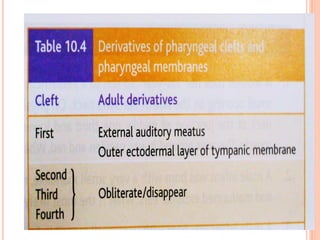
 Pharyngeal clefts
 Pharyngeal pouches
 Pharyngeal membranes
PHARYNGEAL APPARATUS
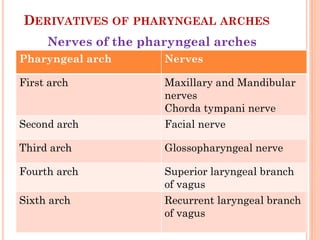
Pharyngeal arch Nerves
First arch Maxillary and Mandibular
nerves
Chorda tympani nerve
Second arch Facial nerve
Third arch Glossopharyngeal nerve
Fourth arch Superior laryngeal branch
of vagus
Sixth arch Recurrent laryngeal branch
of vagus
DERIVATIVES OF PHARYNGEAL ARCHES
Nerves of the pharyngeal arches
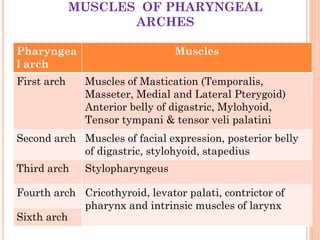
MUSCLES OF PHARYNGEAL
ARCHES
Pharyngea
l arch
Muscles
First arch Muscles of Mastication (Temporalis,
Masseter, Medial and Lateral Pterygoid)
Anterior belly of digastric, Mylohyoid,
Tensor tympani & tensor veli palatini
Second arch Muscles of facial expression, posterior belly
of digastric, stylohyoid, stapedius
Third arch Stylopharyngeus
Fourth arch Cricothyroid, levator palati, contrictor of
pharynx and intrinsic muscles of larynx
Sixth arch
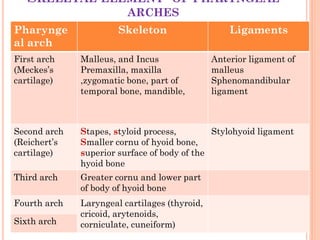
SKELETAL ELEMENT OF PHARYNGEAL
ARCHES
Pharynge
al arch
Skeleton Ligaments
First arch
(Meckes’s
cartilage)
Malleus, and Incus
Premaxilla, maxilla
,zygomatic bone, part of
temporal bone, mandible,
Anterior ligament of
malleus
Sphenomandibular
ligament
Second arch
(Reichert’s
cartilage)
Stapes, styloid process,
Smaller cornu of hyoid bone,
superior surface of body of the
hyoid bone
Stylohyoid ligament
Third arch Greater cornu and lower part
of body of hyoid bone
Fourth arch Laryngeal cartilages (thyroid,
cricoid, arytenoids,
corniculate, cuneiform)Sixth arch
PHARNYGEAL POUCHES
PHARNYGEAL POUCHES
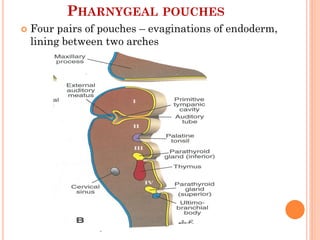
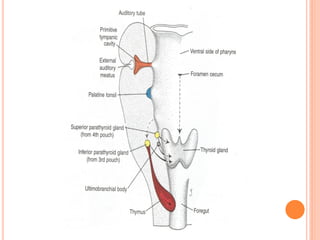
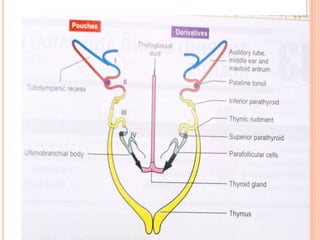
 Four pairs of pouches – evaginations of endoderm,
lining between two arches
FIRST PHARYNGEAL POUCH
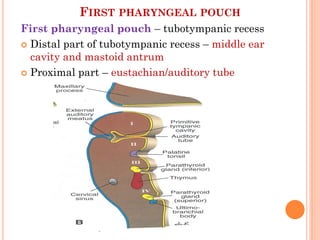
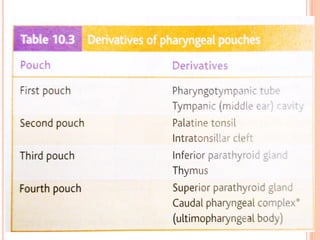
First pharyngeal pouch – tubotympanic recess
 Distal part of tubotympanic recess – middle ear
cavity and mastoid antrum
 Proximal part – eustachian/auditory tube
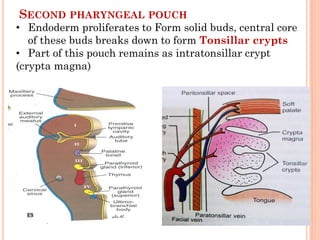
SECOND PHARYNGEAL POUCH
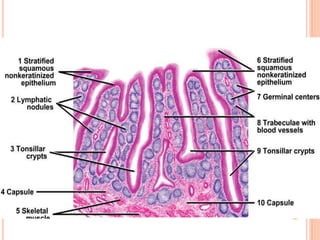
• Endoderm proliferates to Form solid buds, central core
of these buds breaks down to form Tonsillar crypts
• Part of this pouch remains as intratonsillar crypt
(crypta magna)
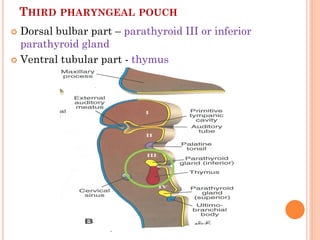
THIRD PHARYNGEAL POUCH
 Dorsal bulbar part – parathyroid III or inferior
parathyroid gland
 Ventral tubular part - thymus
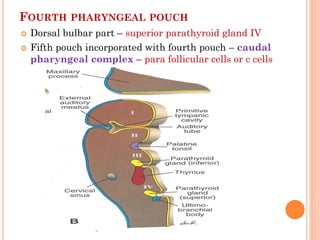
FOURTH PHARYNGEAL POUCH
 Dorsal bulbar part – superior parathyroid gland IV
 Fifth pouch incorporated with fourth pouch – caudal
pharyngeal complex – para follicular cells or c cells
SUMMARY
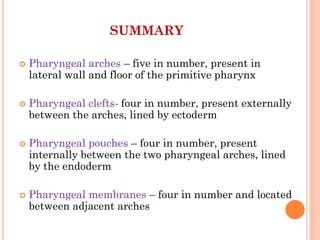
 Pharyngeal arches – five in number, present in
lateral wall and floor of the primitive pharynx
 Pharyngeal clefts- four in number, present externally
between the arches, lined by ectoderm
 Pharyngeal pouches – four in number, present
internally between the two pharyngeal arches, lined
by the endoderm
 Pharyngeal membranes – four in number and located
between adjacent arches
TONGUE
THYROID GLAND
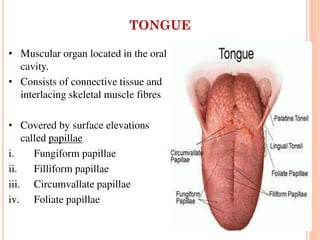
TONGUE
• Muscular organ located in the oral
cavity.
• Consists of connective tissue and
interlacing skeletal muscle fibres
• Covered by surface elevations
called papillae
i. Fungiform papillae
ii. Filliform papillae
iii. Circumvallate papillae
iv. Foliate papillae
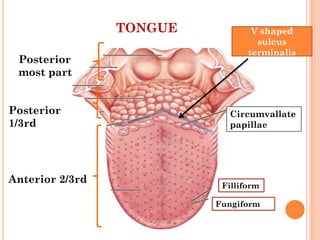
TONGUE
Circumvallate
papillae
Filliform
Fungiform
Anterior 2/3rd
Posterior
1/3rd
Posterior
most part
V shaped
sulcus
terminalis
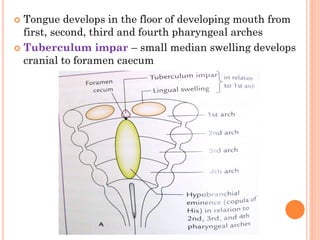
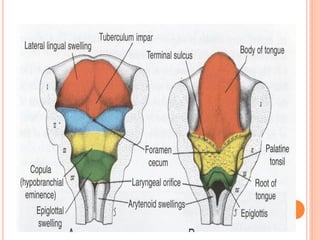
 Tongue develops in the floor of developing mouth from
first, second, third and fourth pharyngeal arches
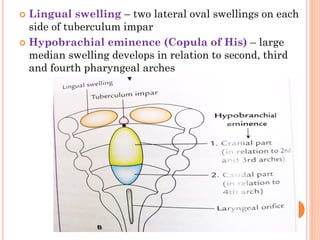
 Tuberculum impar – small median swelling develops
cranial to foramen caecum
 Lingual swelling – two lateral oval swellings on each
side of tuberculum impar
 Hypobrachial eminence (Copula of His) – large
median swelling develops in relation to second, third
and fourth pharyngeal arches
DEVELOPMENT OF VARIOUS PARTS OF
TONGUE
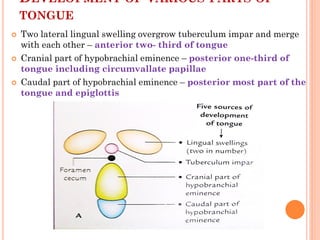
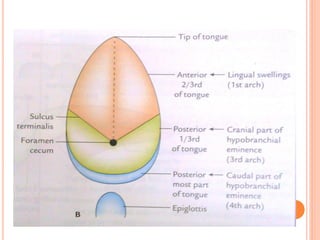
 Two lateral lingual swelling overgrow tuberculum impar and merge
with each other – anterior two- third of tongue
 Cranial part of hypobrachial eminence – posterior one-third of
tongue including circumvallate papillae
 Caudal part of hypobrachial eminence – posterior most part of the
tongue and epiglottis
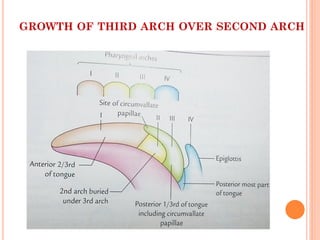
GROWTH OF THIRD ARCH OVER SECOND ARCH
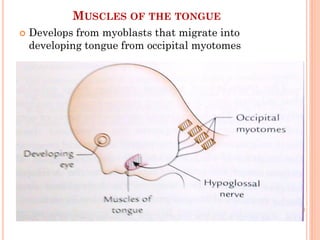
MUSCLES OF THE TONGUE
 Develops from myoblasts that migrate into
developing tongue from occipital myotomes
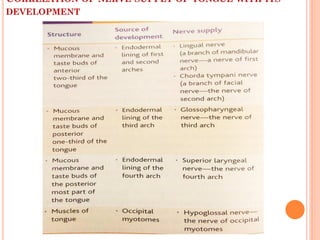
CORRELATION OF NERVE SUPPLY OF TONGUE WITH ITS
DEVELOPMENT
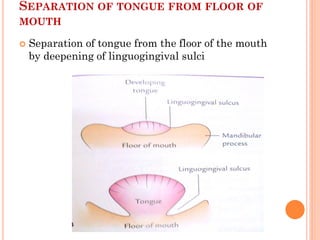
SEPARATION OF TONGUE FROM FLOOR OF
MOUTH
 Separation of tongue from the floor of the mouth
by deepening of linguogingival sulci
ANAMOLIES OF TONGUE
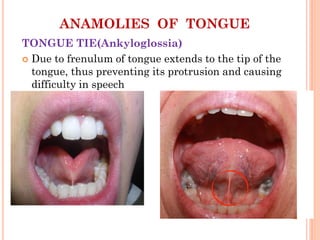
TONGUE TIE(Ankyloglossia)
 Due to frenulum of tongue extends to the tip of the
tongue, thus preventing its protrusion and causing
difficulty in speech
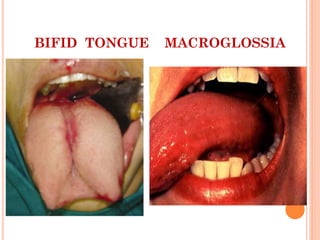
BIFID TONGUE MACROGLOSSIA
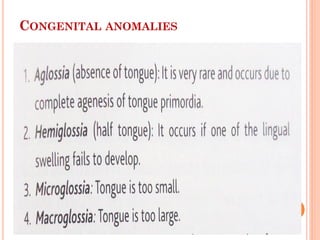
CONGENITAL ANOMALIES
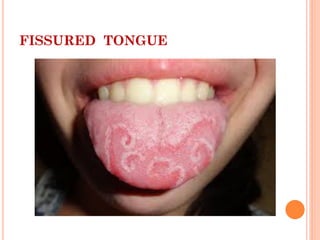
FISSURED TONGUE
THYROID GLAND
THYROID GLAND
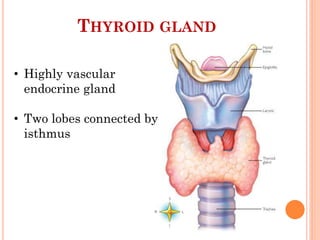
• Highly vascular
endocrine gland
• Two lobes connected by
isthmus
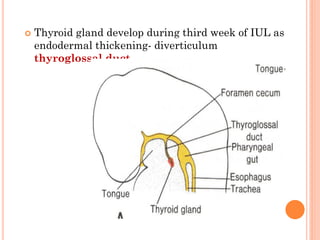
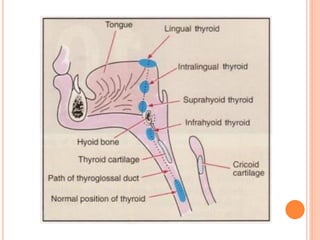
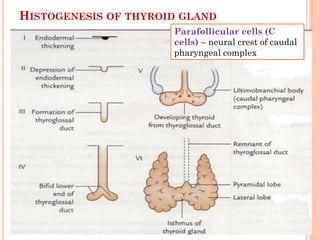
 Thyroid gland develop during third week of IUL as
endodermal thickening- diverticulum
thyroglossal duct
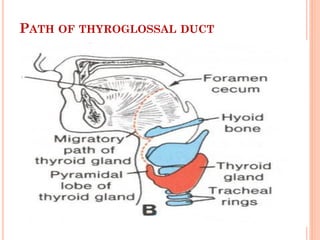
PATH OF THYROGLOSSAL DUCT
HISTOGENESIS OF THYROID GLAND
Parafollicular cells (C
cells) – neural crest of caudal
pharyngeal complex
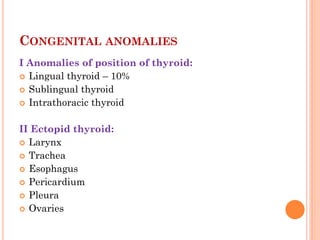
I Anomalies of position of thyroid:
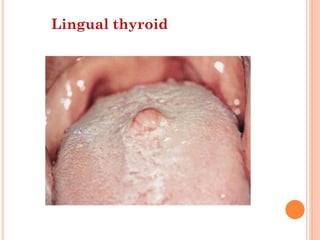
 Lingual thyroid – 10%
 Sublingual thyroid
 Intrathoracic thyroid
II Ectopid thyroid:
 Larynx
 Trachea
 Esophagus
 Pericardium
 Pleura
 Ovaries
CONGENITAL ANOMALIES
Lingual thyroid
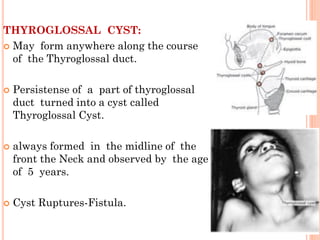
THYROGLOSSAL CYST:
 May form anywhere along the course
of the Thyroglossal duct.
 Persistense of a part of thyroglossal
duct turned into a cyst called
Thyroglossal Cyst.
 always formed in the midline of the
front the Neck and observed by the age
of 5 years.
 Cyst Ruptures-Fistula.
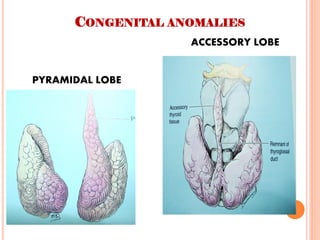
CONGENITAL ANOMALIES
PYRAMIDAL LOBE
ACCESSORY LOBE
1. parathyroid gland arises from
A) 1st and 2nd pharyngeal pouch
B) 3rd and 4th pharyngeal pouch
C) 5th and 6th pharyngeal arch
D) 3rd and 4th pharyngeal arch
 2. nerve of III pharyngeal arch supplies
 A)cricothyroid
 B)stylopharyngeus
 C)stapedius
 D)stylohyoid
3.All the muscles of tongue are supplied by
A) Facial nerve
B) lingual nerve
C) Hypoglossal nerve
D) Occipital nerve
 Enumerate the Derivatives of second pharyngeal
arch
 Name the Derivatives of first pharyngeal arch
 Development oy hyoid bone [apr 2002]
 Explain Cervical sinus
 Development of parathyroid [dec 2010]
 Thyroglossal duct [dec 2011]
 Explain the Development of thyroid gland
 Brief account of Development of tongue
Pharyngeal apparatus ii  tongue, thyroid

Pharyngeal apparatus ii tongue, thyroid

  • 1.
    PHARYNGEAL POUCHES TONGUE, THYROID Dr.G.Prabavathy Assistant Professor Pharyngea l apparatus
  • 2.
    OBJECTIVES  Pharyngeal pouches– derivatives  Development of tongue  Development of thyroid
  • 3.
     Pharyngeal arches Pharyngeal clefts  Pharyngeal pouches  Pharyngeal membranes PHARYNGEAL APPARATUS
  • 5.
    Pharyngeal arch Nerves Firstarch Maxillary and Mandibular nerves Chorda tympani nerve Second arch Facial nerve Third arch Glossopharyngeal nerve Fourth arch Superior laryngeal branch of vagus Sixth arch Recurrent laryngeal branch of vagus DERIVATIVES OF PHARYNGEAL ARCHES Nerves of the pharyngeal arches
  • 6.
    MUSCLES OF PHARYNGEAL ARCHES Pharyngea larch Muscles First arch Muscles of Mastication (Temporalis, Masseter, Medial and Lateral Pterygoid) Anterior belly of digastric, Mylohyoid, Tensor tympani & tensor veli palatini Second arch Muscles of facial expression, posterior belly of digastric, stylohyoid, stapedius Third arch Stylopharyngeus Fourth arch Cricothyroid, levator palati, contrictor of pharynx and intrinsic muscles of larynx Sixth arch
  • 7.
    SKELETAL ELEMENT OFPHARYNGEAL ARCHES Pharynge al arch Skeleton Ligaments First arch (Meckes’s cartilage) Malleus, and Incus Premaxilla, maxilla ,zygomatic bone, part of temporal bone, mandible, Anterior ligament of malleus Sphenomandibular ligament Second arch (Reichert’s cartilage) Stapes, styloid process, Smaller cornu of hyoid bone, superior surface of body of the hyoid bone Stylohyoid ligament Third arch Greater cornu and lower part of body of hyoid bone Fourth arch Laryngeal cartilages (thyroid, cricoid, arytenoids, corniculate, cuneiform)Sixth arch
  • 9.
  • 10.
    PHARNYGEAL POUCHES  Fourpairs of pouches – evaginations of endoderm, lining between two arches
  • 11.
    FIRST PHARYNGEAL POUCH Firstpharyngeal pouch – tubotympanic recess  Distal part of tubotympanic recess – middle ear cavity and mastoid antrum  Proximal part – eustachian/auditory tube
  • 12.
    SECOND PHARYNGEAL POUCH •Endoderm proliferates to Form solid buds, central core of these buds breaks down to form Tonsillar crypts • Part of this pouch remains as intratonsillar crypt (crypta magna)
  • 14.
    THIRD PHARYNGEAL POUCH Dorsal bulbar part – parathyroid III or inferior parathyroid gland  Ventral tubular part - thymus
  • 15.
    FOURTH PHARYNGEAL POUCH Dorsal bulbar part – superior parathyroid gland IV  Fifth pouch incorporated with fourth pouch – caudal pharyngeal complex – para follicular cells or c cells
  • 19.
    SUMMARY  Pharyngeal arches– five in number, present in lateral wall and floor of the primitive pharynx  Pharyngeal clefts- four in number, present externally between the arches, lined by ectoderm  Pharyngeal pouches – four in number, present internally between the two pharyngeal arches, lined by the endoderm  Pharyngeal membranes – four in number and located between adjacent arches
  • 20.
  • 21.
    TONGUE • Muscular organlocated in the oral cavity. • Consists of connective tissue and interlacing skeletal muscle fibres • Covered by surface elevations called papillae i. Fungiform papillae ii. Filliform papillae iii. Circumvallate papillae iv. Foliate papillae
  • 22.
  • 23.
     Tongue developsin the floor of developing mouth from first, second, third and fourth pharyngeal arches  Tuberculum impar – small median swelling develops cranial to foramen caecum
  • 24.
     Lingual swelling– two lateral oval swellings on each side of tuberculum impar  Hypobrachial eminence (Copula of His) – large median swelling develops in relation to second, third and fourth pharyngeal arches
  • 25.
    DEVELOPMENT OF VARIOUSPARTS OF TONGUE  Two lateral lingual swelling overgrow tuberculum impar and merge with each other – anterior two- third of tongue  Cranial part of hypobrachial eminence – posterior one-third of tongue including circumvallate papillae  Caudal part of hypobrachial eminence – posterior most part of the tongue and epiglottis
  • 27.
    GROWTH OF THIRDARCH OVER SECOND ARCH
  • 29.
    MUSCLES OF THETONGUE  Develops from myoblasts that migrate into developing tongue from occipital myotomes
  • 30.
    CORRELATION OF NERVESUPPLY OF TONGUE WITH ITS DEVELOPMENT
  • 31.
    SEPARATION OF TONGUEFROM FLOOR OF MOUTH  Separation of tongue from the floor of the mouth by deepening of linguogingival sulci
  • 32.
    ANAMOLIES OF TONGUE TONGUETIE(Ankyloglossia)  Due to frenulum of tongue extends to the tip of the tongue, thus preventing its protrusion and causing difficulty in speech
  • 33.
  • 34.
  • 35.
  • 36.
  • 37.
    THYROID GLAND • Highlyvascular endocrine gland • Two lobes connected by isthmus
  • 38.
     Thyroid glanddevelop during third week of IUL as endodermal thickening- diverticulum thyroglossal duct
  • 39.
  • 41.
    HISTOGENESIS OF THYROIDGLAND Parafollicular cells (C cells) – neural crest of caudal pharyngeal complex
  • 42.
    I Anomalies ofposition of thyroid:  Lingual thyroid – 10%  Sublingual thyroid  Intrathoracic thyroid II Ectopid thyroid:  Larynx  Trachea  Esophagus  Pericardium  Pleura  Ovaries CONGENITAL ANOMALIES
  • 43.
  • 44.
    THYROGLOSSAL CYST:  Mayform anywhere along the course of the Thyroglossal duct.  Persistense of a part of thyroglossal duct turned into a cyst called Thyroglossal Cyst.  always formed in the midline of the front the Neck and observed by the age of 5 years.  Cyst Ruptures-Fistula.
  • 45.
  • 47.
    1. parathyroid glandarises from A) 1st and 2nd pharyngeal pouch B) 3rd and 4th pharyngeal pouch C) 5th and 6th pharyngeal arch D) 3rd and 4th pharyngeal arch
  • 48.
     2. nerveof III pharyngeal arch supplies  A)cricothyroid  B)stylopharyngeus  C)stapedius  D)stylohyoid
  • 49.
    3.All the musclesof tongue are supplied by A) Facial nerve B) lingual nerve C) Hypoglossal nerve D) Occipital nerve
  • 50.
     Enumerate theDerivatives of second pharyngeal arch  Name the Derivatives of first pharyngeal arch  Development oy hyoid bone [apr 2002]  Explain Cervical sinus  Development of parathyroid [dec 2010]  Thyroglossal duct [dec 2011]  Explain the Development of thyroid gland  Brief account of Development of tongue