Presented By
Presented by
Dr.Mona kamel
Dr.Nardine Zarif
Dr.Mona Abd ElGawad
Dr.Heba Aly Hammam
Dr.Suzy ElHarony
CONTENT
What is pharmacovigilance?
What to report?
Reporting forms in Egypt
Types of ADRs
Why do we need pharmacovigilance?
Roles of Pharmacist in PV
What are the problems facing PV ?
FDA Drug recalls
Pharmacovigilance practice in Egypt.
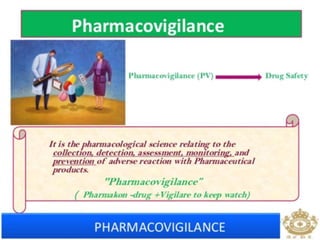
What is pharmacovigilance?
Pharmacovigilance history
WHO established its program for international
drug monitoring at 1968 in response to the
thalidomide disaster which detected in 1961
when thousands of children were born with
phocomelia
Establishment of the Egyptian
Pharmacovigilance Center (EPVC)
The Egyptian Pharmacovigilance Center
(EPVC)
December 2009
‫المصري‬ ‫الدوائية‬ ‫اليقظة‬ ‫مركز‬
‫ديسمبر‬2009
http://epvc.gov.eg
• IN EGYPT, at 2009 the Egyptian
pharmacovigilance center was established
(EPVC) at the central administration for
pharmaceutical affairs (CAPA)
• Regional centers have been established in
Alexandria ,Cairo,Sohag
• Establishment of the satellite center of the
EPVC in Alexandria February 2013
What to report?
 All the suspected adverse events (AEs) or adverse drug
reaction (ADRs)
 Special attention to:
new medicines
New combination
New strength
New dosage form
Increased frequency of a given reaction is suspected
lack of effect (resistance ,interaction ,counterfeiting )
Quality problems
Dependence & abuse
poisoning
medication errors
How to detect ADRs in patients?
 Ask the patient
 Listen carefully (be aware of the hidden complaints)
 review the medical history of patients
 Check the patient’s profile
 Do a proper examination (for physicians)
 Follow up the case
 Verify if the medicine ordered is the one received and
actually taken by the patient at the dose advised
(detection of medication errors/ overdose)
 establish time relationships (by verifying dates of start
/end for the drug and the reaction)
 check the known pharmacology of the medicine
Which information may be required
in a follow up?
Patient’s age/age group
Medical history/concurrent medical condition
Lab tests investigations
 Precise data of the information(ie day , month ,year)
 Sender identifier
Events of special interest
Prospective reports of pregnancy
Cases notifying the death of patient
Case reporting new risks /changes in the
known risks
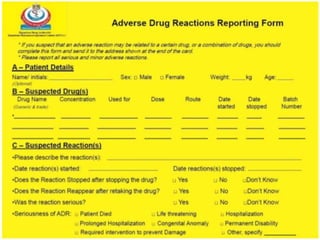
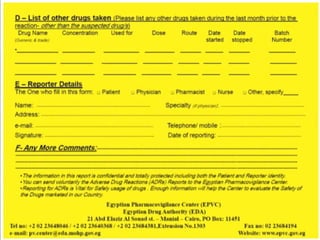
Reporting forms in Egypt
1. yellow form (ADRs reporting form)
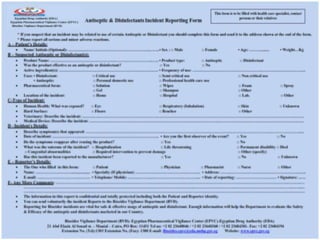
2. blue form (antiseptics and disinfectants
reporting form)
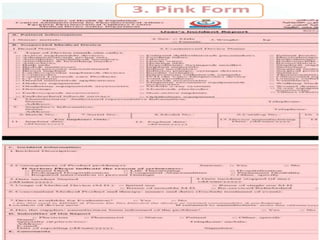
3. pink form (medical devices form)
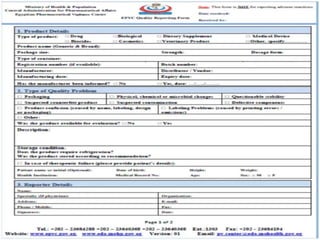
4. white form (quality reporting form)
Who can report?
• All medical staff (physician, pharmacist, dentist
and nurse)
• Pharmaceutical companies qualified persons (
pharmacovigilance / regulatory manager)
Investigational products (clinical trials)
Post-approval reporting – individual case safety
report (ICSR) , periodic safety update report (PSUR)
• Patient and its relatives
Types of ADRs
• Type A (Augmented)
• Type B (Bizarre)
• Type C (Chemical)
• Type D (Delayed)
• Type E (Exit/End of treatment)
• Type F (familial)
• Type G (genotoxic)
• Type H (hypersensitivity)
• Type U (unclassified)
Type A (Augmented) ADR
Reactions which can be predicted from the
known pharmacology of the drug
Dose dependent
Can be alleviated by a dose reduction
For example:
 Anti-coagulants causes bleeding
 Beta-blockers causes bradycardia
 Nitrates causes headache
 Prazosin causes postural hypotension
 Hypoglycemia with sulfonylureas
Type B (Bugs) ADR
Involves interaction with a microorganism
Pharmacologically predictable
Improves if medicine is withdrawn
For example
 sugar-containing medicines promoting dental
caries
 Broad spectrum antibiotics causing oral thrush
 Resistance due to overuse of any one antibiotic
Type C (Chemical) ADR
These reactions are not pharmacologically
predictable, but a knowledge of the physicochemical
characteristics of the causative agents may enable
them to be foreseen
Related to drug concentration
An irritant reaction
For example:
 Extravasation reactions, phlebitis, pain at the site
of an injection owing to the irritant action of a drug
or excipient, acid or alkali burns
 Contact (irritant) dermatitis and gastrointestinal
mucosa damage caused by local irritant action.
Type D (Delivery) ADR
 Occur as a specific consequence of the method of drug
delivery
 These reactions do not depend upon the chemical or
pharmacological properties but occur because of the
physical nature of the formulation and/or the method of
administration.
 If the method of delivery is changed, the adverse reaction
will cease.
 Examples include:
 Inflammation or fibrosis around implants
 Inhaling the ‘dust cap’ of an inhaler, cough after using a dry powder
inhaler
 Infections at the site of an injection (owing to the opening of a port of
entry for bacteria) and infections due to contamination of injection
solution with microorganisms.
 Rash associated to the rapid flow rate of meronem and vancomycin
Type E (End of treatment) ADR
Occur on withdrawal especially when drug is
stopped abruptly.
Pharmacologically predictable
For example:
 Phenytoin withdrawal causes seizures
 Withdrawal reactions due to opoids,
benzodiazepines, clonidine
 Steroid withdrawal causes adrenocortical
insufficiency
Type F (Familial) ADR
Occurs only in the genetically predisposed
For example :
 Hemolytic anemia with primaquin in G6PD
deficient individuals
Type G (Genotoxicity) ADR
Causes irreversible genetic damage
For example :
 Teratogenic agents like thalidomide causing
genetic damage in the fetus
Type H (Hypersensitivity) ADR
Requires activation of immune system
For example :
 Anaphylaxis with penicillin
 Allergic skin reactions with antimicrobial agents
Type U (Unclassified) ADR
Mechanism that is not understood and these
must remain unclassified until more is known
about them
Examples include
 Drug induced taste disturbance ex: metronidazole
 Muscular adverse effects of simvastatin
Why do we need pharmacovigilance?
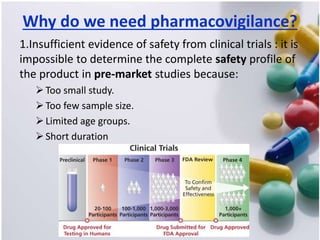
1.Insufficient evidence of safety from clinical trials : it is
impossible to determine the complete safety profile of
the product in pre-market studies because:
Too small study.
Too few sample size.
Limited age groups.
Short duration
2.ensure the safety of medicines in all
countries:
•Dying from a disease is sometimes
unavoidable. But, dying from an ADR is
unacceptable.
•Morbidity & mortality from drug induced
disease should be controlled.
•No drug is entirely safe unless it has no effect
at all.
3.Early detection & prevention can help make drug
therapy more safer and protect patient from adverse
drug reactions (ADRs).
4.Reduce healthcare expenses:
Cost of drug related Morbidity & mortality exceeding that of drug
itself.
5.Promoting rational use of medicines.
6.Rare or delayed serious reaction remain un
noticed.
Why pharmacovigilance is needed in
every country?
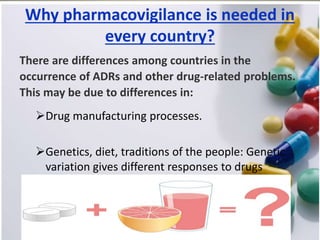
There are differences among countries in the
occurrence of ADRs and other drug-related problems.
This may be due to differences in:
Drug manufacturing processes.
Genetics, diet, traditions of the people: Genetic
variation gives different responses to drugs
Diseases and prescribing practices.
Drug distribution and use including
indications, dose and availability.
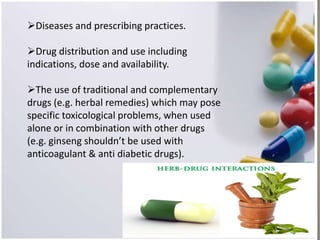
The use of traditional and complementary
drugs (e.g. herbal remedies) which may pose
specific toxicological problems, when used
alone or in combination with other drugs
(e.g. ginseng shouldn’t be used with
anticoagulant & anti diabetic drugs).
Roles of Pharmacist in PV
• Both the community pharmacist and the hospital
pharmacist, can contribute to the safe use of drugs
since they are drug experts.
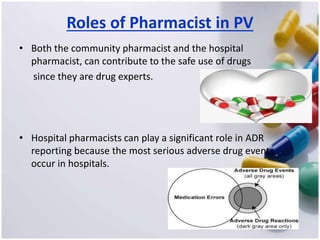
• Hospital pharmacists can play a significant role in ADR
reporting because the most serious adverse drug events
occur in hospitals.
• The adverse event information obtained from hospitals can be
quite advantageous because of their high-quality
documentation retrieval of information.
• Pharmacist plays an essential role in developing
communication materials like newsletters and other
publications through the drug information and poison centers.
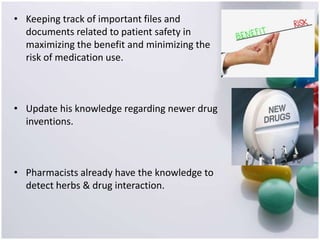
• Keeping track of important files and
documents related to patient safety in
maximizing the benefit and minimizing the
risk of medication use.
• Update his knowledge regarding newer drug
inventions.
• Pharmacists already have the knowledge to
detect herbs & drug interaction.
Problems facing PV
What are the problems facing PV ?
1.Awareness:
Lack of awareness about pharmacovigilance center, its role
and how they can report ADRs.
2.Reporting
A) Reporting By physician:
 Neglect of non serious cases: a known familiar side effects of
some drugs are not reported (e.g. Captopril).
 Priority is on disease, not on drugs & data (easy to change the
drug)
 Lack of time.
 Sometimes doctors are hesitant to report because they fear
litigation and thinks reporting might go against them.
 Non rewarding ,Lack of motivation.
B) Patient reporting:
 Few patient reports due to Lack of awareness .
3.Documentation:
 Lack of clinical details and Difficulty in obtaining
required details.
4.Otc drugs:
 Wider use of OTC, unnecessary irrational use of drugs
and Counterfeit medicines are a major problem
 Self-medication by common people further increases
the Drug interactions
5.Herbal Medicines
 Common belief that “herbal” means “safe”
medicine & long-term use of traditional medicine
assures its efficacy and safety
 Irrational use of herbal and traditional medicines
raises serious concerns about safety.
6.Manpower
 No adequate number of trained persons to take
care of various aspects of Pharmacovigilance in
any center.
 Mostly all shared activities & has no rewards
or incentives.
Challenges to PV in low and middle
income countries (LMIC)
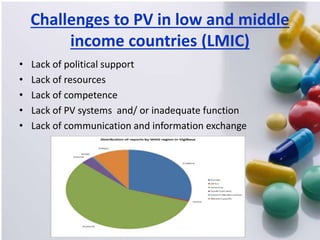
• Lack of political support
• Lack of resources
• Lack of competence
• Lack of PV systems and/ or inadequate function
• Lack of communication and information exchange
How to overcome these problems?
 Marketing the National Pharmacovigilance Center role
and activities through media, workshops, general lectures,
brochures and distribute of educational materials are
needed to increase the health care professional and
patients awareness.
 More trained staff is necessary to improve the services of
Pharmacovigilance center.
Motivate health care professional and patients to
report ADR is required to improve ADR reporting.
Send ADR feed back to health care professionals
about their reports to motivate them for further
collaboration.
Establish and activate the Pharmacovigilance
programs on government and private hospitals as
critical in improving Pharmacovigilance.
FDA Drug Recalls
Recall Classification
Class I: The most serious class
 A dangerous or defective product that could cause serious
health problems or death
 for example labeling that lead to serious health problems or
even death or contamination of raw materials.
Class II:
 the drug may cause a temporary or medically reversible
health problem or a slight chance of a serious problem.
 As missing or incorrect safety information in leaflets
Class III:
 A products that is unlikely to cause any adverse health
reaction, but that violates FDA labeling or manufacturing laws
 for example, faulty packaging a bottle that doesn’t contain
the number of pills stated on the label.
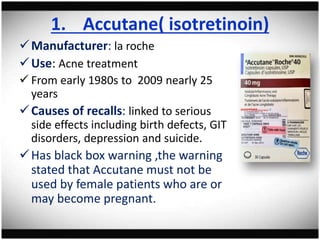
1. Accutane( isotretinoin)
Manufacturer: la roche
Use: Acne treatment
 From early 1980s to 2009 nearly 25
years
Causes of recalls: linked to serious
side effects including birth defects, GIT
disorders, depression and suicide.
Has black box warning ,the warning
stated that Accutane must not be
used by female patients who are or
may become pregnant.
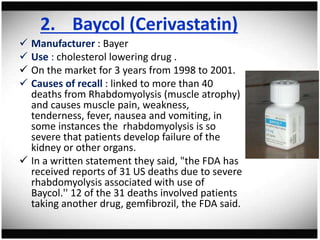
2. Baycol (Cerivastatin)
 Manufacturer : Bayer
 Use : cholesterol lowering drug .
 On the market for 3 years from 1998 to 2001.
 Causes of recall : linked to more than 40
deaths from Rhabdomyolysis (muscle atrophy)
and causes muscle pain, weakness,
tenderness, fever, nausea and vomiting, in
some instances the rhabdomyolysis is so
severe that patients develop failure of the
kidney or other organs.
 In a written statement they said, "the FDA has
received reports of 31 US deaths due to severe
rhabdomyolysis associated with use of
Baycol.'' 12 of the 31 deaths involved patients
taking another drug, gemfibrozil, the FDA said.
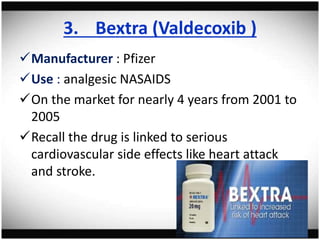
3. Bextra (Valdecoxib )
Manufacturer : Pfizer
Use : analgesic NASAIDS
On the market for nearly 4 years from 2001 to
2005
Recall the drug is linked to serious
cardiovascular side effects like heart attack
and stroke.
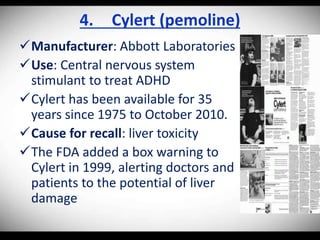
4. Cylert (pemoline)
Manufacturer: Abbott Laboratories
Use: Central nervous system
stimulant to treat ADHD
Cylert has been available for 35
years since 1975 to October 2010.
Cause for recall: liver toxicity
The FDA added a box warning to
Cylert in 1999, alerting doctors and
patients to the potential of liver
damage
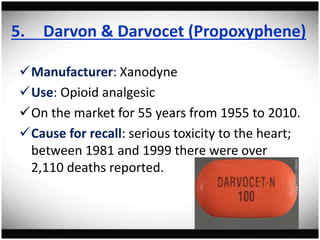
5. Darvon & Darvocet (Propoxyphene)
Manufacturer: Xanodyne
Use: Opioid analgesic
On the market for 55 years from 1955 to 2010.
Cause for recall: serious toxicity to the heart;
between 1981 and 1999 there were over
2,110 deaths reported.
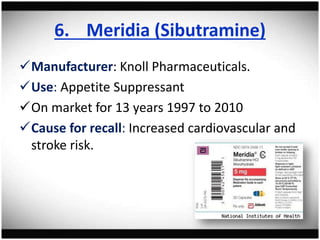
6. Meridia (Sibutramine)
Manufacturer: Knoll Pharmaceuticals.
Use: Appetite Suppressant
On market for 13 years 1997 to 2010
Cause for recall: Increased cardiovascular and
stroke risk.
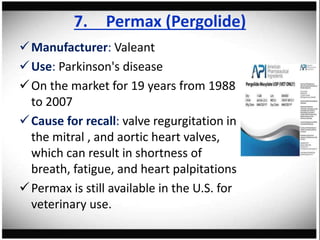
7. Permax (Pergolide)
Manufacturer: Valeant
Use: Parkinson's disease
On the market for 19 years from 1988
to 2007
Cause for recall: valve regurgitation in
the mitral , and aortic heart valves,
which can result in shortness of
breath, fatigue, and heart palpitations
Permax is still available in the U.S. for
veterinary use.
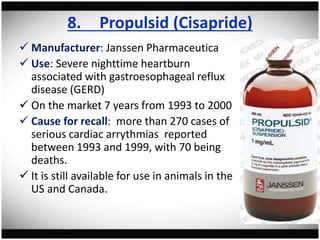
8. Propulsid (Cisapride)
 Manufacturer: Janssen Pharmaceutica
 Use: Severe nighttime heartburn
associated with gastroesophageal reflux
disease (GERD)
 On the market 7 years from 1993 to 2000
 Cause for recall: more than 270 cases of
serious cardiac arrythmias reported
between 1993 and 1999, with 70 being
deaths.
 It is still available for use in animals in the
US and Canada.
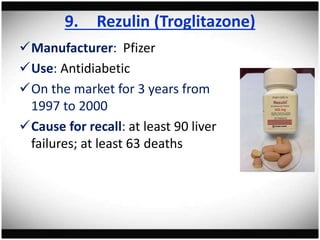
9. Rezulin (Troglitazone)
Manufacturer: Pfizer
Use: Antidiabetic
On the market for 3 years from
1997 to 2000
Cause for recall: at least 90 liver
failures; at least 63 deaths
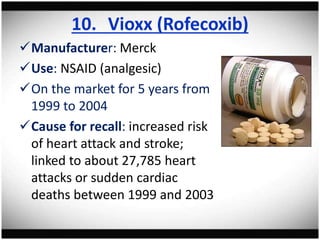
10. Vioxx (Rofecoxib)
Manufacturer: Merck
Use: NSAID (analgesic)
On the market for 5 years from
1999 to 2004
Cause for recall: increased risk
of heart attack and stroke;
linked to about 27,785 heart
attacks or sudden cardiac
deaths between 1999 and 2003
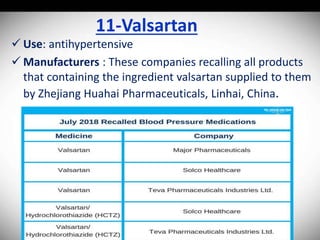
11-Valsartan
 Use: antihypertensive
 Manufacturers : These companies recalling all products
that containing the ingredient valsartan supplied to them
by Zhejiang Huahai Pharmaceuticals, Linhai, China.
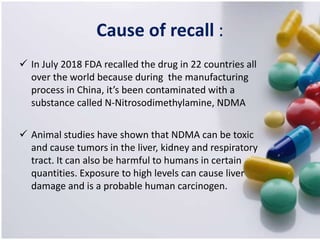
Cause of recall :
 In July 2018 FDA recalled the drug in 22 countries all
over the world because during the manufacturing
process in China, it’s been contaminated with a
substance called N-Nitrosodimethylamine, NDMA
 Animal studies have shown that NDMA can be toxic
and cause tumors in the liver, kidney and respiratory
tract. It can also be harmful to humans in certain
quantities. Exposure to high levels can cause liver
damage and is a probable human carcinogen.
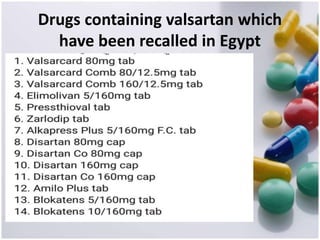
Drugs containing valsartan which
have been recalled in Egypt
Refrences
• www.fda.gov
• EPVC guidelines
• www.who.int/medicines/areas/quality_safety
/safety_efficacy/pharmvigi/en
• Clinical pharmacy and therapeutics by Roger
Walker, 5th edition
Pharmacovigilance

Pharmacovigilance

  • 2.
    Presented By Presented by Dr.Monakamel Dr.Nardine Zarif Dr.Mona Abd ElGawad Dr.Heba Aly Hammam Dr.Suzy ElHarony
  • 3.
    CONTENT What is pharmacovigilance? Whatto report? Reporting forms in Egypt Types of ADRs Why do we need pharmacovigilance? Roles of Pharmacist in PV What are the problems facing PV ? FDA Drug recalls Pharmacovigilance practice in Egypt.
  • 4.
  • 6.
    Pharmacovigilance history WHO establishedits program for international drug monitoring at 1968 in response to the thalidomide disaster which detected in 1961 when thousands of children were born with phocomelia
  • 7.
    Establishment of theEgyptian Pharmacovigilance Center (EPVC) The Egyptian Pharmacovigilance Center (EPVC) December 2009 ‫المصري‬ ‫الدوائية‬ ‫اليقظة‬ ‫مركز‬ ‫ديسمبر‬2009 http://epvc.gov.eg
  • 8.
    • IN EGYPT,at 2009 the Egyptian pharmacovigilance center was established (EPVC) at the central administration for pharmaceutical affairs (CAPA) • Regional centers have been established in Alexandria ,Cairo,Sohag • Establishment of the satellite center of the EPVC in Alexandria February 2013
  • 11.
    What to report? All the suspected adverse events (AEs) or adverse drug reaction (ADRs)  Special attention to: new medicines New combination New strength New dosage form Increased frequency of a given reaction is suspected lack of effect (resistance ,interaction ,counterfeiting ) Quality problems Dependence & abuse poisoning medication errors
  • 12.
    How to detectADRs in patients?  Ask the patient  Listen carefully (be aware of the hidden complaints)  review the medical history of patients  Check the patient’s profile  Do a proper examination (for physicians)  Follow up the case  Verify if the medicine ordered is the one received and actually taken by the patient at the dose advised (detection of medication errors/ overdose)  establish time relationships (by verifying dates of start /end for the drug and the reaction)  check the known pharmacology of the medicine
  • 13.
    Which information maybe required in a follow up? Patient’s age/age group Medical history/concurrent medical condition Lab tests investigations  Precise data of the information(ie day , month ,year)  Sender identifier Events of special interest Prospective reports of pregnancy Cases notifying the death of patient Case reporting new risks /changes in the known risks
  • 14.
  • 15.
    Reporting forms inEgypt 1. yellow form (ADRs reporting form) 2. blue form (antiseptics and disinfectants reporting form) 3. pink form (medical devices form) 4. white form (quality reporting form)
  • 22.
    Who can report? •All medical staff (physician, pharmacist, dentist and nurse) • Pharmaceutical companies qualified persons ( pharmacovigilance / regulatory manager) Investigational products (clinical trials) Post-approval reporting – individual case safety report (ICSR) , periodic safety update report (PSUR) • Patient and its relatives
  • 24.
    Types of ADRs •Type A (Augmented) • Type B (Bizarre) • Type C (Chemical) • Type D (Delayed) • Type E (Exit/End of treatment) • Type F (familial) • Type G (genotoxic) • Type H (hypersensitivity) • Type U (unclassified)
  • 25.
    Type A (Augmented)ADR Reactions which can be predicted from the known pharmacology of the drug Dose dependent Can be alleviated by a dose reduction For example:  Anti-coagulants causes bleeding  Beta-blockers causes bradycardia  Nitrates causes headache  Prazosin causes postural hypotension  Hypoglycemia with sulfonylureas
  • 26.
    Type B (Bugs)ADR Involves interaction with a microorganism Pharmacologically predictable Improves if medicine is withdrawn For example  sugar-containing medicines promoting dental caries  Broad spectrum antibiotics causing oral thrush  Resistance due to overuse of any one antibiotic
  • 27.
    Type C (Chemical)ADR These reactions are not pharmacologically predictable, but a knowledge of the physicochemical characteristics of the causative agents may enable them to be foreseen Related to drug concentration An irritant reaction For example:  Extravasation reactions, phlebitis, pain at the site of an injection owing to the irritant action of a drug or excipient, acid or alkali burns  Contact (irritant) dermatitis and gastrointestinal mucosa damage caused by local irritant action.
  • 28.
    Type D (Delivery)ADR  Occur as a specific consequence of the method of drug delivery  These reactions do not depend upon the chemical or pharmacological properties but occur because of the physical nature of the formulation and/or the method of administration.  If the method of delivery is changed, the adverse reaction will cease.  Examples include:  Inflammation or fibrosis around implants  Inhaling the ‘dust cap’ of an inhaler, cough after using a dry powder inhaler  Infections at the site of an injection (owing to the opening of a port of entry for bacteria) and infections due to contamination of injection solution with microorganisms.  Rash associated to the rapid flow rate of meronem and vancomycin
  • 29.
    Type E (Endof treatment) ADR Occur on withdrawal especially when drug is stopped abruptly. Pharmacologically predictable For example:  Phenytoin withdrawal causes seizures  Withdrawal reactions due to opoids, benzodiazepines, clonidine  Steroid withdrawal causes adrenocortical insufficiency
  • 30.
    Type F (Familial)ADR Occurs only in the genetically predisposed For example :  Hemolytic anemia with primaquin in G6PD deficient individuals Type G (Genotoxicity) ADR Causes irreversible genetic damage For example :  Teratogenic agents like thalidomide causing genetic damage in the fetus
  • 31.
    Type H (Hypersensitivity)ADR Requires activation of immune system For example :  Anaphylaxis with penicillin  Allergic skin reactions with antimicrobial agents Type U (Unclassified) ADR Mechanism that is not understood and these must remain unclassified until more is known about them Examples include  Drug induced taste disturbance ex: metronidazole  Muscular adverse effects of simvastatin
  • 32.
    Why do weneed pharmacovigilance?
  • 33.
    Why do weneed pharmacovigilance? 1.Insufficient evidence of safety from clinical trials : it is impossible to determine the complete safety profile of the product in pre-market studies because: Too small study. Too few sample size. Limited age groups. Short duration
  • 34.
    2.ensure the safetyof medicines in all countries: •Dying from a disease is sometimes unavoidable. But, dying from an ADR is unacceptable. •Morbidity & mortality from drug induced disease should be controlled. •No drug is entirely safe unless it has no effect at all.
  • 35.
    3.Early detection &prevention can help make drug therapy more safer and protect patient from adverse drug reactions (ADRs). 4.Reduce healthcare expenses: Cost of drug related Morbidity & mortality exceeding that of drug itself. 5.Promoting rational use of medicines. 6.Rare or delayed serious reaction remain un noticed.
  • 36.
    Why pharmacovigilance isneeded in every country? There are differences among countries in the occurrence of ADRs and other drug-related problems. This may be due to differences in: Drug manufacturing processes. Genetics, diet, traditions of the people: Genetic variation gives different responses to drugs
  • 37.
    Diseases and prescribingpractices. Drug distribution and use including indications, dose and availability. The use of traditional and complementary drugs (e.g. herbal remedies) which may pose specific toxicological problems, when used alone or in combination with other drugs (e.g. ginseng shouldn’t be used with anticoagulant & anti diabetic drugs).
  • 39.
    Roles of Pharmacistin PV • Both the community pharmacist and the hospital pharmacist, can contribute to the safe use of drugs since they are drug experts. • Hospital pharmacists can play a significant role in ADR reporting because the most serious adverse drug events occur in hospitals.
  • 40.
    • The adverseevent information obtained from hospitals can be quite advantageous because of their high-quality documentation retrieval of information. • Pharmacist plays an essential role in developing communication materials like newsletters and other publications through the drug information and poison centers.
  • 41.
    • Keeping trackof important files and documents related to patient safety in maximizing the benefit and minimizing the risk of medication use. • Update his knowledge regarding newer drug inventions. • Pharmacists already have the knowledge to detect herbs & drug interaction.
  • 42.
  • 43.
    What are theproblems facing PV ? 1.Awareness: Lack of awareness about pharmacovigilance center, its role and how they can report ADRs. 2.Reporting A) Reporting By physician:  Neglect of non serious cases: a known familiar side effects of some drugs are not reported (e.g. Captopril).  Priority is on disease, not on drugs & data (easy to change the drug)  Lack of time.  Sometimes doctors are hesitant to report because they fear litigation and thinks reporting might go against them.  Non rewarding ,Lack of motivation.
  • 44.
    B) Patient reporting: Few patient reports due to Lack of awareness . 3.Documentation:  Lack of clinical details and Difficulty in obtaining required details. 4.Otc drugs:  Wider use of OTC, unnecessary irrational use of drugs and Counterfeit medicines are a major problem  Self-medication by common people further increases the Drug interactions
  • 45.
    5.Herbal Medicines  Commonbelief that “herbal” means “safe” medicine & long-term use of traditional medicine assures its efficacy and safety  Irrational use of herbal and traditional medicines raises serious concerns about safety. 6.Manpower  No adequate number of trained persons to take care of various aspects of Pharmacovigilance in any center.  Mostly all shared activities & has no rewards or incentives.
  • 46.
    Challenges to PVin low and middle income countries (LMIC) • Lack of political support • Lack of resources • Lack of competence • Lack of PV systems and/ or inadequate function • Lack of communication and information exchange
  • 47.
    How to overcomethese problems?  Marketing the National Pharmacovigilance Center role and activities through media, workshops, general lectures, brochures and distribute of educational materials are needed to increase the health care professional and patients awareness.  More trained staff is necessary to improve the services of Pharmacovigilance center.
  • 48.
    Motivate health careprofessional and patients to report ADR is required to improve ADR reporting. Send ADR feed back to health care professionals about their reports to motivate them for further collaboration. Establish and activate the Pharmacovigilance programs on government and private hospitals as critical in improving Pharmacovigilance.
  • 49.
  • 50.
    Recall Classification Class I:The most serious class  A dangerous or defective product that could cause serious health problems or death  for example labeling that lead to serious health problems or even death or contamination of raw materials. Class II:  the drug may cause a temporary or medically reversible health problem or a slight chance of a serious problem.  As missing or incorrect safety information in leaflets Class III:  A products that is unlikely to cause any adverse health reaction, but that violates FDA labeling or manufacturing laws  for example, faulty packaging a bottle that doesn’t contain the number of pills stated on the label.
  • 51.
    1. Accutane( isotretinoin) Manufacturer:la roche Use: Acne treatment  From early 1980s to 2009 nearly 25 years Causes of recalls: linked to serious side effects including birth defects, GIT disorders, depression and suicide. Has black box warning ,the warning stated that Accutane must not be used by female patients who are or may become pregnant.
  • 52.
    2. Baycol (Cerivastatin) Manufacturer : Bayer  Use : cholesterol lowering drug .  On the market for 3 years from 1998 to 2001.  Causes of recall : linked to more than 40 deaths from Rhabdomyolysis (muscle atrophy) and causes muscle pain, weakness, tenderness, fever, nausea and vomiting, in some instances the rhabdomyolysis is so severe that patients develop failure of the kidney or other organs.  In a written statement they said, "the FDA has received reports of 31 US deaths due to severe rhabdomyolysis associated with use of Baycol.'' 12 of the 31 deaths involved patients taking another drug, gemfibrozil, the FDA said.
  • 53.
    3. Bextra (Valdecoxib) Manufacturer : Pfizer Use : analgesic NASAIDS On the market for nearly 4 years from 2001 to 2005 Recall the drug is linked to serious cardiovascular side effects like heart attack and stroke.
  • 54.
    4. Cylert (pemoline) Manufacturer:Abbott Laboratories Use: Central nervous system stimulant to treat ADHD Cylert has been available for 35 years since 1975 to October 2010. Cause for recall: liver toxicity The FDA added a box warning to Cylert in 1999, alerting doctors and patients to the potential of liver damage
  • 55.
    5. Darvon &Darvocet (Propoxyphene) Manufacturer: Xanodyne Use: Opioid analgesic On the market for 55 years from 1955 to 2010. Cause for recall: serious toxicity to the heart; between 1981 and 1999 there were over 2,110 deaths reported.
  • 56.
    6. Meridia (Sibutramine) Manufacturer:Knoll Pharmaceuticals. Use: Appetite Suppressant On market for 13 years 1997 to 2010 Cause for recall: Increased cardiovascular and stroke risk.
  • 57.
    7. Permax (Pergolide) Manufacturer:Valeant Use: Parkinson's disease On the market for 19 years from 1988 to 2007 Cause for recall: valve regurgitation in the mitral , and aortic heart valves, which can result in shortness of breath, fatigue, and heart palpitations Permax is still available in the U.S. for veterinary use.
  • 58.
    8. Propulsid (Cisapride) Manufacturer: Janssen Pharmaceutica  Use: Severe nighttime heartburn associated with gastroesophageal reflux disease (GERD)  On the market 7 years from 1993 to 2000  Cause for recall: more than 270 cases of serious cardiac arrythmias reported between 1993 and 1999, with 70 being deaths.  It is still available for use in animals in the US and Canada.
  • 59.
    9. Rezulin (Troglitazone) Manufacturer:Pfizer Use: Antidiabetic On the market for 3 years from 1997 to 2000 Cause for recall: at least 90 liver failures; at least 63 deaths
  • 60.
    10. Vioxx (Rofecoxib) Manufacturer:Merck Use: NSAID (analgesic) On the market for 5 years from 1999 to 2004 Cause for recall: increased risk of heart attack and stroke; linked to about 27,785 heart attacks or sudden cardiac deaths between 1999 and 2003
  • 61.
    11-Valsartan  Use: antihypertensive Manufacturers : These companies recalling all products that containing the ingredient valsartan supplied to them by Zhejiang Huahai Pharmaceuticals, Linhai, China.
  • 62.
    Cause of recall:  In July 2018 FDA recalled the drug in 22 countries all over the world because during the manufacturing process in China, it’s been contaminated with a substance called N-Nitrosodimethylamine, NDMA  Animal studies have shown that NDMA can be toxic and cause tumors in the liver, kidney and respiratory tract. It can also be harmful to humans in certain quantities. Exposure to high levels can cause liver damage and is a probable human carcinogen.
  • 63.
    Drugs containing valsartanwhich have been recalled in Egypt
  • 64.
    Refrences • www.fda.gov • EPVCguidelines • www.who.int/medicines/areas/quality_safety /safety_efficacy/pharmvigi/en • Clinical pharmacy and therapeutics by Roger Walker, 5th edition