Moderator: Dr. Mohammad Tariq Salman
Presented by : Dr. Fariha Fatima
Junior Resident 1
Pharmacovigilance
What is Pharmacovigilance
???
“The science and activities relating to the detection,
evaluation, understanding and prevention of adverse
drug reactions or any other drug-related problems.”
Pharmakon (Pharmacon) = Drug
+
Vigilare = to watch; alert watchfulness;
- watchfulness in respect of danger;
- process of paying close and continuous attention.
• So Pharmacovigilance generally refers to continuous
monitoring for unwanted effects and other safety – related
aspects of marketed drugs.
Why pharmacovigilance is needed ???
 Tests in animals are insufficiently predictive of human safety.
 In clinical trials patients are selected and limited in number—
may miss rare ADRs
 Conditions of use in trials differ from those in clinical
practice—may miss drug interactions; Off-label uses.
 Duration of trials is limited—may miss ADRs that develop
after years.
 Special groups (such as children, the elderly or pregnant
women)—not involved in clinical trials.
 Illegal sale of medicines and drugs of abuse.
 Increasing self-medication practices  OTC drugs.
 Widespread manufacture and sale of counterfeit and substandard
medicines.
 Increasing use of traditional medicines and herbal medicines with
other medicine with potential for adverse interactions.
Additional factors which enhance the need
of Pharmaco-Vigilance:
The ultimate goal of Pharmacovigilance is to ensure the safe and
rational use of medicines, thereby, improving patient care and
public health.
To prevent unnecessary suffering by patients and to decrease the
financial loss sustained by the patient due to the inappropriate or
unsafe use of medicines.
What are the major Aims of PV ???
According to WHO….
 Early detection of unknown safety problems
 Detection of increases in frequency
 Identification of risk factors
 Quantifying risks
 Preventing patients from being affected unnecessarily
Rational and Safe use of Medicines
 Some of the drugs are mandatorily banned by Drugs
Controller General of India (DCGI) but are still available in
the market (e.g. human placental extract).
Adverse Drug Reaction (ADR)?
The Drug Regulatory Authority defines an Adverse Drug
Reactions (ADR) or adverse reaction as a response to a
medicine used in humans or animals, which is noxious and
unintended, including lack of efficacy, and which occurs at
any dosage and can also result from overdose, misuse or
abuse of a medicine.
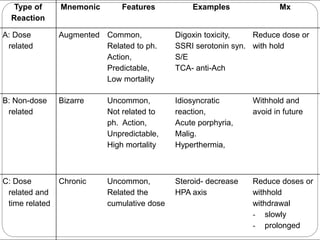
Type of
Reaction
Mnemonic Features Examples Mx
A: Dose
related
Augmented Common,
Related to ph.
Action,
Predictable,
Low mortality
Digoxin toxicity,
SSRI serotonin syn.
S/E
TCA- anti-Ach
Reduce dose or
with hold
B: Non-dose
related
Bizarre Uncommon,
Not related to
ph. Action,
Unpredictable,
High mortality
Idiosyncratic
reaction,
Acute porphyria,
Malig.
Hyperthermia,
Withhold and
avoid in future
C: Dose
related and
time related
Chronic Uncommon,
Related the
cumulative dose
Steroid- decrease
HPA axis
Reduce doses or
withhold
withdrawal
- slowly
- prolonged
Type of
Reaction
Mnemonic Features Examples Mx
D: Time
related
Delayed Uncommon,
Dose related,
Teratogenesis ,
Carcinogenesis,
Tardive
dyskinesia
Often
intractable
E: Withdrawal End of
use
Uncommon,
After
withdrawal
Opioid withdrawal
MI- β blocker
withdrawal
Reintroduce
and withdraw
slowly
F: Failure of
therapy
Failure Common,
Dose related,
Caused by
drug
interaction
Contraceptive
failure
Increase dose,
Consider effect
of concomitant
therapy
ADRs are common and constitute major health problem.
 World statistics show that 5 -10% of the hospital admissions
are attributed to adverse drug reactions, and 0.3% of adverse
reactions are fatal in nature.
Several studies in Europe, Israel, and USA have estimated 5-
10% of all admittance to emergency medical ward are due to
ADRs.
 As many as 98,000 death in USA per year due to medical
error.
Severity of ADR: it has been graded as:
Minor: no therapy , antidote or prolongation of
hospitalization is required.
Moderate: requires change in drug therapy, specific
treatment or prolongs hospital stay by atleast one day.
Severe: potentially life threatening, causes permanent
damage or requires intensive medical treatment.
Lethal: directly or indirectly contributes to the death of the
patient.
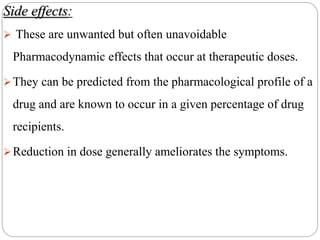
Side effects:
 These are unwanted but often unavoidable
Pharmacodynamic effects that occur at therapeutic doses.
They can be predicted from the pharmacological profile of a
drug and are known to occur in a given percentage of drug
recipients.
Reduction in dose generally ameliorates the symptoms.
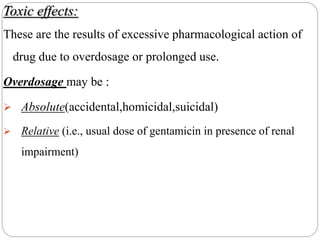
Toxic effects:
These are the results of excessive pharmacological action of
drug due to overdosage or prolonged use.
Overdosage may be :
 Absolute(accidental,homicidal,suicidal)
 Relative (i.e., usual dose of gentamicin in presence of renal
impairment)
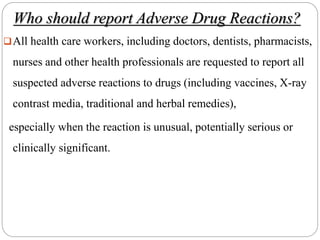
Who should report Adverse Drug Reactions?
All health care workers, including doctors, dentists, pharmacists,
nurses and other health professionals are requested to report all
suspected adverse reactions to drugs (including vaccines, X-ray
contrast media, traditional and herbal remedies),
especially when the reaction is unusual, potentially serious or
clinically significant.
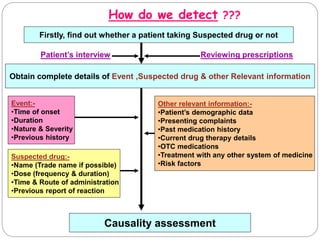
Firstly, find out whether a patient taking Suspected drug or not
Obtain complete details of Event ,Suspected drug & other Relevant information
Event:-
•Time of onset
•Duration
•Nature & Severity
•Previous history
Suspected drug:-
•Name (Trade name if possible)
•Dose (frequency & duration)
•Time & Route of administration
•Previous report of reaction
Other relevant information:-
•Patient’s demographic data
•Presenting complaints
•Past medication history
•Current drug therapy details
•OTC medications
•Treatment with any other system of medicine
•Risk factors
Causality assessment
Patient’s interview Reviewing prescriptions
How do we detect ???
Causality assessment :
To determine likelihood of a causal relationship b/w
drug exposure and adverse events.
Causality Classification:
The WHO has provided a list of causality assessment
criteria for deciding on the contribution of the medicine
towards the adverse event.
WHO Definitions for Causality Assessment:
Certain:
Clinical event, lab test abnormality with plausible time
relationship to drug intake.
Cannot be explained by concurrent disease or other drugs
/chemicals.
Response to dechallenge- plausible.
Event must be definitive pharmacologically /
immunologically.
 Positive rechallenges (if performed).
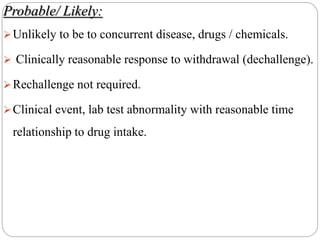
Probable/ Likely:
Unlikely to be to concurrent disease, drugs / chemicals.
 Clinically reasonable response to withdrawal (dechallenge).
Rechallenge not required.
Clinical event, lab test abnormality with reasonable time
relationship to drug intake.
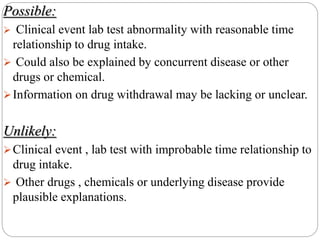
Possible:
 Clinical event lab test abnormality with reasonable time
relationship to drug intake.
 Could also be explained by concurrent disease or other
drugs or chemical.
Information on drug withdrawal may be lacking or unclear.
Unlikely:
Clinical event , lab test with improbable time relationship to
drug intake.
 Other drugs , chemicals or underlying disease provide
plausible explanations.
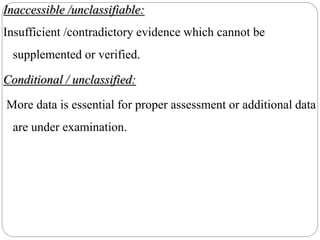
Inaccessible /unclassifiable:
Insufficient /contradictory evidence which cannot be
supplemented or verified.
Conditional / unclassified:
More data is essential for proper assessment or additional data
are under examination.
Periodic Safety Update Reports
(PSURs)
 Provides an update of world-wide safety experience at 6
months for 2 years, annually for two years, and then 5-yearly
or immediately on request
 Description of the reaction
 Detail about the Contents
 Overall safety evaluation
Approval of the product, new drugs should be closely monitored for their
clinical safety once they are marketed. The applicants shall furnish
Periodic Safety Update Reports (PSURs) in order to-
a) Report all the relevant new information from appropriate sources;
b) Relate these data to patient exposure;
c) Summarize the market authorization status in different countries
and any significant variations related to safety; and
d) Indicate whether changes should be made to produce information in
order to optimize the use of the product.
Schedule Y :
Structure of PSUR:
 A title page stating: Periodic safety update report for the product,
applicant’s name, period covered by the report, date of approval of
new drug, date of marketing of new drug and date of reporting;
 Introduction,
 Current worldwide market authorization status,
 Update of actions taken for safety reasons,
 Changes to reference safety information,
 Estimated patient exposure,
 Presentation of individual case histories,
 Studies,
 Other information,
 Overall safety evaluation,
 Conclusions,
 Appendix providing material relating to indications, dosing,
pharmacology and other related information.
The Licensing Authority reserves the right to reject
any data or any document(s) if such data or contents of
such documents are found to be of doubtful integrity.
The Drug Regulatory Authority and the Department of
Health’s Essential Drug Programme are committed to
improving drug safety through adverse drug reaction
monitoring .
 Through the Drug Regulatory Authority’s national
pharmacovigilance programme, adverse reactions should be
reported on a daily basis.
In general, the prime activity of the Pharmacovigilance
Program of India (PvPI) is to collect, collate and analyze
data on adverse drug reactions to arrive at an inference to
recommend regulatory interventions, besides communicating
associated risks to healthcare professionals.
In June 2010, Central Drugs Standard Control Organization
(CDSCO), Directorate General of Health Services under the
aegis of Ministry of Health & Family Welfare, Government
of India in collaboration with Indian Pharmacopeia
Commission, Ghaziabad initiated a nation-wide
Pharmacovigilance programme for protecting the health of
the patients by assuring drug safety with well defined goal
with predestined road map to ensure its future growth and
progress.
Objectives of the PvPI:
To monitor Adverse Drug Reactions in Indian population.
 To create awareness amongst healthcare professionals about
the importance of ADR reporting in India.
To monitor benefit-risk profile of medicines.
Generate independent, evidence based recommendations on
the safety of medicines.
Support the CDSCO for formulating safety related
regulatory decisions for medicines.
Communicate findings with all key stakeholders.
 Create a national centre of excellence at par with global
drug safety monitoring standards.
Program was designed in five phases which included:
 initiation phase (2010-2011)
expansion and consolidation phase (2011-2012),
expansion and maintenance phase (2012-2013),
 expansion and optimization phase(2013-2014)
Excellence phase (2014-15).
Phase I (Initiation phase), 2010 -2011
 Enrol 40 medical colleges.
Start data collection for Adverse event following
immunization.
 Development and establishment of training centre.
Training of pharmacovigilance human resource.
 Linkage with uppsal monitoring centre, sweden.
 Initiate software development for national drug safety data
base.
 Publication of drug safety news letter.
Phase II (Expansion and consolidation phase), 2011-2012
Enrol additional 60 medical colleges.
 Training of pharmacovigilance human resource.
Training in pharmacovigilance software provided by UMC.
 Identify gaps and address through appropriate training
 Software development and validation.
Zonal workshop for public awareness of drug safety.
 Publication of drug safety news letter.
Phase III (Expansion and maintenance phase),2012- 2013:
Enroll additional 100 medical college.
 Training of pharmacovigilance human resource.
 Zonal workshop for public awareness of drug safety.
Publication of drug safety news letter.
Phase IV (Expansion and optimization phase), 2013- 2014:
Enroll additional 100 medical college.
Training of pharmacovigilance human resource.
Interaction with international pharmacovigilance bodies.
 Publication of drug safety news letter.
Phase V (Excellence phase) 2014-2015
Create centre of excellence for pharmacovigilance in Asia
pacific
To ensure that the PvPI is functioning effectively and
achieving its objectives, there is a provision to monitor and
evaluate the program using indicators viz ;
(i) process (i.e. process number of AMCs participating in the
PvPI, number of AMC personnel trained in a year, funds
budgeted for PvPI and funds spent and AMC personnel
working full-time for PvPI).
(ii) outcome (i.e. software platform established, outcome
number of ADR reports received in a year, number of ADR
reports processed in a year and number of ADR reports
submitted to Vigiflow) and ;
(iii) impact (i.e. number of impact signals generated and
confirmed, number of safety related alerts issued by
CDSCO).
Drug safety suveillance relies heavily on the techniques of
pharmacoepidemiology which includes:
 Voluntary Reporting:
doctors, nurses and pharmacists are supplied with cards
on which to record suspected adverse reaction to drugs.in
the UK this is called the ‘yellow card’ system and the
committee on safety of medicines collates the results and
advises the government’s medicines control agency.
It is recommended for :
Newer drugs: all suspected reactions should be noted.
Established drugs: all serious suspected reactions should be
reported, even if the effect is well recognised.
HISTORICAL BACKGROUND
Non systematized form
Thalidomide disaster in early 1960
Yellow card system in UK (now CSM)
Spontaneous reporting system in USA in 1968 by FDA
Benefits of spontaneous reporting are:
 Early recognition/actual potential problem
 Continuous monitoring system
 Compare ADR profile
 Iatrogenic syndrome/predisposing factors
What to report ??? 22
For new drugs
 All suspected reactions including minor ones.
For established drugs
 All serious or unexpected ADRs
 Any increased frequency of a given reaction
 All suspected ADRs associated with drug-drug interactions
 ADRs of special population  Elderly, Child, Pregnancy &
Lactation
 ADRs associated with Drug abuse & Drug withdrawals
 ADRs occurring from overdose or medication error
 Lack of efficacy
All adverse events should be reported.
Need and Advantage of Spontaneous Reporting
 Large population can be covered
 All marketed drugs can be monitored
 Drug may be monitored throughout their lifetime
 Risk factors predisposing to ADR may be identified
 Inexpensive and simple ADR system
 PEM (Prescription Event Monitoring):
 Generating and testing hypothesis about ADRs in defined
population of users.
 Active Surveillance: Registries
 Hospital-based systems: Intensive Surveillance
 Form of observational cohort study.
Medical record linkage:
 Allows computer correlation in a population of life and
health events(birth , marriage ,death , hospital admission)
with history of drug use.
 The largest medical record linkage is the General
Practitioner Research Data Base at the Medicines Control
Agency.
Population statistics: eg . Birth defect registers and cancer
registers.
 These are insensitive unless a drug induced event is highly
remarkable or very frequent.
 If suspicions are aroused then case control and
observational cohort studies will be initiated.
Conclusion
If all healthcare professional including physicians, nurses,
pharmacist and others including the patient report all ADRs
then regulatory authority can take action as soon as possible,
and drugs which are banned worldwide may be not available
in India too.
Careful premarketing screening should reduce the problem
but may also reduce the number of potentially useful drugs
available for full development and subsequent licensing.
Better risk management strategies are needed to handle
problems when they arise, by means other than revocation of
licenses.
You can reduce the suffering and save thousands of
patients lives by doing one thing :
Report suspected adverse drug
reactions
Pharmacovigilance

Pharmacovigilance

  • 1.
    Moderator: Dr. MohammadTariq Salman Presented by : Dr. Fariha Fatima Junior Resident 1 Pharmacovigilance
  • 2.
    What is Pharmacovigilance ??? “Thescience and activities relating to the detection, evaluation, understanding and prevention of adverse drug reactions or any other drug-related problems.” Pharmakon (Pharmacon) = Drug + Vigilare = to watch; alert watchfulness; - watchfulness in respect of danger; - process of paying close and continuous attention. • So Pharmacovigilance generally refers to continuous monitoring for unwanted effects and other safety – related aspects of marketed drugs.
  • 3.
    Why pharmacovigilance isneeded ???  Tests in animals are insufficiently predictive of human safety.  In clinical trials patients are selected and limited in number— may miss rare ADRs  Conditions of use in trials differ from those in clinical practice—may miss drug interactions; Off-label uses.  Duration of trials is limited—may miss ADRs that develop after years.  Special groups (such as children, the elderly or pregnant women)—not involved in clinical trials.
  • 4.
     Illegal saleof medicines and drugs of abuse.  Increasing self-medication practices  OTC drugs.  Widespread manufacture and sale of counterfeit and substandard medicines.  Increasing use of traditional medicines and herbal medicines with other medicine with potential for adverse interactions. Additional factors which enhance the need of Pharmaco-Vigilance:
  • 5.
    The ultimate goalof Pharmacovigilance is to ensure the safe and rational use of medicines, thereby, improving patient care and public health. To prevent unnecessary suffering by patients and to decrease the financial loss sustained by the patient due to the inappropriate or unsafe use of medicines.
  • 6.
    What are themajor Aims of PV ??? According to WHO….  Early detection of unknown safety problems  Detection of increases in frequency  Identification of risk factors  Quantifying risks  Preventing patients from being affected unnecessarily Rational and Safe use of Medicines
  • 8.
     Some ofthe drugs are mandatorily banned by Drugs Controller General of India (DCGI) but are still available in the market (e.g. human placental extract).
  • 11.
    Adverse Drug Reaction(ADR)? The Drug Regulatory Authority defines an Adverse Drug Reactions (ADR) or adverse reaction as a response to a medicine used in humans or animals, which is noxious and unintended, including lack of efficacy, and which occurs at any dosage and can also result from overdose, misuse or abuse of a medicine.
  • 12.
    Type of Reaction Mnemonic FeaturesExamples Mx A: Dose related Augmented Common, Related to ph. Action, Predictable, Low mortality Digoxin toxicity, SSRI serotonin syn. S/E TCA- anti-Ach Reduce dose or with hold B: Non-dose related Bizarre Uncommon, Not related to ph. Action, Unpredictable, High mortality Idiosyncratic reaction, Acute porphyria, Malig. Hyperthermia, Withhold and avoid in future C: Dose related and time related Chronic Uncommon, Related the cumulative dose Steroid- decrease HPA axis Reduce doses or withhold withdrawal - slowly - prolonged
  • 13.
    Type of Reaction Mnemonic FeaturesExamples Mx D: Time related Delayed Uncommon, Dose related, Teratogenesis , Carcinogenesis, Tardive dyskinesia Often intractable E: Withdrawal End of use Uncommon, After withdrawal Opioid withdrawal MI- β blocker withdrawal Reintroduce and withdraw slowly F: Failure of therapy Failure Common, Dose related, Caused by drug interaction Contraceptive failure Increase dose, Consider effect of concomitant therapy
  • 14.
    ADRs are commonand constitute major health problem.  World statistics show that 5 -10% of the hospital admissions are attributed to adverse drug reactions, and 0.3% of adverse reactions are fatal in nature. Several studies in Europe, Israel, and USA have estimated 5- 10% of all admittance to emergency medical ward are due to ADRs.  As many as 98,000 death in USA per year due to medical error.
  • 15.
    Severity of ADR:it has been graded as: Minor: no therapy , antidote or prolongation of hospitalization is required. Moderate: requires change in drug therapy, specific treatment or prolongs hospital stay by atleast one day. Severe: potentially life threatening, causes permanent damage or requires intensive medical treatment. Lethal: directly or indirectly contributes to the death of the patient.
  • 16.
    Side effects:  Theseare unwanted but often unavoidable Pharmacodynamic effects that occur at therapeutic doses. They can be predicted from the pharmacological profile of a drug and are known to occur in a given percentage of drug recipients. Reduction in dose generally ameliorates the symptoms.
  • 17.
    Toxic effects: These arethe results of excessive pharmacological action of drug due to overdosage or prolonged use. Overdosage may be :  Absolute(accidental,homicidal,suicidal)  Relative (i.e., usual dose of gentamicin in presence of renal impairment)
  • 19.
    Who should reportAdverse Drug Reactions? All health care workers, including doctors, dentists, pharmacists, nurses and other health professionals are requested to report all suspected adverse reactions to drugs (including vaccines, X-ray contrast media, traditional and herbal remedies), especially when the reaction is unusual, potentially serious or clinically significant.
  • 20.
    Firstly, find outwhether a patient taking Suspected drug or not Obtain complete details of Event ,Suspected drug & other Relevant information Event:- •Time of onset •Duration •Nature & Severity •Previous history Suspected drug:- •Name (Trade name if possible) •Dose (frequency & duration) •Time & Route of administration •Previous report of reaction Other relevant information:- •Patient’s demographic data •Presenting complaints •Past medication history •Current drug therapy details •OTC medications •Treatment with any other system of medicine •Risk factors Causality assessment Patient’s interview Reviewing prescriptions How do we detect ???
  • 21.
    Causality assessment : Todetermine likelihood of a causal relationship b/w drug exposure and adverse events. Causality Classification: The WHO has provided a list of causality assessment criteria for deciding on the contribution of the medicine towards the adverse event.
  • 22.
    WHO Definitions forCausality Assessment: Certain: Clinical event, lab test abnormality with plausible time relationship to drug intake. Cannot be explained by concurrent disease or other drugs /chemicals. Response to dechallenge- plausible. Event must be definitive pharmacologically / immunologically.  Positive rechallenges (if performed).
  • 23.
    Probable/ Likely: Unlikely tobe to concurrent disease, drugs / chemicals.  Clinically reasonable response to withdrawal (dechallenge). Rechallenge not required. Clinical event, lab test abnormality with reasonable time relationship to drug intake.
  • 24.
    Possible:  Clinical eventlab test abnormality with reasonable time relationship to drug intake.  Could also be explained by concurrent disease or other drugs or chemical. Information on drug withdrawal may be lacking or unclear. Unlikely: Clinical event , lab test with improbable time relationship to drug intake.  Other drugs , chemicals or underlying disease provide plausible explanations.
  • 25.
    Inaccessible /unclassifiable: Insufficient /contradictoryevidence which cannot be supplemented or verified. Conditional / unclassified: More data is essential for proper assessment or additional data are under examination.
  • 29.
    Periodic Safety UpdateReports (PSURs)  Provides an update of world-wide safety experience at 6 months for 2 years, annually for two years, and then 5-yearly or immediately on request  Description of the reaction  Detail about the Contents  Overall safety evaluation
  • 30.
    Approval of theproduct, new drugs should be closely monitored for their clinical safety once they are marketed. The applicants shall furnish Periodic Safety Update Reports (PSURs) in order to- a) Report all the relevant new information from appropriate sources; b) Relate these data to patient exposure; c) Summarize the market authorization status in different countries and any significant variations related to safety; and d) Indicate whether changes should be made to produce information in order to optimize the use of the product. Schedule Y :
  • 31.
    Structure of PSUR: A title page stating: Periodic safety update report for the product, applicant’s name, period covered by the report, date of approval of new drug, date of marketing of new drug and date of reporting;  Introduction,  Current worldwide market authorization status,  Update of actions taken for safety reasons,  Changes to reference safety information,
  • 32.
     Estimated patientexposure,  Presentation of individual case histories,  Studies,  Other information,  Overall safety evaluation,  Conclusions,  Appendix providing material relating to indications, dosing, pharmacology and other related information.
  • 33.
    The Licensing Authorityreserves the right to reject any data or any document(s) if such data or contents of such documents are found to be of doubtful integrity.
  • 34.
    The Drug RegulatoryAuthority and the Department of Health’s Essential Drug Programme are committed to improving drug safety through adverse drug reaction monitoring .  Through the Drug Regulatory Authority’s national pharmacovigilance programme, adverse reactions should be reported on a daily basis.
  • 35.
    In general, theprime activity of the Pharmacovigilance Program of India (PvPI) is to collect, collate and analyze data on adverse drug reactions to arrive at an inference to recommend regulatory interventions, besides communicating associated risks to healthcare professionals.
  • 36.
    In June 2010,Central Drugs Standard Control Organization (CDSCO), Directorate General of Health Services under the aegis of Ministry of Health & Family Welfare, Government of India in collaboration with Indian Pharmacopeia Commission, Ghaziabad initiated a nation-wide Pharmacovigilance programme for protecting the health of the patients by assuring drug safety with well defined goal with predestined road map to ensure its future growth and progress.
  • 37.
    Objectives of thePvPI: To monitor Adverse Drug Reactions in Indian population.  To create awareness amongst healthcare professionals about the importance of ADR reporting in India. To monitor benefit-risk profile of medicines. Generate independent, evidence based recommendations on the safety of medicines. Support the CDSCO for formulating safety related regulatory decisions for medicines. Communicate findings with all key stakeholders.  Create a national centre of excellence at par with global drug safety monitoring standards.
  • 38.
    Program was designedin five phases which included:  initiation phase (2010-2011) expansion and consolidation phase (2011-2012), expansion and maintenance phase (2012-2013),  expansion and optimization phase(2013-2014) Excellence phase (2014-15).
  • 39.
    Phase I (Initiationphase), 2010 -2011  Enrol 40 medical colleges. Start data collection for Adverse event following immunization.  Development and establishment of training centre. Training of pharmacovigilance human resource.  Linkage with uppsal monitoring centre, sweden.  Initiate software development for national drug safety data base.  Publication of drug safety news letter.
  • 40.
    Phase II (Expansionand consolidation phase), 2011-2012 Enrol additional 60 medical colleges.  Training of pharmacovigilance human resource. Training in pharmacovigilance software provided by UMC.  Identify gaps and address through appropriate training  Software development and validation. Zonal workshop for public awareness of drug safety.  Publication of drug safety news letter.
  • 41.
    Phase III (Expansionand maintenance phase),2012- 2013: Enroll additional 100 medical college.  Training of pharmacovigilance human resource.  Zonal workshop for public awareness of drug safety. Publication of drug safety news letter.
  • 42.
    Phase IV (Expansionand optimization phase), 2013- 2014: Enroll additional 100 medical college. Training of pharmacovigilance human resource. Interaction with international pharmacovigilance bodies.  Publication of drug safety news letter. Phase V (Excellence phase) 2014-2015 Create centre of excellence for pharmacovigilance in Asia pacific
  • 43.
    To ensure thatthe PvPI is functioning effectively and achieving its objectives, there is a provision to monitor and evaluate the program using indicators viz ; (i) process (i.e. process number of AMCs participating in the PvPI, number of AMC personnel trained in a year, funds budgeted for PvPI and funds spent and AMC personnel working full-time for PvPI).
  • 44.
    (ii) outcome (i.e.software platform established, outcome number of ADR reports received in a year, number of ADR reports processed in a year and number of ADR reports submitted to Vigiflow) and ; (iii) impact (i.e. number of impact signals generated and confirmed, number of safety related alerts issued by CDSCO).
  • 45.
    Drug safety suveillancerelies heavily on the techniques of pharmacoepidemiology which includes:  Voluntary Reporting: doctors, nurses and pharmacists are supplied with cards on which to record suspected adverse reaction to drugs.in the UK this is called the ‘yellow card’ system and the committee on safety of medicines collates the results and advises the government’s medicines control agency. It is recommended for : Newer drugs: all suspected reactions should be noted. Established drugs: all serious suspected reactions should be reported, even if the effect is well recognised.
  • 46.
    HISTORICAL BACKGROUND Non systematizedform Thalidomide disaster in early 1960 Yellow card system in UK (now CSM) Spontaneous reporting system in USA in 1968 by FDA
  • 47.
    Benefits of spontaneousreporting are:  Early recognition/actual potential problem  Continuous monitoring system  Compare ADR profile  Iatrogenic syndrome/predisposing factors
  • 48.
    What to report??? 22 For new drugs  All suspected reactions including minor ones. For established drugs  All serious or unexpected ADRs  Any increased frequency of a given reaction  All suspected ADRs associated with drug-drug interactions  ADRs of special population  Elderly, Child, Pregnancy & Lactation  ADRs associated with Drug abuse & Drug withdrawals  ADRs occurring from overdose or medication error  Lack of efficacy All adverse events should be reported.
  • 49.
    Need and Advantageof Spontaneous Reporting  Large population can be covered  All marketed drugs can be monitored  Drug may be monitored throughout their lifetime  Risk factors predisposing to ADR may be identified  Inexpensive and simple ADR system
  • 50.
     PEM (PrescriptionEvent Monitoring):  Generating and testing hypothesis about ADRs in defined population of users.  Active Surveillance: Registries  Hospital-based systems: Intensive Surveillance  Form of observational cohort study.
  • 51.
    Medical record linkage: Allows computer correlation in a population of life and health events(birth , marriage ,death , hospital admission) with history of drug use.  The largest medical record linkage is the General Practitioner Research Data Base at the Medicines Control Agency.
  • 52.
    Population statistics: eg. Birth defect registers and cancer registers.  These are insensitive unless a drug induced event is highly remarkable or very frequent.  If suspicions are aroused then case control and observational cohort studies will be initiated.
  • 53.
    Conclusion If all healthcareprofessional including physicians, nurses, pharmacist and others including the patient report all ADRs then regulatory authority can take action as soon as possible, and drugs which are banned worldwide may be not available in India too.
  • 54.
    Careful premarketing screeningshould reduce the problem but may also reduce the number of potentially useful drugs available for full development and subsequent licensing. Better risk management strategies are needed to handle problems when they arise, by means other than revocation of licenses.
  • 55.
    You can reducethe suffering and save thousands of patients lives by doing one thing : Report suspected adverse drug reactions