
Madhuri.Miriyala
Pharmacovigilance
 WHO defines pharmacovigilance as the science and activities
  relating to the detection, assessment, understanding and
  prevention of adverse effects of marketed medicines or those
  under trial.

 The drug regulatory agencies have the responsibility of having a
  well-established pharmacovigilance system to monitor adverse
  reactions of drugs, during the drug development phase and later
  during the life time of a marketed drug.
Pharmacovigilance
 collects, records, codes ADEs / ADRs
 analyses and assesses the reports
 promotes the safe use of drugs
 creates appropriate structures and means of
 communication needed to perform its tasks
Aims of Pharmacovigilance
 to improve patient care and safety
 to improve public health and safety
 to contribute to the assessment of benefit, harm,
  effectiveness and risk of medicines
 to promote education and clinical training
 to promote effective communication to the public
 to promote rational and safe use of medicines
P-vigilance ---- A shared responsibility
 Company – legally and morally responsible for
 monitoring their product

 Regulatory authorities – are responsible for the
 safety of the drugs they license

 Doctors – responsible to patients


 Pharmacist & nurse – responsible to patients
P-vigilance ---- now a specialist discipline

 Large drug companies have special
  departments

 CROs establishing vigilance groups


 Doctors – part of their practicing protocol
Pharmacovigilance - Data Sources
 Spontaneous Reporting Systems
 • National PV Centre / Drug Authority
 • from the published scientific literature.

 Drug Bulletins


 Adverse Reaction Case Reports by the MA(master
 agreement) holder (e.g. collected by sales
 representatives)

 Periodic Safety Update Report (PSUR) provided by
 MA holder
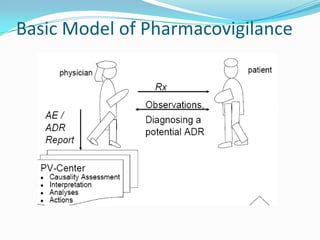
Basic Model of Pharmacovigilance
PHARMACOVIGILANCE METHODS
 Passive surveillance
         Spontaneous Reports
         Case series
   Stimulated Reporting
   Active surveillance
         Sentinel sites
         Drug event monitoring
         Registries
   Comparative observational studies
          Cross-sectional study (survey)
           Case-control study
           Cohort study
   Targeted Clinical Investigations
   Descriptive studies
           Natural history of disease
           Drug utilization study
SPONTANEOUS REPORTS

 A communication by consumers or health care
 professionals to a company or Regulatory Authority
 that describes one or more ADR in a patient who was
 given the drug.


 Plays a major role in the identification of safety
 signals once the drug is marketed
 Gives alerts on rare AEs that were not detected in
 earlier clinical trials or pre marketing studies.


 Provides important information on at risk groups, risk
 factors and clinical features of known serious ADRs.
CASE SERIES
 Series of case reports can provide evidence of an
 association of a drug and AE.

 generally more useful for generating hypotheses than
 for verifying an association between drug exposure
 and outcome

 certain distinct adverse events occur more frequently
 with drug therapy, such as anaphylaxis, aplastic
 anemia, toxic epidermal necrolysis and Stevens-
 Johnson Syndrome events such as these are
 spontaneously reported for detailed and rapid follow-
 up.
STIMULATED REPORTING
 A method used to encourage and facilitate reporting
 by health professionals for new products, or for
 limited time period.

 Methods – On line reporting of AE, systematic
 stimulation of reporting of AE.

 Drawbacks:
  Data are often incomplete.
  Not useful to generate accurate incidence rates.
ACTIVE SURVEILLANCE
 To ascertain completely the number of AE via a
 continuous pre-organised process. Eg:Follow up of
 patients treated with a particular drug.

 More feasible to get comprehensive data on individual
 AE reports.
SENTINEL SITES

 Active surveillance carried out at Institutions,
 Nursing homes, hospitals etc.

 Provide information such as data from specific patient
 subgroups, drug abuse etc.

Weakness:
 Selection bias,
 Small number of patients
 Increased costs
DRUG EVENT MONITORING
 Patients are identified by electronic prescription
 data or automated health insurance claims.


 A follow up questionnaire can be sent to each
 physician or patient at specified intervals.


 Information on patient demographics, indication for
 treatment, duration of therapy (including start dates),
 dosage, clinical events, and reasons for discontinuation
 can be included in the questionnaire.
 Limitations: poor physician and patient
  response rates and unfocused nature of data
  collection can obscure important signals.

 A modification of Drug Event Monitoring is
  Cohort Event Monitoring (CEM), an active
 pharmacovigilance method promoted by the
 World Health Organisation and other
 agencies.
REGISTRIES

 A registry is a list of patients presenting with same
 characteristics.eg: Disease registry, drug registry or
 pregnancy registry.

 Differ from each other depending on type of patient


 Information can be obtained by using standard
 questionnaire.
Comparative Observational Studies
 Traditional epidemiologic methods are a key
     component in the evaluation of adverse events.

 observational study designs are useful in validating
     signals from spontaneous reports or case series.

 types of designs
1. cross-sectional studies
2. case-control studies
3. cohort studies (both retrospective and prospective)
Cross-sectional study (survey)
 Data collected from a population of patients at a
 single point in time (or interval of time) regardless of
 exposure or disease status.

 primarily used to gather data for surveys or for
 ecological analyses

 major drawback: relationship between exposure and
 outcome cannot be directly addressed.

 Adv:best used to examine the prevalence of a disease
 at one time point or to examine trends over time,
 when data for serial time points can be captured.
Case-control study
 cases of disease (or events) are identified.


 Controls, or patients without the disease or event of
 interest, are then selected from the source population

 The controls should be selected : the prevalence of
 exposure among the controls represents the
 prevalence of exposure in the source population.

 exposure status of the two groups is then compared
 using the odds ratio.
Cohort study
 a population-at-risk for the disease (or event) is followed
  over time for the occurrence of the disease (or event)

 Information on exposure status is known throughout the
  follow-up and hence incidence rates can be calculated.

 comparison cohorts of interest are selected on the basis
  of drug use and followed over time

 Multiple adverse events can also be investigated using the
  same data source in a cohort study
TARGETED CLINICAL INVESTIGATIONS
 When significant risks are identified from pre-
 approval clinical trials, further clinical studies might
 be called for to evaluate the mechanism of action for
 ADRs.

 Pharmacodynamic and pharmacokinetic studies might
 be conducted

 Specific studies to investigate potential drug-drug
 interactions and food-drug interactions might be
 called for
Descriptive studies
 primarily used to obtain the background rate of outcome events
     and/or establish the prevalence of the use of drugs in specified
     populations.

1.     Natural history of disease: focused on the natural history of
       disease, including the characteristics of diseased patients and
       the distribution of disease in selected populations, as well as
       estimating the incidence and prevalence of potential outcomes
       of interest

1.     Drug utilization study: These studies provide data on specific
       populations, such as the elderly, children, or patients with
       hepatic or renal dysfunction, often stratified by age, gender,
       concomitant medication, and other characteristics.
Merci!

Pharmacovigilance

  • 1.
  • 2.
    Pharmacovigilance  WHO definespharmacovigilance as the science and activities relating to the detection, assessment, understanding and prevention of adverse effects of marketed medicines or those under trial.  The drug regulatory agencies have the responsibility of having a well-established pharmacovigilance system to monitor adverse reactions of drugs, during the drug development phase and later during the life time of a marketed drug.
  • 3.
    Pharmacovigilance  collects, records,codes ADEs / ADRs  analyses and assesses the reports  promotes the safe use of drugs  creates appropriate structures and means of communication needed to perform its tasks
  • 4.
    Aims of Pharmacovigilance to improve patient care and safety  to improve public health and safety  to contribute to the assessment of benefit, harm, effectiveness and risk of medicines  to promote education and clinical training  to promote effective communication to the public  to promote rational and safe use of medicines
  • 5.
    P-vigilance ---- Ashared responsibility  Company – legally and morally responsible for monitoring their product  Regulatory authorities – are responsible for the safety of the drugs they license  Doctors – responsible to patients  Pharmacist & nurse – responsible to patients
  • 6.
    P-vigilance ---- nowa specialist discipline  Large drug companies have special departments  CROs establishing vigilance groups  Doctors – part of their practicing protocol
  • 7.
    Pharmacovigilance - DataSources  Spontaneous Reporting Systems • National PV Centre / Drug Authority • from the published scientific literature.  Drug Bulletins  Adverse Reaction Case Reports by the MA(master agreement) holder (e.g. collected by sales representatives)  Periodic Safety Update Report (PSUR) provided by MA holder
  • 8.
    Basic Model ofPharmacovigilance
  • 9.
    PHARMACOVIGILANCE METHODS  Passivesurveillance Spontaneous Reports Case series  Stimulated Reporting  Active surveillance Sentinel sites Drug event monitoring Registries  Comparative observational studies Cross-sectional study (survey) Case-control study Cohort study  Targeted Clinical Investigations  Descriptive studies Natural history of disease Drug utilization study
  • 10.
    SPONTANEOUS REPORTS  Acommunication by consumers or health care professionals to a company or Regulatory Authority that describes one or more ADR in a patient who was given the drug.  Plays a major role in the identification of safety signals once the drug is marketed
  • 11.
     Gives alertson rare AEs that were not detected in earlier clinical trials or pre marketing studies.  Provides important information on at risk groups, risk factors and clinical features of known serious ADRs.
  • 12.
    CASE SERIES  Seriesof case reports can provide evidence of an association of a drug and AE.  generally more useful for generating hypotheses than for verifying an association between drug exposure and outcome  certain distinct adverse events occur more frequently with drug therapy, such as anaphylaxis, aplastic anemia, toxic epidermal necrolysis and Stevens- Johnson Syndrome events such as these are spontaneously reported for detailed and rapid follow- up.
  • 13.
    STIMULATED REPORTING  Amethod used to encourage and facilitate reporting by health professionals for new products, or for limited time period.  Methods – On line reporting of AE, systematic stimulation of reporting of AE. Drawbacks: Data are often incomplete. Not useful to generate accurate incidence rates.
  • 14.
    ACTIVE SURVEILLANCE  Toascertain completely the number of AE via a continuous pre-organised process. Eg:Follow up of patients treated with a particular drug.  More feasible to get comprehensive data on individual AE reports.
  • 15.
    SENTINEL SITES  Activesurveillance carried out at Institutions, Nursing homes, hospitals etc.  Provide information such as data from specific patient subgroups, drug abuse etc. Weakness: Selection bias, Small number of patients Increased costs
  • 16.
    DRUG EVENT MONITORING Patients are identified by electronic prescription data or automated health insurance claims.  A follow up questionnaire can be sent to each physician or patient at specified intervals.  Information on patient demographics, indication for treatment, duration of therapy (including start dates), dosage, clinical events, and reasons for discontinuation can be included in the questionnaire.
  • 17.
     Limitations: poorphysician and patient response rates and unfocused nature of data collection can obscure important signals.  A modification of Drug Event Monitoring is Cohort Event Monitoring (CEM), an active pharmacovigilance method promoted by the World Health Organisation and other agencies.
  • 18.
    REGISTRIES  A registryis a list of patients presenting with same characteristics.eg: Disease registry, drug registry or pregnancy registry.  Differ from each other depending on type of patient  Information can be obtained by using standard questionnaire.
  • 19.
    Comparative Observational Studies Traditional epidemiologic methods are a key component in the evaluation of adverse events.  observational study designs are useful in validating signals from spontaneous reports or case series.  types of designs 1. cross-sectional studies 2. case-control studies 3. cohort studies (both retrospective and prospective)
  • 20.
    Cross-sectional study (survey) Data collected from a population of patients at a single point in time (or interval of time) regardless of exposure or disease status.  primarily used to gather data for surveys or for ecological analyses  major drawback: relationship between exposure and outcome cannot be directly addressed.  Adv:best used to examine the prevalence of a disease at one time point or to examine trends over time, when data for serial time points can be captured.
  • 21.
    Case-control study  casesof disease (or events) are identified.  Controls, or patients without the disease or event of interest, are then selected from the source population  The controls should be selected : the prevalence of exposure among the controls represents the prevalence of exposure in the source population.  exposure status of the two groups is then compared using the odds ratio.
  • 22.
    Cohort study  apopulation-at-risk for the disease (or event) is followed over time for the occurrence of the disease (or event)  Information on exposure status is known throughout the follow-up and hence incidence rates can be calculated.  comparison cohorts of interest are selected on the basis of drug use and followed over time  Multiple adverse events can also be investigated using the same data source in a cohort study
  • 23.
    TARGETED CLINICAL INVESTIGATIONS When significant risks are identified from pre- approval clinical trials, further clinical studies might be called for to evaluate the mechanism of action for ADRs.  Pharmacodynamic and pharmacokinetic studies might be conducted  Specific studies to investigate potential drug-drug interactions and food-drug interactions might be called for
  • 24.
    Descriptive studies  primarilyused to obtain the background rate of outcome events and/or establish the prevalence of the use of drugs in specified populations. 1. Natural history of disease: focused on the natural history of disease, including the characteristics of diseased patients and the distribution of disease in selected populations, as well as estimating the incidence and prevalence of potential outcomes of interest 1. Drug utilization study: These studies provide data on specific populations, such as the elderly, children, or patients with hepatic or renal dysfunction, often stratified by age, gender, concomitant medication, and other characteristics.
  • 25.