PHARMACO VIGILANCE
•India ranked 2nd
in World Population
•Indian pharmaceutical industry is growing about 8 – 9%.
•Producing more than 20% of the world’s generics.
•The total pharma market is expected to rise to US$50 billion by 2020.
•It ranks very high amongst all the third world countries, in terms of
technology, quality and vast range of medicines that are
manufactured.
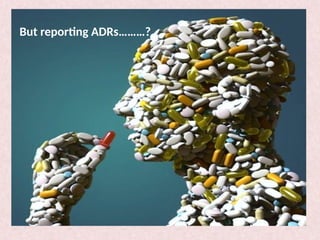
But reporting ADRs………?
• A drug may act or may not act, but it should not
harm the patient. God has given the knowledge to us
only to protect the patient and not to harm him.
• Whether we cure the disease or not we must not
create a new problem for the patient.
• “Pharmakon” is a Greek word means a drug.
• “Vigilare” is a Latin word meaning to be observant, to
keep awake or alert , to keep watch, care, caution,
process of paying close and continuous attention.
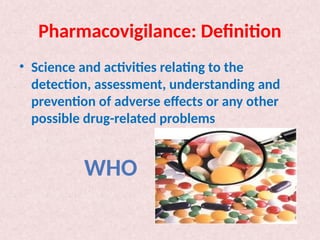
Pharmacovigilance: Definition
• Science and activities relating to the
detection, assessment, understanding and
prevention of adverse effects or any other
possible drug-related problems
WHO
Ultimate Goals of pharmacovigilance
• To promote rational and safe use of
medicines
• To sensitize, educate and inform patients
about drug safety issues
• Analyse the benefit-risk ratio of marketed
medicines to safeguard the health of our
Indian population
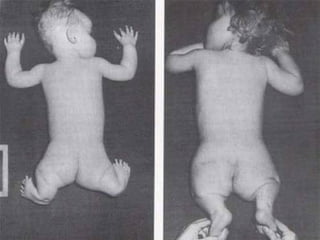
• Thalidomide was introduced in 1957 and was widely
prescribed to pregnant women for the treatment of
morning sickness, i.e nausea and vomiting during
pregnancy.
• Later it was found to produce congenital abnormalities in
children born to women who had use Thaliomide during
pregnancy.
• By 1965 thalidomide had been removed from the market.
• Later it was approved for leprosy and other indications
under strict supervision. inspite of these precautions
between 1969 and 1995, 34 cases of thalidomide
embryopathy was registered in leprosy endemic area in
South America in 1970.
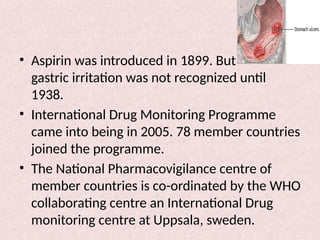
• Aspirin was introduced in 1899. But
gastric irritation was not recognized until
1938.
• International Drug Monitoring Programme
came into being in 2005. 78 member countries
joined the programme.
• The National Pharmacovigilance centre of
member countries is co-ordinated by the WHO
collaborating centre an International Drug
monitoring centre at Uppsala, sweden.
Aims of Pharmacovigilance
1. Identify new information
2. Preventing harm to patient
3. Improve drug therapy
4. To provide alternate therapy
5. Any pharmacogenitical variant
6. Any pharmacogenomic variant
Objectives of Pharmacovigilance
1. To improve patient care and safety in relation to the
use of medicines, all medical and paramedical
interventions.
2. To improve public health and safety in relation to
the use of medicines.
3. To detect problems related to the use of medicines
and report the same.
4. To help in assessing the benefits, harm,
effectiveness, and risk of medicines to prevent harm
and maximize the benefit.
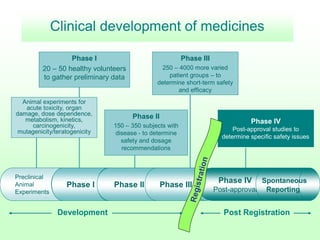
Purpose of clinical trials
1. To find out if a drug works and how well it
works
2. To find out the harmful effects
3. The benefit-harm-risk profile
4. Does it do more good than harm and how
much more
5. If it has a potential for harm how probable
and how serious is the harm.
Phase IV
Post-approval studies to
determine specific safety issues
Clinical development of medicines
Animal experiments for
acute toxicity, organ
damage, dose dependence,
metabolism, kinetics,
carcinogenicity,
mutagenicity/teratogenicity
Preclinical
Animal
Experiments
Phase I Phase II
Development Post Registration
Phase III
Phase IV
Post-approval
Spontaneous
Reporting
R
e
g
i
s
t
r
a
t
i
o
n
Phase I
20 – 50 healthy volunteers
to gather preliminary data
Phase II
150 – 350 subjects with
disease - to determine
safety and dosage
recommendations
Phase III
250 – 4000 more varied
patient groups – to
determine short-term safety
and efficacy
Adverse drug reaction
Definition
• A response to a drug which is noxious
and unintended, and which occurs at
dose normally used in man for
prophylaxis, diagnosis, or therapy of
disease, or for modification of
physiological function.
• Adverse Drug Effects:
• Classification:
• Side effects are in fact pharmacological effects produced
with therapeutic dose of drug
• Eg: Dryness of mouth with Atropine
• useful when given in preanesthetic medication
• Untoward effects: Also develop with therapeutic doses of
a drug but are undesirable and if severe may necessitate
the cessation of treatment
• Toxic Effects: Seen when drug is administered repeatedly
and or in large doses.
• Other types of classification
• Depending on the nature ADR classified into
• Type A –Augmented-(Quantitative):- Hyper response to
main action
• Eg:-Insulin - Hypoglycemia
• Type B Bizzare - (Qualitative):-Bizzare type of action
• Eg:-Penicillin - Allergy
• Type C (chronic)-
• Eg- Analgesic - Nephropathy
• Type D- (Delayed)- Eg Carcinogenesis
• Endometrial Carcinoma with oestrogens.
• Teratogenecity -Thalidomide
• Type E- Ending of use
• a)Rebound adrenocorticoid insufficiency
• b) B blockers in angina
• c) Opiate withdrawal
• Type F- Failure of therapy
• Mostly Drug Interactions
• Warfarin with barbiturates
• Anticoagulant failure
• Incidence
• 1:10 = very common
• 1:100 =common
• 1:1000 =rare
• 1:10,000 =Very rare
• Determinants of ADRs
• Base line lab tests:- LFT, RFT, Thyroid function tests
• Skin prick or intradermal injection test –antibodies
estimation
• ADRs reduced by:-
1)Reduction of dose
2)Management of withdrawal symptoms
3) Caution in future administration
• Causality Assessment scales
• Kerch and lasagna scale
• Naranjo scale
• WHO Probability scale
• Jones Scale
• Kerch and Lasagna Scale
• A= causality is highly probable
• B= Not adequate proof of causality
• C= data are not adequate to asses causality
• Adverse Reactions based on its severity
• Mild = No change in the therapy needed
• Moderate= Change of therapy is desired but events are
not life treating or causality disease
• Severe = Life treating , fatal causes prolong hospital
administration causes persistent disease
“Thus pharmacovigilance will certainly be
boosted as a tool to monitor ADR “
Drug Safety surveillance
It depends upon
Study of the effects of drug when used in general
population or in specific group types
Classified as
1)Experimental
Trials of phase 1-3 :- They provide reliable data on only
Common event as they involve relatively smaller
number of patients( hundred)
They detect an incidence up to about 1 in 200
epidemiologically under in community i.e,
pharmacoepidemiology and pharmacovigilance
• Pharmacoepidemiology:- it is a study of the effects of
drugs when used in general population or in specific
group.
2)Observational
Eg: Case reports ,case control studies, and Quasi
experimental study design
Cohort study:-Prospective –Easy in large number of
patients, follow up study.
A group of patients within common demographic or
statistical character
Advantage good at detecting the effect
Disadvantages Very large ,expensive, time consuming
• Case control studies:
• Retrospective
• Advantages Not expensive, excellent,not time consuming
• Quasi-experimental study is like an experiment
• Eg:-clinical trail except it lacks random assignment of subjects to treatment
3)Anecdotal studies:- Drug reaction, reporting in journals
Advantages:-simple ,cheap.
Disavantages:- detect relatively counter effects
4)Intensive hospital monitoring
Retrospective
Labtests: prothrombin tests
Heparin= bleeding
Limitations:-Selective population studies
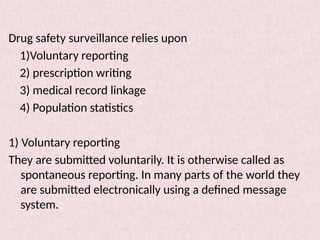
Drug safety surveillance relies upon
1)Voluntary reporting
2) prescription writing
3) medical record linkage
4) Population statistics
1) Voluntary reporting
They are submitted voluntarily. It is otherwise called as
spontaneous reporting. In many parts of the world they
are submitted electronically using a defined message
system.
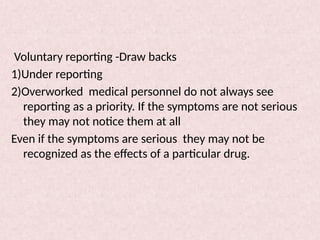
Voluntary reporting -Draw backs
1)Under reporting
2)Overworked medical personnel do not always see
reporting as a priority. If the symptoms are not serious
they may not notice them at all
Even if the symptoms are serious they may not be
recognized as the effects of a particular drug.
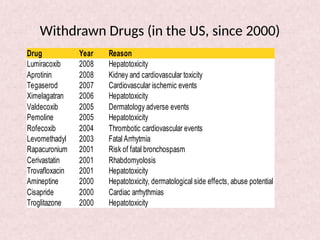
Withdrawn Drugs (in the US, since 2000)
Drug Year Reason
Lumiracoxib 2008 Hepatotoxicity
Aprotinin 2008 Kidney and cardiovascular toxicity
Tegaserod 2007 Cardiovascular ischemic events
Ximelagatran 2006 Hepatotoxicity
Valdecoxib 2005 Dermatology adverse events
Pemoline 2005 Hepatotoxicity
Rofecoxib 2004 Thrombotic cardiovascular events
Levomethadyl 2003 Fatal Arrhytmia
Rapacuronium 2001 Risk of fatal bronchospasm
Cerivastatin 2001 Rhabdomyolosis
Trovafloxacin 2001 Hepatotoxicity
Amineptine 2000 Hepatotoxicity, dermatological side effects, abuse potential
Cisapride 2000 Cardiac arrhythmias
Troglitazone 2000 Hepatotoxicity
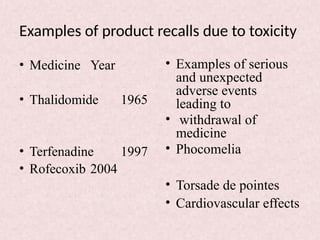
Examples of product recalls due to toxicity
• Medicine Year
• Thalidomide 1965
• Terfenadine 1997
• Rofecoxib 2004
• Examples of serious
and unexpected
adverse events
leading to
• withdrawal of
medicine
• Phocomelia
• Torsade de pointes
• Cardiovascular effects
PHARMACO VIGILANCE IN VARIOUS
COUNTRIES
• EUROPIAN UNION: Here it is co –ordination by European
medical agency and conducted by national competent
authority. This system is called endure vigilance and it is
separate for human and veterinary subjects.
• United states : three primary branches FDA ,
pharmaceutical manufacturers and academic organization.
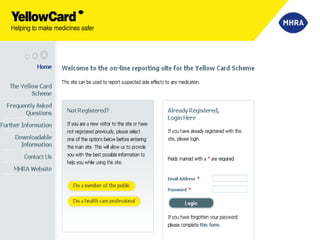
• Great Britain : here it is called YELLOW CARD SYSTEM and
commission for human medicine correlates the results and
advice to regulatory agency of government voluntary
reporting is the first line in pharmacovigilance.
2.Prescription event monitoring
• This is a form of observation cohort study.
Prescription for drug (20,000)are collected.
The prescribent is sent to a questioners and
asked to report all the events including ADRS.
• This can be used routinely to a newly licensed
drug and the drugs widely prescribed in
public.
3.MEDICAL RECORD LINKAGE
It allows computer based birth, marriage,
death and hospital admission with history of
drug use.
Advantages: access to large sources
Disadvantage: time consuming
4.POPULATION STATISTICS
• BIRTH DEFECTS REGISTER AND CANCER
REGISTERS
• Adv: large number of study
• Dis adv: difficult to co-ordinate
ADR reduced by
• 1. skillful prescribing
• 2. careful clinical assessment
• 3. review of medical repots
• 4. simple drug and correct dose are required
• 5. knowledge of pharmacokinetic s and
dynamics of the drug
• 6.drugs are used when it is absolutely
indicated
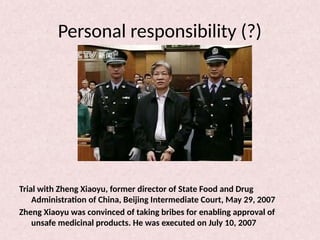
Personal responsibility (?)
Trial with Zheng Xiaoyu, former director of State Food and Drug
Administration of China, Beijing Intermediate Court, May 29, 2007
Zheng Xiaoyu was convinced of taking bribes for enabling approval of
unsafe medicinal products. He was executed on July 10, 2007
Few achievements of pharmacovigilance
• 1. with drawl of tenfinadine due to increased
risk of cardiac arrythmias and sudden cardiac
depression
• 2. rofecoxib – for increase incidence of CVS
morbidity and mortality
• 3. insulin sensitize i.e rosiglitazone – due to
increase incidence of myocardiac infarction
and risk of death from cvs causes
• 4. TNF –Alfa inhibitors- it produces
demyelization diseases , auto immune
diseases like multiple sclerosis and SLE.
• 5. BORTIZOMIB used for multiple myeloma
produce bone marrow depression
• 6. Gatifloxacin – cardiac problems ,
prolongation of QTc interval
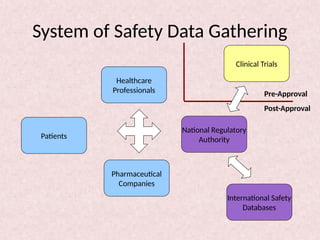
System of Safety Data Gathering
Pharmaceutical
Companies
Patients
National Regulatory
Authority
International Safety
Databases
Healthcare
Professionals
Clinical Trials
Pre-Approval
Post-Approval
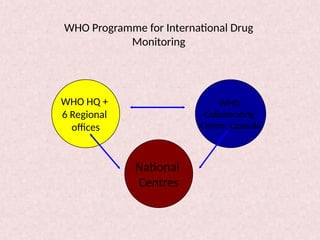
WHO Programme for International Drug
Monitoring
WHO HQ +
6 Regional
offices
WHO
Collaborating
Centre, Uppsala
National
Centres
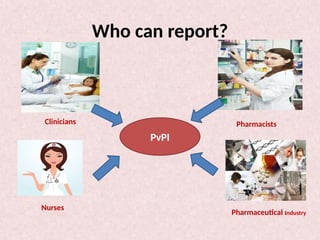
Who can report?
PvPI
Clinicians Pharmacists
Nurses
Pharmaceutical Industry
What to report?
• All types of suspected ADRs (whether
known /unknown, serious /non-serious,
frequent /rare)
• Although primarily concerned with allopathic
medicines, ADRs with traditional medicines
(herbal remedies etc) is also being considered
Whom to report?
• By using the ‘Suspected Adverse Drug
Reaction Reporting Form’
• A reporter who is not a part of AMC can
submit the ICSR to the nearest AMC or
directly to the NCC.
• Toll free help line number 1800-180-3024
• When there are several reports of adverse
reactions to a particular drug, this process
may lead to the detection of a signal .
• signal : it means a possible hazard
communicable to member countries. This
happen only after detailed evolutional expert
review .
• Any suspected drug interaction
• Any reaction causing death
• Any life threatening reaction
• Any reaction which requires hospitalisation
• Any reaction which caused disability
• Any reaction which causes permanent
damage.
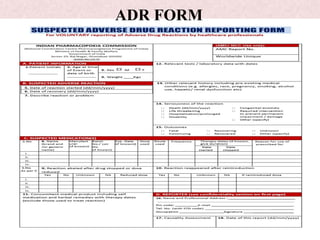
ADR FORM
MINIMUM REQIURNMENT FOR
REPORTING
• *A Patient (patient initials, age &
gender)
• *A Reporter
• An ADR
• A Drug
*confidentiality to be ensured
A. Patient Information
B. Suspected ADR information
C. Suspected Medications
D. Reporter
MAJOR COMPONENTS OF AN ADR FORM
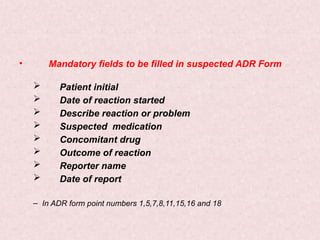
• Mandatory fields to be filled in suspected ADR Form
 Patient initial
 Date of reaction started
 Describe reaction or problem
 Suspected medication
 Concomitant drug
 Outcome of reaction
 Reporter name
 Date of report
– In ADR form point numbers 1,5,7,8,11,15,16 and 18
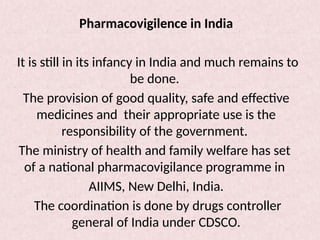
Pharmacovigilence in India
It is still in its infancy in India and much remains to
be done.
The provision of good quality, safe and effective
medicines and their appropriate use is the
responsibility of the government.
The ministry of health and family welfare has set
of a national pharmacovigilance programme in
AIIMS, New Delhi, India.
The coordination is done by drugs controller
general of India under CDSCO.
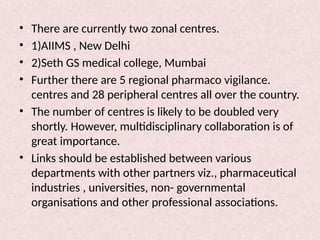
• There are currently two zonal centres.
• 1)AIIMS , New Delhi
• 2)Seth GS medical college, Mumbai
• Further there are 5 regional pharmaco vigilance.
centres and 28 peripheral centres all over the country.
• The number of centres is likely to be doubled very
shortly. However, multidisciplinary collaboration is of
great importance.
• Links should be established between various
departments with other partners viz., pharmaceutical
industries , universities, non- governmental
organisations and other professional associations.
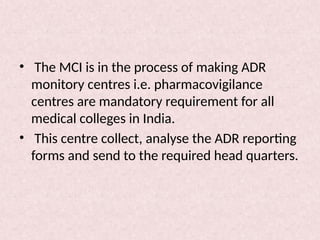
• The MCI is in the process of making ADR
monitory centres i.e. pharmacovigilance
centres are mandatory requirement for all
medical colleges in India.
• This centre collect, analyse the ADR reporting
forms and send to the required head quarters.
• C D S C O i.e central drug standard control
organisation initiated a well structured and
highly participative nationalpharmacovigilance
programme.
• It is largely based on recommendations made
in the W.H.O. document titled “safety
monitoring of medicinal products. Guidelines
for setting up running a pharmacovigilance
centre”.
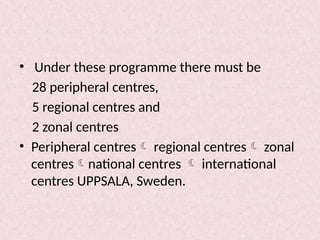
• Under these programme there must be
28 peripheral centres,
5 regional centres and
2 zonal centres
• Peripheral centres regional centres zonal
centresnational centres  international
centres UPPSALA, Sweden.
• The peripheral centres will record the adverse
events and send to regional centres.
• They in turn correlate and send the data and
submit to the zonal centres.
• Zonal centres analyse the data submit a
consolidated information to the national
pharmacovigilance centre.
• The zonal centres also provide training, support
and coordinate the functioning of regional centres.
• Review Periodic Safety Update Reports(PSURS) submitted
by pharmacoceutical companies .
• PSURS should be submitted every 6 months for the first 2
yrs of marketing in India and annually for subsequent 2
years.
• Maintain contacts with international bodies working in in
pharmacovigilance and exchange
• Assess regularly information relating to safety. Based on
the available data, the advisory committee shall make
recommendation on product label amendment, product
withdrawal and suspension.
• Provide information through drug reaction new bulletins,
drug alerts, signal, seminars
• National pharmacovigilance programme(NPP) :- it is
coordinated by the country regulatory agency.
• The various centers are:
• peripheral pharmacovigilance centre(PPC):- they are
the primary pharmacovigilance centres, this includes
small medical institutions, medical practitioners,
clinics, private hospitals, nursing homes,pharmacies.
• regional P.V. centre(RPC):- they are the secondary
pharmacovigilance centres. They include large health
care facilities attached with medical college. They will
function as first contact ADE DATA collection units
also.
• Zonal P.V.centre(ZPC):- they are tertiary P.V.
centres. They include large health care
facilities attached with medical college in
metro cities identified by CDSCO. They also act
same as that of first contact ADE data
collection unit also.
• The main uses of pharmacovigilance are
• 1.promoting rational use of medicine
• 2.To increase safety to patient
• 3.To gain public confidence in medicines as
well as doctors
• 4.To decrease the cost of the treatment.
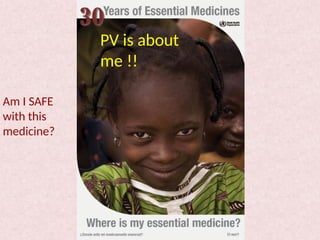
Am I SAFE
with this
medicine?
PV is about
me !!
Conclusion
• Drug development is high risk business. Early
hopes and expectations can later be shattered
by the reality of clinical practice, when the risk
as well as benefits of a medicine emerge with
the passage of time.
• Medicines are supposed to save the life of
patients. No medical product is entirely or
absolutely safe for all people, in all places and
at all times.
Dying from disease is some times
unavoidable , BUT dying from
medicine/adverse drug reaction is
unacceptable.
“WE MUST BE VIGILANT TODAY
FOR A SAFE TOMORROW “
TAKE HOME MESSAGE
KEEP REPORTING ADVERSE DRUG REACTIONS
TAKE TO HEART MESSAGE
KEEP REPORTING ADVERSE DRUG REACTIONS
…………………………….thank u

pharmacovigilance.pptx for MBBS undergraduates

  • 1.
  • 2.
    •India ranked 2nd inWorld Population •Indian pharmaceutical industry is growing about 8 – 9%. •Producing more than 20% of the world’s generics. •The total pharma market is expected to rise to US$50 billion by 2020. •It ranks very high amongst all the third world countries, in terms of technology, quality and vast range of medicines that are manufactured.
  • 3.
  • 4.
    • A drugmay act or may not act, but it should not harm the patient. God has given the knowledge to us only to protect the patient and not to harm him. • Whether we cure the disease or not we must not create a new problem for the patient. • “Pharmakon” is a Greek word means a drug. • “Vigilare” is a Latin word meaning to be observant, to keep awake or alert , to keep watch, care, caution, process of paying close and continuous attention.
  • 5.
    Pharmacovigilance: Definition • Scienceand activities relating to the detection, assessment, understanding and prevention of adverse effects or any other possible drug-related problems WHO
  • 6.
    Ultimate Goals ofpharmacovigilance • To promote rational and safe use of medicines • To sensitize, educate and inform patients about drug safety issues • Analyse the benefit-risk ratio of marketed medicines to safeguard the health of our Indian population
  • 7.
    • Thalidomide wasintroduced in 1957 and was widely prescribed to pregnant women for the treatment of morning sickness, i.e nausea and vomiting during pregnancy. • Later it was found to produce congenital abnormalities in children born to women who had use Thaliomide during pregnancy. • By 1965 thalidomide had been removed from the market. • Later it was approved for leprosy and other indications under strict supervision. inspite of these precautions between 1969 and 1995, 34 cases of thalidomide embryopathy was registered in leprosy endemic area in South America in 1970.
  • 10.
    • Aspirin wasintroduced in 1899. But gastric irritation was not recognized until 1938. • International Drug Monitoring Programme came into being in 2005. 78 member countries joined the programme. • The National Pharmacovigilance centre of member countries is co-ordinated by the WHO collaborating centre an International Drug monitoring centre at Uppsala, sweden.
  • 11.
    Aims of Pharmacovigilance 1.Identify new information 2. Preventing harm to patient 3. Improve drug therapy 4. To provide alternate therapy 5. Any pharmacogenitical variant 6. Any pharmacogenomic variant
  • 12.
    Objectives of Pharmacovigilance 1.To improve patient care and safety in relation to the use of medicines, all medical and paramedical interventions. 2. To improve public health and safety in relation to the use of medicines. 3. To detect problems related to the use of medicines and report the same. 4. To help in assessing the benefits, harm, effectiveness, and risk of medicines to prevent harm and maximize the benefit.
  • 13.
    Purpose of clinicaltrials 1. To find out if a drug works and how well it works 2. To find out the harmful effects 3. The benefit-harm-risk profile 4. Does it do more good than harm and how much more 5. If it has a potential for harm how probable and how serious is the harm.
  • 14.
    Phase IV Post-approval studiesto determine specific safety issues Clinical development of medicines Animal experiments for acute toxicity, organ damage, dose dependence, metabolism, kinetics, carcinogenicity, mutagenicity/teratogenicity Preclinical Animal Experiments Phase I Phase II Development Post Registration Phase III Phase IV Post-approval Spontaneous Reporting R e g i s t r a t i o n Phase I 20 – 50 healthy volunteers to gather preliminary data Phase II 150 – 350 subjects with disease - to determine safety and dosage recommendations Phase III 250 – 4000 more varied patient groups – to determine short-term safety and efficacy
  • 15.
    Adverse drug reaction Definition •A response to a drug which is noxious and unintended, and which occurs at dose normally used in man for prophylaxis, diagnosis, or therapy of disease, or for modification of physiological function.
  • 16.
    • Adverse DrugEffects: • Classification: • Side effects are in fact pharmacological effects produced with therapeutic dose of drug • Eg: Dryness of mouth with Atropine • useful when given in preanesthetic medication • Untoward effects: Also develop with therapeutic doses of a drug but are undesirable and if severe may necessitate the cessation of treatment • Toxic Effects: Seen when drug is administered repeatedly and or in large doses.
  • 17.
    • Other typesof classification • Depending on the nature ADR classified into • Type A –Augmented-(Quantitative):- Hyper response to main action • Eg:-Insulin - Hypoglycemia • Type B Bizzare - (Qualitative):-Bizzare type of action • Eg:-Penicillin - Allergy • Type C (chronic)- • Eg- Analgesic - Nephropathy • Type D- (Delayed)- Eg Carcinogenesis • Endometrial Carcinoma with oestrogens. • Teratogenecity -Thalidomide
  • 18.
    • Type E-Ending of use • a)Rebound adrenocorticoid insufficiency • b) B blockers in angina • c) Opiate withdrawal • Type F- Failure of therapy • Mostly Drug Interactions • Warfarin with barbiturates • Anticoagulant failure • Incidence • 1:10 = very common • 1:100 =common • 1:1000 =rare • 1:10,000 =Very rare
  • 19.
    • Determinants ofADRs • Base line lab tests:- LFT, RFT, Thyroid function tests • Skin prick or intradermal injection test –antibodies estimation • ADRs reduced by:- 1)Reduction of dose 2)Management of withdrawal symptoms 3) Caution in future administration
  • 20.
    • Causality Assessmentscales • Kerch and lasagna scale • Naranjo scale • WHO Probability scale • Jones Scale • Kerch and Lasagna Scale • A= causality is highly probable • B= Not adequate proof of causality • C= data are not adequate to asses causality
  • 21.
    • Adverse Reactionsbased on its severity • Mild = No change in the therapy needed • Moderate= Change of therapy is desired but events are not life treating or causality disease • Severe = Life treating , fatal causes prolong hospital administration causes persistent disease
  • 22.
    “Thus pharmacovigilance willcertainly be boosted as a tool to monitor ADR “
  • 23.
    Drug Safety surveillance Itdepends upon Study of the effects of drug when used in general population or in specific group types Classified as 1)Experimental Trials of phase 1-3 :- They provide reliable data on only Common event as they involve relatively smaller number of patients( hundred) They detect an incidence up to about 1 in 200 epidemiologically under in community i.e, pharmacoepidemiology and pharmacovigilance
  • 24.
    • Pharmacoepidemiology:- itis a study of the effects of drugs when used in general population or in specific group. 2)Observational Eg: Case reports ,case control studies, and Quasi experimental study design Cohort study:-Prospective –Easy in large number of patients, follow up study. A group of patients within common demographic or statistical character Advantage good at detecting the effect Disadvantages Very large ,expensive, time consuming
  • 25.
    • Case controlstudies: • Retrospective • Advantages Not expensive, excellent,not time consuming • Quasi-experimental study is like an experiment • Eg:-clinical trail except it lacks random assignment of subjects to treatment 3)Anecdotal studies:- Drug reaction, reporting in journals Advantages:-simple ,cheap. Disavantages:- detect relatively counter effects 4)Intensive hospital monitoring Retrospective Labtests: prothrombin tests Heparin= bleeding Limitations:-Selective population studies
  • 26.
    Drug safety surveillancerelies upon 1)Voluntary reporting 2) prescription writing 3) medical record linkage 4) Population statistics 1) Voluntary reporting They are submitted voluntarily. It is otherwise called as spontaneous reporting. In many parts of the world they are submitted electronically using a defined message system.
  • 27.
    Voluntary reporting -Drawbacks 1)Under reporting 2)Overworked medical personnel do not always see reporting as a priority. If the symptoms are not serious they may not notice them at all Even if the symptoms are serious they may not be recognized as the effects of a particular drug.
  • 28.
    Withdrawn Drugs (inthe US, since 2000) Drug Year Reason Lumiracoxib 2008 Hepatotoxicity Aprotinin 2008 Kidney and cardiovascular toxicity Tegaserod 2007 Cardiovascular ischemic events Ximelagatran 2006 Hepatotoxicity Valdecoxib 2005 Dermatology adverse events Pemoline 2005 Hepatotoxicity Rofecoxib 2004 Thrombotic cardiovascular events Levomethadyl 2003 Fatal Arrhytmia Rapacuronium 2001 Risk of fatal bronchospasm Cerivastatin 2001 Rhabdomyolosis Trovafloxacin 2001 Hepatotoxicity Amineptine 2000 Hepatotoxicity, dermatological side effects, abuse potential Cisapride 2000 Cardiac arrhythmias Troglitazone 2000 Hepatotoxicity
  • 29.
    Examples of productrecalls due to toxicity • Medicine Year • Thalidomide 1965 • Terfenadine 1997 • Rofecoxib 2004 • Examples of serious and unexpected adverse events leading to • withdrawal of medicine • Phocomelia • Torsade de pointes • Cardiovascular effects
  • 30.
    PHARMACO VIGILANCE INVARIOUS COUNTRIES • EUROPIAN UNION: Here it is co –ordination by European medical agency and conducted by national competent authority. This system is called endure vigilance and it is separate for human and veterinary subjects. • United states : three primary branches FDA , pharmaceutical manufacturers and academic organization. • Great Britain : here it is called YELLOW CARD SYSTEM and commission for human medicine correlates the results and advice to regulatory agency of government voluntary reporting is the first line in pharmacovigilance.
  • 32.
    2.Prescription event monitoring •This is a form of observation cohort study. Prescription for drug (20,000)are collected. The prescribent is sent to a questioners and asked to report all the events including ADRS. • This can be used routinely to a newly licensed drug and the drugs widely prescribed in public.
  • 33.
    3.MEDICAL RECORD LINKAGE Itallows computer based birth, marriage, death and hospital admission with history of drug use. Advantages: access to large sources Disadvantage: time consuming
  • 34.
    4.POPULATION STATISTICS • BIRTHDEFECTS REGISTER AND CANCER REGISTERS • Adv: large number of study • Dis adv: difficult to co-ordinate
  • 35.
    ADR reduced by •1. skillful prescribing • 2. careful clinical assessment • 3. review of medical repots • 4. simple drug and correct dose are required • 5. knowledge of pharmacokinetic s and dynamics of the drug • 6.drugs are used when it is absolutely indicated
  • 36.
    Personal responsibility (?) Trialwith Zheng Xiaoyu, former director of State Food and Drug Administration of China, Beijing Intermediate Court, May 29, 2007 Zheng Xiaoyu was convinced of taking bribes for enabling approval of unsafe medicinal products. He was executed on July 10, 2007
  • 37.
    Few achievements ofpharmacovigilance • 1. with drawl of tenfinadine due to increased risk of cardiac arrythmias and sudden cardiac depression • 2. rofecoxib – for increase incidence of CVS morbidity and mortality • 3. insulin sensitize i.e rosiglitazone – due to increase incidence of myocardiac infarction and risk of death from cvs causes
  • 38.
    • 4. TNF–Alfa inhibitors- it produces demyelization diseases , auto immune diseases like multiple sclerosis and SLE. • 5. BORTIZOMIB used for multiple myeloma produce bone marrow depression • 6. Gatifloxacin – cardiac problems , prolongation of QTc interval
  • 39.
    System of SafetyData Gathering Pharmaceutical Companies Patients National Regulatory Authority International Safety Databases Healthcare Professionals Clinical Trials Pre-Approval Post-Approval
  • 40.
    WHO Programme forInternational Drug Monitoring WHO HQ + 6 Regional offices WHO Collaborating Centre, Uppsala National Centres
  • 41.
    Who can report? PvPI CliniciansPharmacists Nurses Pharmaceutical Industry
  • 42.
    What to report? •All types of suspected ADRs (whether known /unknown, serious /non-serious, frequent /rare) • Although primarily concerned with allopathic medicines, ADRs with traditional medicines (herbal remedies etc) is also being considered
  • 43.
    Whom to report? •By using the ‘Suspected Adverse Drug Reaction Reporting Form’ • A reporter who is not a part of AMC can submit the ICSR to the nearest AMC or directly to the NCC. • Toll free help line number 1800-180-3024
  • 44.
    • When thereare several reports of adverse reactions to a particular drug, this process may lead to the detection of a signal . • signal : it means a possible hazard communicable to member countries. This happen only after detailed evolutional expert review .
  • 45.
    • Any suspecteddrug interaction • Any reaction causing death • Any life threatening reaction • Any reaction which requires hospitalisation • Any reaction which caused disability • Any reaction which causes permanent damage.
  • 46.
  • 47.
    MINIMUM REQIURNMENT FOR REPORTING •*A Patient (patient initials, age & gender) • *A Reporter • An ADR • A Drug *confidentiality to be ensured
  • 48.
    A. Patient Information B.Suspected ADR information C. Suspected Medications D. Reporter MAJOR COMPONENTS OF AN ADR FORM
  • 49.
    • Mandatory fieldsto be filled in suspected ADR Form  Patient initial  Date of reaction started  Describe reaction or problem  Suspected medication  Concomitant drug  Outcome of reaction  Reporter name  Date of report – In ADR form point numbers 1,5,7,8,11,15,16 and 18
  • 50.
    Pharmacovigilence in India Itis still in its infancy in India and much remains to be done. The provision of good quality, safe and effective medicines and their appropriate use is the responsibility of the government. The ministry of health and family welfare has set of a national pharmacovigilance programme in AIIMS, New Delhi, India. The coordination is done by drugs controller general of India under CDSCO.
  • 51.
    • There arecurrently two zonal centres. • 1)AIIMS , New Delhi • 2)Seth GS medical college, Mumbai • Further there are 5 regional pharmaco vigilance. centres and 28 peripheral centres all over the country. • The number of centres is likely to be doubled very shortly. However, multidisciplinary collaboration is of great importance. • Links should be established between various departments with other partners viz., pharmaceutical industries , universities, non- governmental organisations and other professional associations.
  • 52.
    • The MCIis in the process of making ADR monitory centres i.e. pharmacovigilance centres are mandatory requirement for all medical colleges in India. • This centre collect, analyse the ADR reporting forms and send to the required head quarters.
  • 53.
    • C DS C O i.e central drug standard control organisation initiated a well structured and highly participative nationalpharmacovigilance programme. • It is largely based on recommendations made in the W.H.O. document titled “safety monitoring of medicinal products. Guidelines for setting up running a pharmacovigilance centre”.
  • 54.
    • Under theseprogramme there must be 28 peripheral centres, 5 regional centres and 2 zonal centres • Peripheral centres regional centres zonal centresnational centres  international centres UPPSALA, Sweden.
  • 55.
    • The peripheralcentres will record the adverse events and send to regional centres. • They in turn correlate and send the data and submit to the zonal centres. • Zonal centres analyse the data submit a consolidated information to the national pharmacovigilance centre. • The zonal centres also provide training, support and coordinate the functioning of regional centres.
  • 56.
    • Review PeriodicSafety Update Reports(PSURS) submitted by pharmacoceutical companies . • PSURS should be submitted every 6 months for the first 2 yrs of marketing in India and annually for subsequent 2 years. • Maintain contacts with international bodies working in in pharmacovigilance and exchange • Assess regularly information relating to safety. Based on the available data, the advisory committee shall make recommendation on product label amendment, product withdrawal and suspension. • Provide information through drug reaction new bulletins, drug alerts, signal, seminars
  • 57.
    • National pharmacovigilanceprogramme(NPP) :- it is coordinated by the country regulatory agency. • The various centers are: • peripheral pharmacovigilance centre(PPC):- they are the primary pharmacovigilance centres, this includes small medical institutions, medical practitioners, clinics, private hospitals, nursing homes,pharmacies. • regional P.V. centre(RPC):- they are the secondary pharmacovigilance centres. They include large health care facilities attached with medical college. They will function as first contact ADE DATA collection units also.
  • 58.
    • Zonal P.V.centre(ZPC):-they are tertiary P.V. centres. They include large health care facilities attached with medical college in metro cities identified by CDSCO. They also act same as that of first contact ADE data collection unit also.
  • 59.
    • The mainuses of pharmacovigilance are • 1.promoting rational use of medicine • 2.To increase safety to patient • 3.To gain public confidence in medicines as well as doctors • 4.To decrease the cost of the treatment.
  • 60.
    Am I SAFE withthis medicine? PV is about me !!
  • 61.
    Conclusion • Drug developmentis high risk business. Early hopes and expectations can later be shattered by the reality of clinical practice, when the risk as well as benefits of a medicine emerge with the passage of time. • Medicines are supposed to save the life of patients. No medical product is entirely or absolutely safe for all people, in all places and at all times.
  • 62.
    Dying from diseaseis some times unavoidable , BUT dying from medicine/adverse drug reaction is unacceptable.
  • 63.
    “WE MUST BEVIGILANT TODAY FOR A SAFE TOMORROW “
  • 64.
    TAKE HOME MESSAGE KEEPREPORTING ADVERSE DRUG REACTIONS TAKE TO HEART MESSAGE KEEP REPORTING ADVERSE DRUG REACTIONS …………………………….thank u