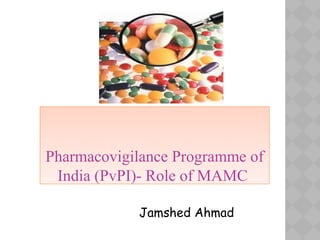
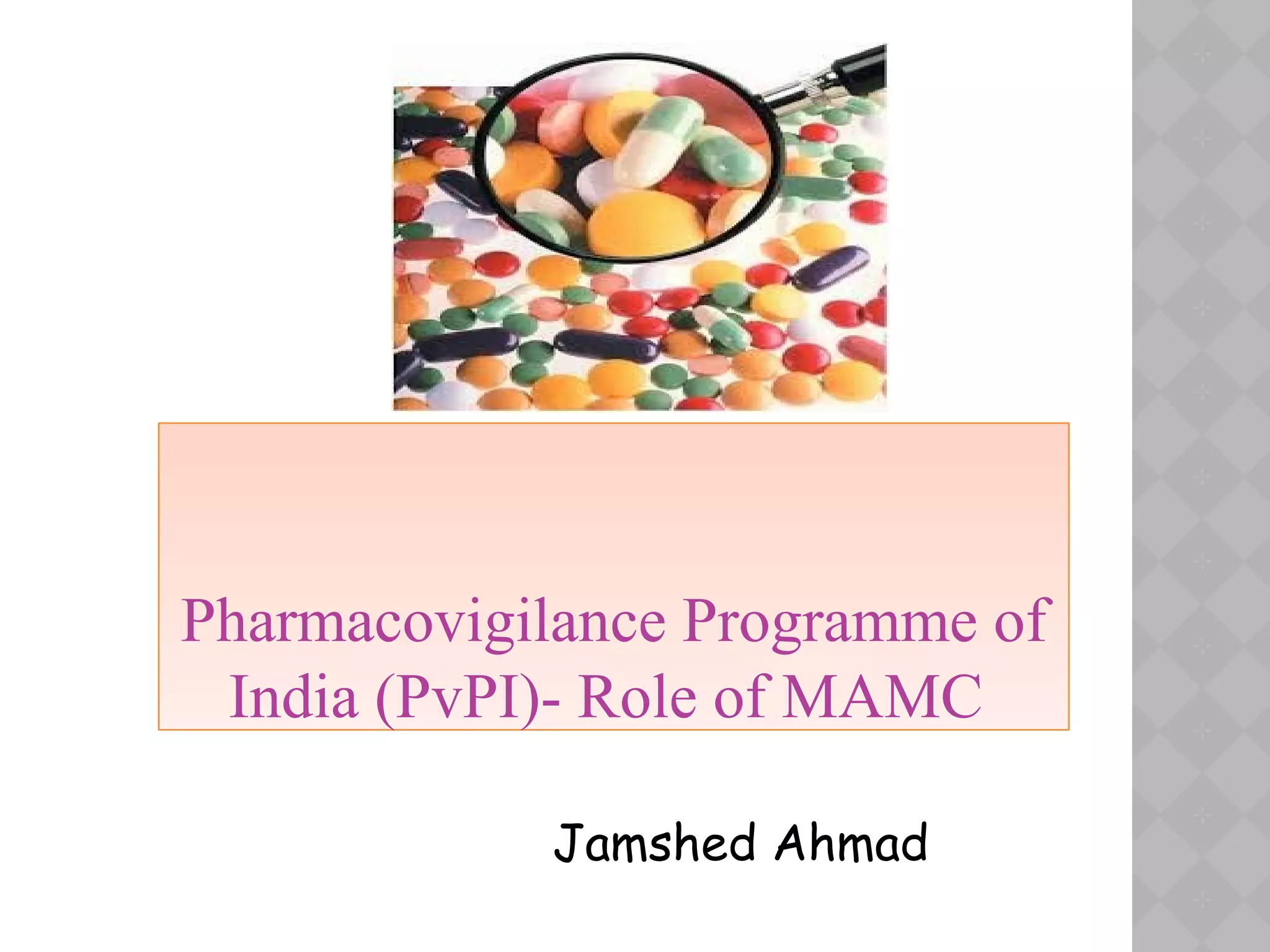
Pharmacovigilance Programme of
India (PvPI)- Role of MAMC
Jamshed Ahmad
04/21/15
In Safety do not forget
danger; in peace, do not
forget disorder
Pharmacovigilance?
Pharmacovigilance: science and activities relating
to the
 Detection
 Assessment
 Understanding
&
 Prevention
of adverse drug reactions or any other possible drug related
problems
WHO 2002
Cont…
• 1962
USA revised law requiring to prove safety and
efficacy before issuing marketing authorization
• 1963
British Committee on Safety of drug monitoring
• 1964
UK starts “yellow cards” system
Cont…
• 1964-65
National ADR reporting system UK, Australia,
New Zealand, Canada, West Germany, Sweden.
Uppsala Monitoring Centre
• 1968 - WHO Collaborating Centre for
International Drug Monitoring, Geneva
• 1978 - Moved to Uppsala after agreement between
Sweden and WHO
• Non-profit foundation with
international administrative board
• WHO Headquarters responsible for policy
• Self-financing
• Global Pharmacovigilance
India?
Pharmacovigilance in India
1986
 ADR monitoring system for India proposed with
12 regional centres
 Oversaw areas with population sizes of
approximately 50 million each
Cont…
1997
 India joined WHO-ADR reporting program based
in Uppsala, Sweden
 3 centres viz, AIIMS, KEM and AMU
National Pharmacovigilance
Program (NPP)
2004
 The National Pharmacovigilance Program (NPP)
officially inaugurated by the Central Health
Minister at New Delhi
Cont…
2005
 The Ministry of Health and Family Welfare in
India initiated the NPP, coordinated by the Central
Drugs Standard Control Organization (CDSCO)
 Programme was started with 2 zonal, 5 regional
and 24 peripheral centres
Pharmacovigilance Programme of
India (PvPI)
July 2010
 The Pharmacovigilance Programme of India
(PvPI) initiated with AIIMS, New Delhi as
National Coordination Centre (NCC) for
monitoring ADRs in the country
Cont…
15th
April 2011
 The NCC shifted from AIIMS, New Delhi to
Indian Pharmacopoeia Commission (IPC),
Ghaziabad
Mission
Safeguard the health of the Indian population by
ensuring that the benefits of use of medicine
outweigh the risks associated with its use
Objectives
• To create a national-wide system for patient safety
reporting
• To identify and analyze new signal from the report
cases
• To analyze the benefit-risk ratio of marketed
medications
• To generate evidence based information on safety
of medicines
• To support regulatory agency in the decision-
making process on use of medications
• To promote rational use of medicine
Short term goals
• To develop & implement pharmacovigilance
system in India
• To enroll, initially all MCI approved medical
colleges in the program covering north, south, east
and west of India
• To encourage healthcare professionals in reporting
of adverse reaction to drugs, vaccines, medical
devices and biological products
• Collection of case reports and data
Long term goals
• To expand the PvPI to all hospitals (govt. &
private), public heath programs located across
India
• To develop & implement e-reporting system
• To develop reporting culture amongst HCPs
• To make ADR reporting mandatory for HCPs
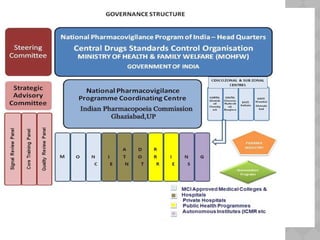
Committees under NCC
 Steering Committee
 Working Group
 Quality Review Panel
 Signal Review Panel
 Core Training Panel
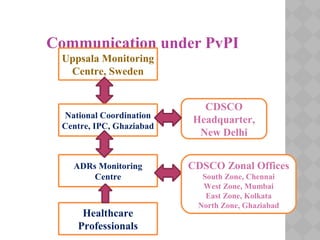
Communication under PvPI
Uppsala Monitoring
Centre, Sweden
National Coordination
Centre, IPC, Ghaziabad
ADRs Monitoring
Centre
Healthcare
Professionals
CDSCO Zonal Offices
South Zone, Chennai
West Zone, Mumbai
East Zone, Kolkata
North Zone, Ghaziabad
CDSCO
Headquarter,
New Delhi
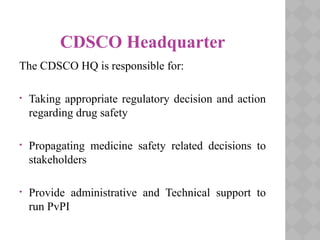
CDSCO Headquarter
The CDSCO HQ is responsible for:
• Taking appropriate regulatory decision and action
regarding drug safety
• Propagating medicine safety related decisions to
stakeholders
• Provide administrative and Technical support to
run PvPI
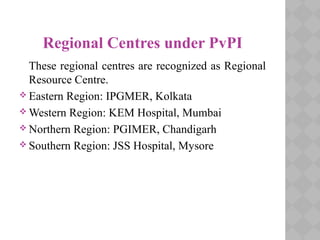
Regional Centres under PvPI
These regional centres are recognized as Regional
Resource Centre.
 Eastern Region: IPGMER, Kolkata
 Western Region: KEM Hospital, Mumbai
 Northern Region: PGIMER, Chandigarh
 Southern Region: JSS Hospital, Mysore
Whom to Report?
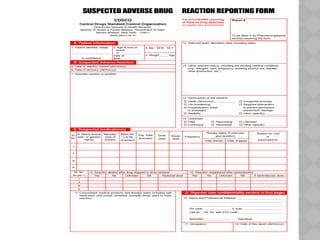
 Use the ‘Suspected Adverse Drug Reaction Reporting
Form’ to report any ADR
 Form available in all AMCs or download from
www.ipc.gov.in or www.cdsco.nic.in
 The filled reporting form can be submitted to the AMC or
directly to the NCC
 A reporter can also mail the form at
pvpi.ipcindia@gmail.com
 Toll free number 1800-180-3024 for reporting ADR
Current status of NCC-PvPI
Till 31st
Jan 2015-
 Total number of ADR monitoring centres: 90
 Total number of proposed ADR monitoring centres: 60
 Number of ADRs committed by NCC to WHO-UMC:
75,663
 Number of ADRs under assessment of NCC: 6421
 Number of reports reverted back to AMCs: 705
 Total number of Individual Case Safety Reports
(ICSRs) in PvPI database: 84,470
ADRs Reporting Status
 ADR reporting rate in India has gradually
increased as compared to previous year
 PvPI in-house assessment shows that;
 64.66% of ICSRs reported by Clinicians
• 14.75% by Pharmacists
• 18.83% by Nurses and Dentists
India’s contribution to WHO-
UMC, 2013
 117 countries participating in the WHO
programme for International Drug Monitoring
 India stood at 7th
position in contributing to
global ICSRs safety database for the year 2013
EXPANSION OF PvPI
Medical Council of India (MCI)
 Mandatory for every medical college in India to
have a Pharmacovigilance committee, as per
regulations of Medical Council of India, 2010
Haemovigilance
COLLABORATION BETWEEN NIB AND
PvPI
IPC in collaboration with National Institute of
Biologicals (NIB) has launched Haemovigilance
Program of India on 10th
Dec 2012 as an integral
part of PvPI
Revised National TB Control
Programme (RNTCP)
COLLABORATION BETWEEN RNTCP
AND PvPI
In order to improve patient care and safety in
relation to the use of anti-tubercular drugs.
RNTCP formally collaborated with PvPI on
October 11th
, 2013
Participation of Nursing
Professionals
NCC-PvPI oraganized a meeting with president
Nursing Coumcil of India (NCI), on July 16,
2014, New Delhi to initiate the participation of
nursing professionals in PvPI.
National AIDS Control
Organization (NACO)
COLLABORATION BETWEEN NACO &
PvPI
To ensure the safety of ARV medicines used in the
programme, the Indian Pharmacopoeia
Commission and the National AIDS Control
Organization (NACO) formally agreed on 15
September 2014.
ADR Monitoring Centres (AMCs)
 All MCI approved teaching hospitals established
as AMCs under the PvPI.
 Total number of AMCs in India till now is 150
 Department of Pharmacology, MAMC has been
established as an AMC under the PvPI.
34
MAMC as AMC
 As per the MCI guideline, all Medical Colleges to
have a college pharmacovigilance committee.
 MAMC has made a College Pharmacovigilance
Committee involving 30 Departments of college
and associated hospitals.
MAMC as AMC
 Total number of Individual Case Safety reports
(ICSRs) collected at AMC (Sep-2014 to Mar-
2015): 198
 Total number of ICSRs reported from MAMC to
NCC : 135
36
MAMC as AMC
Major ADR reported from MAMC
 Thrombophlebitis: Ceftriaxone
 Lymphadenopathy: Dapsone
 Exfoliative dermatitis: Phenytoin
 Optic neuropathy: Ethambutol
 Oliguria: Amphotericin B
 Red man syndrome: Vancomycin
 Tongue protrusion: Trifluoperazine
 Hematuria: Cyclophosphamide
 Hand-foot syndrome: Capecitabine
 Peripheral neuropathy: Paclitaxel
MAMC as AMC
Departments actively involved in reporting of
ADRs:
 Radiotherapy
 HIV/ART Clinic
 Medicine
 TB & Chest Clinic
 Surgery
 Dermatology
 Obs & Gyn
 Psychiatry
 Radio-diagnosis
MAMC as AMC
How to report & Whom to report?
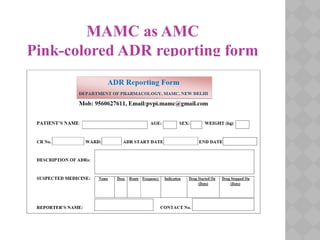
 Pink colored ADR reporting form available at
centre as well as all OPDs & Nursing stations
 Through mobile number: 9560627611
 Email: pvpi.mamc@gmail.com
 Contact detail: ADR Monitoring Centre, Room
No. 176, Department of Pharmacology, Pathology
Block, MAMC
MAMC as AMC
Pink-colored ADR reporting form
Recently banned drugs in India
 Dextropropoxyphene (23rd
May, 2013)
 Serodiagnostic test kits for diagnosis of
tuberculosis (7th
Jun, 2013)
 Fixed dose combination of Flupentixol+Melitracen
(18th
Jun, 2013)
 Analgin (18th
Jun, 2013)
 Pioglitazone (18th
Jun, 2013)
04/21/15
A journey of thousand miles
must begin with a single step
 Lao-Tzu
Thank You

Pharmacovigilance Programme of India (PvPI)

  • 1.
    Pharmacovigilance Programme of India(PvPI)- Role of MAMC Jamshed Ahmad
  • 2.
    04/21/15 In Safety donot forget danger; in peace, do not forget disorder
  • 3.
    Pharmacovigilance? Pharmacovigilance: science andactivities relating to the  Detection  Assessment  Understanding &  Prevention of adverse drug reactions or any other possible drug related problems WHO 2002
  • 4.
    Cont… • 1962 USA revisedlaw requiring to prove safety and efficacy before issuing marketing authorization • 1963 British Committee on Safety of drug monitoring • 1964 UK starts “yellow cards” system
  • 5.
    Cont… • 1964-65 National ADRreporting system UK, Australia, New Zealand, Canada, West Germany, Sweden.
  • 6.
    Uppsala Monitoring Centre •1968 - WHO Collaborating Centre for International Drug Monitoring, Geneva • 1978 - Moved to Uppsala after agreement between Sweden and WHO • Non-profit foundation with international administrative board • WHO Headquarters responsible for policy • Self-financing • Global Pharmacovigilance
  • 7.
  • 8.
    Pharmacovigilance in India 1986 ADR monitoring system for India proposed with 12 regional centres  Oversaw areas with population sizes of approximately 50 million each
  • 9.
    Cont… 1997  India joinedWHO-ADR reporting program based in Uppsala, Sweden  3 centres viz, AIIMS, KEM and AMU
  • 10.
    National Pharmacovigilance Program (NPP) 2004 The National Pharmacovigilance Program (NPP) officially inaugurated by the Central Health Minister at New Delhi
  • 11.
    Cont… 2005  The Ministryof Health and Family Welfare in India initiated the NPP, coordinated by the Central Drugs Standard Control Organization (CDSCO)  Programme was started with 2 zonal, 5 regional and 24 peripheral centres
  • 12.
    Pharmacovigilance Programme of India(PvPI) July 2010  The Pharmacovigilance Programme of India (PvPI) initiated with AIIMS, New Delhi as National Coordination Centre (NCC) for monitoring ADRs in the country
  • 13.
    Cont… 15th April 2011  TheNCC shifted from AIIMS, New Delhi to Indian Pharmacopoeia Commission (IPC), Ghaziabad
  • 14.
    Mission Safeguard the healthof the Indian population by ensuring that the benefits of use of medicine outweigh the risks associated with its use
  • 15.
    Objectives • To createa national-wide system for patient safety reporting • To identify and analyze new signal from the report cases • To analyze the benefit-risk ratio of marketed medications • To generate evidence based information on safety of medicines • To support regulatory agency in the decision- making process on use of medications • To promote rational use of medicine
  • 16.
    Short term goals •To develop & implement pharmacovigilance system in India • To enroll, initially all MCI approved medical colleges in the program covering north, south, east and west of India • To encourage healthcare professionals in reporting of adverse reaction to drugs, vaccines, medical devices and biological products • Collection of case reports and data
  • 17.
    Long term goals •To expand the PvPI to all hospitals (govt. & private), public heath programs located across India • To develop & implement e-reporting system • To develop reporting culture amongst HCPs • To make ADR reporting mandatory for HCPs
  • 18.
    Committees under NCC Steering Committee  Working Group  Quality Review Panel  Signal Review Panel  Core Training Panel
  • 20.
    Communication under PvPI UppsalaMonitoring Centre, Sweden National Coordination Centre, IPC, Ghaziabad ADRs Monitoring Centre Healthcare Professionals CDSCO Zonal Offices South Zone, Chennai West Zone, Mumbai East Zone, Kolkata North Zone, Ghaziabad CDSCO Headquarter, New Delhi
  • 21.
    CDSCO Headquarter The CDSCOHQ is responsible for: • Taking appropriate regulatory decision and action regarding drug safety • Propagating medicine safety related decisions to stakeholders • Provide administrative and Technical support to run PvPI
  • 22.
    Regional Centres underPvPI These regional centres are recognized as Regional Resource Centre.  Eastern Region: IPGMER, Kolkata  Western Region: KEM Hospital, Mumbai  Northern Region: PGIMER, Chandigarh  Southern Region: JSS Hospital, Mysore
  • 23.
    Whom to Report? Use the ‘Suspected Adverse Drug Reaction Reporting Form’ to report any ADR  Form available in all AMCs or download from www.ipc.gov.in or www.cdsco.nic.in  The filled reporting form can be submitted to the AMC or directly to the NCC  A reporter can also mail the form at pvpi.ipcindia@gmail.com  Toll free number 1800-180-3024 for reporting ADR
  • 24.
    Current status ofNCC-PvPI Till 31st Jan 2015-  Total number of ADR monitoring centres: 90  Total number of proposed ADR monitoring centres: 60  Number of ADRs committed by NCC to WHO-UMC: 75,663  Number of ADRs under assessment of NCC: 6421  Number of reports reverted back to AMCs: 705  Total number of Individual Case Safety Reports (ICSRs) in PvPI database: 84,470
  • 25.
    ADRs Reporting Status ADR reporting rate in India has gradually increased as compared to previous year  PvPI in-house assessment shows that;  64.66% of ICSRs reported by Clinicians • 14.75% by Pharmacists • 18.83% by Nurses and Dentists
  • 26.
    India’s contribution toWHO- UMC, 2013  117 countries participating in the WHO programme for International Drug Monitoring  India stood at 7th position in contributing to global ICSRs safety database for the year 2013
  • 27.
  • 28.
    Medical Council ofIndia (MCI)  Mandatory for every medical college in India to have a Pharmacovigilance committee, as per regulations of Medical Council of India, 2010
  • 29.
    Haemovigilance COLLABORATION BETWEEN NIBAND PvPI IPC in collaboration with National Institute of Biologicals (NIB) has launched Haemovigilance Program of India on 10th Dec 2012 as an integral part of PvPI
  • 30.
    Revised National TBControl Programme (RNTCP) COLLABORATION BETWEEN RNTCP AND PvPI In order to improve patient care and safety in relation to the use of anti-tubercular drugs. RNTCP formally collaborated with PvPI on October 11th , 2013
  • 31.
    Participation of Nursing Professionals NCC-PvPIoraganized a meeting with president Nursing Coumcil of India (NCI), on July 16, 2014, New Delhi to initiate the participation of nursing professionals in PvPI.
  • 32.
    National AIDS Control Organization(NACO) COLLABORATION BETWEEN NACO & PvPI To ensure the safety of ARV medicines used in the programme, the Indian Pharmacopoeia Commission and the National AIDS Control Organization (NACO) formally agreed on 15 September 2014.
  • 33.
    ADR Monitoring Centres(AMCs)  All MCI approved teaching hospitals established as AMCs under the PvPI.  Total number of AMCs in India till now is 150  Department of Pharmacology, MAMC has been established as an AMC under the PvPI.
  • 34.
    34 MAMC as AMC As per the MCI guideline, all Medical Colleges to have a college pharmacovigilance committee.  MAMC has made a College Pharmacovigilance Committee involving 30 Departments of college and associated hospitals.
  • 35.
    MAMC as AMC Total number of Individual Case Safety reports (ICSRs) collected at AMC (Sep-2014 to Mar- 2015): 198  Total number of ICSRs reported from MAMC to NCC : 135
  • 36.
    36 MAMC as AMC MajorADR reported from MAMC  Thrombophlebitis: Ceftriaxone  Lymphadenopathy: Dapsone  Exfoliative dermatitis: Phenytoin  Optic neuropathy: Ethambutol  Oliguria: Amphotericin B  Red man syndrome: Vancomycin  Tongue protrusion: Trifluoperazine  Hematuria: Cyclophosphamide  Hand-foot syndrome: Capecitabine  Peripheral neuropathy: Paclitaxel
  • 37.
    MAMC as AMC Departmentsactively involved in reporting of ADRs:  Radiotherapy  HIV/ART Clinic  Medicine  TB & Chest Clinic  Surgery  Dermatology  Obs & Gyn  Psychiatry  Radio-diagnosis
  • 38.
    MAMC as AMC Howto report & Whom to report?  Pink colored ADR reporting form available at centre as well as all OPDs & Nursing stations  Through mobile number: 9560627611  Email: pvpi.mamc@gmail.com  Contact detail: ADR Monitoring Centre, Room No. 176, Department of Pharmacology, Pathology Block, MAMC
  • 39.
    MAMC as AMC Pink-coloredADR reporting form
  • 41.
    Recently banned drugsin India  Dextropropoxyphene (23rd May, 2013)  Serodiagnostic test kits for diagnosis of tuberculosis (7th Jun, 2013)  Fixed dose combination of Flupentixol+Melitracen (18th Jun, 2013)  Analgin (18th Jun, 2013)  Pioglitazone (18th Jun, 2013)
  • 42.
    04/21/15 A journey ofthousand miles must begin with a single step  Lao-Tzu
  • 43.