OVERVIEW OF VALIDATION IN PHARMACEUTICALS
Prepared By:
Syed Muhammad Umer Ali
INTRODUCTION
In Pharmaceuticals, the word “Validation” is
• Proposed by two FDA officials, Ted Byers and Bud Loftus.
• In the mid 1970’s .
• To improve the quality of pharmaceuticals.
DEFINITION
As per FDA
Validation is defined as “ establishing a Documented evidence, which
provides a high degree of assurance that a specific process will consistently
produce a product meeting its pre-determined specifications and quality
attributes”.
As per WHO
Validation means providing documented evidence that any procedure,
process, activity or system actually leads to the expected results.
According to European commission:
Action providing in accordance with the principles of GMP, that any
procedure, process, equipment, material, activity or system actually lead to the
expected results.
WHY VALIDATION?
Need of Validation:
• To obtain consistent, reliable and accurate data
• Act as a proof in decision making
• To get assurance of Quality product
WHEN SHOULD BE VALIDATED ?
• Changes in established methods or processes
• Development of a New method, system or process
• Installation of a new equipment
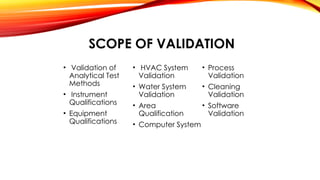
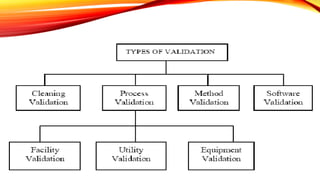
SCOPE OF VALIDATION
• Validation of
Analytical Test
Methods
• Instrument
Qualifications
• Equipment
Qualifications
• HVAC System
Validation
• Water System
Validation
• Area
Qualification
• Computer System
• Process
Validation
• Cleaning
Validation
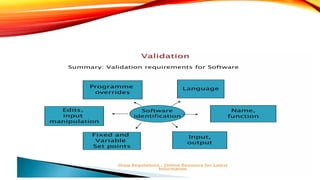
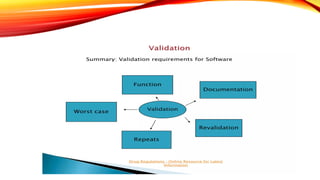
• Software
Validation
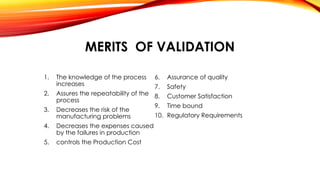
MERITS OF VALIDATION
1. The knowledge of the process
increases
2. Assures the repeatability of the
process
3. Decreases the risk of the
manufacturing problems
4. Decreases the expenses caused
by the failures in production
5. controls the Production Cost
6. Assurance of quality
7. Safety
8. Customer Satisfaction
9. Time bound
10. Regulatory Requirements
GOVERNMENT REGULATION
• Validation is considered to be an integral part of GMPs.
• Worldwide compliance with validation requirements is necessary for
obtaining approval to manufacture and to introduce new products.
• The accuracy, sensitivity, specificity and reproducibility of test methods
employed by the firm shall be established and documented.
DOCUMENTATION OF VALIDATION
• Validation Master Plan(VMP)
• Validation Protocol(VP)
• Validation Reports(VR)
• Standard Operating Procedure(SOP)
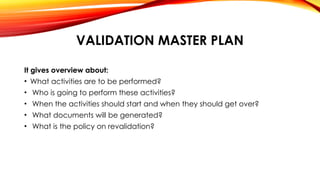
VALIDATION MASTER PLAN
It gives overview about:
• What activities are to be performed?
• Who is going to perform these activities?
• When the activities should start and when they should get over?
• What documents will be generated?
• What is the policy on revalidation?
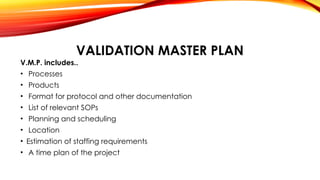
VALIDATION MASTER PLAN
V.M.P. includes..
• Processes
• Products
• Format for protocol and other documentation
• List of relevant SOPs
• Planning and scheduling
• Location
• Estimation of staffing requirements
• A time plan of the project
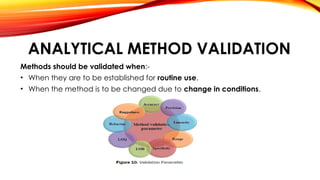
ANALYTICAL METHOD VALIDATION
Methods should be validated when:-
• When they are to be established for routine use.
• When the method is to be changed due to change in conditions.
ANALYTICAL METHOD VALIDATION
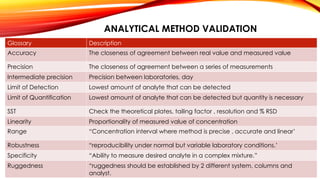
Glossary Description
Accuracy The closeness of agreement between real value and measured value
Precision The closeness of agreement between a series of measurements
Intermediate precision Precision between laboratories, day
Limit of Detection Lowest amount of analyte that can be detected
Limit of Quantification Lowest amount of analyte that can be detected but quantity is necessary
SST Check the theoretical plates, tailing factor , resolution and % RSD
Linearity Proportionality of measured value of concentration
Range “Concentration interval where method is precise , accurate and linear’
Robustness “reproducibility under normal but variable laboratory conditions.’
Specificity “Ability to measure desired analyte in a complex mixture.”
Ruggedness “ruggedness should be established by 2 different system, columns and
analyst.
ANALYTICAL METHOD VALIDATION
CLEANING VALIDATION
CLEANING VALIDATION
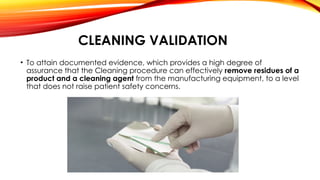
• To attain documented evidence, which provides a high degree of
assurance that the Cleaning procedure can effectively remove residues of a
product and a cleaning agent from the manufacturing equipment, to a level
that does not raise patient safety concerns.
CLEANING VALIDATION
ADVANTAGE OF CLEANING VALIDATION
• Assurance of quality & safety
• Government regulations
• Cross contamination integrity
• Batch integrity
• Equipment reuse
• Reduction of quality costs.
• Less down time, fewer batch failures
CLEANING VALIDATION
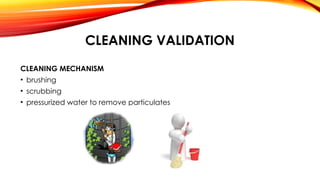
CLEANING MECHANISM
• brushing
• scrubbing
• pressurized water to remove particulates
CLEANING VALIDATION
CLEANING METHOD
• Manual cleaning
• Semi automatic procedures
• Automatic procedures
• CIP (Clean-in-place)
• COP (Clean-out-of-place)
CLEANING VALIDATION
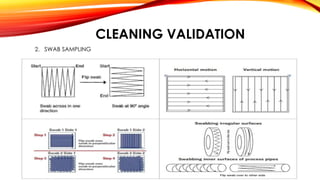
SAMPLING METHOD
1. Rinse samples (indirect method)
This method allows sampling of a large surface area that are
inaccessible or that cannot be routinely disassembled and
provides an overall picture. Rinse samples may give
sufficient evidence of adequate cleaning where
accessibility of equipment parts can preclude direct surface
sampling, and be useful for checking of the residues for
cleaning agent e.g. detergents.
2. SWAB SAMPLING
CLEANING VALIDATION
SETTING OF LIMITS
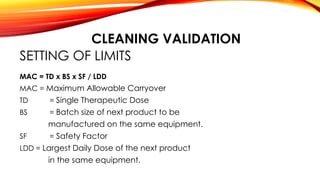
MAC = TD x BS x SF / LDD
MAC = Maximum Allowable Carryover
TD = Single Therapeutic Dose
BS = Batch size of next product to be
manufactured on the same equipment.
SF = Safety Factor
LDD = Largest Daily Dose of the next product
in the same equipment.
CLEANING VALIDATION
PROCESS VALIDATION
PROCESS VALIDATION
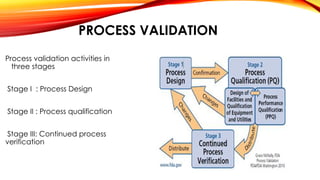
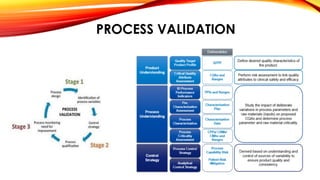
Process validation activities in
three stages
Stage I : Process Design
Stage II : Process qualification
Stage III: Continued process
verification
PROCESS VALIDATION
PROCESS VALIDATION
TYPES OF PROCESS VALIDATION
• Prospective Validation (Premarket validation)
• Retrospective Validation
• Concurrent Validation
• Revalidation
PROSPECTIVE VALIDATION
Definition: It is establishing documented evidence prior to process
implementation that a system does what it proposed to do based on pre-
planned protocols.
• An experimental plan called the validation protocol is executed before the
process is put into commercial use.
• It is normally undertaken for a new drug product or new facilities are
introduced into a routine pharmaceutical production.
PROCESS VALIDATION
CONCURRENT VALIDATION
• Definition: Concurrent Validation means establishing documented evidence
a process does what it is supposed to do based on data generated during
actual implementation of the process.
• Validation – during routine production
Validation involves –
• In-process monitoring
• End product testing
Personnel – Authorized staff
Documentation – as per Prospective Validation
PROCESS VALIDATION
RETROSPECTIVE VALIDATION
Definition:
• It is an establishing documented evidence that a process does what it is supposed to
do based on review and analysis of historic data.
• Validation of these processes - historical data to provide the necessary documentary
evidence that the process is doing what it is supposed to do.
Steps require for validation
• Protocol preparation
• Validation reports
• Data analysis
• Conclusion
• Recommendations
PROCESS VALIDATION
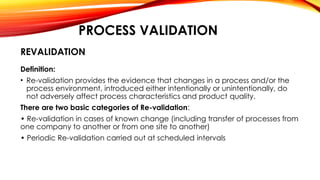
REVALIDATION
Definition:
• Re-validation provides the evidence that changes in a process and/or the
process environment, introduced either intentionally or unintentionally, do
not adversely affect process characteristics and product quality.
There are two basic categories of Re-validation:
• Re-validation in cases of known change (including transfer of processes from
one company to another or from one site to another)
• Periodic Re-validation carried out at scheduled intervals
PROCESS VALIDATION
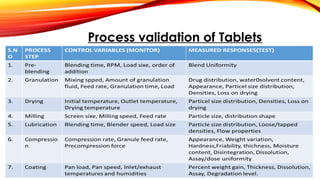
Process validation of Tablets
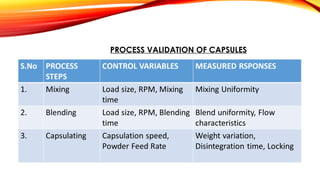
PROCESS VALIDATION OF CAPSULES
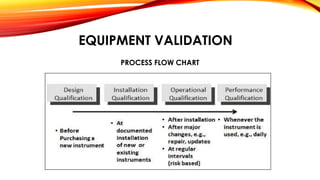
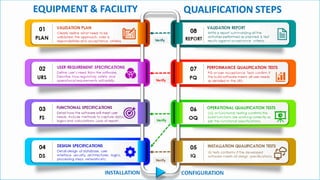
EQUIPMENT VALIDATION
PROCESS FLOW CHART
DESIGN QUALIFICATION
o User requirements should be considered when deciding on the
specific design of a system or equipment.
o A suitable supplier should be selected for the appropriate system or
equipment(approved vendor).
o If the user asks for a specialized type of instrument, then he must
submit his Requirements in the form of a detailed design qualification
document to the supplier.
CALIBRATION
• It is the process of determining its accuracy.
• Defined as “ Comparison of measurement system or device of unknown
accuracy to another measurement system or device of known accuracy.
To maintain the accuracy and precision of test equipment at all times
To determine whether the equipment is still fits for intended purpose
CALIBRATION
Need for calibration:
New instrument
When specified time period elapsed
When operating hours elapsed
Sudden changes in weather
Repair of instrument
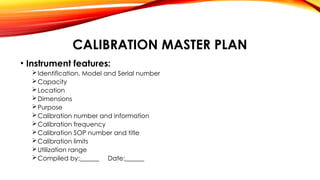
CALIBRATION MASTER PLAN
• Instrument features:
Identification, Model and Serial number
Capacity
Location
Dimensions
Purpose
Calibration number and information
Calibration frequency
Calibration SOP number and title
Calibration limits
Utilization range
Compiled by:______ Date:______
WHO GUIDELINES FOR VALIDATION OF EQUIPMENT
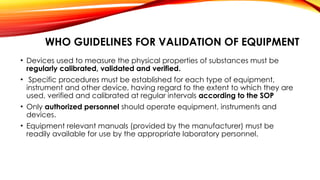
• Devices used to measure the physical properties of substances must be
regularly calibrated, validated and verified.
• Specific procedures must be established for each type of equipment,
instrument and other device, having regard to the extent to which they are
used, verified and calibrated at regular intervals according to the SOP
• Only authorized personnel should operate equipment, instruments and
devices.
• Equipment relevant manuals (provided by the manufacturer) must be
readily available for use by the appropriate laboratory personnel.
WHO GUIDELINES FOR VALIDATION OF EQUIPMENT
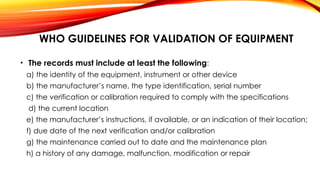
• The records must include at least the following:
a) the identity of the equipment, instrument or other device
b) the manufacturer’s name, the type identification, serial number
c) the verification or calibration required to comply with the specifications
d) the current location
e) the manufacturer’s instructions, if available, or an indication of their location;
f) due date of the next verification and/or calibration
g) the maintenance carried out to date and the maintenance plan
h) a history of any damage, malfunction, modification or repair
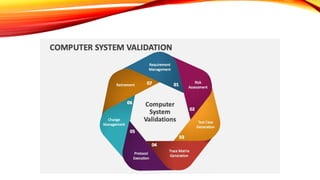
COMPUTER SYSTEM VALIDATION
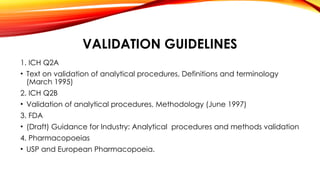
VALIDATION GUIDELINES
1. ICH Q2A
• Text on validation of analytical procedures, Definitions and terminology
(March 1995)
2. ICH Q2B
• Validation of analytical procedures, Methodology (June 1997)
3. FDA
• (Draft) Guidance for Industry: Analytical procedures and methods validation
4. Pharmacopoeias
• USP and European Pharmacopoeia.
Overview on Validation in Pharmaceuticals.pptx