VALIDATION
By:
Dr. Amitha Shetty
Assistant Professor
NGSMIPS
HISTORY OF VALIDATION
 In the mid-1970s, several issues were encountered in
the sterility of large-volume parenteral.
 In response to this, two FDA officials, Bud Loftus and
Ted Byers proposed the concept of validation to avoid
such quality issues.
 Initially, validation activities were centered around
the processes involved in this category of products;
later, the idea spread to other areas of the
pharmaceutical industry.
 Thus, validation was a concept pioneered by the US
FDA.
 However, there was no definition or mention of it in
the regulations until 1978.
INTRODUCTION
 Every pharmaceutical manufacturer has to comply
with the requirements of cGMP.
 To verify that quality standards are being met, there
has to be a systematic approach by which data is
collected and studied to confirm that processes
operate as intended.
 This systematic approach is called Validation.
 When a process is validated, it ensures a high level of
assurance that batches produced by that same process
will be uniform and meet pre-determined quality
requirements.
 Thus, validation serves to confirm that a given process
has been developed correctly and that it operates within
specific controls.
 In turn, this assures that quality products are being
consistently produced and reduces the chances of
rejected batches and the need for reworking.
DEFINITION
 Each of the regulatory bodies has defined validation
in different words. Some of the important definitions
include:
 European Commission: “Validation is documented
evidence that the process, operated within established
parameters, can perform effectively and reproducibly
to produce a medicinal product meeting its
predetermined specifications and quality attributes.”
 US FDA Definition: “Process validation is establishing
documented evidence which provides a high degree of
assurance that a specified process will consistently
produce a product meeting its pre-determined
specifications and quality characteristics.”
 WHO Definition: “Validation is the documented act of
proving that any procedure, process, equipment,
material, activity or system leads to the expected result.”
 ICH Definition: “Process Validation is the means of
ensuring and providing documentary evidence that
processes within their specified design parameters are
capable of repeatedly and reliably producing a finished
product of the required quality.”
SCOPE OF VALIDATION
 Pharmaceutical manufacturers have to make sure their
validation program covers all the important areas of
pharmaceutical processing.
 The major areas include:
 Equipment validation (also called qualification).
 Facilities and utility validation (water system, air
handling unit, compressed gas system, computer
systems).
 Process validation.
 Cleaning validation.
 Analytical method validation.
 Instrument calibration.
 Validation needs to be carried out for any new:
 Equipment,
 Premises,
 Utilities,
 Systems,
 Procedures, and
 Processes
 It must also be performed when any major change has
occurred in any of these.
ADVANTAGES/ IMPORTANCE OF
VALIDATION
 Optimized processes.
 Assured quality of products.
 Reduced cost of maintaining quality.
 Increased output.
 Reduced complaints, rejections, batch failure, mix-ups,
and cross-contamination.
 Faster scale-up from pilot level to the manufacturing
level.
REASONS FOR VALIDATION
 Customer satisfaction: Non-conforming products can lead
to lost customers.
 Product liability: Conformance to product specifications
must be maintained.
 Reduced production costs: Validation leads to reduced
inspections, testing, scrap, and rework.
 Supports improvements: Testing data can be used to
support improvements in the process or the development of
the next generation of the process.
RELATIONSHIP BETWEEN VALIDATION AND
QUALIFICATION
 Qualification and validation are essentially the same.
 The term qualification is normally used for equipment
and utilities, and validation is for systems and processes.
 In this sense, qualification can be seen as part of
validation.
VALIDATION MASTER PLAN (VMP)
 A Validation Master Plan (VMP) is defined as a document
that provides information about the company’s
validation program.
 This document must contain details of the validation to be
done, and the timeframes for the studies to be
performed.
 There must be clear statements regarding who is
responsible for each part of the validation program.
IMPORTANCE/ BENEFITS/ PURPOSE OF VMP
 Main purpose of VMP is to give comprehensive overview
of the complete validation operation, how it has been
organized, what it will cover, and the validation plan.
 It helps management to understand how much time will
be required, the personnel to be involved, and the
expenses expected to be incurred.
 It informs members of the validation team about their
jobs and responsibilities.
 It helps inspectors/auditors to understand the company’s
approach to validation activities.
 Identifies the systems and controls to be validated.
 It provides the total pictures of the project.
 It is a management tool for tracking progress.
 Assignment of responsibility, which promotes teamwork.
 It identifies acceptance criteria before the start of
validation.
WHO WRITES THE VMP?
 The best VMP is a result of a team-writing effort because
it ensures a representation of the perspectives of
different departments involved in the operations.
 When people from diverse areas of the operation are
involved, it is more likely that all possible angles of
approaching the VMP are covered.
 A VMP must be as long as required to convey all the
necessary information to ensure a successful validation
program.
WHO PERFORMS VMP?
 Members:
 Validation manager
 Quality Assurance department
 Member from production
 Member Engineering (utilities)
 Member from the Calibration lab
 Member from QC lab
 Member from Maintenance
 Member from the HVAC department
 Member from the Product development lab
ELEMENTS OF A GOOD VMP
 Company’s validation policy.
 Organizational structure.
 List of items to be validated.
 A brief outline of systems, equipment, facilities, and
processes to be validated.
 Formats for documenting protocols and test reports.
 Planning and scheduling of validation activities.
 Change control procedure.
 Training requirements for validation team.
 Details of persons responsible for each stage of
validation:
 Preparing the plan,
 Drawing up protocols and standard operating procedures
(sops),
 Actual validation work,
 Preparation and control of reports and documents,
 Approval of validation protocols and reports at every stage
of validation,
 A system for tracking validation, and
 Training requirements for the validation team.
FORMAT FOR VALIDATION PROTOCOL
 Title page with document number & version
information, and authorization in the form of approval
signatures.
 Table of contents listing out critical areas of the VMP.
 Glossary to define technical terms and abbreviations.
 Plan for validation – details of the process steps, critical
parts of the process that impact product quality, and what is
to be validated, when, where, how, and why.
 Management’s approach to validation.
 Scope of the validation – what will be covered under
validation (and what will not be covered too).
 Roles and responsibilities of the different departments
(validation team, manufacturing department, engineering
department, Quality Assurance department, etc.) for each
of the activities involved.
 Services to be outsourced to outside vendors.
 Deviation management – how to document, investigate
and deal with deviations that may be encountered.
 Change control procedures.
 Risk management policy.
 Training of personnel.
 Validation matrix that outlines the validation required
throughout the manufacturing facility in the order of most
to least critical.
 References – documents that guide the validation process.
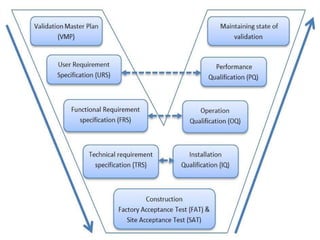
V MODEL CONCEPT
 Universally accepted model popularly known as the V
model
 The left arm of the V always deals with defining the
requirement and detailing the change and the right arm
of the V ensures that each item in the left arm
USER REQUIREMENT SPECIFICATION (URS)
 URS is to:
 Provide sufficient detail to the supplier to produce a cost,
resource, and time estimate to engineer and document the
computer system within a validation life cycle
 Provide information for the system supplier’s functional
design specification (FDS)
 Provide an unambiguous and commonly understood
operational and interface listing of functional and system
requirements, which can be tested during PQ
 Identify all manufacturing design data, including
quality-related critical parameters and data for system
design and testing
 Identify the project documentation (and task
responsibilities) to support the validation program
FACTORY ACCEPTANCE TEST (FAT)
 The first stage of system acceptance testing should be
witnessed by the pharmaceutical manufacturer prior to
the agreement for the system to be delivered to the site.
 The supplier should ensure that the system can pass the
predefined tests before the witnessed acceptance testing
to minimize the risk of retesting.
 Normally a contractual acceptance test serves to ensure
that within the limitations of testing available at the
supplier’s premises the system operates satisfactorily,
and for any problems identified during testing has the
advantage of being directly resourced and resolved in
the development environment.
SITE ACCEPTANCE TEST (SAT)
 Once the computer system has been delivered to the
pharmaceutical manufacturer site and is installed and
connected through field cabling and tubing to
instrumentation (and possibly other systems) it is ready for
site acceptance testing — this for both critical and
noncritical parameters and functions.
 For continuity, SAT test results should be analyzed and
compared to the FAT results.
WHO GUIDELINES FOR VALIDATION OF
EQUIPMENT
 All equipment, instruments, and other devices used to
measure the physical properties of substances must be
regularly calibrated, validated, and verified.
 Specific procedures must be established for each type of
equipment, instrument, and other devices, having regard to
the extent to which they are used, verified, and calibrated
at regular intervals according to the SOP
 Only authorized personnel should operate equipment,
instruments, and devices. Up-to-date instructions must be
there.
 Each item of equipment, instrument or other device used
for testing, verification, and calibration must, when
practicable, be uniquely identified.
 Records must be kept of each item of equipment,
instrument, or other device used to perform testing,
verification, and/or calibration.
TYPES OF VALIDATION
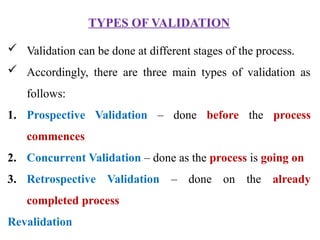
 Validation can be done at different stages of the process.
 Accordingly, there are three main types of validation as
follows:
1. Prospective Validation – done before the process
commences
2. Concurrent Validation – done as the process is going on
3. Retrospective Validation – done on the already
completed process
Revalidation
PROSPECTIVE VALIDATION
 Defined as establishing documented evidence that a
given system does what it purports to do based on a
previously determined protocol.
 This type of validation is generally carried out before the
start of a new process of manufacture.
 It must be done on a minimum of three consecutive
batches of the product.
 To carry out this validation, each step of the proposed
process is evaluated to determine which parameters are
critical to the quality of the finished product.
 With this information, experiments are designed and
documented in an authorized protocol.
 Only after data has been obtained about the critical
process parameters, it will be possible to prepare the
Master Batch Records.
 Once the data generated has been reviewed, guidelines can
be prepared regarding the level of monitoring necessary as
a part of in-process controls during regular production.
 All such guidelines should be made a part of the Batch
Manufacturing Record and Batch Packing Record.
 Prospective validation data is also to be used to determine
limits, frequencies of testing, and actions to be taken in
situations when the limits are exceeded.
Information in Prospective Validation Protocol
 Brief description of the process to be validated.
 Summary of the critical manufacturing steps to be studied.
 List of facilities and equipment to be used including
monitoring/recording/measuring instruments/equipment and
their calibration status.
 Analytical test methods to be used and their validation
status.
 In-process controls proposed and their acceptance criteria.
 Sampling plan and procedures.
 Methods to record results and evaluate the data obtained.
 Specifications for finished product acceptance.
 Additional tests to be performed and their acceptance
criteria and validation status.
 Proposed timeframe for the validation process.
 Functions and responsibilities in the validation program.
CONCURRENT VALIDATION
 Carried out during normal production
 It is useful only if process is well understood during the
development stage
 Involves monitoring of the critical processing and testing
steps at the in-process stage
 There must be documents maintained that show the
justification for a concurrent validation
 Documentation for concurrent validation is the same as
that for prospective validation
RETROSPECTIVE VALIDATION
 Defined as establishing documented evidence that a system
performs as purported, by reviewing the historical data that
had been collected during the manufacturing and testing
stages.
 This validation is done for products that have already been
distributed
 Unsuitable in cases where there has been any recent change
in either the product composition, or processing steps, or
equipment used in the manufacture and testing of the product.
 A specific protocol must be prepared first, outlining how
the retrospective validation will be carried out.
 Historical data is collected from batch manufacturing and
packaging records, equipment logbooks, process control
charts, personnel change records, finished product testing
data, and stability test results.
 After historical data collection and review, results must be
reported, along with a conclusion and
recommendations, if any
REVALIDATION
 New equipment or instruments may be installed, or there
may be a change in the utility systems.
 Whenever any such changes are introduced, it is vital to
prove that these changes do not have any adverse effect
on the process or the product quality.
 Collecting such evidence is described as revalidation.
 The documentation and other requirements for revalidation
match those of prospective validation.
 Often, due to wear and tear, over time, there may be a
drift from normal operating conditions.
 This makes it important for manufacturers to make sure
they schedule a periodic revalidation of their systems,
equipment, facilities, and processes to confirm that they
continue to perform as expected to meet the prescribed
quality requirements.
Changes that Necessitate Revalidation:
 Change in raw materials (especially physical properties
such as particle size, moisture content, density, viscosity,
etc. tends to affect product or process quality.
 Change in the vendor from whom APIs and other raw
materials are procured.
 Change in the primary container or other packaging
material.
 Process changes (such as drying temperature, mixing time,
batch size, etc.).
 Substitution of equipment with a new type of equipment
(same equipment new model does not require validation;
but the qualification steps of DQ, IQ, OQ, and PQ must be
performed and documented).
 Any change in the facility/premises/plant.
QUALIFICATION
 To demonstrate that the equipment and utilities in a
pharmaceutical company are appropriate for their intended
use, and to prove that they are performing as expected.
 The activities undertaken to generate such evidence are
called Qualifications.
 Qualification may be defined as proving and documenting
that given equipment or utility is correctly installed,
working properly, and consistently producing the expected
results.
PHASES OF QUALIFICATION
 There are four major phases of qualification:
1. Design Qualification (DQ),
2. Installation Qualification (IQ),
3. Operational Qualification (OQ), and
4. Performance Qualification (PQ).
1. Design Qualification (DQ):
 Defined as documented verification that the proposed
equipment, systems, and facilities design is appropriate
for the intended purpose.
 DQ must be performed whenever purchasing new
equipment; it should also be performed when existing
equipment is going to be used for any new
application.
2. Installation Qualification (IQ):
 Defined as documented evidence that the equipment,
supporting utilities, and premises have been built or
installed in keeping with design specifications.
 IQ serves to verify that equipment installation has
been done as recommended by the manufacturer,
correctly, and kept in a suitable environment.
3. Operational Qualification (OQ):
 Defined as establishing documented evidence that any
equipment, facility, or utility functions as intended, in
keeping with its operational specifications.
 OQ thus helps to verify that the installed equipment
works correctly.
4. Performance Qualification (PQ):
 Defined as establishing documented evidence that the
process works to consistently produce a product that
meets all the predetermined quality requirements.
 PQ helps to verify that performance within the
specified limits is as expected.
PROCEDURE
 All the new facilities and equipment shall be qualified
prior to use in production as per procedure is given
below:
1. Design Qualification (DQ):
 The first task of qualification for new facility, system and
new equipment shall start with Design Qualification
 The DQ protocol shall prepare by the concerned
department with in-corporation of supplier or vendor in
accordance with user requirements
 For DQ first make the necessary diagrams layouts and write
down the tentative specification with the help of supplier's
specification and user requirements by considering
regulatory cGMP requirements and safety requirements
 The DQ protocol shall be prepared for each equipment/
system/ facility quotation/ proposal and technical discussions
between supplier and user department
 DQ shall be done based on the process requirements, cGMP
Requirements like the material construction of product
contact parts etc., safety parameters like earthing parameters,
overload settings etc.
 Approvals of concerned persons mentioned in protocol
shall be taken and then execute the protocol
 Once DQ is over Purchase order will be released to the
vendor along with the specification
2. Installation Qualification (IQ):
 IQ shall contain, but not be limited to the following points:
a. Installation of equipment, piping, services, and
instrumentation shall check to current engineering
drawings and specifications.
b. Collection of supplier operating and working instructions
and maintenance requirements.
c. Calibration requirements.
d. Verification of construction and design criteria as applicable
at this stage.
3. Operational Qualification (OQ):
 OQ shall be performed after completion of Installation
Qualification.
 OQ shall contain, but not be limited to the following points:
a. Tests that have been developed from knowledge of processes,
systems and equipment and working of the subsystem.
b. Tests to include conditions encompassing upper and lower
limits of operation
c. Verification of operation criteria and specification.
d. Development of operating and cleaning SOPs, maintenance
schedule and Training of operators.
 The successful OQ shall be well demonstrated and
documented, as per the guidelines mentioned in Master
Qualification/ Validation Protocol
4. Performance Qualification (PQ):
 PQ shall include, but not be limited to the following:
a. Tests, using production materials, qualified substitutes or
simulated products that have been developed from knowledge of
the process and the facilities, systems or equipment.
b. Tests to include a condition or set of conditions encompassing
upper and lower operating limits
 After successful OQ, Quality Assurance Department shall
prepare the PQ Protocol and perform the qualification of
facilities and equipment as per the approved protocol.
 The final release of facility/equipment’s will be given by
Head Quality Assurance for usage of equipment after review
of PQ Report
UTILITY:
 Power: Check the location of the connections and its
voltage and phase with the design specification
 Water: Check supply of potable, domestic hot and
purified water supply and the number of points.
 Steam: Check availability of low-pressure steam and
number of points.
 Gas/compressed air: Check compressed air connection
and number of points
 Drains: Check the number of drain points and the type of
drain trap.
 HVAC supply & return diffusers: Check for the number of
supply and return air diffusers Also, record the
temperature and humidity Compare with that of the design
specification
 Lighting: Check the type of light fixture. Whether it is
flameproof or non-flameproof Also, check and record the
intensity of light.
 Dust extractor system: Check the number of the dust
extractor points
 Equipment: Record all the pieces of equipment installed in
the area.
 Check all the safety systems such as alarm push button, the
location of closest fire extinguisher, fire detection system,
eyewash station, intercom/ telephone and its location
 Attach all related drawings of the area and their availability
with revision status. Prepare a summary report of qualification
and shall be reviewed. Variance has to be recorded
 The final report of the qualification shall be reviewed and
conclusion should be drawn by head of production and
head of quality control and quality assurance.