Pharmaceutical Quality
Control Laboratory
Presented By: Group 06
BCH 7th Semester
(Evening)
Submitted To: Dr. Nafeesa
Hanif
Course Name: GLP
Group (6) Members:
• Farwa Zakir (20-Arid-2308)
• Isha Maryam (20-Arid-2313)
• Zinnia Rashad (20-Arid-2340)
• Bibi Saira (20-Arid-2305)
• Faryal Nadeen (20-Arid-2309)
• Haseeb Ahmad (20-Arid-2312)
• Shahiq ul Hassan (20-Arid-2333)
Pharmaceutical Quality
Control Lab
• Quality control (QC) is a procedure
or set of procedures intended to
ensure that a manufactured product
or performed service adheres to a
defined set of quality criteria or
meets the requirements of the client
or customer.
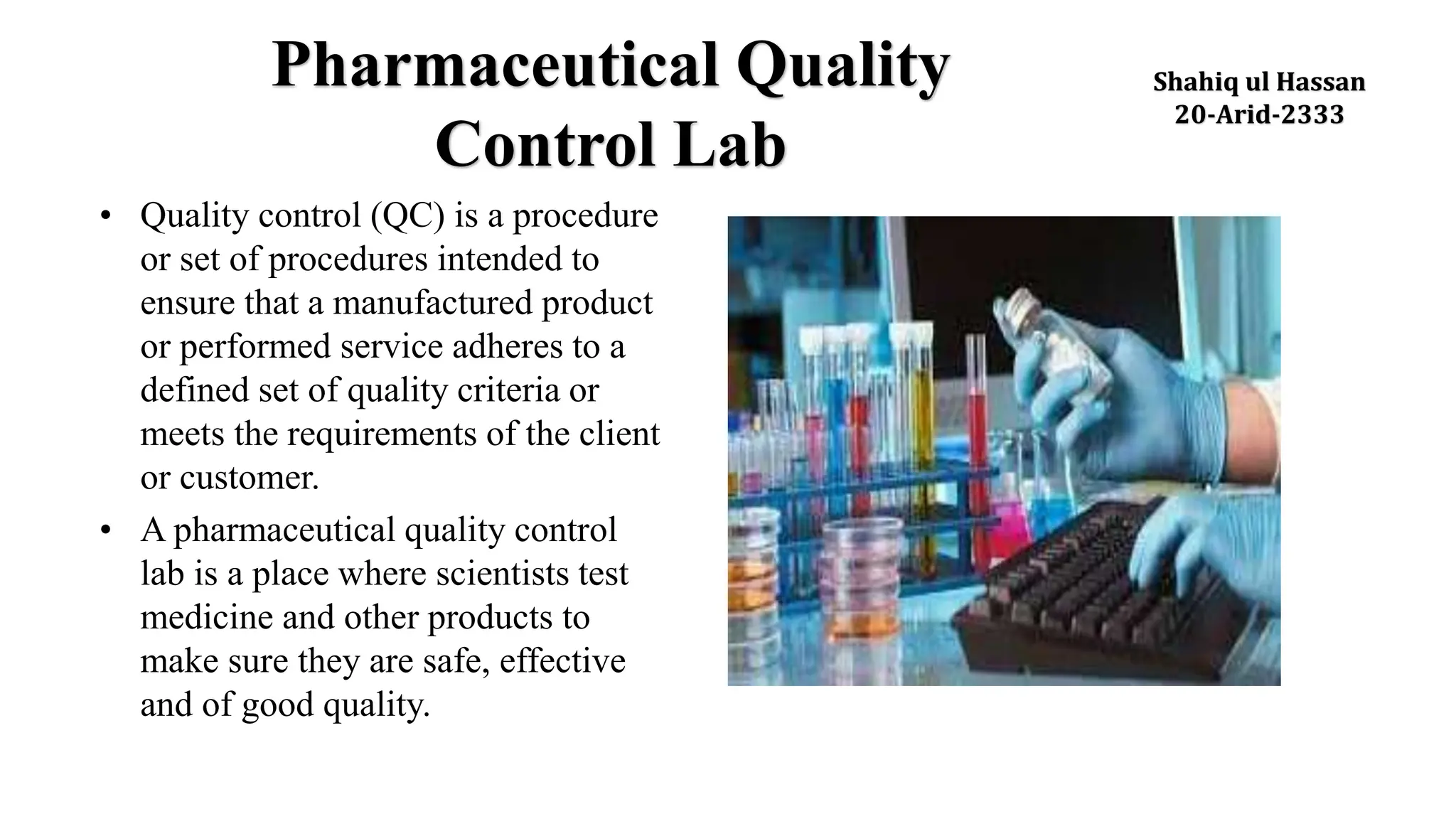
• A pharmaceutical quality control
lab is a place where scientists test
medicine and other products to
make sure they are safe, effective
and of good quality.
Shahiq ul Hassan
20-Arid-2333
QC in pharmaceutical
• Quality control is an essential operation of the pharmaceutical industry
• Drugs must be marketed as safe and therapeutically active formulations whose
performance is consistent and predictable
• New and better medicinal agents are being produced at an accelerated rate. At the
same time more exacting and sophisticated analytical methods are being developed
for their evaluation.
• The 4 Main responsibilities of quality control in pharmaceutical industry include:
 Efficacy
 Quality
 Safety
 Compliance
Objectives of QC in pharmaceutical
• Establishment of quality standard
• Locating quality deviations
• Evaluating method and process of production
• Quick sales quality goods
• Production of standard quality goods
• Improvement in quality
Imprtance of QC in pharmaceutical
• The pharmaceutical environment today is changing quickly due to
globalization,increased competition , increased cost constraints ,demand for
efficiency ,product complexity etc .in this fast changing environment the people and
companies that learn to adopt will prosper
• To manufacture and deliever zero defect products to the patients
• The quality ,efficacy and safety attributes of product must be ensured so that the
costumer health is not compromised
The Regulatory and Ethical Requirement for
PQCL
GLP (Good Laboratory Practice):
GLP stands for Good Laboratory Practice, which is a set
of principles and guidelines for conducting non-clinical
studies that support or are intended to support applications
for research or marketing permits for products regulated
by government agencies.
GLP aims to ensure the quality, integrity, and
reliability of the data generated by the studies
Isha Maryam
20-Arid-2313
GMP (Good Manufacturing Practice):
GMP stands for Good Manufacturing Practice,
which is a system for ensuring that products are
consistently produced and controlled according to
quality standards. GMP covers all aspects of
production from the starting materials, premises,
and equipment to the training and personal hygiene
of staff.
GMP ensures that the products are safe,
effective, and fit for their intended use
ISO/IEC 17025
ISO/IEC 17025 is an international standard that
specifies the general requirements for the
competence, impartiality, and consistent operation
of testing and calibration laboratories. ISO/IEC
17025 covers the management and technical aspects
of laboratory activities, such as personnel,
equipment, methods, procedures, quality control,
and reporting.
ISO/IEC 17025 accreditation provides formal
recognition of the laboratory’s competence and
credibility.
Continue.......
These requirements apply to PQCLs in different ways, depending on the type and scope
of the testing or calibration activities they perform, the regulatory authorities they work
with, and the customers they serve.
For example, some PQCLs may need to comply with GLP for conducting non-clinical
studies for drug development, GMP for testing the quality of drug products, and
ISO/IEC 17025 for demonstrating their technical competence and quality management
system.
Other PQCLs may only need to comply with one or two of these requirements,
depending on their specific situation. In any case, PQCLs should follow the
relevant requirements to ensure the quality, safety, and efficacy of the
pharmaceutical products they test or calibrate
Organization and Regulation of
pharmaceutical Quality control
Laboratory
• Quality Management System (QMS):
The foundation of a QCL lies in its QMS, which comprises policies,
procedures, processes, and resources used to ensure product quality.
This system adheres to regulatory standards (such as cGMP – current
Good Manufacturing Practices) and encompasses quality planning,
control, assurance, and improvement. Bibi Saira
20-Arid-2305
• Documentation and Records:
Accurate and comprehensive documentation is vital in a PQCL. This includes SOPs
(Standard Operating Procedures), test methods, specifications, validation protocols,
calibration records, and reports. Proper maintenance of records ensures traceability,
facilitates audits, and demonstrates compliance with regulatory requirements
• Personnel:
The PQCL requires trained and qualified personnel to conduct analyses and oversee
quality control processes. This includes chemists, microbiologists, analysts, and quality
assurance professionals. Training programs, qualifications, and ongoing education are
essential to ensure competency and adherence to protocols
• Premises:
The laboratory’s physical environment must meet specific standards for cleanliness,
temperature control, safety, and adequate space to prevent contamination and ensure
accurate testing. Compliance with regulatory guidelines for laboratory design and
maintenance is
crucial.
• Equipment:
Accurate and validated equipment is integral to PQCL operations. This
includes analytical instruments (HPLC, GC, spectrophotometers),
balances, incubators, and more. Calibration, validation, maintenance,
and qualification of equipment are essential to ensure accuracy and
reliability of test results
• Contracts:
PQCLs often engage in contracts for services, such as outsourcing specialized tests or
collaborating with third-party laboratories. Contracts outline responsibilities, quality
standards, confidentiality agreements, and compliance with regulatory requirements.
Reagent,reference substances,callibration and verification
devices and Qualification
Reference Substances
Definition: Highly pure and well-characterized materials.
Purpose: Used for comparison, calibration, and validation.
Role: Benchmark for accurate and reliable analytical results.
Functions: Validate methods, verify instrument performance, and maintain product quality.
Importance:Critical in ensuring consistency and quality during testing in pharmaceutical
laboratories.
Reagents
• Titration solutions
• Reference standards for calibration
• Solvents
• Reagents for chromatography, spectroscopy, and assays, depending on testing methods.
•Indicators
•Buffers
Zinnia Rashad
20-Arid-2340
Devices used for Calibration:
• Calipers:Measure dimensions of objects with high precision.
• Weights: Used for calibrating scales and balances.
• Pressure Gauges: Calibrated to ensure accurate pressure readings.
• Thermocouples: Devices to calibrate temperature-measuring instruments.
• Multimeters: Calibrated for accurate electrical measurements.
• pH Meters: Calibration ensures accurate pH readings.
• Flow Meters: Calibrated to ensure accurate flow rate measurements.
• Spectrophotometers: Calibration ensures accurate absorbance and concentration
readings.
• Gas Detectors:Calibrated for precise gas concentration measurements.
Verification
• Instrument Calibration: Regular verification of analytical instruments to maintain
accuracy.
• Method Verification: Confirming that testing methods are accurate, reliable, and meet
regulatory standards.
• Quality Control Standards:Verifying that reference substances and reagents adhere to
defined quality standards.
• Data Verification: Ensuring accuracy and integrity of data through review and
validation.
• Equipment Validation
• Compliance Verification
• Training Verification
• Environmental Monitoring
Qualification:
• Educational Background: Bachelor’s or Master’s degree in a relevant field (e.g.,
Chemistry, Pharmacy, Biochemistry).
• Technical Skills: Proficiency in analytical techniques (e.g., chromatography,
spectroscopy).
• Regulatory Knowledge: Understanding of Good Laboratory Practices (GLP) and
regulatory guidelines.
• Documentation Skills: Ability to maintain accurate and detailed records.
• Attention to Detail: Precision and accuracy in conducting tests and interpreting
results.
• Problem-Solving Skills: Ability to troubleshoot and address unexpected issues.
• Communication Skills: Clear communication of results and documentation.
• Computer Proficiency: Familiarity with laboratory information management systems
(LIMS) and data analysis software.
The working procedures and Methods for Sampling,
Testing, Validation, Evaluating and Reporting of
analytical results
• Sampling:
This involves selecting a representative sample of the material or product to be tested,
ensuring its integrity and traceability, and preparing it for analysis. Sampling should
follow a written protocol that specifies the sampling plan, the sampling method, the
sample size, the sample labeling, the sample storage, and the sample transportation
Farwa Zakir
20-Arid-2308
• Testing:
This involves performing the analytical method on the sample, following the written
procedure that describes the apparatus, equipment, reagents, standards, operating
parameters, system suitability, and calculation of results.
Testing should be done by qualified and trained personnel, using calibrated and
validated instruments, and following good laboratory practices (GLP).
• Validation:
This involves demonstrating that the analytical method is suitable for its intended
purpose, by verifying its accuracy, precision, specificity, linearity, range, detection limit,
quantitation limit, robustness, and ruggedness.
Continue...
Continue..
• Evaluation:
This involves comparing the analytical results with the acceptance criteria, specifications,
or reference values, and determining whether the sample passes or fails the test.
• Reporting:
This involves presenting the analytical results in a clear, concise, and complete manner,
following the format and content required by the customer or the regulatory authority.
Reporting should include the sample identification, the analytical method, the test results,
the acceptance criteria, the conclusion, and any deviations, anomalies, or remarks.
Reporting should also include the signature, name, and date of the analyst and the
reviewer.
Continue..
These are some of the general steps for the working procedures and methods for
sampling, testing, validation, evaluating and reporting of analytical results in PQCL.
However, each PQCL may have its own specific procedures and methods, depending on
the nature and scope of the analysis, the regulatory requirements, and the quality
standards. Therefore, it is important to consult the relevant guidelines, protocols, and
manuals for each PQCL before performing any analysis.
The safety measures and precautions for handling
hazard substances and preventing contamination
Working in Pharmaceutical quality control laboratory
• Hazardous substances:
“A hazardous substance is any material which can cause harm to you either directly
or indirectly. You may encounter hazardous substances either during the sampling or
in the working environment where you are conducting the sampling.”
Faryal Nadeem
20-Arid-2309
Types of hazardous material
• Explosives
• Flammable Liquid and Combustible Liquid
• Flammable Solid, Spontanaeously Combustible and Dangerous
When Wet
• Oxidizer
• Gases
Safety measures and precautions:
• Handling hazardous substances requires careful attention and adherence
to safet protocols to ensure well being of individual and prevent
contamination.Safety measures and precautions for handling hazardous
substances are
• Personal protective equipment
• Proper storage Of hazardous substances
• Handling and transportation
• Ventilation
• Waste disposal
• Emergency preparedness
Working inPQCL:
• Working in a pharmaceutical quality control laboratory involves ensuring that
products meet the required standards and specifications.
Instrumentation Skills
Training
Documentation
Quality Assurance
Safety
Sample Handling
Calibration
Testing and Analysis
Conclusion:
 Handling hazardous substances requires strict adherence to safety measures and
precautions to protect individuals and prevent contamination.
 By following proper protocols for personal protective equipment, storage, handling,
ventilation, waste disposal, and emergency preparedness, the risk of accidents and
contamination can be significantly minimized.
Challenges And Oppurtunities of PQCL
Pharmaceutical Quality Control (QC) laboratories play a crucial role in
ensuring the safety, efficacy, and quality of pharmaceutical products. However,
like any other field, they face several challenges and opportunities
1.Challenges:
i. Regulatory Compliance
ii. Technological Advancements
iii. Data Management
iv. Personnel Training
v. Sample Volume and Turnaround Time
vi. Globalization and Supply Chain Complexity
vii. Environmental Monitoring
Haseeb Ahmad
20-Arid-2312
CONTD…
2. Opportunities:
i. Advanced Analytical Technologies
ii. Automation and Robotics
iii. Data Analytics and AICollaboration and Networking
iv. Regulatory Alignment
v. Sustainability Initiatives
vi. Continuous Improvement Culture
Ethical and Social Implications for Developing Countries
1. Ethical Implications
i. Patient Safety
Ensuring the quality of pharmaceutical products through rigorous quality control is
an ethical imperative to safeguard the health and well-being of patients. Substandard or
counterfeit drugs can have severe consequences for individuals and communities.
ii. Equitable Access to Quality Healthcare
include the need for equitable access to high-quality medicines. Developing countries
often face challenges in accessing affordable, safe, and effective medications.
Implementing robust quality control processes contributes to addressing this ethical
concern
iii. Clinical Trials and Informed Consent
Ethical pharmaceutical quality control involves adherence to standards in the
conduct of clinical trials. Ensuring that participants in these trials are fully
informed and have given their voluntary consent is crucial
iv. Transparency and Accountability
Ethical pharmaceutical practices demand transparency in reporting and
accountability in the manufacturing and distribution processes. This is essential
to maintain public trust in the pharmaceutical industry
v. Preventing Exploitation
Developing countries may be vulnerable to the importation of substandard
drugs. Ethical quality control measures help prevent the exploitation of
vulnerable populations through the sale of low-quality or ineffective
pharmaceuticals
CONTD...
Social Implications
i. Public Health Impact
 Substandard or counterfeit drugs can have severe consequences on public
health, leading to treatment failures, increased morbidity, and mortality.
Robust quality control is essential to mitigate these social impacts
ii. Economic Burden
 The use of poor-quality pharmaceuticals can result in increased healthcare
costs due to prolonged illnesses, hospitalizations, and the need for
additional treatments. This places an economic burden on both individuals
and the healthcare system
iii. Access to Essential Medicines
 Quality control processes impact the availability of essential medicines.
Adequate quality control ensures that vital medications are accessible to
those who need them, contributing to the overall well-being of communities
CONTD...
iv. Trust in Healthcare Systems
Ensuring the quality of pharmaceuticals builds trust in healthcare systems. This
trust is vital for encouraging individuals to seek medical care, comply with
treatment regimens, and participate in public health initiatives
v. Capacity Building and Local Industry
Implementing quality control measures can lead to capacity building in local
industries. This not only enhances the skills and knowledge of the workforce but
also supports the growth of a sustainable pharmaceutical sector in developing
countries
vi. International Collaboration and Aid
Adhering to high-quality standards in pharmaceuticals facilitates international
collaboration and aids. It encourages partnerships between developed and
developing countries, promoting the exchange of knowledge, resources, and
technologies
Pharmaceutical Quality Control Laboratory.pptx..........pptx

Pharmaceutical Quality Control Laboratory.pptx..........pptx

  • 1.
    Pharmaceutical Quality Control Laboratory PresentedBy: Group 06 BCH 7th Semester (Evening) Submitted To: Dr. Nafeesa Hanif Course Name: GLP
  • 2.
    Group (6) Members: •Farwa Zakir (20-Arid-2308) • Isha Maryam (20-Arid-2313) • Zinnia Rashad (20-Arid-2340) • Bibi Saira (20-Arid-2305) • Faryal Nadeen (20-Arid-2309) • Haseeb Ahmad (20-Arid-2312) • Shahiq ul Hassan (20-Arid-2333)
  • 3.
    Pharmaceutical Quality Control Lab •Quality control (QC) is a procedure or set of procedures intended to ensure that a manufactured product or performed service adheres to a defined set of quality criteria or meets the requirements of the client or customer. • A pharmaceutical quality control lab is a place where scientists test medicine and other products to make sure they are safe, effective and of good quality. Shahiq ul Hassan 20-Arid-2333
  • 4.
    QC in pharmaceutical •Quality control is an essential operation of the pharmaceutical industry • Drugs must be marketed as safe and therapeutically active formulations whose performance is consistent and predictable • New and better medicinal agents are being produced at an accelerated rate. At the same time more exacting and sophisticated analytical methods are being developed for their evaluation. • The 4 Main responsibilities of quality control in pharmaceutical industry include:  Efficacy  Quality  Safety  Compliance
  • 5.
    Objectives of QCin pharmaceutical • Establishment of quality standard • Locating quality deviations • Evaluating method and process of production • Quick sales quality goods • Production of standard quality goods • Improvement in quality
  • 6.
    Imprtance of QCin pharmaceutical • The pharmaceutical environment today is changing quickly due to globalization,increased competition , increased cost constraints ,demand for efficiency ,product complexity etc .in this fast changing environment the people and companies that learn to adopt will prosper • To manufacture and deliever zero defect products to the patients • The quality ,efficacy and safety attributes of product must be ensured so that the costumer health is not compromised
  • 7.
    The Regulatory andEthical Requirement for PQCL GLP (Good Laboratory Practice): GLP stands for Good Laboratory Practice, which is a set of principles and guidelines for conducting non-clinical studies that support or are intended to support applications for research or marketing permits for products regulated by government agencies. GLP aims to ensure the quality, integrity, and reliability of the data generated by the studies Isha Maryam 20-Arid-2313
  • 8.
    GMP (Good ManufacturingPractice): GMP stands for Good Manufacturing Practice, which is a system for ensuring that products are consistently produced and controlled according to quality standards. GMP covers all aspects of production from the starting materials, premises, and equipment to the training and personal hygiene of staff. GMP ensures that the products are safe, effective, and fit for their intended use
  • 9.
    ISO/IEC 17025 ISO/IEC 17025is an international standard that specifies the general requirements for the competence, impartiality, and consistent operation of testing and calibration laboratories. ISO/IEC 17025 covers the management and technical aspects of laboratory activities, such as personnel, equipment, methods, procedures, quality control, and reporting. ISO/IEC 17025 accreditation provides formal recognition of the laboratory’s competence and credibility.
  • 10.
    Continue....... These requirements applyto PQCLs in different ways, depending on the type and scope of the testing or calibration activities they perform, the regulatory authorities they work with, and the customers they serve. For example, some PQCLs may need to comply with GLP for conducting non-clinical studies for drug development, GMP for testing the quality of drug products, and ISO/IEC 17025 for demonstrating their technical competence and quality management system. Other PQCLs may only need to comply with one or two of these requirements, depending on their specific situation. In any case, PQCLs should follow the relevant requirements to ensure the quality, safety, and efficacy of the pharmaceutical products they test or calibrate
  • 11.
    Organization and Regulationof pharmaceutical Quality control Laboratory • Quality Management System (QMS): The foundation of a QCL lies in its QMS, which comprises policies, procedures, processes, and resources used to ensure product quality. This system adheres to regulatory standards (such as cGMP – current Good Manufacturing Practices) and encompasses quality planning, control, assurance, and improvement. Bibi Saira 20-Arid-2305
  • 12.
    • Documentation andRecords: Accurate and comprehensive documentation is vital in a PQCL. This includes SOPs (Standard Operating Procedures), test methods, specifications, validation protocols, calibration records, and reports. Proper maintenance of records ensures traceability, facilitates audits, and demonstrates compliance with regulatory requirements • Personnel: The PQCL requires trained and qualified personnel to conduct analyses and oversee quality control processes. This includes chemists, microbiologists, analysts, and quality assurance professionals. Training programs, qualifications, and ongoing education are essential to ensure competency and adherence to protocols
  • 13.
    • Premises: The laboratory’sphysical environment must meet specific standards for cleanliness, temperature control, safety, and adequate space to prevent contamination and ensure accurate testing. Compliance with regulatory guidelines for laboratory design and maintenance is crucial. • Equipment: Accurate and validated equipment is integral to PQCL operations. This includes analytical instruments (HPLC, GC, spectrophotometers), balances, incubators, and more. Calibration, validation, maintenance, and qualification of equipment are essential to ensure accuracy and reliability of test results
  • 14.
    • Contracts: PQCLs oftenengage in contracts for services, such as outsourcing specialized tests or collaborating with third-party laboratories. Contracts outline responsibilities, quality standards, confidentiality agreements, and compliance with regulatory requirements.
  • 15.
    Reagent,reference substances,callibration andverification devices and Qualification Reference Substances Definition: Highly pure and well-characterized materials. Purpose: Used for comparison, calibration, and validation. Role: Benchmark for accurate and reliable analytical results. Functions: Validate methods, verify instrument performance, and maintain product quality. Importance:Critical in ensuring consistency and quality during testing in pharmaceutical laboratories. Reagents • Titration solutions • Reference standards for calibration • Solvents • Reagents for chromatography, spectroscopy, and assays, depending on testing methods. •Indicators •Buffers Zinnia Rashad 20-Arid-2340
  • 16.
    Devices used forCalibration: • Calipers:Measure dimensions of objects with high precision. • Weights: Used for calibrating scales and balances. • Pressure Gauges: Calibrated to ensure accurate pressure readings. • Thermocouples: Devices to calibrate temperature-measuring instruments. • Multimeters: Calibrated for accurate electrical measurements. • pH Meters: Calibration ensures accurate pH readings. • Flow Meters: Calibrated to ensure accurate flow rate measurements. • Spectrophotometers: Calibration ensures accurate absorbance and concentration readings. • Gas Detectors:Calibrated for precise gas concentration measurements.
  • 17.
    Verification • Instrument Calibration:Regular verification of analytical instruments to maintain accuracy. • Method Verification: Confirming that testing methods are accurate, reliable, and meet regulatory standards. • Quality Control Standards:Verifying that reference substances and reagents adhere to defined quality standards. • Data Verification: Ensuring accuracy and integrity of data through review and validation. • Equipment Validation • Compliance Verification • Training Verification • Environmental Monitoring
  • 18.
    Qualification: • Educational Background:Bachelor’s or Master’s degree in a relevant field (e.g., Chemistry, Pharmacy, Biochemistry). • Technical Skills: Proficiency in analytical techniques (e.g., chromatography, spectroscopy). • Regulatory Knowledge: Understanding of Good Laboratory Practices (GLP) and regulatory guidelines. • Documentation Skills: Ability to maintain accurate and detailed records. • Attention to Detail: Precision and accuracy in conducting tests and interpreting results. • Problem-Solving Skills: Ability to troubleshoot and address unexpected issues. • Communication Skills: Clear communication of results and documentation. • Computer Proficiency: Familiarity with laboratory information management systems (LIMS) and data analysis software.
  • 19.
    The working proceduresand Methods for Sampling, Testing, Validation, Evaluating and Reporting of analytical results • Sampling: This involves selecting a representative sample of the material or product to be tested, ensuring its integrity and traceability, and preparing it for analysis. Sampling should follow a written protocol that specifies the sampling plan, the sampling method, the sample size, the sample labeling, the sample storage, and the sample transportation Farwa Zakir 20-Arid-2308
  • 20.
    • Testing: This involvesperforming the analytical method on the sample, following the written procedure that describes the apparatus, equipment, reagents, standards, operating parameters, system suitability, and calculation of results. Testing should be done by qualified and trained personnel, using calibrated and validated instruments, and following good laboratory practices (GLP). • Validation: This involves demonstrating that the analytical method is suitable for its intended purpose, by verifying its accuracy, precision, specificity, linearity, range, detection limit, quantitation limit, robustness, and ruggedness. Continue...
  • 21.
    Continue.. • Evaluation: This involvescomparing the analytical results with the acceptance criteria, specifications, or reference values, and determining whether the sample passes or fails the test. • Reporting: This involves presenting the analytical results in a clear, concise, and complete manner, following the format and content required by the customer or the regulatory authority. Reporting should include the sample identification, the analytical method, the test results, the acceptance criteria, the conclusion, and any deviations, anomalies, or remarks. Reporting should also include the signature, name, and date of the analyst and the reviewer.
  • 22.
    Continue.. These are someof the general steps for the working procedures and methods for sampling, testing, validation, evaluating and reporting of analytical results in PQCL. However, each PQCL may have its own specific procedures and methods, depending on the nature and scope of the analysis, the regulatory requirements, and the quality standards. Therefore, it is important to consult the relevant guidelines, protocols, and manuals for each PQCL before performing any analysis.
  • 23.
    The safety measuresand precautions for handling hazard substances and preventing contamination Working in Pharmaceutical quality control laboratory • Hazardous substances: “A hazardous substance is any material which can cause harm to you either directly or indirectly. You may encounter hazardous substances either during the sampling or in the working environment where you are conducting the sampling.” Faryal Nadeem 20-Arid-2309
  • 24.
    Types of hazardousmaterial • Explosives • Flammable Liquid and Combustible Liquid • Flammable Solid, Spontanaeously Combustible and Dangerous When Wet • Oxidizer • Gases
  • 25.
    Safety measures andprecautions: • Handling hazardous substances requires careful attention and adherence to safet protocols to ensure well being of individual and prevent contamination.Safety measures and precautions for handling hazardous substances are • Personal protective equipment • Proper storage Of hazardous substances • Handling and transportation • Ventilation • Waste disposal • Emergency preparedness
  • 26.
    Working inPQCL: • Workingin a pharmaceutical quality control laboratory involves ensuring that products meet the required standards and specifications. Instrumentation Skills Training Documentation Quality Assurance Safety Sample Handling Calibration Testing and Analysis
  • 27.
    Conclusion:  Handling hazardoussubstances requires strict adherence to safety measures and precautions to protect individuals and prevent contamination.  By following proper protocols for personal protective equipment, storage, handling, ventilation, waste disposal, and emergency preparedness, the risk of accidents and contamination can be significantly minimized.
  • 28.
    Challenges And Oppurtunitiesof PQCL Pharmaceutical Quality Control (QC) laboratories play a crucial role in ensuring the safety, efficacy, and quality of pharmaceutical products. However, like any other field, they face several challenges and opportunities 1.Challenges: i. Regulatory Compliance ii. Technological Advancements iii. Data Management iv. Personnel Training v. Sample Volume and Turnaround Time vi. Globalization and Supply Chain Complexity vii. Environmental Monitoring Haseeb Ahmad 20-Arid-2312
  • 29.
    CONTD… 2. Opportunities: i. AdvancedAnalytical Technologies ii. Automation and Robotics iii. Data Analytics and AICollaboration and Networking iv. Regulatory Alignment v. Sustainability Initiatives vi. Continuous Improvement Culture
  • 30.
    Ethical and SocialImplications for Developing Countries 1. Ethical Implications i. Patient Safety Ensuring the quality of pharmaceutical products through rigorous quality control is an ethical imperative to safeguard the health and well-being of patients. Substandard or counterfeit drugs can have severe consequences for individuals and communities. ii. Equitable Access to Quality Healthcare include the need for equitable access to high-quality medicines. Developing countries often face challenges in accessing affordable, safe, and effective medications. Implementing robust quality control processes contributes to addressing this ethical concern
  • 31.
    iii. Clinical Trialsand Informed Consent Ethical pharmaceutical quality control involves adherence to standards in the conduct of clinical trials. Ensuring that participants in these trials are fully informed and have given their voluntary consent is crucial iv. Transparency and Accountability Ethical pharmaceutical practices demand transparency in reporting and accountability in the manufacturing and distribution processes. This is essential to maintain public trust in the pharmaceutical industry v. Preventing Exploitation Developing countries may be vulnerable to the importation of substandard drugs. Ethical quality control measures help prevent the exploitation of vulnerable populations through the sale of low-quality or ineffective pharmaceuticals CONTD...
  • 32.
    Social Implications i. PublicHealth Impact  Substandard or counterfeit drugs can have severe consequences on public health, leading to treatment failures, increased morbidity, and mortality. Robust quality control is essential to mitigate these social impacts ii. Economic Burden  The use of poor-quality pharmaceuticals can result in increased healthcare costs due to prolonged illnesses, hospitalizations, and the need for additional treatments. This places an economic burden on both individuals and the healthcare system iii. Access to Essential Medicines  Quality control processes impact the availability of essential medicines. Adequate quality control ensures that vital medications are accessible to those who need them, contributing to the overall well-being of communities
  • 33.
    CONTD... iv. Trust inHealthcare Systems Ensuring the quality of pharmaceuticals builds trust in healthcare systems. This trust is vital for encouraging individuals to seek medical care, comply with treatment regimens, and participate in public health initiatives v. Capacity Building and Local Industry Implementing quality control measures can lead to capacity building in local industries. This not only enhances the skills and knowledge of the workforce but also supports the growth of a sustainable pharmaceutical sector in developing countries vi. International Collaboration and Aid Adhering to high-quality standards in pharmaceuticals facilitates international collaboration and aids. It encourages partnerships between developed and developing countries, promoting the exchange of knowledge, resources, and technologies