Dr. Babasaheb Ambedkar
Technological University
Shree Mahavir Education Society’
SHREE MAHAVIR EDUCATION SOCIETY’
DTE CODE - 5281
• B-Pharmacy
Approved by AICTE, PCI New Delhi, DTE, Govt. Of Maharashtra
Affiliated to MSBTE, Mumbai, DBATU, Lonere
Course structure and contains for
PRACTICE SCHOOL
(BP706PS)
B. Pharm Final Year (SEM VII)
DOMAIN – 10
QUALITY ASSURANCE
&QUALITY CONTROL IN
PHARMACEUTICALS
A Review Article By:
VEDIKA NANDU GOSAVI
Final Year B. Pharmacy
(1952811823025)
Guided By:
Prof. Soniya S. Satpute
Flow of content
 Introduction
 Quality Assurance
 Quality Control
 GLP, GMP
 ICH Guidelines
 In process quality control
 Regulatory Authorities
 Documentation
 Instrument handling
 Validation
 Calibration
 Qualification
Quality Assurance and Quality Control
Quality Assurance (QA) activities include a planned system of review procedures conducted by
personnel not directly involved in the inventory compilation/development process.
Quality Control (QC) is a system of routine technical activities, to measure and control the quality
of the inventory as it is being developed. The QC system is designed to: (i) Provide routine and
consistent checks to ensure data integrity, correctness, and completeness; (ii) Identify and address
errors and omissions; (iii) Document and archive inventory material and record all QC activities.
Use - Quality Assurance (QA) is a proactive activity in nature – looking to reduce the number of
defects by measuring the processes. On the other hand, the main goal of Quality Control (QC) is to
identify any possible issues, prevent them, if needed, and verify the quality of the product.
Scope - The Quality Assurance (QA) and Quality Control (QC) are very important units of
any health care industry. Their aim is not only to test but also to produce superior quality
of end product. The quality of health care products have become important aspect for the
World Health Organization and International conference for harmonization with a motto that
the Drugs must be market as safer and efficacious form.
What is GMP?
Good manufacturing practice (GMP) is a system for ensuring that
products are consistently produced and controlled according to quality
standards. It is designed to minimize the risks involved in any
pharmaceutical production that cannot be eliminated through testing
the final product.
Good Laboratory Practice (GLP)
A set of principles that provides a framework within which laboratory
studies are planned, performed, monitored, recorded, reported and
archived.
ICH- (International council for
harmonisation)
• Prevention of unnecessary duplication of clinical
trials and post market clinical evaluations
• Development and manufacturing of new medicines
• Registration and supervision of new medicines
• Reduction of unnecessary animal testing without
compromising safety and effectiveness.
• ICH Guidelines categorized into 4 types – QSEM
Q- Quality guidelines
S- safety guidelines
E- Efficacy guidelines
M- Multidisciplinary guidelines
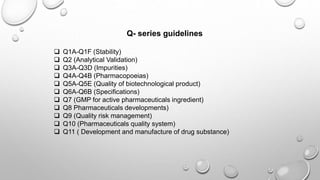
Q- series guidelines
 Q1A-Q1F (Stability)
 Q2 (Analytical Validation)
 Q3A-Q3D (Impurities)
 Q4A-Q4B (Pharmacopoeias)
 Q5A-Q5E (Quality of biotechnological product)
 Q6A-Q6B (Specifications)
 Q7 (GMP for active pharmaceuticals ingredient)
 Q8 Pharmaceuticals developments)
 Q9 (Quality risk management)
 Q10 (Pharmaceuticals quality system)
 Q11 ( Development and manufacture of drug substance)
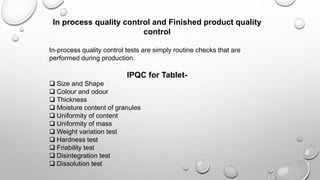
In process quality control and Finished product quality
control
In-process quality control tests are simply routine checks that are
performed during production.
IPQC for Tablet-
 Size and Shape
 Colour and odour
 Thickness
 Moisture content of granules
 Uniformity of content
 Uniformity of mass
 Weight variation test
 Hardness test
 Friability test
 Disintegration test
 Dissolution test
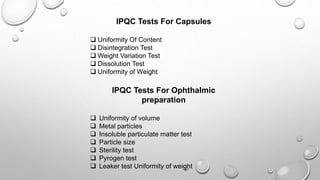
IPQC Tests For Capsules
 Uniformity Of Content
 Disintegration Test
 Weight Variation Test
 Dissolution Test
 Uniformity of Weight
IPQC Tests For Ophthalmic
preparation
 Uniformity of volume
 Metal particles
 Insoluble particulate matter test
 Particle size
 Sterility test
 Pyrogen test
 Leaker test Uniformity of weight
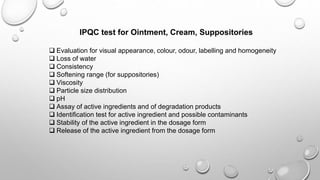
IPQC test for Ointment, Cream, Suppositories
 Evaluation for visual appearance, colour, odour, labelling and homogeneity
 Loss of water
 Consistency
 Softening range (for suppositories)
 Viscosity
 Particle size distribution
 pH
 Assay of active ingredients and of degradation products
 Identification test for active ingredient and possible contaminants
 Stability of the active ingredient in the dosage form
 Release of the active ingredient from the dosage form
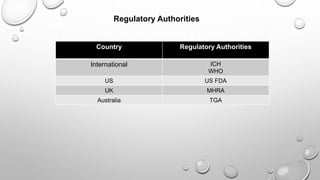
Regulatory Authorities
Country Regulatory Authorities
International ICH
WHO
US US FDA
UK MHRA
Australia TGA
Documentation in pharmaceutical industry
Define the specifications and procedure for all material
and manufacture and control method.
Standard operating procedures (SOPs)
Step-by-step instructions for performing operational
tasks or activities.
Batch records
These documents are typically used and completed by
the manufacturing department. Batch records provide
step-by-step instructions for production-related tasks
and activities, besides including areas on the batch
record itself for documenting such tasks.
Instrument handling
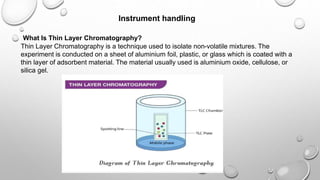
What Is Thin Layer Chromatography?
Thin Layer Chromatography is a technique used to isolate non-volatile mixtures. The
experiment is conducted on a sheet of aluminium foil, plastic, or glass which is coated with a
thin layer of adsorbent material. The material usually used is aluminium oxide, cellulose, or
silica gel.
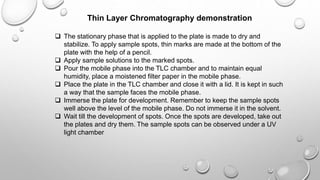
Thin Layer Chromatography demonstration
 The stationary phase that is applied to the plate is made to dry and
stabilize. To apply sample spots, thin marks are made at the bottom of the
plate with the help of a pencil.
 Apply sample solutions to the marked spots.
 Pour the mobile phase into the TLC chamber and to maintain equal
humidity, place a moistened filter paper in the mobile phase.
 Place the plate in the TLC chamber and close it with a lid. It is kept in such
a way that the sample faces the mobile phase.
 Immerse the plate for development. Remember to keep the sample spots
well above the level of the mobile phase. Do not immerse it in the solvent.
 Wait till the development of spots. Once the spots are developed, take out
the plates and dry them. The sample spots can be observed under a UV
light chamber
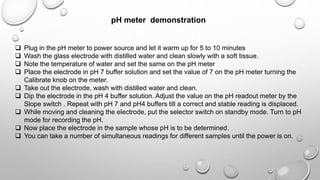
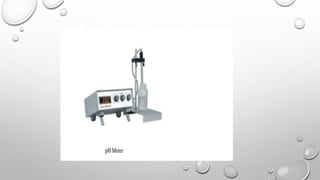
pH meter demonstration
 Plug in the pH meter to power source and let it warm up for 5 to 10 minutes
 Wash the glass electrode with distilled water and clean slowly with a soft tissue.
 Note the temperature of water and set the same on the pH meter
 Place the electrode in pH 7 buffer solution and set the value of 7 on the pH meter turning the
Calibrate knob on the meter.
 Take out the electrode, wash with distilled water and clean.
 Dip the electrode in the pH 4 buffer solution. Adjust the value on the pH readout meter by the
Slope switch . Repeat with pH 7 and pH4 buffers till a correct and stable reading is displaced.
 While moving and cleaning the electrode, put the selector switch on standby mode. Turn to pH
mode for recording the pH.
 Now place the electrode in the sample whose pH is to be determined.
 You can take a number of simultaneous readings for different samples until the power is on.
Dissolution apparatus
 Rotating basket
 Paddle
 Reciprocating cylinder
 Flow through the cell
 Paddle over disc
 Rotating cylinder
Validation, Calibration and Qualification
 VALIDATION- Validation is the documented process that
provide assurance I.e product, equipment, system
consistently provide results within the acceptable criteria.
 CALIBRATION- Calibration of an instrument is the
process of determining its accuracy.
 QULIFICATION- Qualification is the documented
evidence.
Importance of validation
 Assurance of quality
 Time bound
 Process optimization
 Reduction of quality cost.
 Minimal hatch failures, improved efficiently
and productivity
 Reduction in rejections.
 Increased output.
 Fewer complaints about process related
failures.
 Reduced testing in process and in finished
goods.
 More rapid and reliable start-up of new
equipments
 Easier maintenance of equipment.
 Improved employee awareness of
processes.
Validation Master Plan
The validation master plan should provide an overview of the entire validation operation, its
organizational structure, its content and planning.
The format and content should include-
 Introduction: validation policy, scope, location and schedule.
 Organizational structure: personnel responsibilities.
 Plant/process/product description: rational for inclusions or exclusions and extent of
validation.
 Specific process considerations that are critical and those requiring extra attention.
 Key acceptance criteria.
 Documentation format.
 Reference to the required SOPs.
 Time plans of each validation project and sub-project.
 List of products/processes/ systems to be validated, summarized in a matrix format,
validation approach.
 Re-validation activities, actual status and future planning
Type of validation
 Prospective validation
 Retrospective validation
 Concurrent Validation
Qualification phases
 Design qualification
 Installation qualification
 Operational qualification
 Performance qualification
https://nitsri.ac.in/Department/Civil
https://journals.indexcopernicus.com/api/file/viewByFileId/
695531
https://www.slideshare.net/HenishaPatel3/in-process-
quality-control-test-for-ophthalmic-and-parenterals
https://www.slideshare.net/sagarsavale1/regulatory-
authorities-usfda-who-and-
ich#:~:text=To%20promote%20the%20public%20health,pr
oducts%20in%20a%20timely%20manner.
https://nitsri.ac.in/Department/Civil
BIBLIOGRAPHY
THANK
YOU…

VEDIKA-1.pptx

  • 1.
    Dr. Babasaheb Ambedkar TechnologicalUniversity Shree Mahavir Education Society’ SHREE MAHAVIR EDUCATION SOCIETY’ DTE CODE - 5281 • B-Pharmacy Approved by AICTE, PCI New Delhi, DTE, Govt. Of Maharashtra Affiliated to MSBTE, Mumbai, DBATU, Lonere
  • 2.
    Course structure andcontains for PRACTICE SCHOOL (BP706PS) B. Pharm Final Year (SEM VII) DOMAIN – 10 QUALITY ASSURANCE &QUALITY CONTROL IN PHARMACEUTICALS
  • 3.
    A Review ArticleBy: VEDIKA NANDU GOSAVI Final Year B. Pharmacy (1952811823025) Guided By: Prof. Soniya S. Satpute
  • 4.
    Flow of content Introduction  Quality Assurance  Quality Control  GLP, GMP  ICH Guidelines  In process quality control  Regulatory Authorities  Documentation  Instrument handling  Validation  Calibration  Qualification
  • 5.
    Quality Assurance andQuality Control Quality Assurance (QA) activities include a planned system of review procedures conducted by personnel not directly involved in the inventory compilation/development process. Quality Control (QC) is a system of routine technical activities, to measure and control the quality of the inventory as it is being developed. The QC system is designed to: (i) Provide routine and consistent checks to ensure data integrity, correctness, and completeness; (ii) Identify and address errors and omissions; (iii) Document and archive inventory material and record all QC activities. Use - Quality Assurance (QA) is a proactive activity in nature – looking to reduce the number of defects by measuring the processes. On the other hand, the main goal of Quality Control (QC) is to identify any possible issues, prevent them, if needed, and verify the quality of the product. Scope - The Quality Assurance (QA) and Quality Control (QC) are very important units of any health care industry. Their aim is not only to test but also to produce superior quality of end product. The quality of health care products have become important aspect for the World Health Organization and International conference for harmonization with a motto that the Drugs must be market as safer and efficacious form.
  • 6.
    What is GMP? Goodmanufacturing practice (GMP) is a system for ensuring that products are consistently produced and controlled according to quality standards. It is designed to minimize the risks involved in any pharmaceutical production that cannot be eliminated through testing the final product. Good Laboratory Practice (GLP) A set of principles that provides a framework within which laboratory studies are planned, performed, monitored, recorded, reported and archived.
  • 7.
    ICH- (International councilfor harmonisation) • Prevention of unnecessary duplication of clinical trials and post market clinical evaluations • Development and manufacturing of new medicines • Registration and supervision of new medicines • Reduction of unnecessary animal testing without compromising safety and effectiveness. • ICH Guidelines categorized into 4 types – QSEM Q- Quality guidelines S- safety guidelines E- Efficacy guidelines M- Multidisciplinary guidelines
  • 8.
    Q- series guidelines Q1A-Q1F (Stability)  Q2 (Analytical Validation)  Q3A-Q3D (Impurities)  Q4A-Q4B (Pharmacopoeias)  Q5A-Q5E (Quality of biotechnological product)  Q6A-Q6B (Specifications)  Q7 (GMP for active pharmaceuticals ingredient)  Q8 Pharmaceuticals developments)  Q9 (Quality risk management)  Q10 (Pharmaceuticals quality system)  Q11 ( Development and manufacture of drug substance)
  • 9.
    In process qualitycontrol and Finished product quality control In-process quality control tests are simply routine checks that are performed during production. IPQC for Tablet-  Size and Shape  Colour and odour  Thickness  Moisture content of granules  Uniformity of content  Uniformity of mass  Weight variation test  Hardness test  Friability test  Disintegration test  Dissolution test
  • 10.
    IPQC Tests ForCapsules  Uniformity Of Content  Disintegration Test  Weight Variation Test  Dissolution Test  Uniformity of Weight IPQC Tests For Ophthalmic preparation  Uniformity of volume  Metal particles  Insoluble particulate matter test  Particle size  Sterility test  Pyrogen test  Leaker test Uniformity of weight
  • 11.
    IPQC test forOintment, Cream, Suppositories  Evaluation for visual appearance, colour, odour, labelling and homogeneity  Loss of water  Consistency  Softening range (for suppositories)  Viscosity  Particle size distribution  pH  Assay of active ingredients and of degradation products  Identification test for active ingredient and possible contaminants  Stability of the active ingredient in the dosage form  Release of the active ingredient from the dosage form
  • 12.
    Regulatory Authorities Country RegulatoryAuthorities International ICH WHO US US FDA UK MHRA Australia TGA
  • 13.
    Documentation in pharmaceuticalindustry Define the specifications and procedure for all material and manufacture and control method. Standard operating procedures (SOPs) Step-by-step instructions for performing operational tasks or activities. Batch records These documents are typically used and completed by the manufacturing department. Batch records provide step-by-step instructions for production-related tasks and activities, besides including areas on the batch record itself for documenting such tasks.
  • 14.
    Instrument handling What IsThin Layer Chromatography? Thin Layer Chromatography is a technique used to isolate non-volatile mixtures. The experiment is conducted on a sheet of aluminium foil, plastic, or glass which is coated with a thin layer of adsorbent material. The material usually used is aluminium oxide, cellulose, or silica gel.
  • 15.
    Thin Layer Chromatographydemonstration  The stationary phase that is applied to the plate is made to dry and stabilize. To apply sample spots, thin marks are made at the bottom of the plate with the help of a pencil.  Apply sample solutions to the marked spots.  Pour the mobile phase into the TLC chamber and to maintain equal humidity, place a moistened filter paper in the mobile phase.  Place the plate in the TLC chamber and close it with a lid. It is kept in such a way that the sample faces the mobile phase.  Immerse the plate for development. Remember to keep the sample spots well above the level of the mobile phase. Do not immerse it in the solvent.  Wait till the development of spots. Once the spots are developed, take out the plates and dry them. The sample spots can be observed under a UV light chamber
  • 16.
    pH meter demonstration Plug in the pH meter to power source and let it warm up for 5 to 10 minutes  Wash the glass electrode with distilled water and clean slowly with a soft tissue.  Note the temperature of water and set the same on the pH meter  Place the electrode in pH 7 buffer solution and set the value of 7 on the pH meter turning the Calibrate knob on the meter.  Take out the electrode, wash with distilled water and clean.  Dip the electrode in the pH 4 buffer solution. Adjust the value on the pH readout meter by the Slope switch . Repeat with pH 7 and pH4 buffers till a correct and stable reading is displaced.  While moving and cleaning the electrode, put the selector switch on standby mode. Turn to pH mode for recording the pH.  Now place the electrode in the sample whose pH is to be determined.  You can take a number of simultaneous readings for different samples until the power is on.
  • 18.
    Dissolution apparatus  Rotatingbasket  Paddle  Reciprocating cylinder  Flow through the cell  Paddle over disc  Rotating cylinder
  • 19.
    Validation, Calibration andQualification  VALIDATION- Validation is the documented process that provide assurance I.e product, equipment, system consistently provide results within the acceptable criteria.  CALIBRATION- Calibration of an instrument is the process of determining its accuracy.  QULIFICATION- Qualification is the documented evidence.
  • 20.
    Importance of validation Assurance of quality  Time bound  Process optimization  Reduction of quality cost.  Minimal hatch failures, improved efficiently and productivity  Reduction in rejections.  Increased output.  Fewer complaints about process related failures.  Reduced testing in process and in finished goods.  More rapid and reliable start-up of new equipments  Easier maintenance of equipment.  Improved employee awareness of processes.
  • 21.
    Validation Master Plan Thevalidation master plan should provide an overview of the entire validation operation, its organizational structure, its content and planning. The format and content should include-  Introduction: validation policy, scope, location and schedule.  Organizational structure: personnel responsibilities.  Plant/process/product description: rational for inclusions or exclusions and extent of validation.  Specific process considerations that are critical and those requiring extra attention.  Key acceptance criteria.  Documentation format.  Reference to the required SOPs.  Time plans of each validation project and sub-project.  List of products/processes/ systems to be validated, summarized in a matrix format, validation approach.  Re-validation activities, actual status and future planning
  • 22.
    Type of validation Prospective validation  Retrospective validation  Concurrent Validation Qualification phases  Design qualification  Installation qualification  Operational qualification  Performance qualification
  • 23.
  • 24.