STRATEGIES OF ASSURING
QUALITY OF LABORATORY
RESULTS
CHEMICAL PATHOLOGY LABORATORY METHODS
(SEMINAR)
By
Godwin Joseph EMEKA
1
OUTLINE:
1. Introduction
2. Laboratory Results
3. The Medical Laboratory
4. History of Quality in the Laboratory
5. Quality Management Agencies
6. Quality Assurance Awareness
7. Quality Management Guidelines
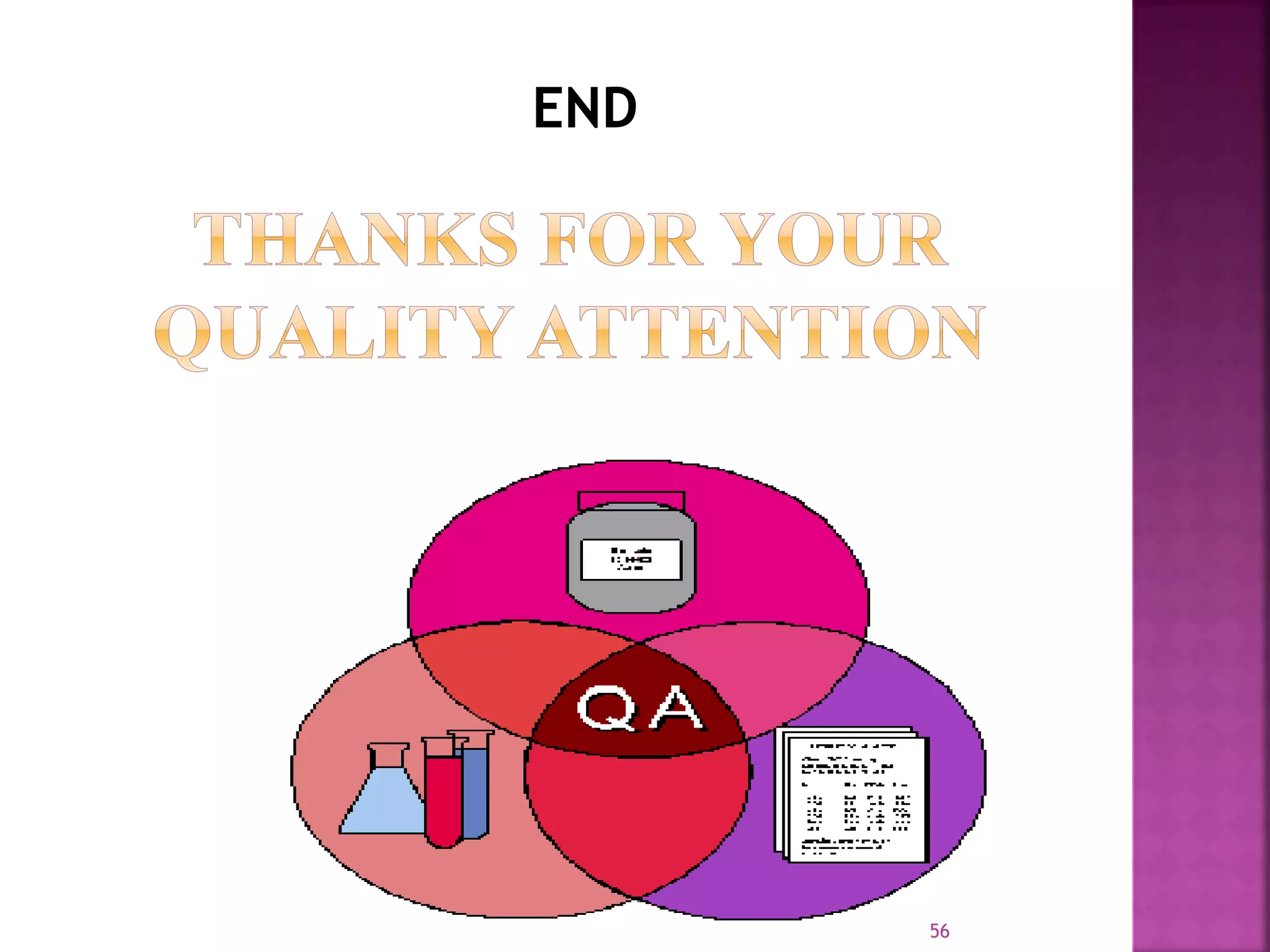
8. Quality Assurance
9. Principles of Quality Assurance
10. Components of Quality Assurance
11. Strategies of Assuring Quality of Lab. Results
12. Conclusion
2
INTRODUCTION
•Laboratory tests are medical procedures that
involve analysing samples of blood, urine, tissues or
other body substances. Example of tests ordered for
include: glucose tolerance test, pregnancy test, viral
test, allergy test etc (FDA, 2009).
•A medical laboratory or clinical laboratory is a
laboratory where tests are done on clinical specimens
in order to get information about the health of a
patient
(Farr & Shatkin, 2004).
3
LABORATORY RESULTS
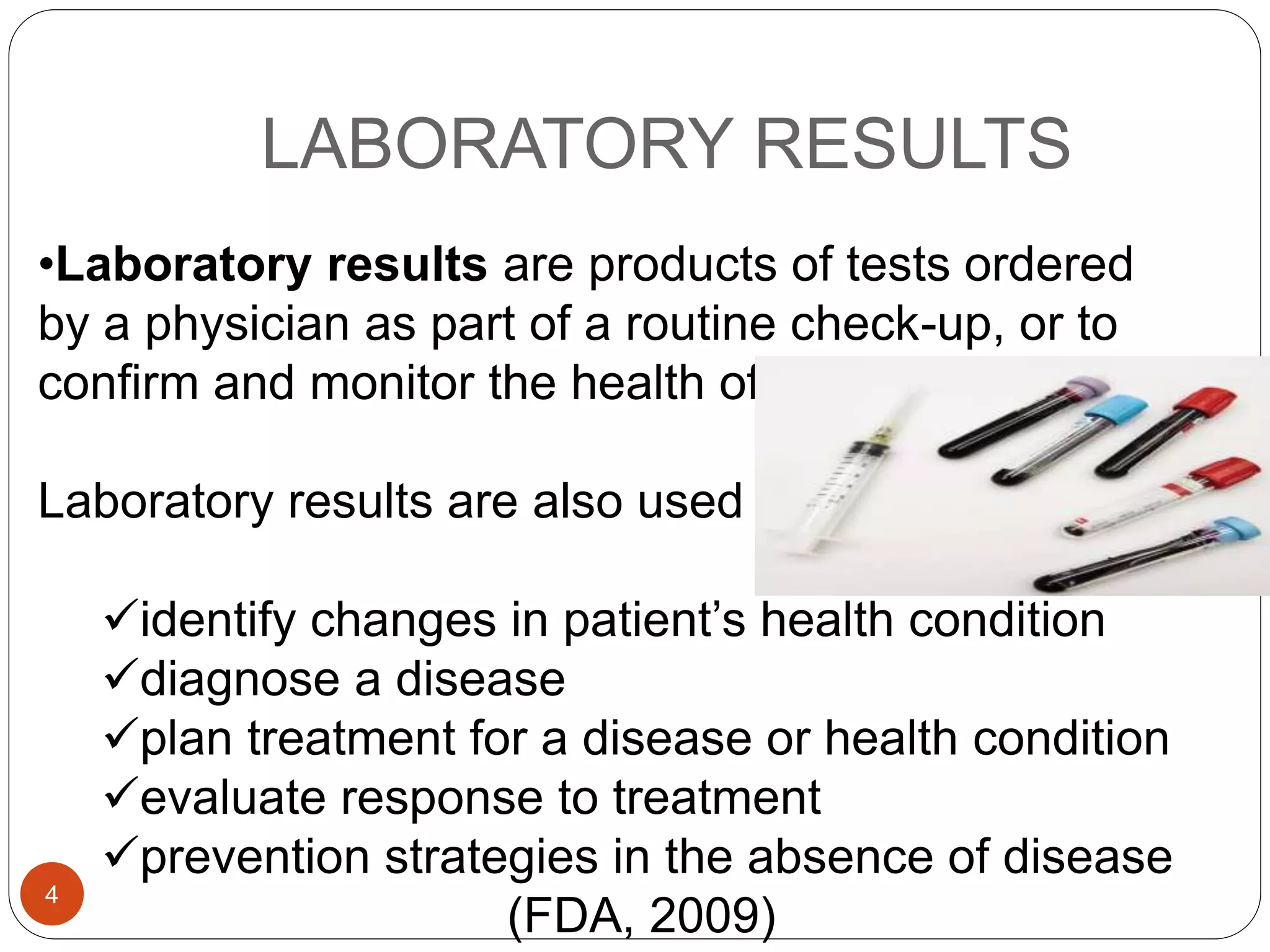
•Laboratory results are products of tests ordered
by a physician as part of a routine check-up, or to
confirm and monitor the health of a patient.
Laboratory results are also used to:
identify changes in patient’s health condition
diagnose a disease
plan treatment for a disease or health condition
evaluate response to treatment
prevention strategies in the absence of disease
(FDA, 2009)
4
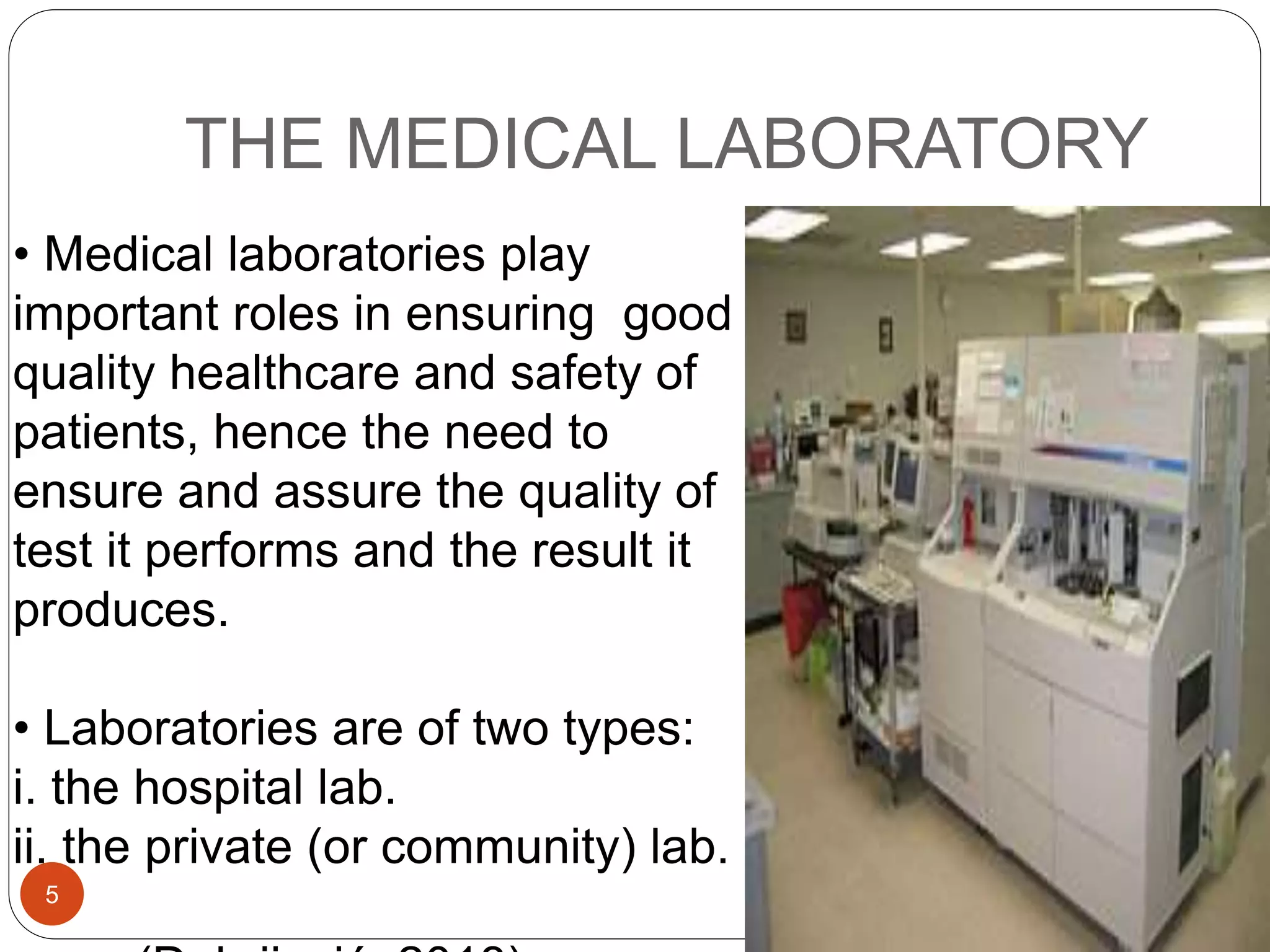
THE MEDICAL LABORATORY
• Medical laboratories play
important roles in ensuring good
quality healthcare and safety of
patients, hence the need to
ensure and assure the quality of
test it performs and the result it
produces.
• Laboratories are of two types:
i. the hospital lab.
ii. the private (or community) lab.
5
HISTORY OF QUALITY IN THE
LABORATORY
• The principle of quality management dates back more than
60 years ago. It became prominent in the days of Walter A.
Shewhart and Edwards W. Deming i.e. in the 1920’s and
1930’s.
• Quality Management had been an international initiative
from the early era of industrialization and has been
documented to be a valuable tool in military, government,
industries and later in the laboratory.
• In 1947, the International Organization for Standardization
(ISO) was created to adopt and enforce industrial standards.
(Noble, 2005).
6
HISTORY OF QUALITY IN THE
LABORATORY (contd.)
• With the emergence of numerous health organizations and
agencies, efforts had been focused on harmonizing
laboratory requirements on quality assurance.
• As a result, the formation of the IUPAC/ISO/AOAC working
party in 1978 for harmonization of Quality Assurance
schemes was put in place in achieving this.
• The IUPAC Interdivisional Working Party for Harmonization
of Quality Assurance (WPHQA) opened the door for single-
laboratory method validation, also known as “in-house
method validation”.
(Fajgelj, 2007).
7
QUALITY MANAGEMENT
AGENCIES
• Other quality accrediting bodies with similar function as the
ISO include:
i. ILAC: International Laboratory Accreditation Cooperation
ii. CLSI (formerly NCCLS): Clinical and Laboratory Standards
Institute
iii. IQLM: Institute for Quality in Laboratory Medicine
iv. ISQH: International Society for Quality in Healthcare
v. NCMLQS: National Committee for Medical Laboratory
Quality Systems
vi. IM: Institute of Medicine
vii.AHRQ: Agency for Healthcare Research and Quality
viii.IUPAC: International Union of Pure and Applied Chemistry
ix. JCAHO: Joint Committee on Accreditation of Healthcare
x. WHO: World Health Organisation
8
QUALITY MANAGEMENT
AGENCIES (contd.)
xi. IHI: Institute for Healthcare Improvement
xii. AOAC: Association of Official Analytical Chemist
Organizations
xiii.CCHSA: Canadian Council for Healthcare Services
Accreditation
xiv.CDC-DLS: Centers for Disease Control (Division of
Laboratory Systems.) ( Noble, 2005).
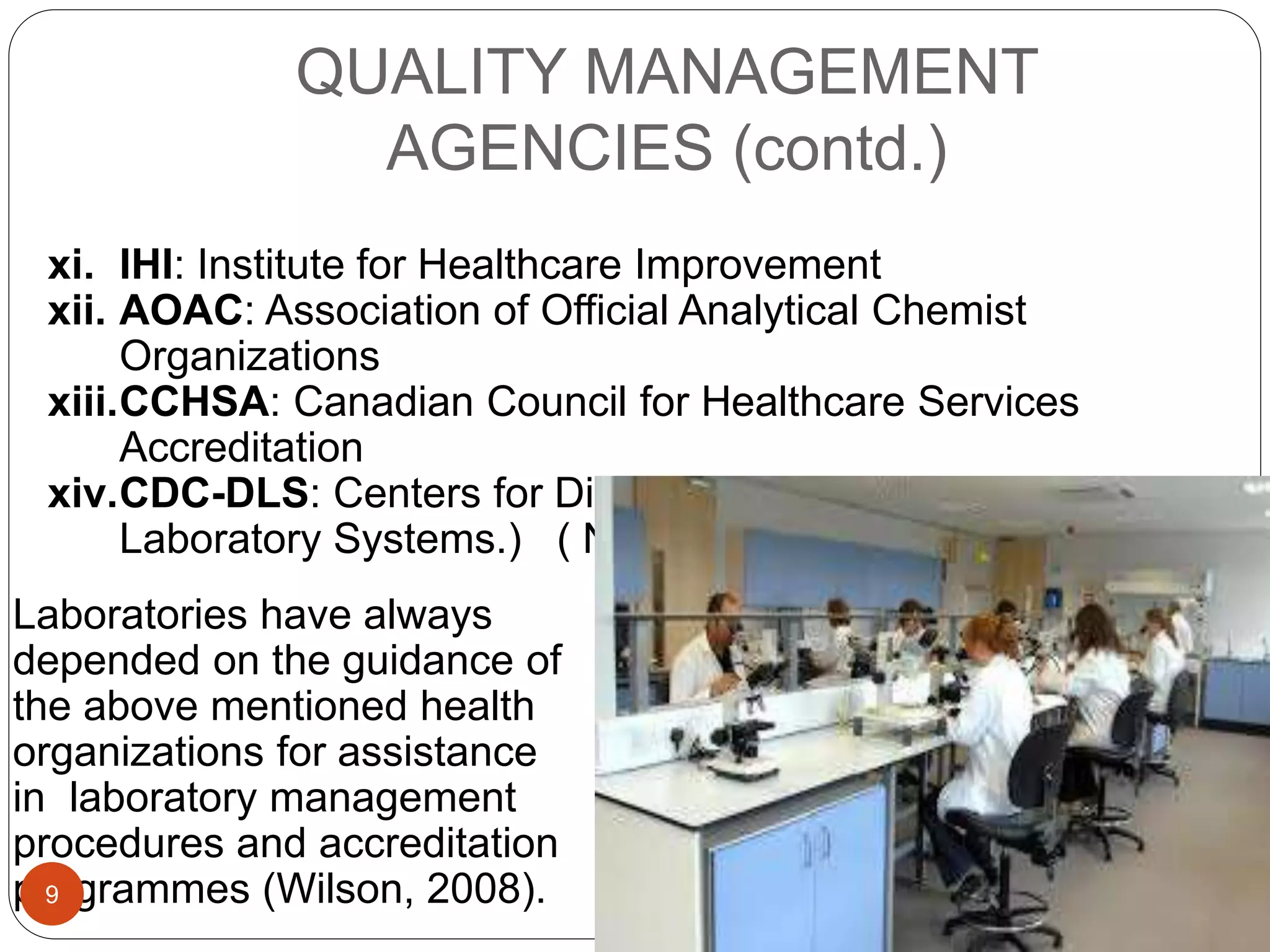
Laboratories have always
depended on the guidance of
the above mentioned health
organizations for assistance
in laboratory management
procedures and accreditation
programmes (Wilson, 2008).9
QUALITY ASSURANCE
AWARENESS
• The Quality and Compliance Department of
these organisations assists clients (i.e. laboratories)
with the development of their own quality process,
primarily through lectures, workshops, inspections
and telephone consultation. It also assists clients
with accreditation and licensure.
•Over the years, with the sensitisation and
enforcements carried out by these regulatory
bodies, laboratories now know and understand that
the quality of the laboratory result is directly related
to the quality and reliability of the equipment and10
QUALITY MANAGEMENT
GUIDELINES
The afore mentioned health organizations formulate
guidelines and regulations from time to time to meet the
expectations and challenges encountered in the laboratory.
Of prominence among these regulations are:
CLSI:
GP26-A2 - Application of a Quality System Model for Laboratory
Services; Approved Guideline—Second Edition.
HS01-A - A Quality System Model for Health Care; Approved
Guideline.
ISO:
ISO 17025:1999 - General Requirements for the Competence of
Testing and Calibration Laboratories.
ISO 9001:2000 - Quality Management.
ISO 15189:2003 - Medical laboratories -- Particular Requirements
for Quality and Competence.
11
QUALITY MANAGEMENT
GUIDELINES (contd.)
• ISO guidelines contain15 management
requirements and 10 technical requirements. These
requirements outline what a laboratory must do to
become accredited.
• The ISO 17025 is an international standard that
specifies the general requirements for the
competence to carry out tests and or calibrations
(Middlebrook, 2006).
• The ISO developed and promulgated the ISO 9000
standards. It is a set of four standards (i.e. ISO 9001-
9004) enacted to ensure quality management and12
QUALITY OF LABORATORY
RESULTS
• The International Standards Organisation defines
“quality” as the degree to which a set of inherent
characteristics fulfils requirements (ISO 9000:2000).
• The quality of a laboratory result is determined by
the protocols and standards put in place by the
laboratory management or healthcare system.
• These standards involve procedures, specifications
and technical recommendations utilized by the
laboratory to achieve her goal and objectives. Usually,
they are documented in form of a manual called the
quality manual.
13
ASSURING QUALITY OF
LABORATORY RESULTS
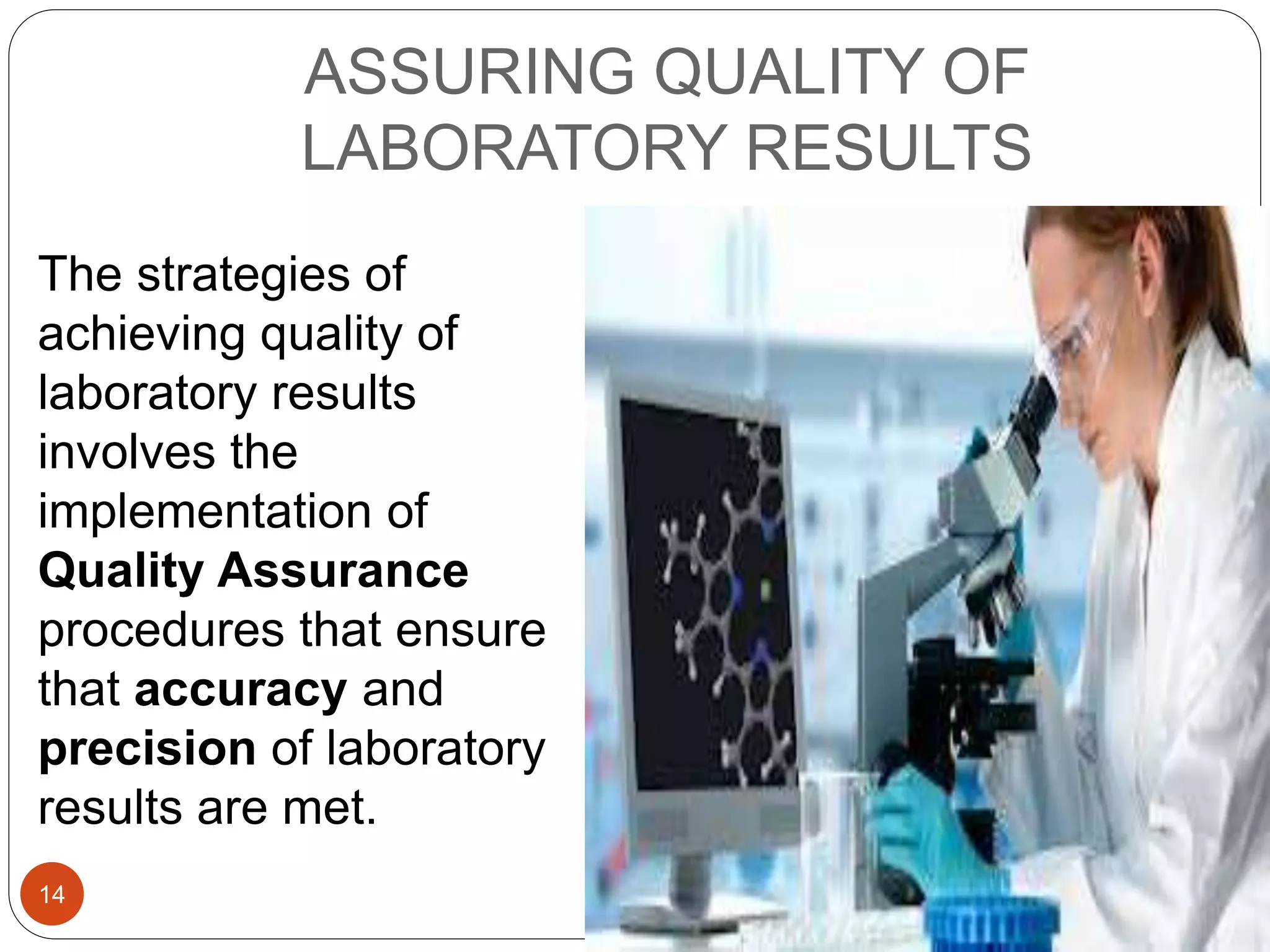
The strategies of
achieving quality of
laboratory results
involves the
implementation of
Quality Assurance
procedures that ensure
that accuracy and
precision of laboratory
results are met.
14
WHAT IS QUALITY
ASSURANCE?
•Quality Assurance (QA) is defined as the sum total
of the activities aimed at achieving a required
standard (ISO, 1994).
•It is a management method that is defined as “all
those planned and systematic actions needed to
provide adequate confidence that a product, service
or result will satisfy given requirements for quality and
be fit for use (Storey et al., 2000).
•Quality Assurance is also defined as a way of
preventing mistakes or avoiding problems and15
LABORATORY QUALITY
ASSURANCE
 Laboratory Quality Assurance encompasses a range of
activities that enable laboratories to achieve and maintain high
levels of accuracy and proficiency despite changes in test
methods and the volume of specimens tested.
 QA describes the overall measures that a laboratory uses to
ensure the quality of its operations.
 It summarily involves:
 systematic measurement,
 monitoring of processes,
 comparison with a standard,
 an associated feedback mechanism that confers error16
PRINCIPLES OF QUALITY
ASSURANCE IN THE
LABORATORY
The principles of QA have been formalised in a
number of published protocols or standards. Those
most widely recognised and used in chemical
analysis fall into three groups and are applied
according to a laboratory's individual needs.
The three groups are:
a) ISO/IEC 17025:1999: (RefB1) This standard
addresses the technical competence of laboratories
to carry out specific tests and calibrations and is
used by laboratory accreditation bodies world-wide
as the core requirements for the accreditation of
17
ASSURANCE IN THE LABORATORY
contd.
b) ISO 9001:2000: (Ref B2) and its national and
international equivalents. This standard relates
primarily to quality management, for facilities
carrying out production, or providing services,
including chemical analysis;
c) OECD Principles of Good Laboratory Practice
(GLP): 1998 (Ref B3) and its national and sectorial
equivalents. These guidelines are concerned with the
organisational processes and conditions under which
laboratory studies related to certain regulatory work
are carried out.18
QUALITIES OF A GOOD QUALITY
ASSURANCE SYSTEM
A good QA system does these four things:
a) establishes standard operating procedures (SOPs) for
each step of the laboratory testing process, ranging from
specimen handling to instrument performance validation;
b) defines administrative requirements, such as mandatory
recordkeeping, data evaluation, and internal audits to monitor
adherence to SOPs;
c) specifies corrective actions, documentation, and the
persons responsible for carrying out corrective actions when
problems are identified;
d) sustains high-quality employee performance
19
QUALITY ASSURANCE
SYSTEM
• There is no single method for establishing a QA
system. Each organisation has its own problems that
will require special consideration and planning.
• Once the decision to implement a QA system has
been taken and the necessary funds and facilities
have been made available, then a plan must be
drawn up.
• It is better to build on procedures already in place
and only to remove them if they are clearly
unsatisfactory.20
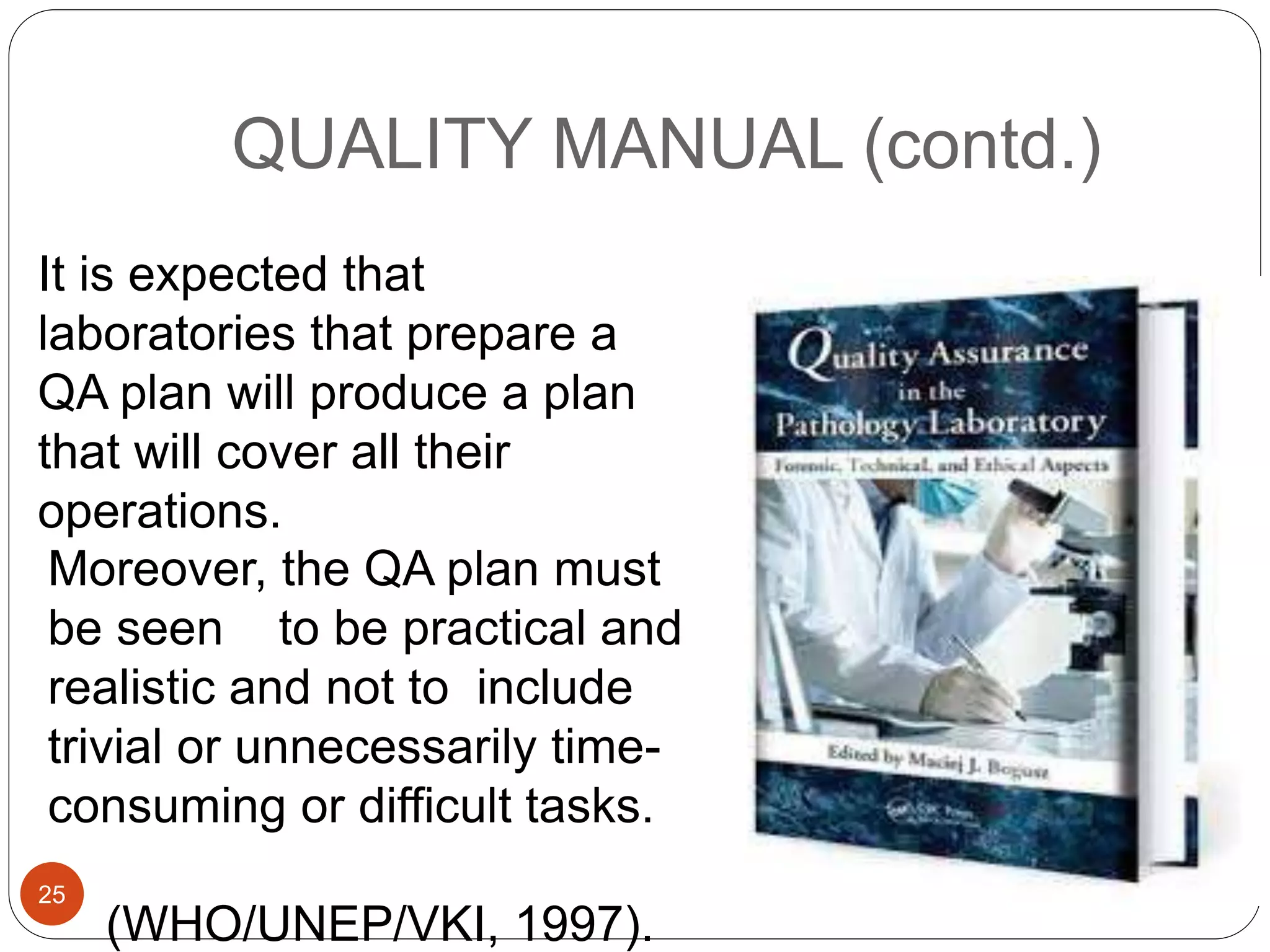
QUALITY MANUAL
• The quality manual (also called quality
assurance plan) is a management
document needed to implement QA
programmes (ISO, 1990).
• It is a document that outlines the goals
to be achieved in the laboratory, with
regard to quality of tests and results, and
the quality assurance procedures that
would be put in place to achieve it.
(Storey et al., 2000)
21
QUALITY MANUAL (contd.)
A typical quality manual contains the following items:
1) A quality policy statement, including objectives and
commitments.
2) The organisation and management structure of the project,
its place in any parent organisation and relevant organisational
charts.
3) The relationship between management, technical
operations, support services and the quality system.
4) Procedures for control and maintenance of documentation.
5) Job descriptions for key staff and reference to the job
descriptions of other staff.
6) Identification of approved signatories.
7) The laboratory's scope for calibrations and tests.
22
QUALITY MANUAL (contd.)
8) Procedures for ensuring traceability of all paperwork, data
and reports.
9) Procedures for protecting confidentiality and property
rights.
10) Procedures for audit and review.
11) Arrangements for ensuring that all new projects are
reviewed to ensure that there are adequate resources to
manage them properly.
12) Reference to the calibration, verification and testing
procedures used.
13) Procedures for handling calibration and test items.
14) Reference to the major equipment and reference
measurement standards used.
23
QUALITY MANUAL (contd.)
15) Reference to procedures for calibration, verification and
maintenance of equipment.
16) Reference to verification practices including inter-
laboratory comparisons, proficiency testing programmes, use
of reference materials and internal quality control schemes.
17) Procedures to be followed for feedback and corrective
actions whenever testing discrepancies or departure from
documented procedures are detected.
18) Procedures to be followed for feedback and corrective
actions whenever testing discrepancies or departure from
documented procedures are detected.
19) Complaints procedure.
(Storey et al., 2000)24
QUALITY MANUAL (contd.)
Moreover, the QA plan must
be seen to be practical and
realistic and not to include
trivial or unnecessarily time-
consuming or difficult tasks.
(WHO/UNEP/VKI, 1997).
It is expected that
laboratories that prepare a
QA plan will produce a plan
that will cover all their
operations.
25
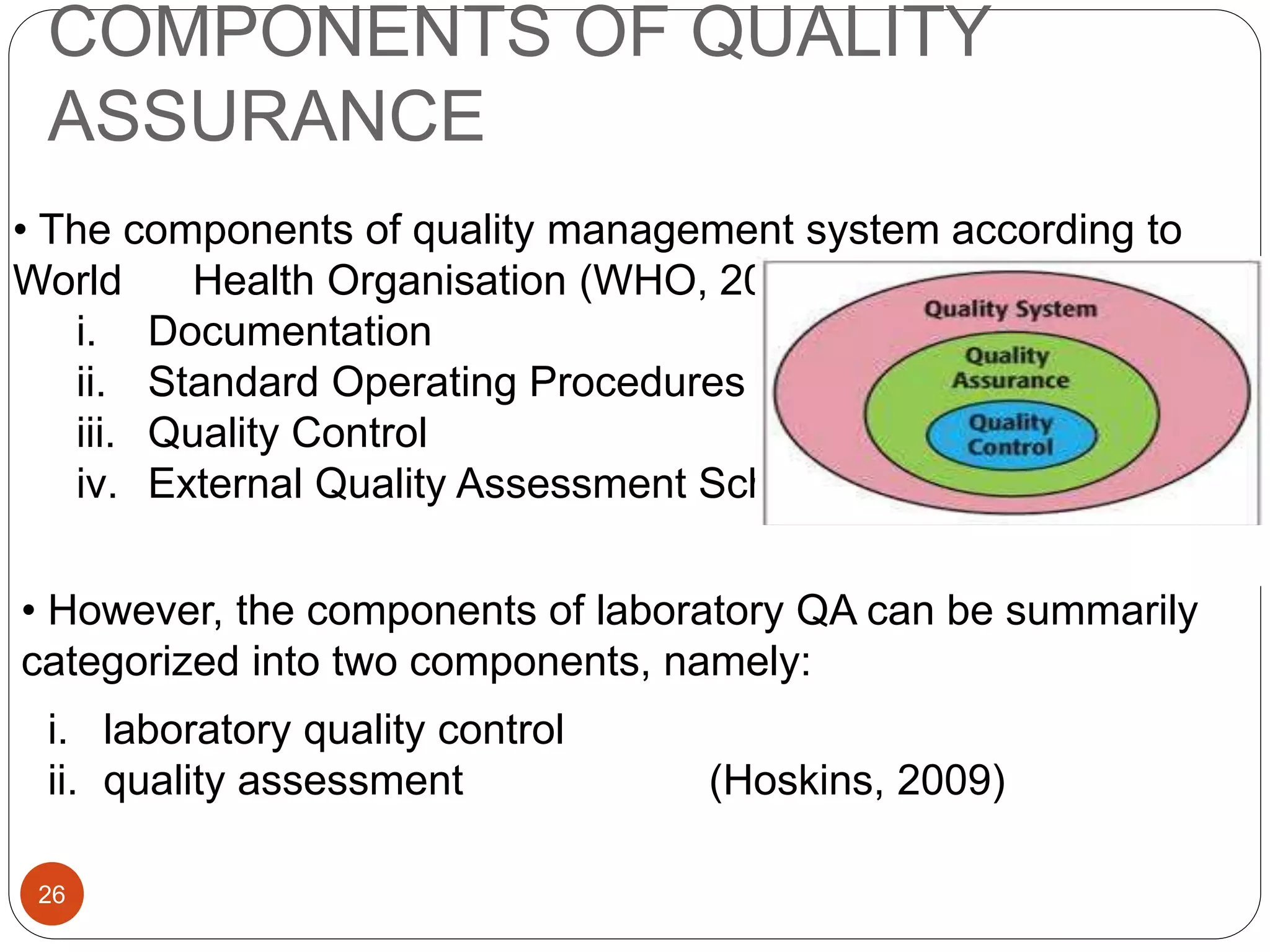
COMPONENTS OF QUALITY
ASSURANCE
• The components of quality management system according to
World Health Organisation (WHO, 2014) include:
i. Documentation
ii. Standard Operating Procedures (SOP's)
iii. Quality Control
iv. External Quality Assessment Scheme
• However, the components of laboratory QA can be summarily
categorized into two components, namely:
i. laboratory quality control
ii. quality assessment (Hoskins, 2009)
26
LABORATORY QUALITY
CONTROL
• Laboratory Quality Control is a measure of
precision, or how well the measurement system
reproduces the same result over time and under
varying operating conditions.
• Quality control is designed to detect, reduce, and
correct deficiencies in a laboratory's internal
analytical process prior to the release of patient
results.• The operational techniques and activities that are
used in quality control ensure the fulfilment of the
requirements for quality laboratory results with
emphasis on accuracy and precision.
(Tietz, 2008) 27
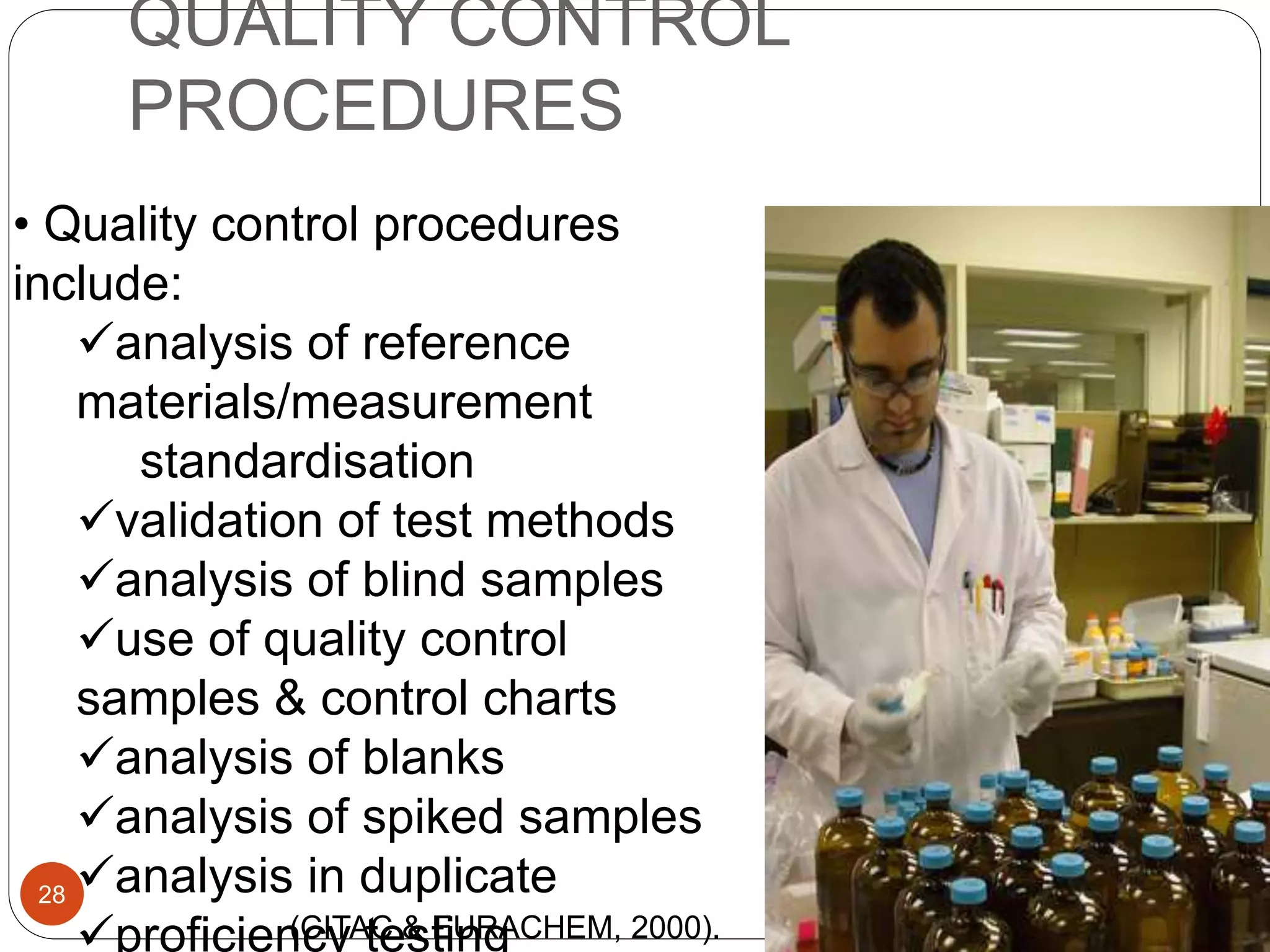
QUALITY CONTROL
PROCEDURES
• Quality control procedures
include:
analysis of reference
materials/measurement
standardisation
validation of test methods
analysis of blind samples
use of quality control
samples & control charts
analysis of blanks
analysis of spiked samples
analysis in duplicate
proficiency testing
28
(CITAC & EURACHEM, 2000).
TYPES OF QUALITY CONTROL
• Quality Control consists of two elements:
a). internal quality control (IQC)
b). external quality control (EQC).
• Internal quality control consists of the operational
techniques used by the laboratory staff for
continuous assessment of the quality of the results of
individual analytical procedures.
• External quality control or inter-laboratory control
is
carried out periodically and checked by the29
CONTROL CHARTS
• The control chart is one of the seven basic tools of quality
control which include the histogram, pareto chart, check sheet,
cause and effect diagram, flowchart and scatter diagram.
• Control charts prevents unnecessary process adjustments. It
provides diagnostic information as well as information about
process capability. The control chart is a proven technique for
improving productivity.
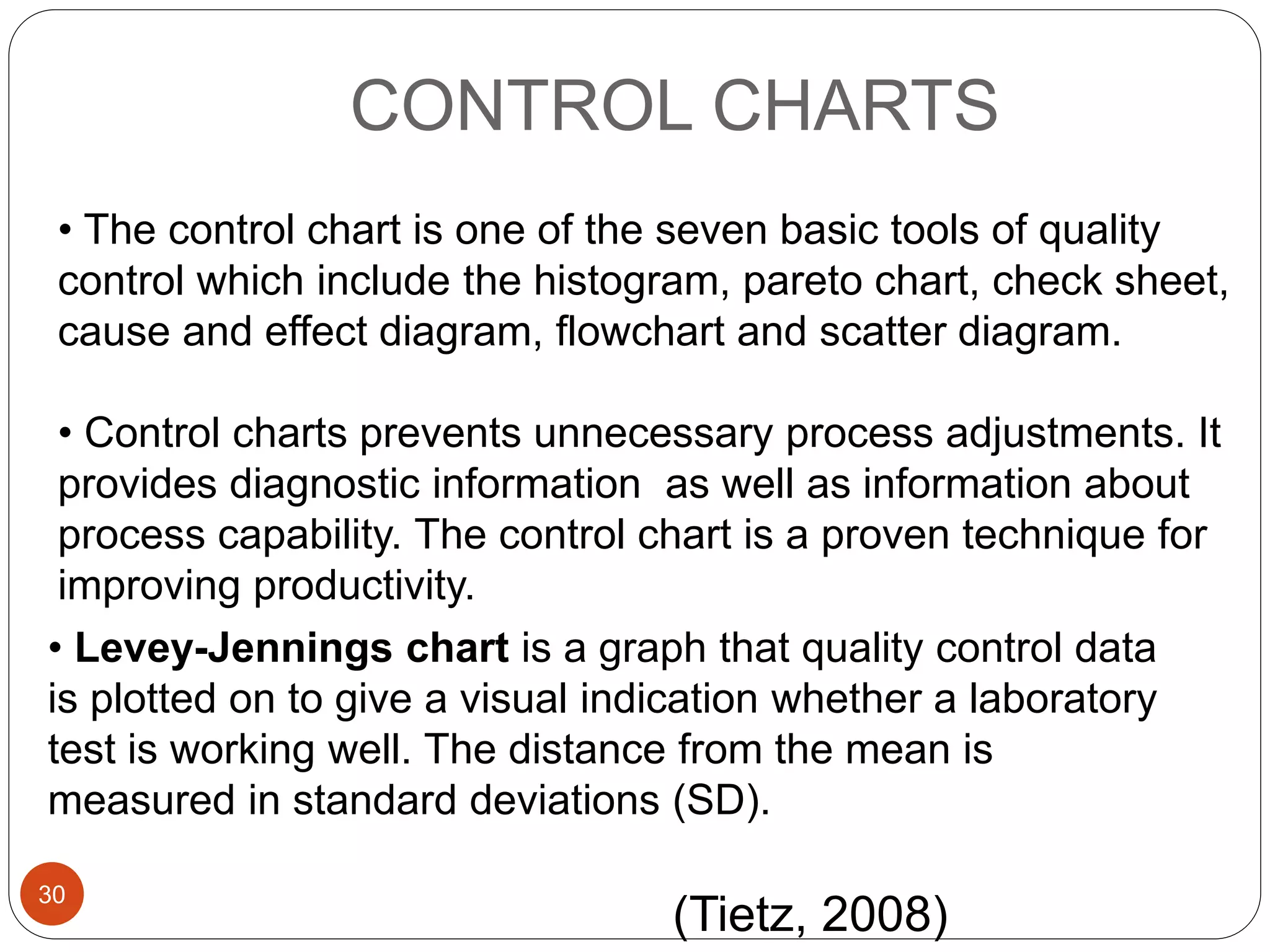
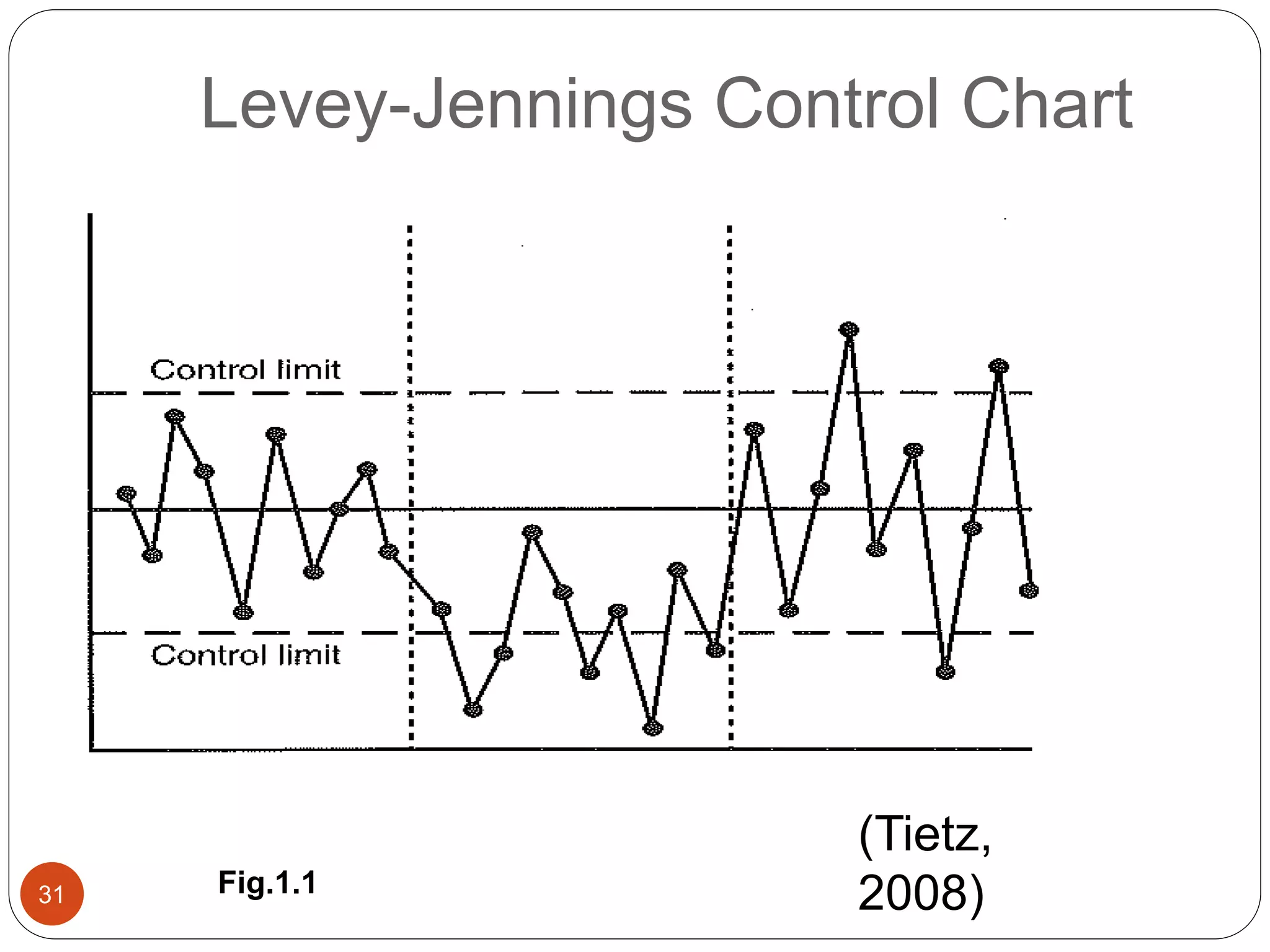
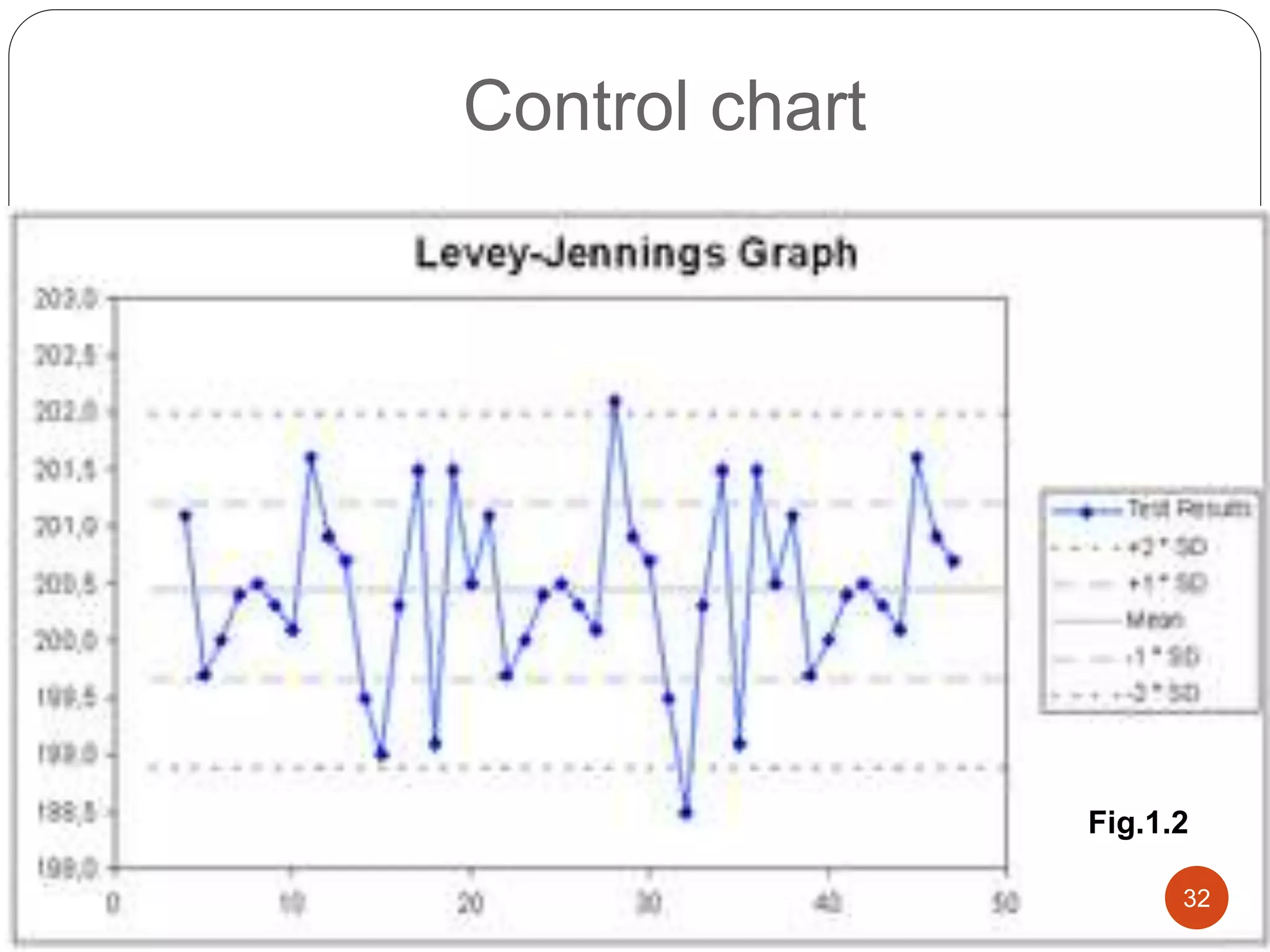
• Levey-Jennings chart is a graph that quality control data
is plotted on to give a visual indication whether a laboratory
test is working well. The distance from the mean is
measured in standard deviations (SD).
(Tietz, 2008)
30
Levey-Jennings Control Chart
31
(Tietz,
2008)Fig.1.1
Control chart
32
Fig.1.2
CONTROL CHARTS (contd.)
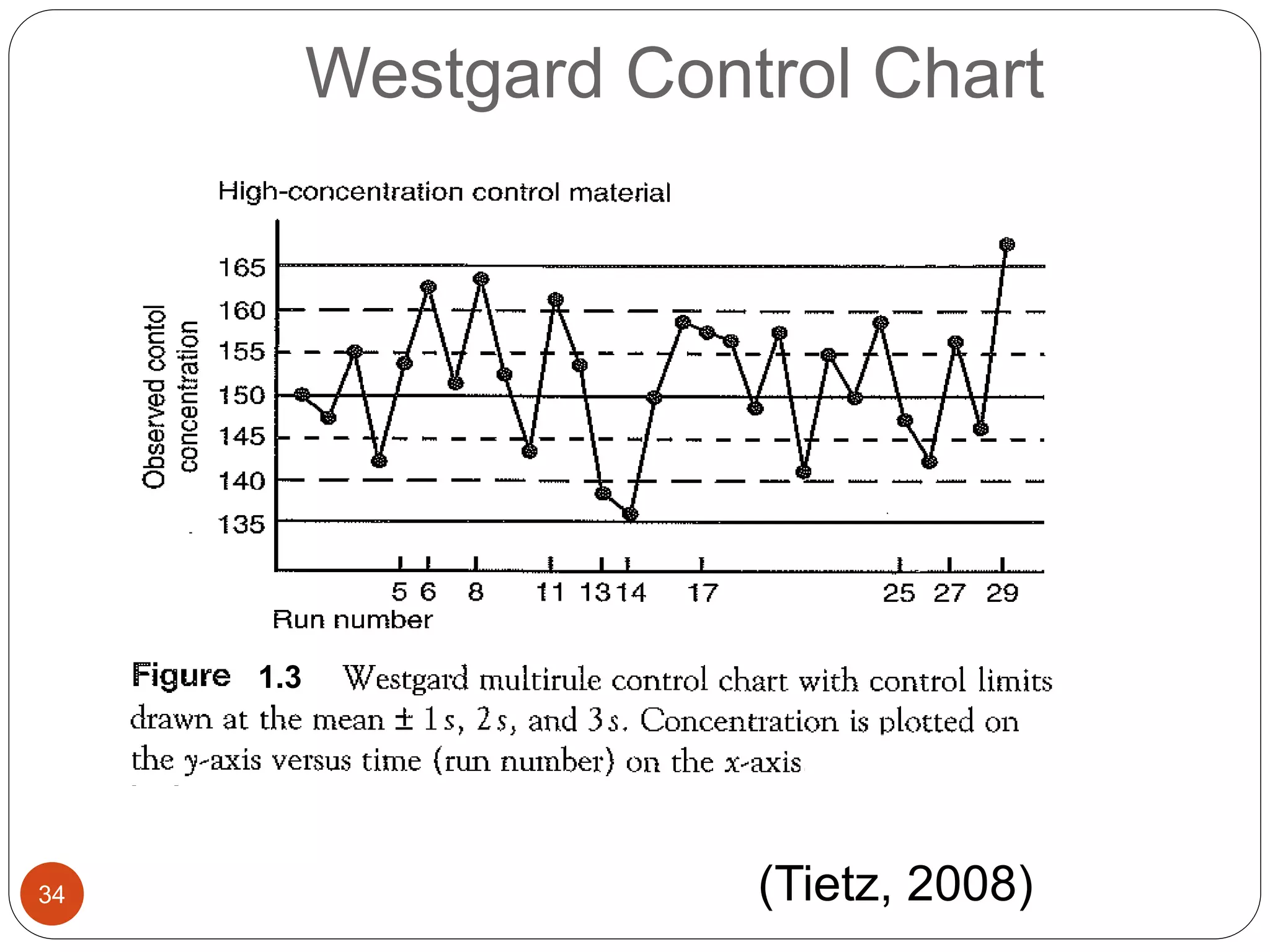
• The Westgard rule can be applied to see whether the
results from the samples when the control was done can be
released, or if they need to be rerun. It is programmed into
automated analyzers to determine when an analytical run
should be rejected.
•Westgard rules are commonly used to analyse data in
Shewhart control charts. They are used to define specific
performance limits for a particular assay and can be used to
detect both random and systematic errors.
• The Shewhart chart or Process-behaviour chart is a
statistical tool intended to assess the nature of variation in a
process and to facilitate forecasting and management.
33
Westgard Control Chart
34 (Tietz, 2008)
1.3
LABORATORY QUALITY
ASSESSMENT
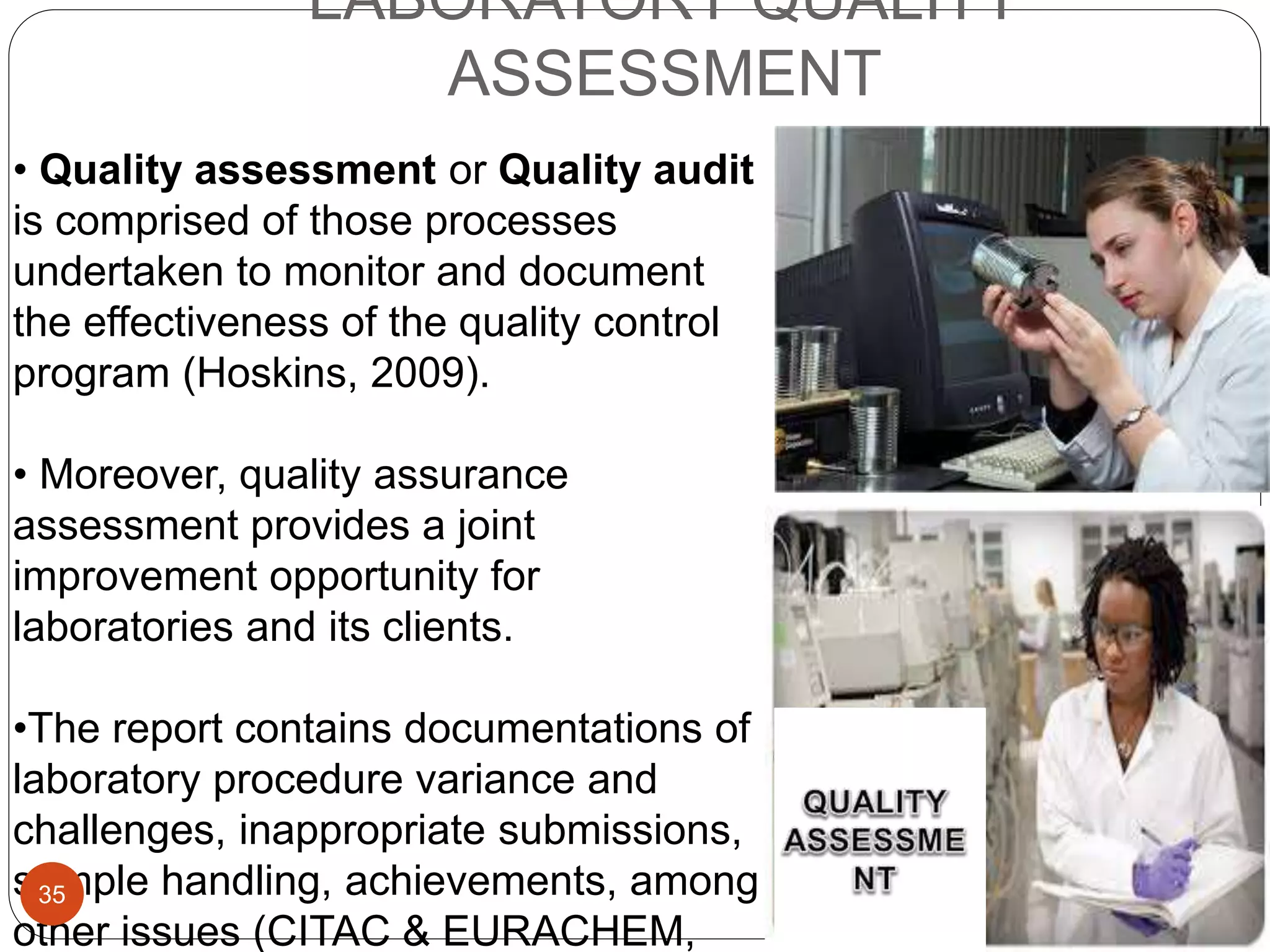
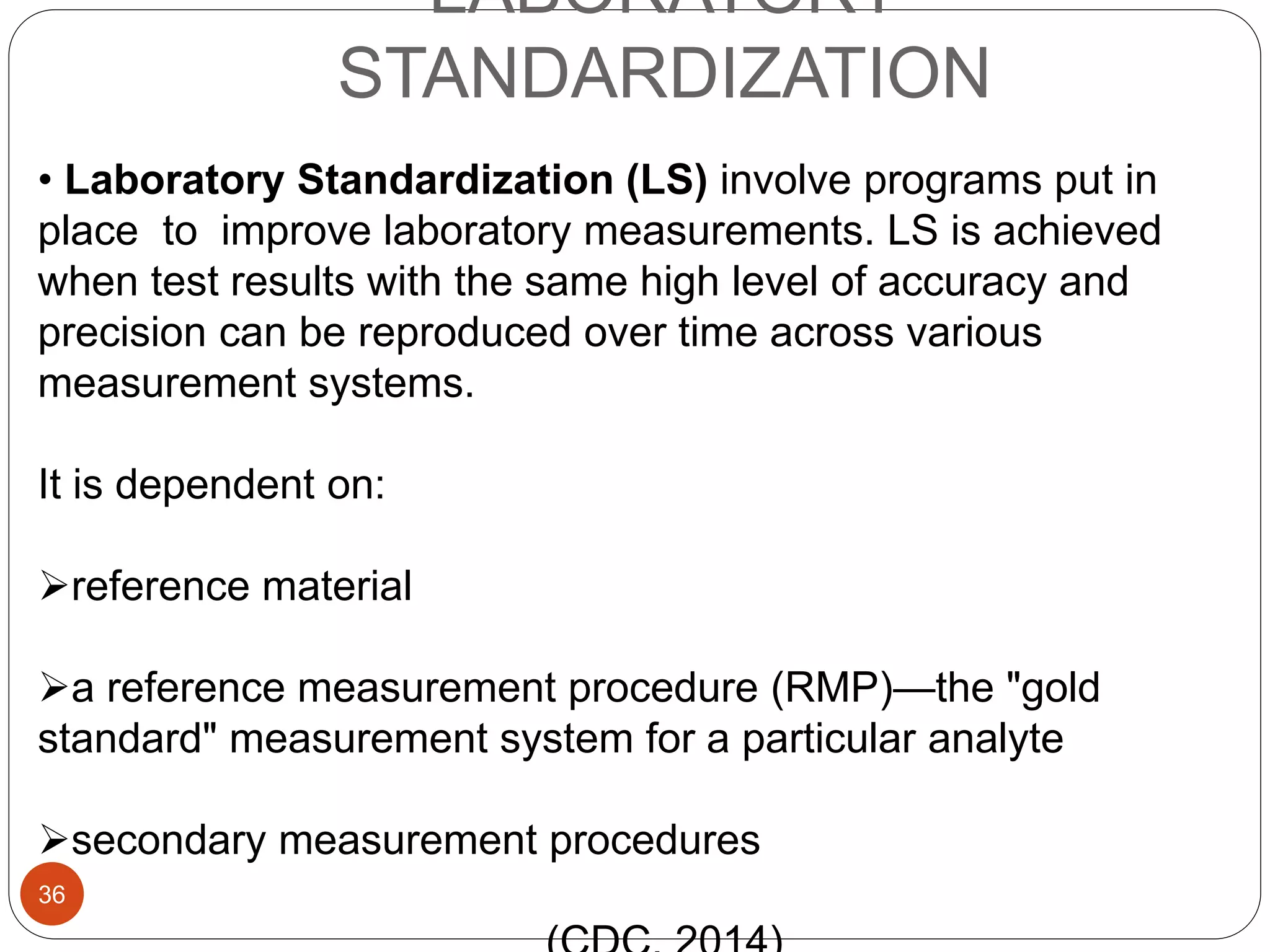
• Quality assessment or Quality audit
is comprised of those processes
undertaken to monitor and document
the effectiveness of the quality control
program (Hoskins, 2009).
• Moreover, quality assurance
assessment provides a joint
improvement opportunity for
laboratories and its clients.
•The report contains documentations of
laboratory procedure variance and
challenges, inappropriate submissions,
sample handling, achievements, among
other issues (CITAC & EURACHEM,
35
LABORATORY
STANDARDIZATION
• Laboratory Standardization (LS) involve programs put in
place to improve laboratory measurements. LS is achieved
when test results with the same high level of accuracy and
precision can be reproduced over time across various
measurement systems.
It is dependent on:
reference material
a reference measurement procedure (RMP)—the "gold
standard" measurement system for a particular analyte
secondary measurement procedures
36
METHOD VALIDATION
• Validation entails checks needed to be carried out to ensure
that the performance characteristics of a method are scientifically
sound and well understood (CITAC/EURACHEM, 2000).
• The time interval required to validate a new, commercially
available laboratory test is substantially between 3 to 6 months
(Wilson, 2008).
• After a method has been validated, found to be suitable and
introduced into routine use in the laboratory, it is necessary to
ensure that it continues to produce satisfactory results. Validity
checks should be made on every laboratory device at frequent or
regular intervals (Storey et al., 2000).
• More on the concept of validation is found in the ISO 9000 and37
PROFICIENCY TEST
• Proficiency testing is a means of assessing the ability of
laboratories to competently perform specific tests and
measurements. It is an important means of monitoring quality.
• One of the best ways for an analytical laboratory to monitor its
performance against its own requirements and the norm of other
laboratories, is to participate regularly in proficiency testing
schemes.
• Proficiency testing helps to highlight repeatability and
reproducibility performance of a laboratory.
(CITAC/EURACHEM, 2000).38
CALIBRATION
Calibration is a comparison between measurement devices
i.e. one of known magnitude or correctness
(standard/reference material) and another made in a similar
way (test instrument or unit under test).
Regular internal and external calibration checks must be
performed on equipment such as balances, pipettes, pH
meters etc.
Calibration and maintenance records should be kept for all
equipment, thus allowing the repair status to be monitored
(Storey et al., 2000).39
STRATEGIES OF ASSURING
QUALITY LABORATORY
RESULTS
Laboratory results can be of reliable quality with the
implementation of all procedures involving quality
assurance.40
STRATEGIES OF ASSURING
QUALITY LABORATORY
RESULTS (contd.)
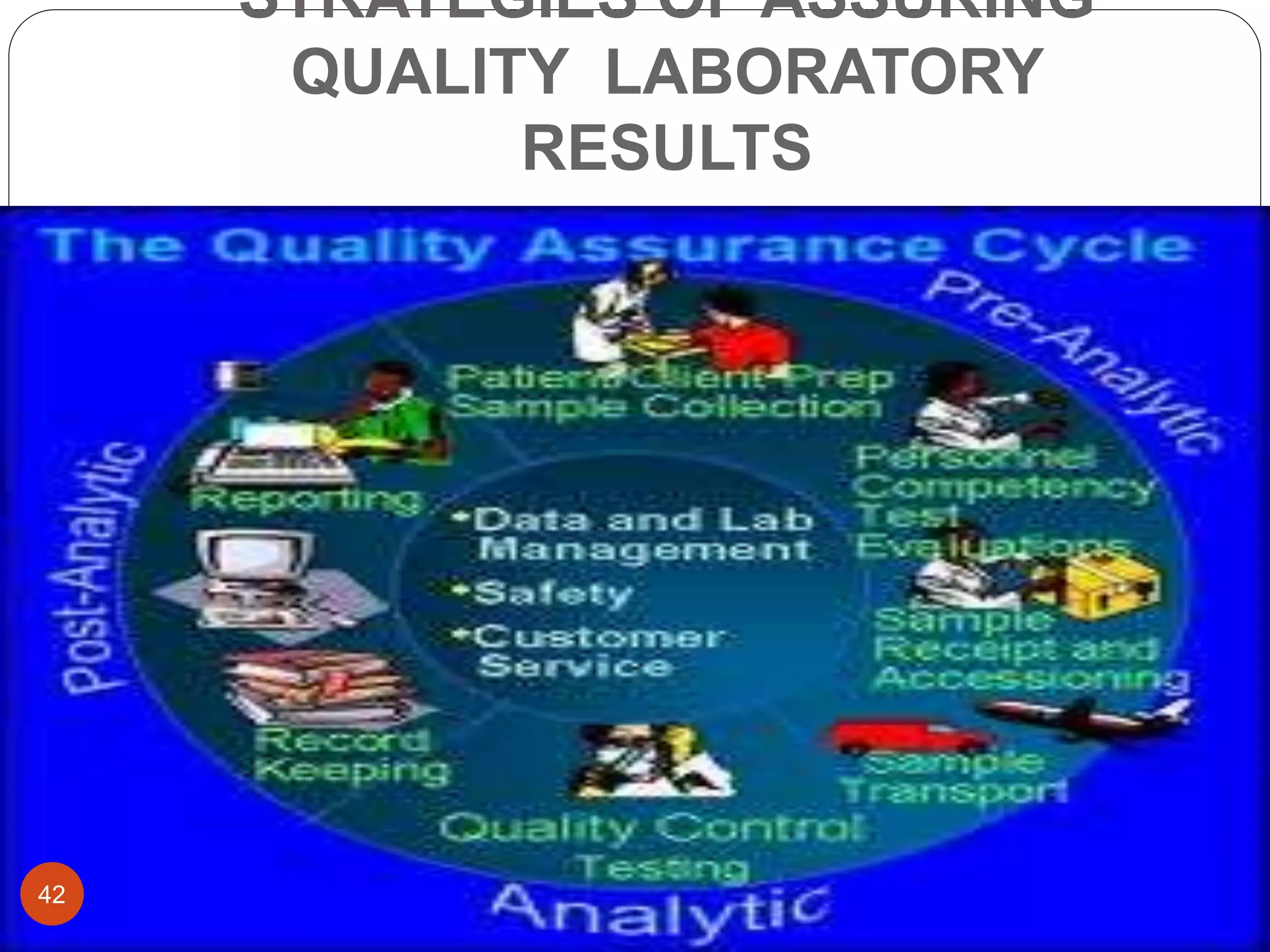
Moreover, the strategies of assuring quality of
laboratory results can be conveniently grouped with
regard to the three phases of laboratory practice i.e.
the pre-analytical, analytical and post-analytical.
Hence, we have the:
i. Pre-analytical strategies
ii. Analytical strategies
iii. Post-analytical strategies of assuring quality of
laboratory results.
41
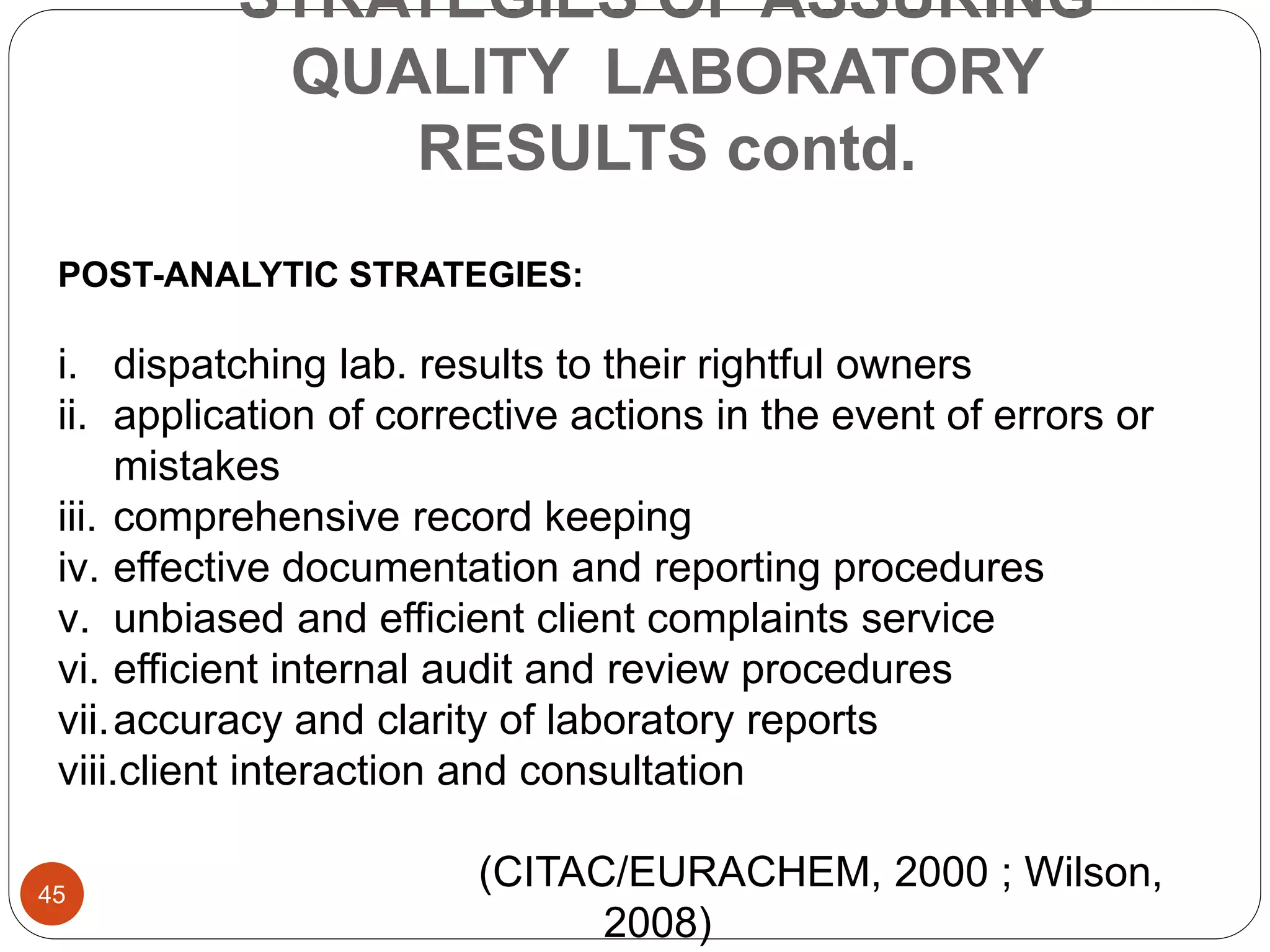
STRATEGIES OF ASSURING
QUALITY LABORATORY
RESULTS
42
QUALITY LABORATORY RESULTS
contd.
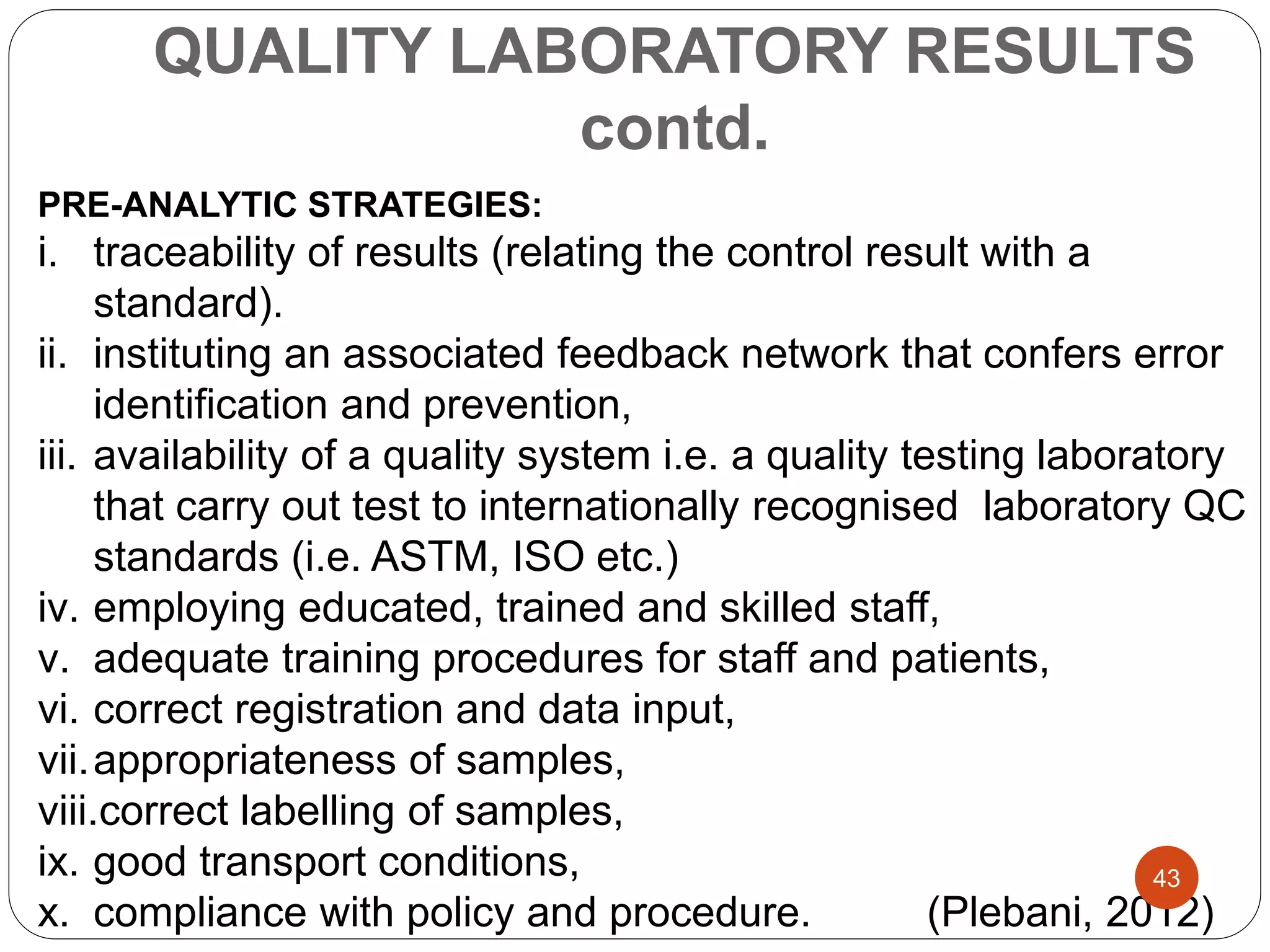
PRE-ANALYTIC STRATEGIES:
i. traceability of results (relating the control result with a
standard).
ii. instituting an associated feedback network that confers error
identification and prevention,
iii. availability of a quality system i.e. a quality testing laboratory
that carry out test to internationally recognised laboratory QC
standards (i.e. ASTM, ISO etc.)
iv. employing educated, trained and skilled staff,
v. adequate training procedures for staff and patients,
vi. correct registration and data input,
vii.appropriateness of samples,
viii.correct labelling of samples,
ix. good transport conditions,
x. compliance with policy and procedure. (Plebani, 2012)
43
STRATEGIES OF ASSURING
QUALITY LABORATORY
RESULTS contd.
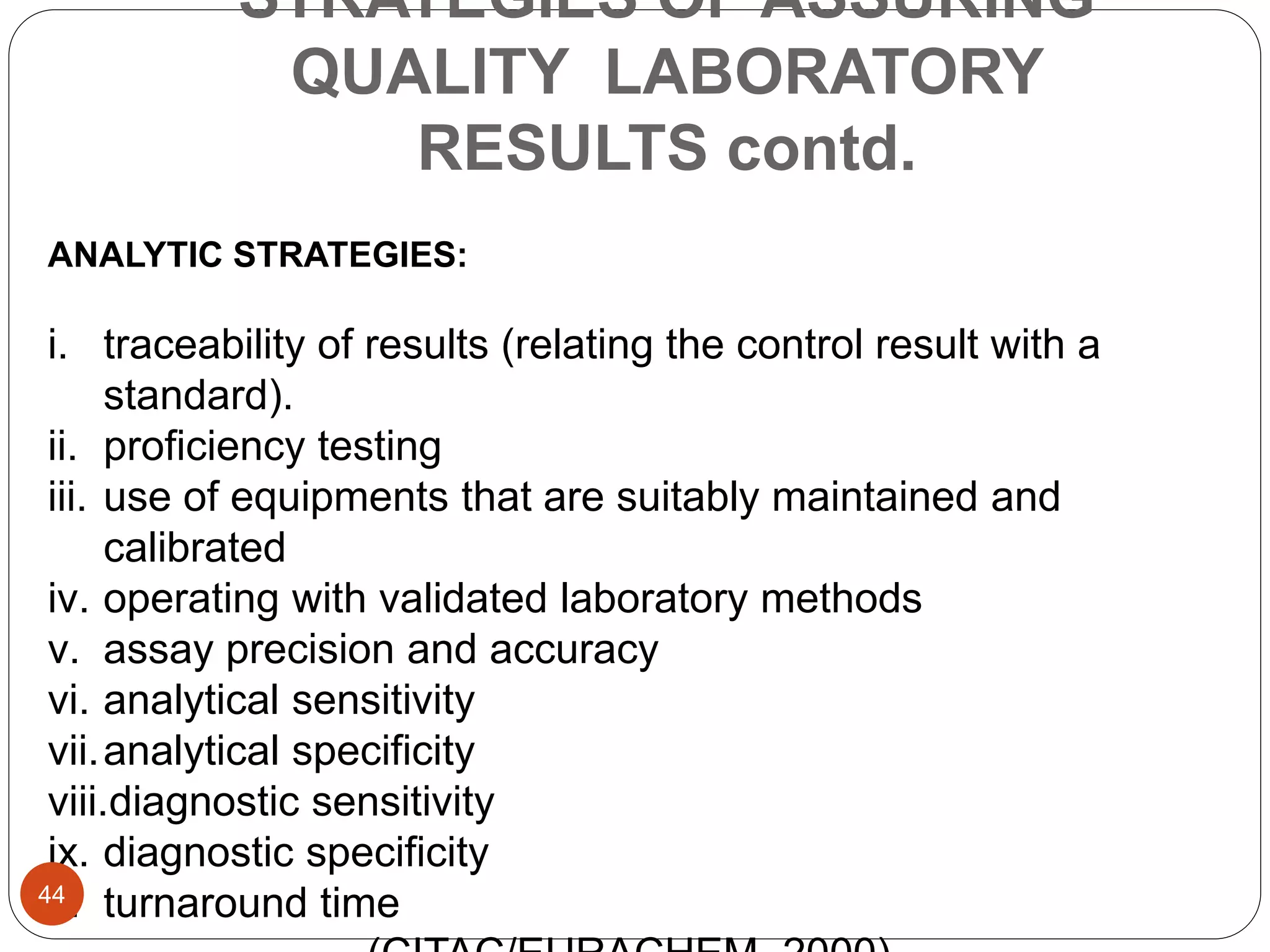
ANALYTIC STRATEGIES:
i. traceability of results (relating the control result with a
standard).
ii. proficiency testing
iii. use of equipments that are suitably maintained and
calibrated
iv. operating with validated laboratory methods
v. assay precision and accuracy
vi. analytical sensitivity
vii.analytical specificity
viii.diagnostic sensitivity
ix. diagnostic specificity
x. turnaround time44
STRATEGIES OF ASSURING
QUALITY LABORATORY
RESULTS contd.
POST-ANALYTIC STRATEGIES:
i. dispatching lab. results to their rightful owners
ii. application of corrective actions in the event of errors or
mistakes
iii. comprehensive record keeping
iv. effective documentation and reporting procedures
v. unbiased and efficient client complaints service
vi. efficient internal audit and review procedures
vii.accuracy and clarity of laboratory reports
viii.client interaction and consultation
(CITAC/EURACHEM, 2000 ; Wilson,
2008)
45
STRATEGIES OF ASSURING QUALITY
LABORATORY RESULTS contd.
Other strategies of assuring analytical quality laboratory results
include:
1. the ability of the lab. to be up to date with current updates
on clinical laboratory practice
2. meeting up with accreditation and regulatory requirements
3. identifying malfunctions or deterioration of instruments or its
compartments and replacing them.
4. keeping the lab. environment safe and suitable for
meaningful analysis.
5. proper sample receipt and storage
6. use of duplicate analysis
7. the care and cleaning of equipment.
8. maintaining laboratory equipments on a regular basis as
documented in the relevant standard of procedures (SOP),
46
STRATEGIES OF ASSURING
QUALITY OF LABORATORY
RESULTS contd.
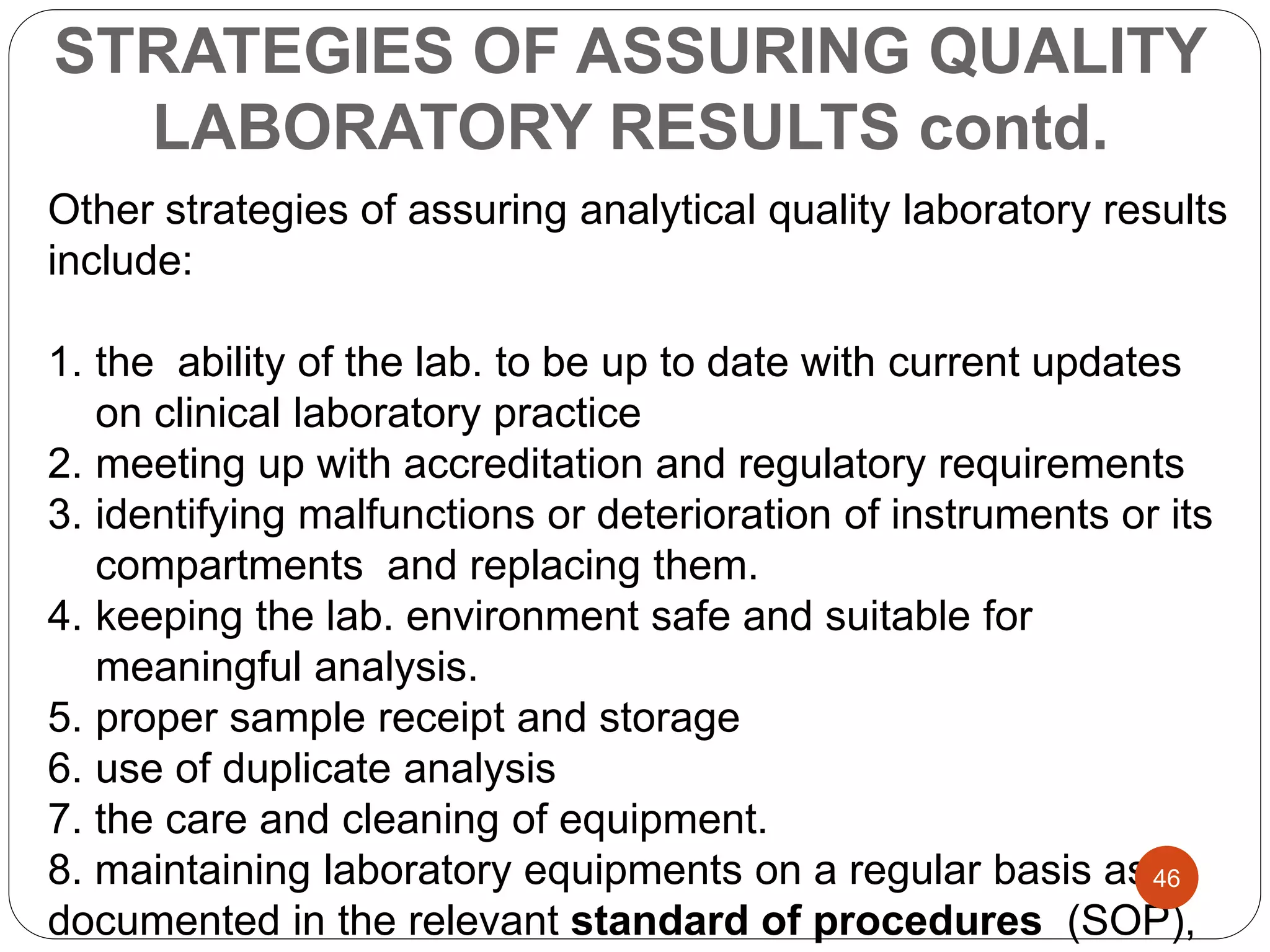
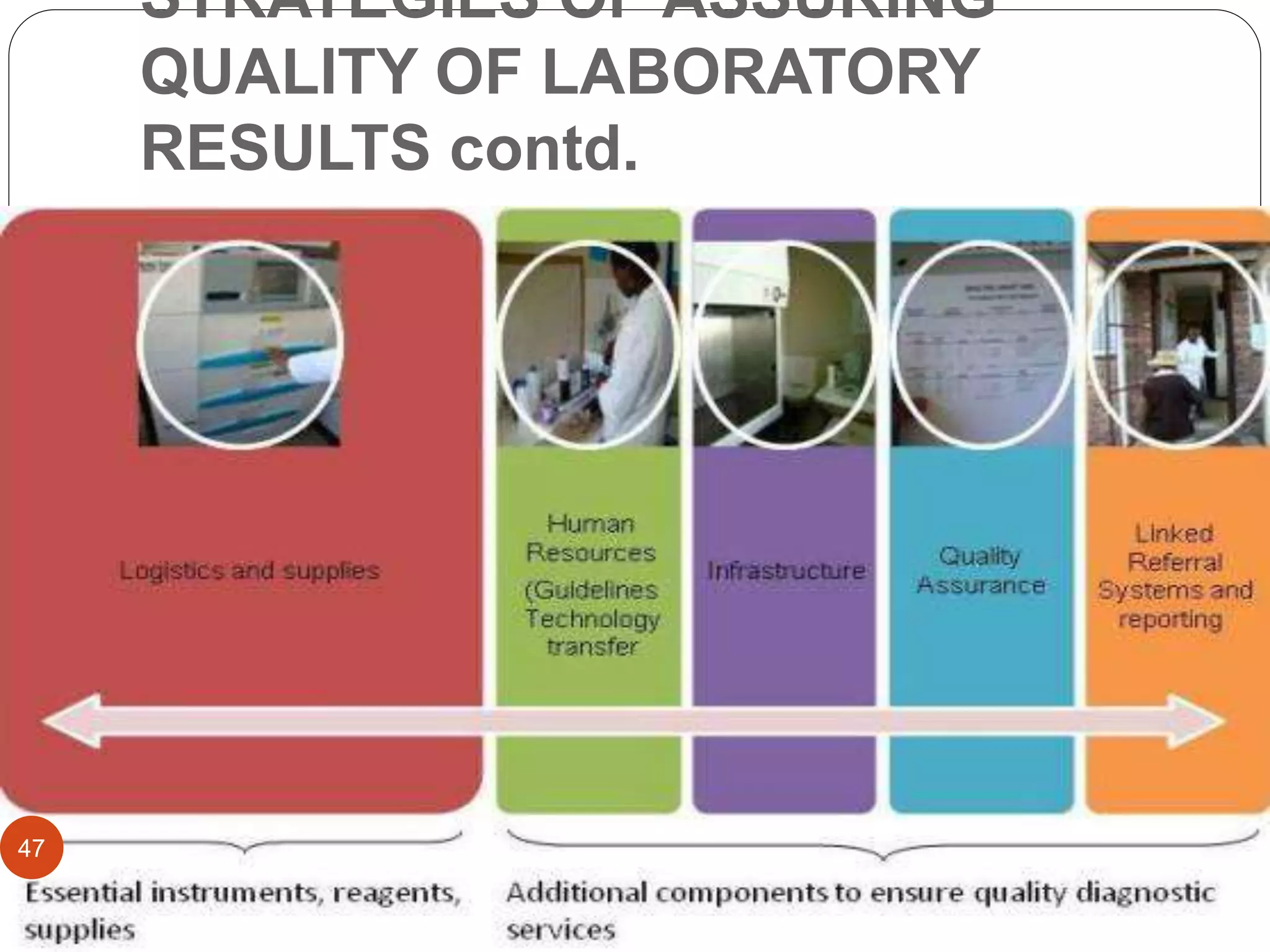
47
STRATEGIES OF ASSURING
QUALITY OF LABORATORY
RESULTS contd.
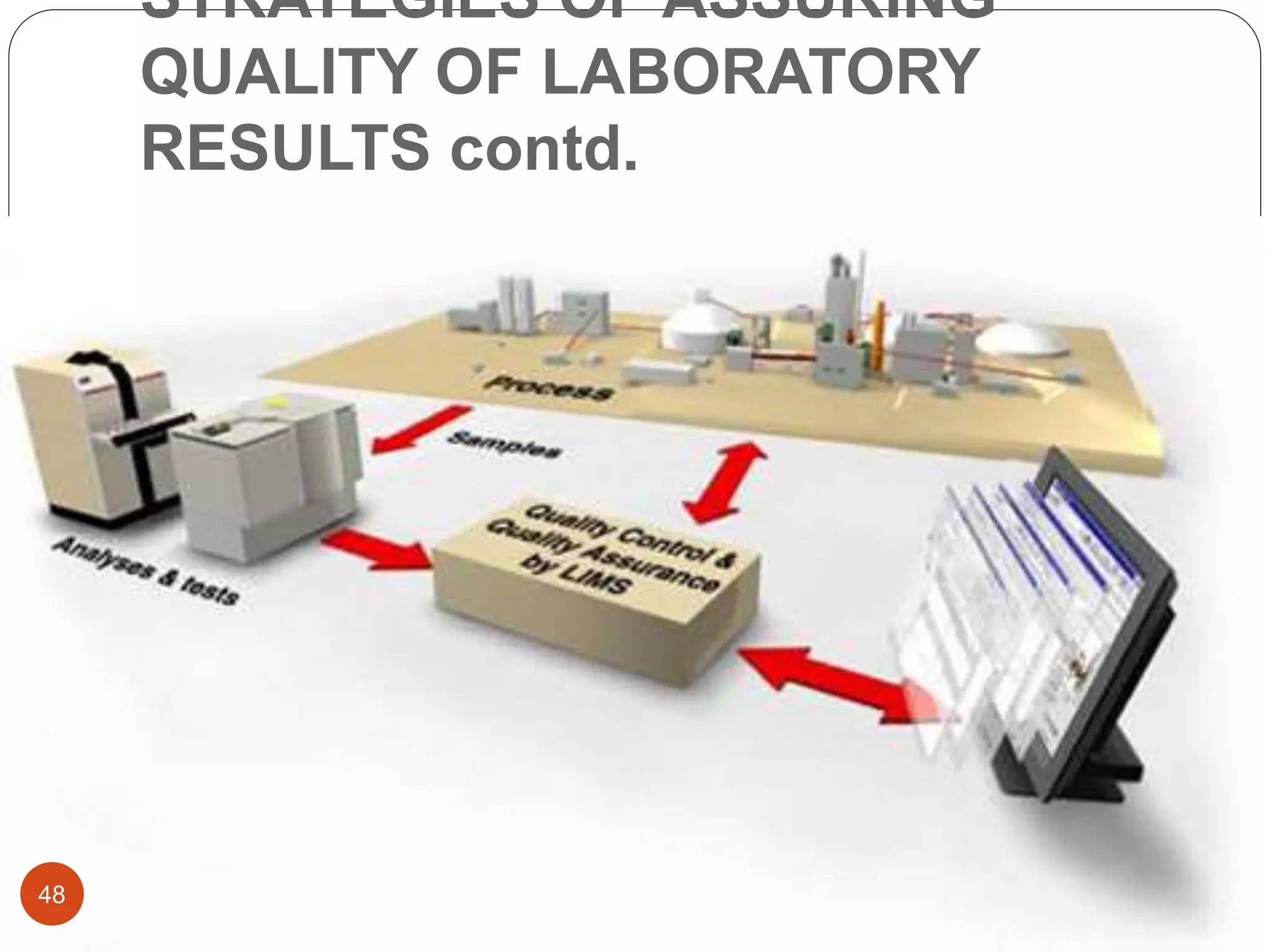
48
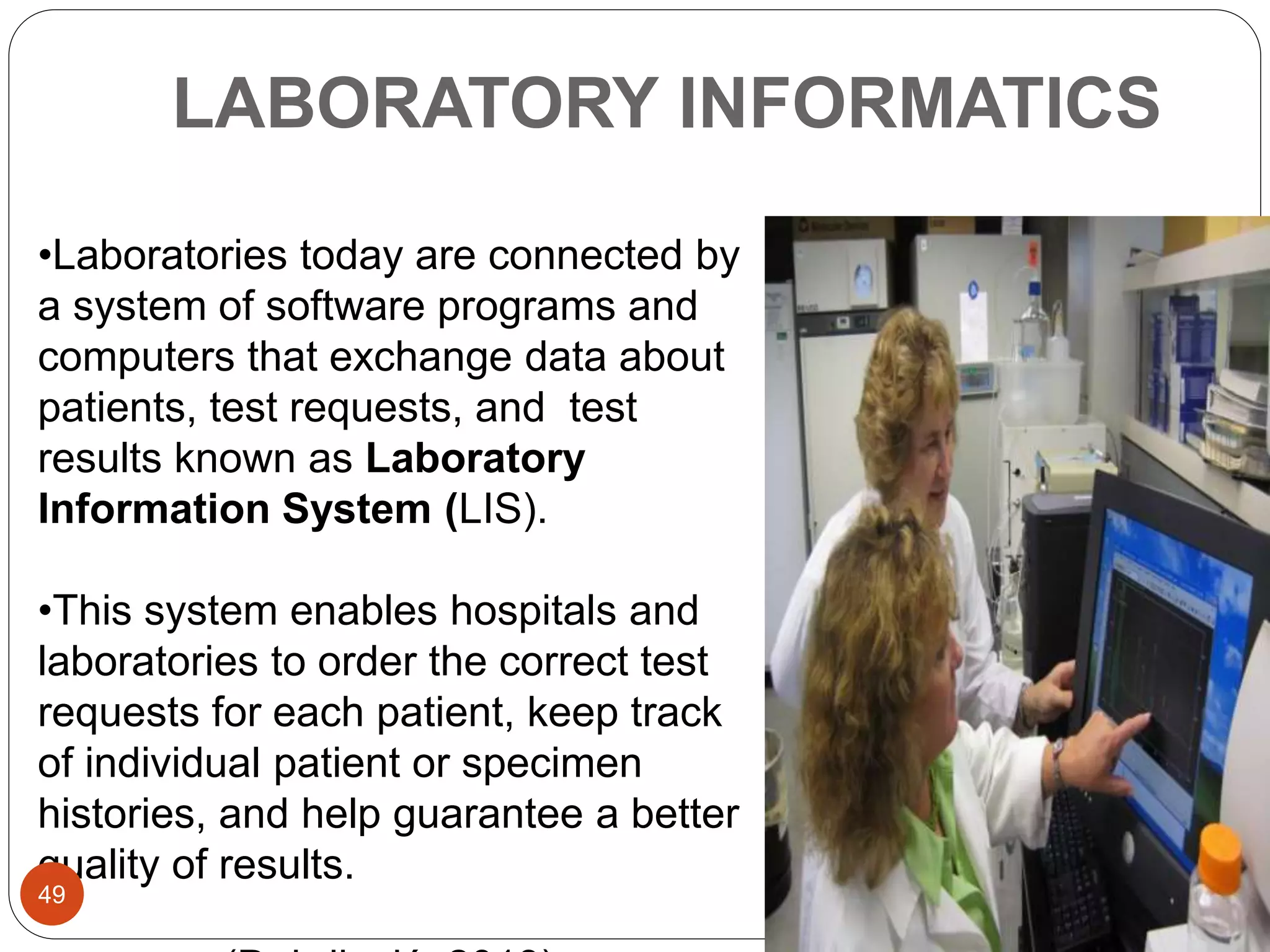
LABORATORY INFORMATICS
•Laboratories today are connected by
a system of software programs and
computers that exchange data about
patients, test requests, and test
results known as Laboratory
Information System (LIS).
•This system enables hospitals and
laboratories to order the correct test
requests for each patient, keep track
of individual patient or specimen
histories, and help guarantee a better
quality of results.
49
Summary
•Quality management is not static, therefore quality
improvement is expected of every laboratory as required by
the College of American Pathologists (CAP).
• Medical laboratories play important roles in ensuring quality of
care and patient safety. Much of this role relate to the timely
reporting of accurate test results, which depends on the
practice of effective QA.
• There is no compelling reason to deviate from practicing
quality management in the laboratory, particularly because test
results that would be generated without QA are likely to be
clinically irrelevant, misleading, or even dangerous to patients
(Wilson, 2008).
50
Summary (contd.)
• To achieve and maintain high operational standards
through quality assurance, there is the need to address
the quality of sample assayed from the pre-analytical to
post-analytical phases of laboratory analysis.
• It has been reported that the ability of a laboratory to
meet up with accreditation and regulatory requirements
help to determine the quality of results produced.
• However, accreditation alone does not guarantee
high quality testing or results
(Wilson, 2008).
51
CONCLUSION
• To assure quality of laboratory results, there must
be an effective and efficient quality assurance
management system put in place in the laboratory.
• Staff competency, training and motivation should
be given adequate attention right from the top
management to the least worker. It is important to
remember – as in the words of Dr. Mabel Charles-
Davies (personal contact): “In the laboratory, even
the so called ordinary cleaner is very relevant to the
accuracy of your analysis”.
52
References
1. Centre for Disease Control and Prevention: Laboratory Quality Assurance
and Standardization Programs. www.cdc.gov (accessed 26th March, 2014).
2. Recommended Soil Testing Procedures for the Northeastern United States
(2009): Laboratory Quality Assurance Program. Coperative Bulletin No.
493; pg1-10.
3. A. Storey, R. Briggs, H. Jones and R. Russell (2000): “Quality Assurance” -
Monitoring Bathing Waters ; A Practical Guide to the Design and
Implementation of Assessments and Monitoring Programmes . Chapter 4.
(World Health Organisation, Geneva).
4. Ken Middlebrook (2006): A Discussion Of Proficiency Testing Benefits And
Program Strategies. Canadian Association for Environmental Analytical
Laboratories (CAEAL); Pg 1-8.
5. CITAC / EURACHEM GUIDE (2000): Guide to Quality in Analytical
Chemistry- An Aid to Accreditation. [CITAC www.citac.ws and EURACHEM
53
References
6. Ales Fajgelj (2007): Assuring Quality of Analytical Measurement Results - The
IUPAC Role.
Chemistry International Vol. 29 No. 3.
7. www.iupac.org/publications/
8. Michael L. Wilson (2008): Assuring the Quality of Clinical Microbiology Test
Results. Clinical Infectious Diseases ; 47:1077–82.
9. Wayne, P.A. (2007): Laboratory Instrument Implementation, Verification, and
Maintenance; Proposed Guideline. Clinical and Laboratory Standards Institute. 2nd
ed. CLSI document GP27-A2.
10. M. A. Noble (2005) : History of Quality for the Modern Medical Laboratory (ppt.
accessed on 31st March, 2014).
11. www.wikipedia.org/ Quality Assurance /: Quality Assurance (accessed March,
2014)
54
References
13. www.wikipedia.org/ Laboratory Quality Control /: Laboratory Quality Control
(accessed March, 2014).
14. Tietz Fundamentals of Clinical Chemistry (2008): 6th Edition. Sauders Elsevier
Inc. ISBN: 9780721638652. pg 235-261.
15. Mario Plebani (2012): Quality Indicators to Detect Pre-Analytical Errors in
Laboratory Testing. Clin Biochem Rev. Vol 33. pg 85 – 88.
16. Bruce Hoskins (2009): Laboratory Quality Assurance Programs -
Recommended Soil Testing Procedures for the North-Eastern United States .
Cooperative Bulletin No. 493, chapter 1; pg 1- 10.
17. Vesna Dobrijević (2013): ‘Laboratory’. (ppt. accessed March, 2014).
18. J. M. Farr and Laurence Shatkin (2004): Best jobs for the 21st century. JIST
Works. p. 460. ISBN 1-56370-961-9.55
END
56

Strategies of assuring quality of laboratory results

  • 1.
    STRATEGIES OF ASSURING QUALITYOF LABORATORY RESULTS CHEMICAL PATHOLOGY LABORATORY METHODS (SEMINAR) By Godwin Joseph EMEKA 1
  • 2.
    OUTLINE: 1. Introduction 2. LaboratoryResults 3. The Medical Laboratory 4. History of Quality in the Laboratory 5. Quality Management Agencies 6. Quality Assurance Awareness 7. Quality Management Guidelines 8. Quality Assurance 9. Principles of Quality Assurance 10. Components of Quality Assurance 11. Strategies of Assuring Quality of Lab. Results 12. Conclusion 2
  • 3.
    INTRODUCTION •Laboratory tests aremedical procedures that involve analysing samples of blood, urine, tissues or other body substances. Example of tests ordered for include: glucose tolerance test, pregnancy test, viral test, allergy test etc (FDA, 2009). •A medical laboratory or clinical laboratory is a laboratory where tests are done on clinical specimens in order to get information about the health of a patient (Farr & Shatkin, 2004). 3
  • 4.
    LABORATORY RESULTS •Laboratory resultsare products of tests ordered by a physician as part of a routine check-up, or to confirm and monitor the health of a patient. Laboratory results are also used to: identify changes in patient’s health condition diagnose a disease plan treatment for a disease or health condition evaluate response to treatment prevention strategies in the absence of disease (FDA, 2009) 4
  • 5.
    THE MEDICAL LABORATORY •Medical laboratories play important roles in ensuring good quality healthcare and safety of patients, hence the need to ensure and assure the quality of test it performs and the result it produces. • Laboratories are of two types: i. the hospital lab. ii. the private (or community) lab. 5
  • 6.
    HISTORY OF QUALITYIN THE LABORATORY • The principle of quality management dates back more than 60 years ago. It became prominent in the days of Walter A. Shewhart and Edwards W. Deming i.e. in the 1920’s and 1930’s. • Quality Management had been an international initiative from the early era of industrialization and has been documented to be a valuable tool in military, government, industries and later in the laboratory. • In 1947, the International Organization for Standardization (ISO) was created to adopt and enforce industrial standards. (Noble, 2005). 6
  • 7.
    HISTORY OF QUALITYIN THE LABORATORY (contd.) • With the emergence of numerous health organizations and agencies, efforts had been focused on harmonizing laboratory requirements on quality assurance. • As a result, the formation of the IUPAC/ISO/AOAC working party in 1978 for harmonization of Quality Assurance schemes was put in place in achieving this. • The IUPAC Interdivisional Working Party for Harmonization of Quality Assurance (WPHQA) opened the door for single- laboratory method validation, also known as “in-house method validation”. (Fajgelj, 2007). 7
  • 8.
    QUALITY MANAGEMENT AGENCIES • Otherquality accrediting bodies with similar function as the ISO include: i. ILAC: International Laboratory Accreditation Cooperation ii. CLSI (formerly NCCLS): Clinical and Laboratory Standards Institute iii. IQLM: Institute for Quality in Laboratory Medicine iv. ISQH: International Society for Quality in Healthcare v. NCMLQS: National Committee for Medical Laboratory Quality Systems vi. IM: Institute of Medicine vii.AHRQ: Agency for Healthcare Research and Quality viii.IUPAC: International Union of Pure and Applied Chemistry ix. JCAHO: Joint Committee on Accreditation of Healthcare x. WHO: World Health Organisation 8
  • 9.
    QUALITY MANAGEMENT AGENCIES (contd.) xi.IHI: Institute for Healthcare Improvement xii. AOAC: Association of Official Analytical Chemist Organizations xiii.CCHSA: Canadian Council for Healthcare Services Accreditation xiv.CDC-DLS: Centers for Disease Control (Division of Laboratory Systems.) ( Noble, 2005). Laboratories have always depended on the guidance of the above mentioned health organizations for assistance in laboratory management procedures and accreditation programmes (Wilson, 2008).9
  • 10.
    QUALITY ASSURANCE AWARENESS • TheQuality and Compliance Department of these organisations assists clients (i.e. laboratories) with the development of their own quality process, primarily through lectures, workshops, inspections and telephone consultation. It also assists clients with accreditation and licensure. •Over the years, with the sensitisation and enforcements carried out by these regulatory bodies, laboratories now know and understand that the quality of the laboratory result is directly related to the quality and reliability of the equipment and10
  • 11.
    QUALITY MANAGEMENT GUIDELINES The aforementioned health organizations formulate guidelines and regulations from time to time to meet the expectations and challenges encountered in the laboratory. Of prominence among these regulations are: CLSI: GP26-A2 - Application of a Quality System Model for Laboratory Services; Approved Guideline—Second Edition. HS01-A - A Quality System Model for Health Care; Approved Guideline. ISO: ISO 17025:1999 - General Requirements for the Competence of Testing and Calibration Laboratories. ISO 9001:2000 - Quality Management. ISO 15189:2003 - Medical laboratories -- Particular Requirements for Quality and Competence. 11
  • 12.
    QUALITY MANAGEMENT GUIDELINES (contd.) •ISO guidelines contain15 management requirements and 10 technical requirements. These requirements outline what a laboratory must do to become accredited. • The ISO 17025 is an international standard that specifies the general requirements for the competence to carry out tests and or calibrations (Middlebrook, 2006). • The ISO developed and promulgated the ISO 9000 standards. It is a set of four standards (i.e. ISO 9001- 9004) enacted to ensure quality management and12
  • 13.
    QUALITY OF LABORATORY RESULTS •The International Standards Organisation defines “quality” as the degree to which a set of inherent characteristics fulfils requirements (ISO 9000:2000). • The quality of a laboratory result is determined by the protocols and standards put in place by the laboratory management or healthcare system. • These standards involve procedures, specifications and technical recommendations utilized by the laboratory to achieve her goal and objectives. Usually, they are documented in form of a manual called the quality manual. 13
  • 14.
    ASSURING QUALITY OF LABORATORYRESULTS The strategies of achieving quality of laboratory results involves the implementation of Quality Assurance procedures that ensure that accuracy and precision of laboratory results are met. 14
  • 15.
    WHAT IS QUALITY ASSURANCE? •QualityAssurance (QA) is defined as the sum total of the activities aimed at achieving a required standard (ISO, 1994). •It is a management method that is defined as “all those planned and systematic actions needed to provide adequate confidence that a product, service or result will satisfy given requirements for quality and be fit for use (Storey et al., 2000). •Quality Assurance is also defined as a way of preventing mistakes or avoiding problems and15
  • 16.
    LABORATORY QUALITY ASSURANCE  LaboratoryQuality Assurance encompasses a range of activities that enable laboratories to achieve and maintain high levels of accuracy and proficiency despite changes in test methods and the volume of specimens tested.  QA describes the overall measures that a laboratory uses to ensure the quality of its operations.  It summarily involves:  systematic measurement,  monitoring of processes,  comparison with a standard,  an associated feedback mechanism that confers error16
  • 17.
    PRINCIPLES OF QUALITY ASSURANCEIN THE LABORATORY The principles of QA have been formalised in a number of published protocols or standards. Those most widely recognised and used in chemical analysis fall into three groups and are applied according to a laboratory's individual needs. The three groups are: a) ISO/IEC 17025:1999: (RefB1) This standard addresses the technical competence of laboratories to carry out specific tests and calibrations and is used by laboratory accreditation bodies world-wide as the core requirements for the accreditation of 17
  • 18.
    ASSURANCE IN THELABORATORY contd. b) ISO 9001:2000: (Ref B2) and its national and international equivalents. This standard relates primarily to quality management, for facilities carrying out production, or providing services, including chemical analysis; c) OECD Principles of Good Laboratory Practice (GLP): 1998 (Ref B3) and its national and sectorial equivalents. These guidelines are concerned with the organisational processes and conditions under which laboratory studies related to certain regulatory work are carried out.18
  • 19.
    QUALITIES OF AGOOD QUALITY ASSURANCE SYSTEM A good QA system does these four things: a) establishes standard operating procedures (SOPs) for each step of the laboratory testing process, ranging from specimen handling to instrument performance validation; b) defines administrative requirements, such as mandatory recordkeeping, data evaluation, and internal audits to monitor adherence to SOPs; c) specifies corrective actions, documentation, and the persons responsible for carrying out corrective actions when problems are identified; d) sustains high-quality employee performance 19
  • 20.
    QUALITY ASSURANCE SYSTEM • Thereis no single method for establishing a QA system. Each organisation has its own problems that will require special consideration and planning. • Once the decision to implement a QA system has been taken and the necessary funds and facilities have been made available, then a plan must be drawn up. • It is better to build on procedures already in place and only to remove them if they are clearly unsatisfactory.20
  • 21.
    QUALITY MANUAL • Thequality manual (also called quality assurance plan) is a management document needed to implement QA programmes (ISO, 1990). • It is a document that outlines the goals to be achieved in the laboratory, with regard to quality of tests and results, and the quality assurance procedures that would be put in place to achieve it. (Storey et al., 2000) 21
  • 22.
    QUALITY MANUAL (contd.) Atypical quality manual contains the following items: 1) A quality policy statement, including objectives and commitments. 2) The organisation and management structure of the project, its place in any parent organisation and relevant organisational charts. 3) The relationship between management, technical operations, support services and the quality system. 4) Procedures for control and maintenance of documentation. 5) Job descriptions for key staff and reference to the job descriptions of other staff. 6) Identification of approved signatories. 7) The laboratory's scope for calibrations and tests. 22
  • 23.
    QUALITY MANUAL (contd.) 8)Procedures for ensuring traceability of all paperwork, data and reports. 9) Procedures for protecting confidentiality and property rights. 10) Procedures for audit and review. 11) Arrangements for ensuring that all new projects are reviewed to ensure that there are adequate resources to manage them properly. 12) Reference to the calibration, verification and testing procedures used. 13) Procedures for handling calibration and test items. 14) Reference to the major equipment and reference measurement standards used. 23
  • 24.
    QUALITY MANUAL (contd.) 15)Reference to procedures for calibration, verification and maintenance of equipment. 16) Reference to verification practices including inter- laboratory comparisons, proficiency testing programmes, use of reference materials and internal quality control schemes. 17) Procedures to be followed for feedback and corrective actions whenever testing discrepancies or departure from documented procedures are detected. 18) Procedures to be followed for feedback and corrective actions whenever testing discrepancies or departure from documented procedures are detected. 19) Complaints procedure. (Storey et al., 2000)24
  • 25.
    QUALITY MANUAL (contd.) Moreover,the QA plan must be seen to be practical and realistic and not to include trivial or unnecessarily time- consuming or difficult tasks. (WHO/UNEP/VKI, 1997). It is expected that laboratories that prepare a QA plan will produce a plan that will cover all their operations. 25
  • 26.
    COMPONENTS OF QUALITY ASSURANCE •The components of quality management system according to World Health Organisation (WHO, 2014) include: i. Documentation ii. Standard Operating Procedures (SOP's) iii. Quality Control iv. External Quality Assessment Scheme • However, the components of laboratory QA can be summarily categorized into two components, namely: i. laboratory quality control ii. quality assessment (Hoskins, 2009) 26
  • 27.
    LABORATORY QUALITY CONTROL • LaboratoryQuality Control is a measure of precision, or how well the measurement system reproduces the same result over time and under varying operating conditions. • Quality control is designed to detect, reduce, and correct deficiencies in a laboratory's internal analytical process prior to the release of patient results.• The operational techniques and activities that are used in quality control ensure the fulfilment of the requirements for quality laboratory results with emphasis on accuracy and precision. (Tietz, 2008) 27
  • 28.
    QUALITY CONTROL PROCEDURES • Qualitycontrol procedures include: analysis of reference materials/measurement standardisation validation of test methods analysis of blind samples use of quality control samples & control charts analysis of blanks analysis of spiked samples analysis in duplicate proficiency testing 28 (CITAC & EURACHEM, 2000).
  • 29.
    TYPES OF QUALITYCONTROL • Quality Control consists of two elements: a). internal quality control (IQC) b). external quality control (EQC). • Internal quality control consists of the operational techniques used by the laboratory staff for continuous assessment of the quality of the results of individual analytical procedures. • External quality control or inter-laboratory control is carried out periodically and checked by the29
  • 30.
    CONTROL CHARTS • Thecontrol chart is one of the seven basic tools of quality control which include the histogram, pareto chart, check sheet, cause and effect diagram, flowchart and scatter diagram. • Control charts prevents unnecessary process adjustments. It provides diagnostic information as well as information about process capability. The control chart is a proven technique for improving productivity. • Levey-Jennings chart is a graph that quality control data is plotted on to give a visual indication whether a laboratory test is working well. The distance from the mean is measured in standard deviations (SD). (Tietz, 2008) 30
  • 31.
  • 32.
  • 33.
    CONTROL CHARTS (contd.) •The Westgard rule can be applied to see whether the results from the samples when the control was done can be released, or if they need to be rerun. It is programmed into automated analyzers to determine when an analytical run should be rejected. •Westgard rules are commonly used to analyse data in Shewhart control charts. They are used to define specific performance limits for a particular assay and can be used to detect both random and systematic errors. • The Shewhart chart or Process-behaviour chart is a statistical tool intended to assess the nature of variation in a process and to facilitate forecasting and management. 33
  • 34.
    Westgard Control Chart 34(Tietz, 2008) 1.3
  • 35.
    LABORATORY QUALITY ASSESSMENT • Qualityassessment or Quality audit is comprised of those processes undertaken to monitor and document the effectiveness of the quality control program (Hoskins, 2009). • Moreover, quality assurance assessment provides a joint improvement opportunity for laboratories and its clients. •The report contains documentations of laboratory procedure variance and challenges, inappropriate submissions, sample handling, achievements, among other issues (CITAC & EURACHEM, 35
  • 36.
    LABORATORY STANDARDIZATION • Laboratory Standardization(LS) involve programs put in place to improve laboratory measurements. LS is achieved when test results with the same high level of accuracy and precision can be reproduced over time across various measurement systems. It is dependent on: reference material a reference measurement procedure (RMP)—the "gold standard" measurement system for a particular analyte secondary measurement procedures 36
  • 37.
    METHOD VALIDATION • Validationentails checks needed to be carried out to ensure that the performance characteristics of a method are scientifically sound and well understood (CITAC/EURACHEM, 2000). • The time interval required to validate a new, commercially available laboratory test is substantially between 3 to 6 months (Wilson, 2008). • After a method has been validated, found to be suitable and introduced into routine use in the laboratory, it is necessary to ensure that it continues to produce satisfactory results. Validity checks should be made on every laboratory device at frequent or regular intervals (Storey et al., 2000). • More on the concept of validation is found in the ISO 9000 and37
  • 38.
    PROFICIENCY TEST • Proficiencytesting is a means of assessing the ability of laboratories to competently perform specific tests and measurements. It is an important means of monitoring quality. • One of the best ways for an analytical laboratory to monitor its performance against its own requirements and the norm of other laboratories, is to participate regularly in proficiency testing schemes. • Proficiency testing helps to highlight repeatability and reproducibility performance of a laboratory. (CITAC/EURACHEM, 2000).38
  • 39.
    CALIBRATION Calibration is acomparison between measurement devices i.e. one of known magnitude or correctness (standard/reference material) and another made in a similar way (test instrument or unit under test). Regular internal and external calibration checks must be performed on equipment such as balances, pipettes, pH meters etc. Calibration and maintenance records should be kept for all equipment, thus allowing the repair status to be monitored (Storey et al., 2000).39
  • 40.
    STRATEGIES OF ASSURING QUALITYLABORATORY RESULTS Laboratory results can be of reliable quality with the implementation of all procedures involving quality assurance.40
  • 41.
    STRATEGIES OF ASSURING QUALITYLABORATORY RESULTS (contd.) Moreover, the strategies of assuring quality of laboratory results can be conveniently grouped with regard to the three phases of laboratory practice i.e. the pre-analytical, analytical and post-analytical. Hence, we have the: i. Pre-analytical strategies ii. Analytical strategies iii. Post-analytical strategies of assuring quality of laboratory results. 41
  • 42.
    STRATEGIES OF ASSURING QUALITYLABORATORY RESULTS 42
  • 43.
    QUALITY LABORATORY RESULTS contd. PRE-ANALYTICSTRATEGIES: i. traceability of results (relating the control result with a standard). ii. instituting an associated feedback network that confers error identification and prevention, iii. availability of a quality system i.e. a quality testing laboratory that carry out test to internationally recognised laboratory QC standards (i.e. ASTM, ISO etc.) iv. employing educated, trained and skilled staff, v. adequate training procedures for staff and patients, vi. correct registration and data input, vii.appropriateness of samples, viii.correct labelling of samples, ix. good transport conditions, x. compliance with policy and procedure. (Plebani, 2012) 43
  • 44.
    STRATEGIES OF ASSURING QUALITYLABORATORY RESULTS contd. ANALYTIC STRATEGIES: i. traceability of results (relating the control result with a standard). ii. proficiency testing iii. use of equipments that are suitably maintained and calibrated iv. operating with validated laboratory methods v. assay precision and accuracy vi. analytical sensitivity vii.analytical specificity viii.diagnostic sensitivity ix. diagnostic specificity x. turnaround time44
  • 45.
    STRATEGIES OF ASSURING QUALITYLABORATORY RESULTS contd. POST-ANALYTIC STRATEGIES: i. dispatching lab. results to their rightful owners ii. application of corrective actions in the event of errors or mistakes iii. comprehensive record keeping iv. effective documentation and reporting procedures v. unbiased and efficient client complaints service vi. efficient internal audit and review procedures vii.accuracy and clarity of laboratory reports viii.client interaction and consultation (CITAC/EURACHEM, 2000 ; Wilson, 2008) 45
  • 46.
    STRATEGIES OF ASSURINGQUALITY LABORATORY RESULTS contd. Other strategies of assuring analytical quality laboratory results include: 1. the ability of the lab. to be up to date with current updates on clinical laboratory practice 2. meeting up with accreditation and regulatory requirements 3. identifying malfunctions or deterioration of instruments or its compartments and replacing them. 4. keeping the lab. environment safe and suitable for meaningful analysis. 5. proper sample receipt and storage 6. use of duplicate analysis 7. the care and cleaning of equipment. 8. maintaining laboratory equipments on a regular basis as documented in the relevant standard of procedures (SOP), 46
  • 47.
    STRATEGIES OF ASSURING QUALITYOF LABORATORY RESULTS contd. 47
  • 48.
    STRATEGIES OF ASSURING QUALITYOF LABORATORY RESULTS contd. 48
  • 49.
    LABORATORY INFORMATICS •Laboratories todayare connected by a system of software programs and computers that exchange data about patients, test requests, and test results known as Laboratory Information System (LIS). •This system enables hospitals and laboratories to order the correct test requests for each patient, keep track of individual patient or specimen histories, and help guarantee a better quality of results. 49
  • 50.
    Summary •Quality management isnot static, therefore quality improvement is expected of every laboratory as required by the College of American Pathologists (CAP). • Medical laboratories play important roles in ensuring quality of care and patient safety. Much of this role relate to the timely reporting of accurate test results, which depends on the practice of effective QA. • There is no compelling reason to deviate from practicing quality management in the laboratory, particularly because test results that would be generated without QA are likely to be clinically irrelevant, misleading, or even dangerous to patients (Wilson, 2008). 50
  • 51.
    Summary (contd.) • Toachieve and maintain high operational standards through quality assurance, there is the need to address the quality of sample assayed from the pre-analytical to post-analytical phases of laboratory analysis. • It has been reported that the ability of a laboratory to meet up with accreditation and regulatory requirements help to determine the quality of results produced. • However, accreditation alone does not guarantee high quality testing or results (Wilson, 2008). 51
  • 52.
    CONCLUSION • To assurequality of laboratory results, there must be an effective and efficient quality assurance management system put in place in the laboratory. • Staff competency, training and motivation should be given adequate attention right from the top management to the least worker. It is important to remember – as in the words of Dr. Mabel Charles- Davies (personal contact): “In the laboratory, even the so called ordinary cleaner is very relevant to the accuracy of your analysis”. 52
  • 53.
    References 1. Centre forDisease Control and Prevention: Laboratory Quality Assurance and Standardization Programs. www.cdc.gov (accessed 26th March, 2014). 2. Recommended Soil Testing Procedures for the Northeastern United States (2009): Laboratory Quality Assurance Program. Coperative Bulletin No. 493; pg1-10. 3. A. Storey, R. Briggs, H. Jones and R. Russell (2000): “Quality Assurance” - Monitoring Bathing Waters ; A Practical Guide to the Design and Implementation of Assessments and Monitoring Programmes . Chapter 4. (World Health Organisation, Geneva). 4. Ken Middlebrook (2006): A Discussion Of Proficiency Testing Benefits And Program Strategies. Canadian Association for Environmental Analytical Laboratories (CAEAL); Pg 1-8. 5. CITAC / EURACHEM GUIDE (2000): Guide to Quality in Analytical Chemistry- An Aid to Accreditation. [CITAC www.citac.ws and EURACHEM 53
  • 54.
    References 6. Ales Fajgelj(2007): Assuring Quality of Analytical Measurement Results - The IUPAC Role. Chemistry International Vol. 29 No. 3. 7. www.iupac.org/publications/ 8. Michael L. Wilson (2008): Assuring the Quality of Clinical Microbiology Test Results. Clinical Infectious Diseases ; 47:1077–82. 9. Wayne, P.A. (2007): Laboratory Instrument Implementation, Verification, and Maintenance; Proposed Guideline. Clinical and Laboratory Standards Institute. 2nd ed. CLSI document GP27-A2. 10. M. A. Noble (2005) : History of Quality for the Modern Medical Laboratory (ppt. accessed on 31st March, 2014). 11. www.wikipedia.org/ Quality Assurance /: Quality Assurance (accessed March, 2014) 54
  • 55.
    References 13. www.wikipedia.org/ LaboratoryQuality Control /: Laboratory Quality Control (accessed March, 2014). 14. Tietz Fundamentals of Clinical Chemistry (2008): 6th Edition. Sauders Elsevier Inc. ISBN: 9780721638652. pg 235-261. 15. Mario Plebani (2012): Quality Indicators to Detect Pre-Analytical Errors in Laboratory Testing. Clin Biochem Rev. Vol 33. pg 85 – 88. 16. Bruce Hoskins (2009): Laboratory Quality Assurance Programs - Recommended Soil Testing Procedures for the North-Eastern United States . Cooperative Bulletin No. 493, chapter 1; pg 1- 10. 17. Vesna Dobrijević (2013): ‘Laboratory’. (ppt. accessed March, 2014). 18. J. M. Farr and Laurence Shatkin (2004): Best jobs for the 21st century. JIST Works. p. 460. ISBN 1-56370-961-9.55
  • 56.