Aseptic Area &
Microbial Control
• Introduction
• Designing of Aseptic Area
• Laminar Flow equipment's
• Sources of Contamination, Prevention & Classification of Aseptic Area
• Testing of Clean & Aseptic rooms
Prepared by-
Prof. Shinde Kiran (M.Pharm)
Assistant Professor
Pharmaceutical Microbiology-I
Second year B. Pharm
IIIRD Semester
VIDYA NIKETAN INSTITUTE
OF PHARMACY & RESEARCH
CENTRE, BOTA
1
INTRODUCTION
1. An aseptic area is a room within a clean area designed, constructed, serviced and used with the
intention of preventing microbial contamination of the product.
2. Aseptic techniques are used to prevent the access of microbial & particulate contamination into
ophthalmic & parental products.
3. Control of microbial contamination is also necessary to eliminate pyrogens and toxic bacterial
products.
4. Terminally sterilized products are required formulated or prepared in an aseptic area.
5. Terminally sterilized products are the product sealed in container and then sterilized.
6. Such aseptically prepared products are required to be formulated and prepared in an aseptic room.
2
DESIGNING OF ASEPTIC AREA
Sterile Products should be carried out in a clean aseptic environment for prevent the risk of
contamination of the products.
The production are normally divided into
• The Clean-up area,
• The Compounding area,
• The Aseptic area,
• The Quarantine area and
• The Packaging area
All these areas should be designed and constructed for
• Ease of clearing,
• Efficient operation,
• Attractiveness and
• Comfort of personnel
3
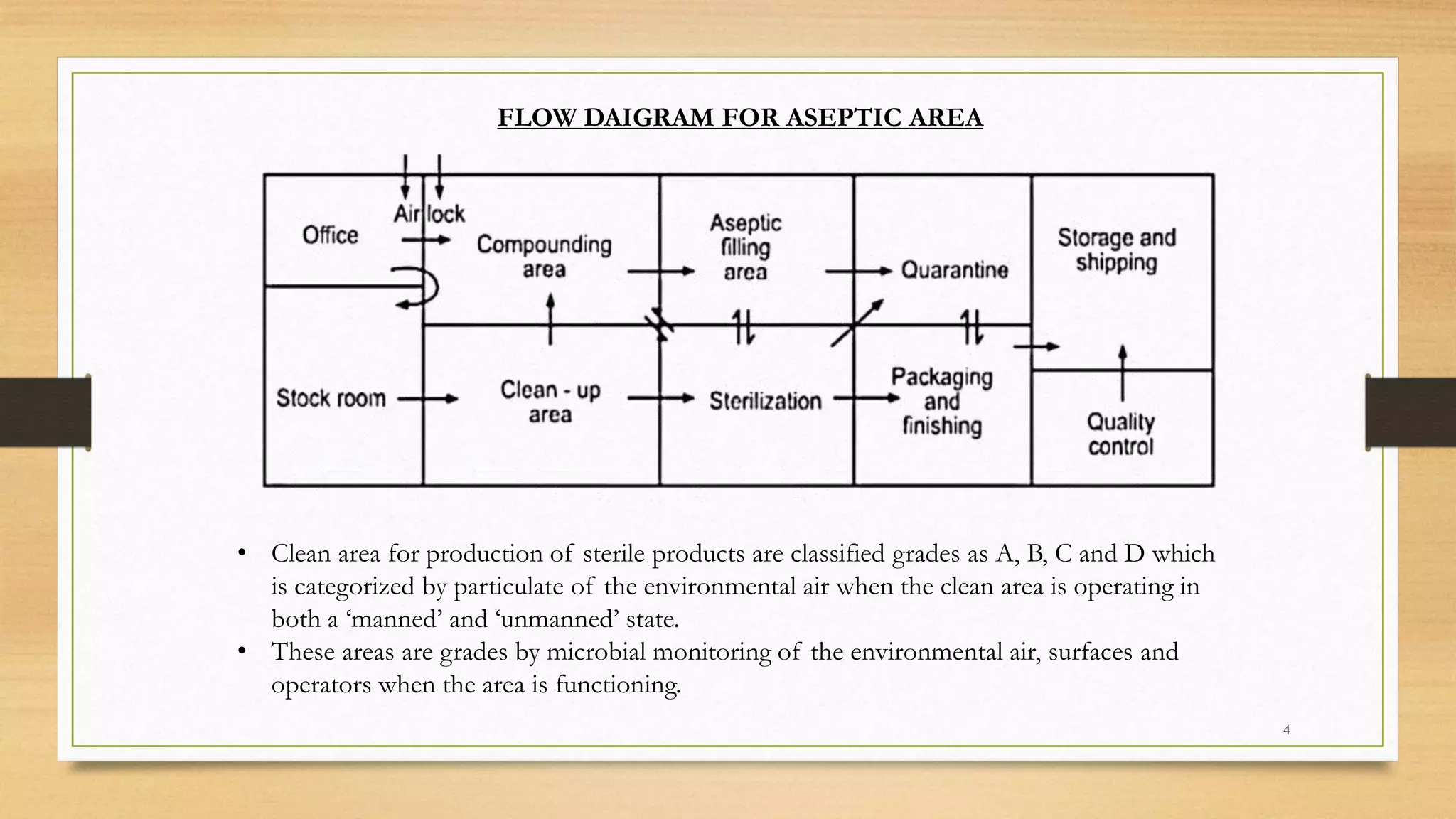
FLOW DAIGRAM FOR ASEPTIC AREA
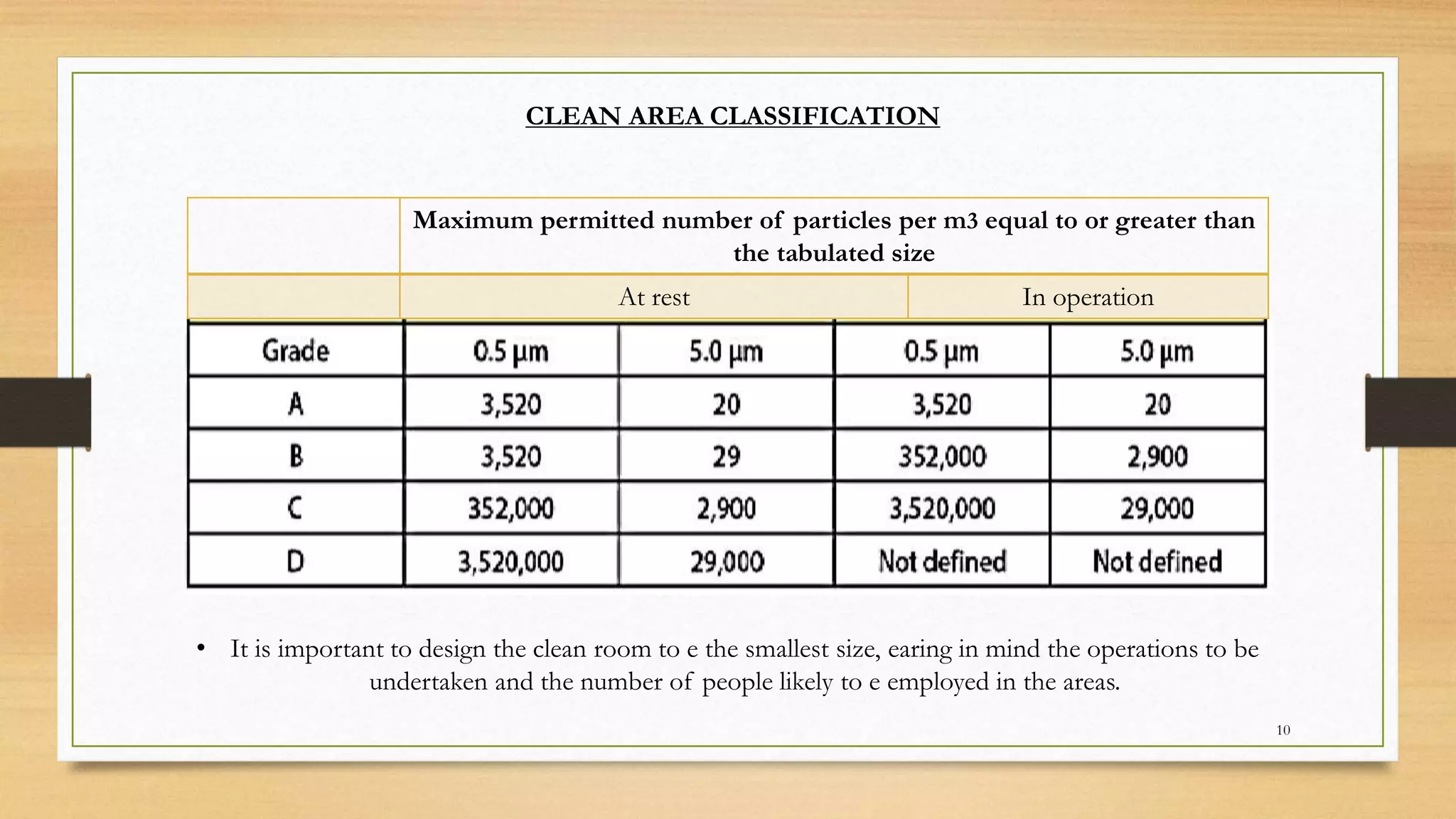
• Clean area for production of sterile products are classified grades as A, B, C and D which
is categorized by particulate of the environmental air when the clean area is operating in
both a ‘manned’ and ‘unmanned’ state.
• These areas are grades by microbial monitoring of the environmental air, surfaces and
operators when the area is functioning.
4
1. Floors, Walls & Ceilings: They must e smooth, impervious, easily cleaned and disinfected to minimize
microbial & particulate contamination. Walls must be made of non-inflammable
or fire-resistant materials. The ceilings are sealed to prevent the entry of
microbial contaminants.
2. Doors, Windows & Services: Doors & Windows should be flush with walls and non-open-able. Limited
doors, airlock doors, wall ports, autoclaves and dry heat sterilizers fitted inside
interlocked doors. Gas cylinder & non-essentials switches should be outside
the aseptic rooms. Sinks, drains & light sources fitted inside the aseptic rooms.
3. Personnel & Protective Clothing: Personnel must be in good health, well-trained for good manufacturing
practises and aseptic techniques, free from dermatological conditions.
Protective clothing is designed to prevent contamination from body.
Clothes should be sterilized by moist heat sterilization , fresh sterile
clothing. The operator must wear headwear, powder-free rubber or
plastic gloves, a non-fibre shedding facemask and footwear.
4. Cleaning & Disinfectant: This used for removal of microbial and particulate contamination. Different
disinfectants must be employed in rotation to prevent the development of
resistant strains of micro-organisms.
5
LAMINAR FLOW EQUIPMENT
Laminar air flow equipment can deliver clean air in direction
• Vertical Laminar Air Flow bench
• Horizontal Laminar Air Flow bench.
Horizontal Laminar Air Flow bench Horizontal Direction for Air FlowVertical Laminar Air Flow bench
6
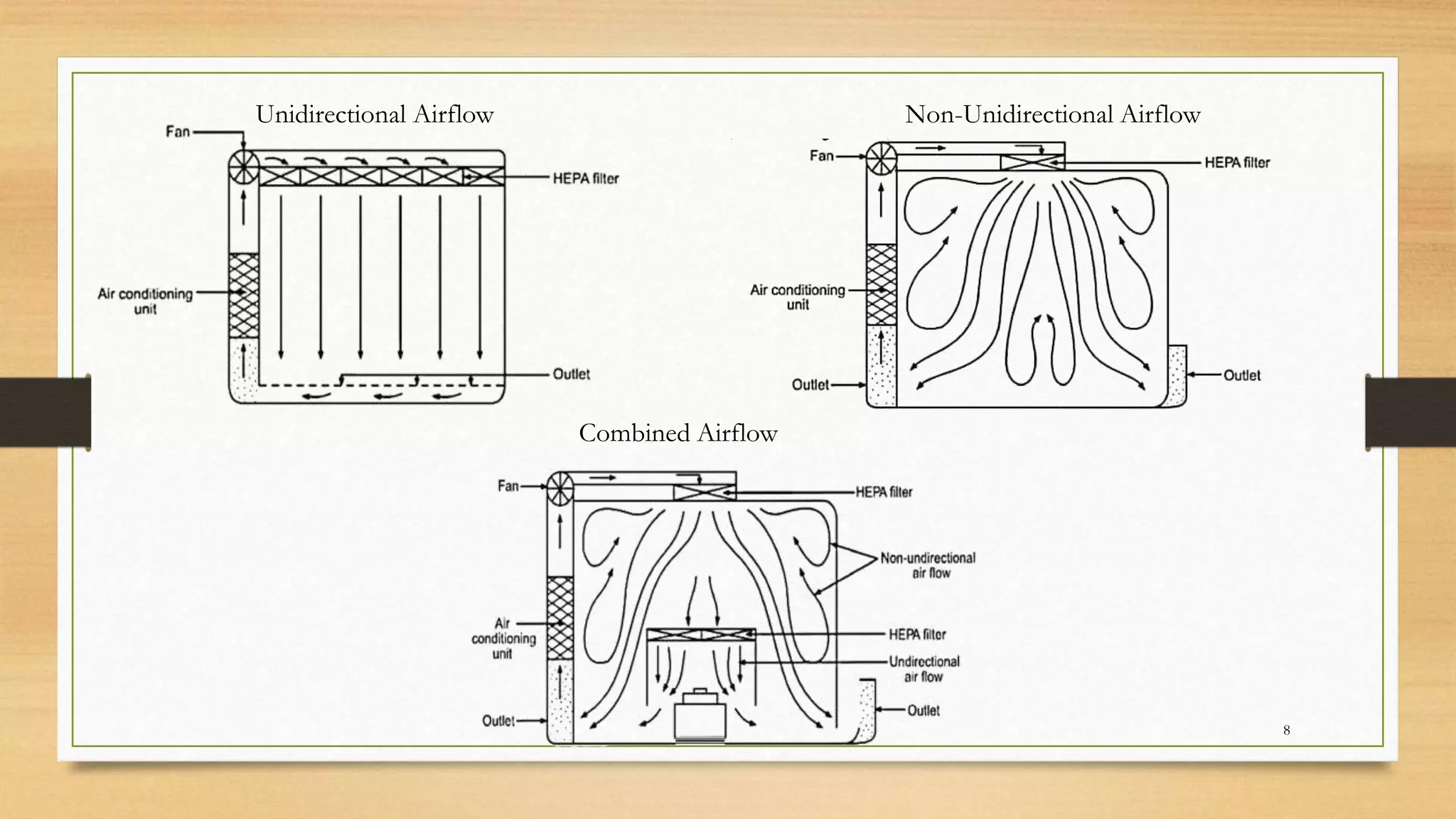
2. Air Flow Pattern: The air flow pattern within the clean room must e carefully regulated to avoid generating
particles from the clean room floor, walls and operators.
The general air flow patterns in clean rooms are,
1. Unidirectional airflow
2. Non-unidirectional airflow
3. Combined airflow
1. Air Supply: The air supply to a clean room must e filtered through high-efficiency particulate air
[HEPA] filters.
• The air filtered by laminar air flow is 99.97% free from microbial contamination
• This level is based upon the removal of dioctylphtalate [DOP] Particles of size 0.3 m and larger.
• Air velocity at all parts of the filter should be 90  feet/min [0.54 m/sec].
• Air quality is evaluated using settle plates, microbial air sampler or by particle counters
7
Unidirectional Airflow Non-Unidirectional Airflow
Combined Airflow
8
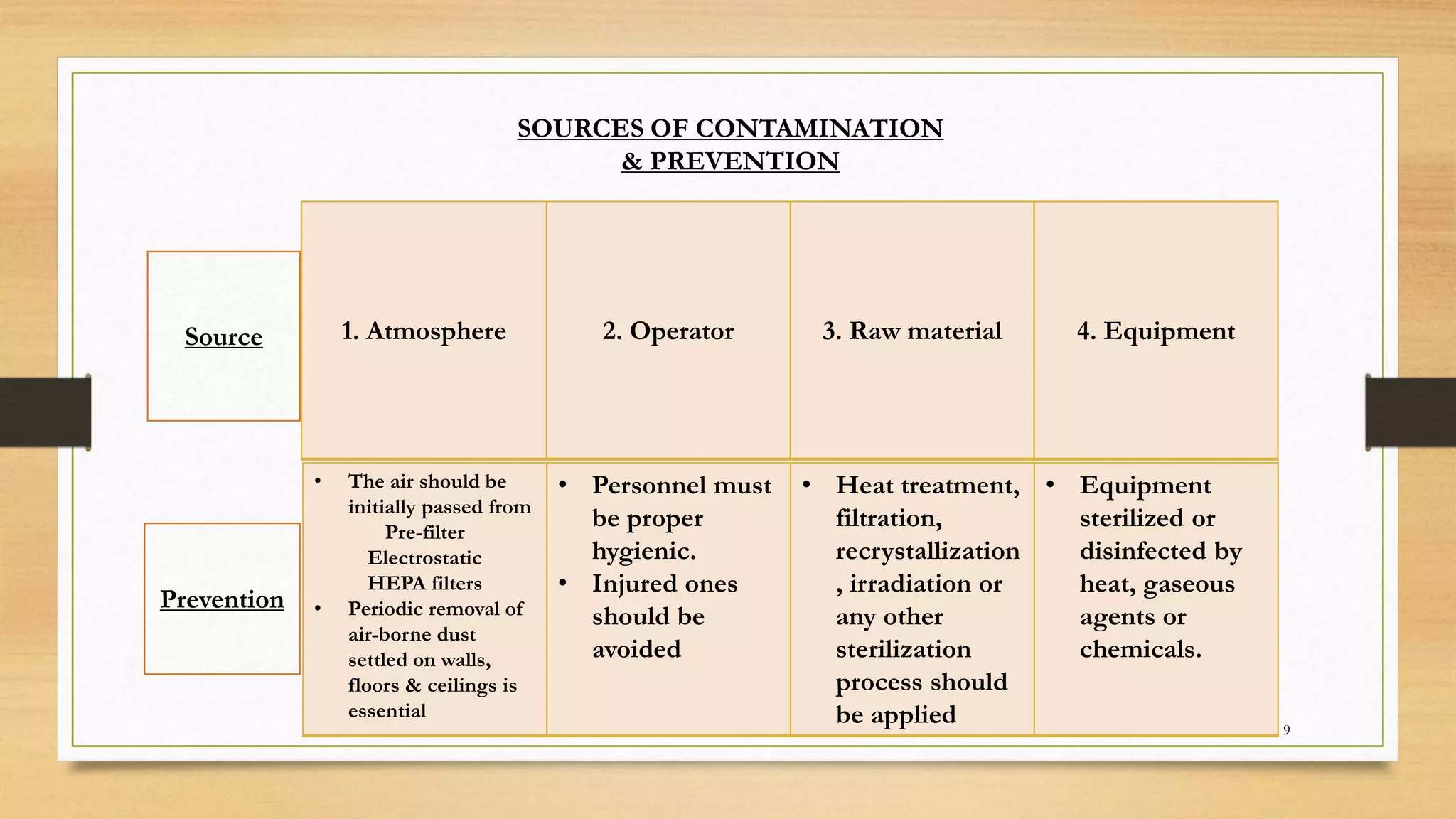
SOURCES OF CONTAMINATION
& PREVENTION
1. Atmosphere 2. Operator 3. Raw material 4. EquipmentSource
• The air should be
initially passed from
Pre-filter
Electrostatic
HEPA filters
• Periodic removal of
air-borne dust
settled on walls,
floors & ceilings is
essential
• Personnel must
be proper
hygienic.
• Injured ones
should be
avoided
• Heat treatment,
filtration,
recrystallization
, irradiation or
any other
sterilization
process should
be applied
• Equipment
sterilized or
disinfected by
heat, gaseous
agents or
chemicals.
Prevention
9
CLEAN AREA CLASSIFICATION
• It is important to design the clean room to e the smallest size, earing in mind the operations to be
undertaken and the number of people likely to e employed in the areas.
Maximum permitted number of particles per m3 equal to or greater than
the tabulated size
At rest In operation
10
TESTING OF CLEAN & ASEPTIC ROOOMS
It is necessary to monitor the area by suitable environmental control tests.
 The methods are divided as
1. General methods
2. Air sampling methods
3. Surface sampling methods
a) Rodac plate
b) Swab-rinse test
a) Slit-air sampler
b) Liquid impinger
c) Centrifugal air sampler [Bio test ]
11
THANKYOU
12

Aseptic Area and Microbial Control. - Pharmaceutical Microbiology (SYBpharm) (3rd Semester)

  • 1.
    Aseptic Area & MicrobialControl • Introduction • Designing of Aseptic Area • Laminar Flow equipment's • Sources of Contamination, Prevention & Classification of Aseptic Area • Testing of Clean & Aseptic rooms Prepared by- Prof. Shinde Kiran (M.Pharm) Assistant Professor Pharmaceutical Microbiology-I Second year B. Pharm IIIRD Semester VIDYA NIKETAN INSTITUTE OF PHARMACY & RESEARCH CENTRE, BOTA 1
  • 2.
    INTRODUCTION 1. An asepticarea is a room within a clean area designed, constructed, serviced and used with the intention of preventing microbial contamination of the product. 2. Aseptic techniques are used to prevent the access of microbial & particulate contamination into ophthalmic & parental products. 3. Control of microbial contamination is also necessary to eliminate pyrogens and toxic bacterial products. 4. Terminally sterilized products are required formulated or prepared in an aseptic area. 5. Terminally sterilized products are the product sealed in container and then sterilized. 6. Such aseptically prepared products are required to be formulated and prepared in an aseptic room. 2
  • 3.
    DESIGNING OF ASEPTICAREA Sterile Products should be carried out in a clean aseptic environment for prevent the risk of contamination of the products. The production are normally divided into • The Clean-up area, • The Compounding area, • The Aseptic area, • The Quarantine area and • The Packaging area All these areas should be designed and constructed for • Ease of clearing, • Efficient operation, • Attractiveness and • Comfort of personnel 3
  • 4.
    FLOW DAIGRAM FORASEPTIC AREA • Clean area for production of sterile products are classified grades as A, B, C and D which is categorized by particulate of the environmental air when the clean area is operating in both a ‘manned’ and ‘unmanned’ state. • These areas are grades by microbial monitoring of the environmental air, surfaces and operators when the area is functioning. 4
  • 5.
    1. Floors, Walls& Ceilings: They must e smooth, impervious, easily cleaned and disinfected to minimize microbial & particulate contamination. Walls must be made of non-inflammable or fire-resistant materials. The ceilings are sealed to prevent the entry of microbial contaminants. 2. Doors, Windows & Services: Doors & Windows should be flush with walls and non-open-able. Limited doors, airlock doors, wall ports, autoclaves and dry heat sterilizers fitted inside interlocked doors. Gas cylinder & non-essentials switches should be outside the aseptic rooms. Sinks, drains & light sources fitted inside the aseptic rooms. 3. Personnel & Protective Clothing: Personnel must be in good health, well-trained for good manufacturing practises and aseptic techniques, free from dermatological conditions. Protective clothing is designed to prevent contamination from body. Clothes should be sterilized by moist heat sterilization , fresh sterile clothing. The operator must wear headwear, powder-free rubber or plastic gloves, a non-fibre shedding facemask and footwear. 4. Cleaning & Disinfectant: This used for removal of microbial and particulate contamination. Different disinfectants must be employed in rotation to prevent the development of resistant strains of micro-organisms. 5
  • 6.
    LAMINAR FLOW EQUIPMENT Laminarair flow equipment can deliver clean air in direction • Vertical Laminar Air Flow bench • Horizontal Laminar Air Flow bench. Horizontal Laminar Air Flow bench Horizontal Direction for Air FlowVertical Laminar Air Flow bench 6
  • 7.
    2. Air FlowPattern: The air flow pattern within the clean room must e carefully regulated to avoid generating particles from the clean room floor, walls and operators. The general air flow patterns in clean rooms are, 1. Unidirectional airflow 2. Non-unidirectional airflow 3. Combined airflow 1. Air Supply: The air supply to a clean room must e filtered through high-efficiency particulate air [HEPA] filters. • The air filtered by laminar air flow is 99.97% free from microbial contamination • This level is based upon the removal of dioctylphtalate [DOP] Particles of size 0.3 m and larger. • Air velocity at all parts of the filter should be 90  feet/min [0.54 m/sec]. • Air quality is evaluated using settle plates, microbial air sampler or by particle counters 7
  • 8.
  • 9.
    SOURCES OF CONTAMINATION &PREVENTION 1. Atmosphere 2. Operator 3. Raw material 4. EquipmentSource • The air should be initially passed from Pre-filter Electrostatic HEPA filters • Periodic removal of air-borne dust settled on walls, floors & ceilings is essential • Personnel must be proper hygienic. • Injured ones should be avoided • Heat treatment, filtration, recrystallization , irradiation or any other sterilization process should be applied • Equipment sterilized or disinfected by heat, gaseous agents or chemicals. Prevention 9
  • 10.
    CLEAN AREA CLASSIFICATION •It is important to design the clean room to e the smallest size, earing in mind the operations to be undertaken and the number of people likely to e employed in the areas. Maximum permitted number of particles per m3 equal to or greater than the tabulated size At rest In operation 10
  • 11.
    TESTING OF CLEAN& ASEPTIC ROOOMS It is necessary to monitor the area by suitable environmental control tests.  The methods are divided as 1. General methods 2. Air sampling methods 3. Surface sampling methods a) Rodac plate b) Swab-rinse test a) Slit-air sampler b) Liquid impinger c) Centrifugal air sampler [Bio test ] 11
  • 12.