pharmaceutical aids
Definition
• Substances which are of little or no therapeutic value,
but are necessary in the manufacture, compounding,
storage, etc., of pharmaceutical preparations or drug
dosage forms.
• They include solvents, diluting agents, and suspending
agents, and emulsifying agents, antioxidants;
preservatives, pharmaceutical; colouring agents;
flavouring agents; vehicles; excipients; ointment bases.
• Substances added to pharmaceutical preparations to
protect them from chemical change or microbial action.
they include anti-bacterial agents and antioxidants.
Definition
• "Pharmaceutical aids are the drugs or substances
which have no or little pharmacological effect but
they are essentially used in the preparation of
pharmaceutical dosage forms" (like tablets,
injections, emulsions, ointments.)
• Substances added to pharmaceutical preparations to
protect them from chemical change or microbial
action.
• They may be plant, animal, mineral or synthetic
origin.
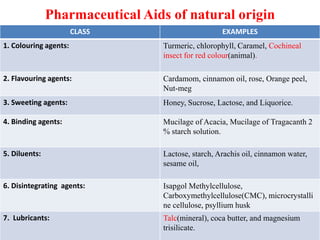
Pharmaceutical Aids of natural origin
CLASS EXAMPLES
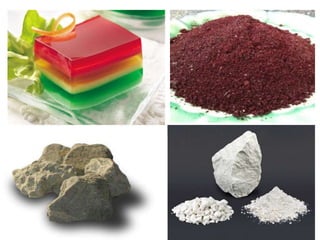
1. Colouring agents: Turmeric, chlorophyll, Caramel, Cochineal
insect for red colour(animal).
2. Flavouring agents: Cardamom, cinnamon oil, rose, Orange peel,
Nut-meg
3. Sweeting agents: Honey, Sucrose, Lactose, and Liquorice.
4. Binding agents: Mucilage of Acacia, Mucilage of Tragacanth 2
% starch solution.
5. Diluents: Lactose, starch, Arachis oil, cinnamon water,
sesame oil,
6. Disintegrating agents: Isapgol Methylcellulose,
Carboxymethylcellulose(CMC), microcrystalli
ne cellulose, psyllium husk
7. Lubricants: Talc(mineral), coca butter, and magnesium
trisilicate.
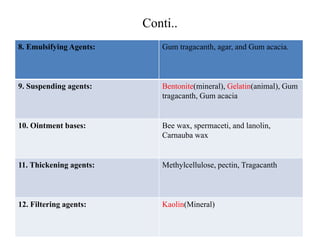
Conti..
8. Emulsifying Agents: Gum tragacanth, agar, and Gum acacia.
9. Suspending agents: Bentonite(mineral), Gelatin(animal), Gum
tragacanth, Gum acacia
10. Ointment bases: Bee wax, spermaceti, and lanolin,
Carnauba wax
11. Thickening agents: Methylcellulose, pectin, Tragacanth
12. Filtering agents: Kaolin(Mineral)
Bentonite
Synonym- anti caking agent,
• Bentonite-
an absorbent aluminium phyllosilicate clay
consisting mostly of montmorillonite
• It has the incredible ability to increase as
much as 14 times its original volume.
• They mainly exist in cationic form of
organic compounds such as aromatic or
aliphatic hydrocarbon and are employed to
modify high cations exchange capacity
• Bentonite is a layer of natural silicate clay
mineral having numerous properties such
as large specific surface area, great
absorption and interlayer exchangeable
cations.
Formation of Bentonite
• Bentonite is a material derived from the
alteration, over geological time periods,
of glassy material emitted from
volcanoes (tuff or ash), or from the
alteration of silica bearing rocks such as
granite and basalt. Bentonite only forms
in the presence of water.
Types of Bentonite
• Two types of Bentonite are recognized, and the
uses of each depend on specific physical
properties.
• Type 1: Sodium Bentonite
Sodium Bentonite is the type of swelling clay. It
has single water layer particles which contain
Na+ as the exchangeable ion.
• Type 2: Calcium Bentonite
Calcium Bentonite is the non-swelling clay. It has
a double water layer with Ca2+ as the
exchangeable ion.
Distribution
• Rajasthan, karnataka, kerala, Gujarat, etc.
• Chemical constituents: Aluminium
oxide(Al2O3), Iron oxide( Fe2O3), Magnesium
oxide(MgO), Calcium oxide(CaO), Titanium
Dioxide(TiO2), Potassium oxide(K2O), Sodium
oxide(Na2O)
Preparation
• Bentonite deposits are normally exploited by quarrying(large
deep hole). Extracted bentonite is distinctly solid, even with a
moisture content of approximately 30%. The material is
initially crushed and, if necessary, activated with the addition
of soda ash (Na2CO3). Bentonite is subsequently dried (air
and/or forced drying) to reach a moisture content of
approximately 15%
• According to the final application, bentonite is either sieved
(granular form) or milled (into powder and super fine powder
form). For special applications, bentonite is purified by
removing the associated gangue minerals, or treated with
acids to produce acid-activated bentonite.
Physical Properties
• Specific gravity=2.49-2.72
• Specific surface area=370-487
• Oil absorption(% by wt)=73-87
• Water absorption(% by wt)=115-207
• Attrition resistance(%) =80-95
• Adsorption of water vapour (%) =11-17
Uses
Based on the physical and chemical properties
the Bentonite can be used in the following
industries:
• Bleaching of edible oil.
• Oil absorption.
• Odour and liquid absorbent.
• Waste water treatment.
• Cast iron industry.
• Pelletizing(molding of material into the shape of
pellet).
• Filtering and clarification.
Kaolin
• Synonym- Bolus alba; China Clay;
Porcelain clay; White bole; Argilla
• Kaolin= hydrous aluminum silicate
(Al2O3.2SiO2.2H2O, Where
Al2O3=39.3%, SiO2=46.8%,
H2O=13.9%.
• Physical characters:
- Soft, Clay material
- Particle size of heavy kaolin=20µm in
diameter/ fine particle=2µm
- Slightly plastic
- Normally white in colour
- Unctuous and soapy to touch
- Fusion point=1700-1800°
Conti..
• Formation: Kaolins are derived from pegmatites
or from hydrothermal alterations. They may also
occur as blanket deposits in extensive area of
igneous of metamorphic rocks.
• Distribution: Garo Hill of Assam, Bihar,
Maharastra, Madya pradesh, Delhi, Kerala.
• Chemical constituents: Kaolin group contains
Kaolinite, Nacrite, Dickite, Annauxite and
Hallosysite. All Al2O3.2SiO2. 2H2O with traces of
Mg, Ca and Fe.
Preparation
• Kaolin is prepared when the rock in
mined, excavated and the impurities are
washed with water and then powdered.
The rock is elutriated with water and
large-sized particles are separated. On
allowing the turbid to settle, heavy kaolin
containing particle of large size and
colloidal kaolin containing particles of
small size are separated and then dried
Uses
• Dusting powder
• Poultice
• Carrier of heat
• Filtering agent
• Cleaning agent
• Fine kaolin is used internally as an adsorbent and to
coat irritated intestinal mucosa in case of diarrhoea,
dysentery and intestinal fermentation.
• They are also used to manufacture porcelain,
pottery, bricks, Portland cement, plaster mineral,
electric and heat insulators; clarifying liquids,
drying and emollient agents.
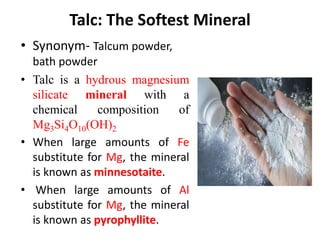
Talc: The Softest Mineral
• Synonym- Talcum powder,
bath powder
• Talc is a hydrous magnesium
silicate mineral with a
chemical composition of
Mg3Si4O10(OH)2
• When large amounts of Fe
substitute for Mg, the mineral
is known as minnesotaite.
• When large amounts of Al
substitute for Mg, the mineral
is known as pyrophyllite.
• Talc: Talc is a phyllosilicate mineral that cleaves into thin sheets. These
sheets are held together only by van der Waals bonds, which allows
them to easily slip past one another. This characteristic is responsible
for talc's extreme softness, its greasy to soapy feel, and its value as a
high-temperature lubricant.
How Does Talc Form?
• Talc is a mineral that is most often found in
the metamorphic rocks of convergent plate
boundaries(between an oceanic and
continental plate). It forms from at least two
processes.
• First process, Most large talc is formed when
heated waters carrying dissolved magnesium
and silica reacted with dolomitic marbles.
• A second process of talc formation occurred
when heat and chemically active fluids altered
rocks such as dunite and serpentinite into talc.
Physical properties
1. Chemical Classification Silicate
2. Crystal system Monoclinic or triclinic
3. Color Green, white, gray, brown, colorless
4. Rock Type Metamorphic
5. Optical properties Biaxial (-)
6. Cleavage Perfect
7. Mohs Hardness 1
8. Specific Gravity 2.7 to 2.8
9. Chemical Composition Mg3Si4O10(OH)2
10. Transparency Transparent to opaque
12. Refractive index nα = 1.538 – 1.550
nβ = 1.589 – 1.594
nγ = 1.589 – 1.600
13. Luster Pearly
VARIETIES
• Beaconite- A fibrous variety of Talc resembling asbestos.
• Chromian Talc- A chromian variety of talc
• Polyphant Stone- A greyish-green potstone flecked with white
and brown. Used since Norman times as an ornamental stone
in churches.
• Pseudolite- Octahedral talc pseudomorphs after spinel.
• Steatite-A massive variety of Talc with a greasy feeling, often
used for ornamental carvings.
• Zincian Talc- Zn-bearing variety from the "Mixed Series"
formation.
• Distribution:
Rajasthan, Maharastra, kerala, Gujarat,
Madya pradesh, etc.
• Chemical composition: Talc is a hydrous
magnesium silicate mineral with a chemical
composition of Mg3Si4O10(OH)2. Although
the composition of talc usually stays close to
this generalized formula, some substitution
occurs.
Preparation
• Talc is a metamorphic mineral that results from the metamorphism
of magnesian minerals such as serpentine, pyroxene, amphibole,
and olivine, in the presence of carbon dioxide and water. This is
known as "talc carbonation" or "steatization" and produces a suite
of rocks known as talc carbonates.
• Talc is primarily formed by hydration and carbonation by this
reaction:
2Mg3Si2O5(OH)4(serpentine) +3CO2(carbondioxide) → Mg3Si4O10(OH)2 (talc)
+ 3MgCO3(magnesite) + 3H2O(water)
• Talc can also be formed via a reaction between
dolomite and silica, which is typical
of skarnification of dolomites by silica-flooding in
contact metamorphic aureoles:
3CaMg(CO3)2(dolomite) + 4 SiO2 (silica) + H2O
(water)→ Mg3Si4O10(OH)2(talc) + 3CaCO3 (calcite)+ 3
CO2(carbon dioxide)
• Talc can also be formed from magnesium chlorite
and quartz in blueschist and eclogite metamorphism
by the following metamorphic reaction:
chlorite+ quartz → kyanite + talc + water
• In this reaction, the ratio of talc and kyanite depends
on aluminium content, with more aluminous rocks
favoring production of kyanite. Such rocks are
typically white, friable, and fibrous, and are known
as whiteschist.
Uses
• Talc in Ceramics
• Talc in Paint
• A lubricant, and as a filler in paper manufacture.
• Talc in Cosmetics(talcum powder), and Antiperspirants
• Talc in Roofing Materials
• Coatings
• In pharmaceutical products as a glidant.
• Sterile talc powder: In medicine, talc is used as
a pleurodesis agent to prevent recurrent pleural
effusion or pneumothorax.
• electric cable, electrical switchboards because of its
resistance to heat and electricity
• Gelatin & Diatomite

Pharmaceutical aids

  • 1.
  • 3.
    Definition • Substances whichare of little or no therapeutic value, but are necessary in the manufacture, compounding, storage, etc., of pharmaceutical preparations or drug dosage forms. • They include solvents, diluting agents, and suspending agents, and emulsifying agents, antioxidants; preservatives, pharmaceutical; colouring agents; flavouring agents; vehicles; excipients; ointment bases. • Substances added to pharmaceutical preparations to protect them from chemical change or microbial action. they include anti-bacterial agents and antioxidants.
  • 4.
    Definition • "Pharmaceutical aidsare the drugs or substances which have no or little pharmacological effect but they are essentially used in the preparation of pharmaceutical dosage forms" (like tablets, injections, emulsions, ointments.) • Substances added to pharmaceutical preparations to protect them from chemical change or microbial action. • They may be plant, animal, mineral or synthetic origin.
  • 5.
    Pharmaceutical Aids ofnatural origin CLASS EXAMPLES 1. Colouring agents: Turmeric, chlorophyll, Caramel, Cochineal insect for red colour(animal). 2. Flavouring agents: Cardamom, cinnamon oil, rose, Orange peel, Nut-meg 3. Sweeting agents: Honey, Sucrose, Lactose, and Liquorice. 4. Binding agents: Mucilage of Acacia, Mucilage of Tragacanth 2 % starch solution. 5. Diluents: Lactose, starch, Arachis oil, cinnamon water, sesame oil, 6. Disintegrating agents: Isapgol Methylcellulose, Carboxymethylcellulose(CMC), microcrystalli ne cellulose, psyllium husk 7. Lubricants: Talc(mineral), coca butter, and magnesium trisilicate.
  • 6.
    Conti.. 8. Emulsifying Agents:Gum tragacanth, agar, and Gum acacia. 9. Suspending agents: Bentonite(mineral), Gelatin(animal), Gum tragacanth, Gum acacia 10. Ointment bases: Bee wax, spermaceti, and lanolin, Carnauba wax 11. Thickening agents: Methylcellulose, pectin, Tragacanth 12. Filtering agents: Kaolin(Mineral)
  • 7.
    Bentonite Synonym- anti cakingagent, • Bentonite- an absorbent aluminium phyllosilicate clay consisting mostly of montmorillonite • It has the incredible ability to increase as much as 14 times its original volume. • They mainly exist in cationic form of organic compounds such as aromatic or aliphatic hydrocarbon and are employed to modify high cations exchange capacity • Bentonite is a layer of natural silicate clay mineral having numerous properties such as large specific surface area, great absorption and interlayer exchangeable cations.
  • 8.
    Formation of Bentonite •Bentonite is a material derived from the alteration, over geological time periods, of glassy material emitted from volcanoes (tuff or ash), or from the alteration of silica bearing rocks such as granite and basalt. Bentonite only forms in the presence of water.
  • 9.
    Types of Bentonite •Two types of Bentonite are recognized, and the uses of each depend on specific physical properties. • Type 1: Sodium Bentonite Sodium Bentonite is the type of swelling clay. It has single water layer particles which contain Na+ as the exchangeable ion. • Type 2: Calcium Bentonite Calcium Bentonite is the non-swelling clay. It has a double water layer with Ca2+ as the exchangeable ion.
  • 10.
    Distribution • Rajasthan, karnataka,kerala, Gujarat, etc. • Chemical constituents: Aluminium oxide(Al2O3), Iron oxide( Fe2O3), Magnesium oxide(MgO), Calcium oxide(CaO), Titanium Dioxide(TiO2), Potassium oxide(K2O), Sodium oxide(Na2O)
  • 11.
    Preparation • Bentonite depositsare normally exploited by quarrying(large deep hole). Extracted bentonite is distinctly solid, even with a moisture content of approximately 30%. The material is initially crushed and, if necessary, activated with the addition of soda ash (Na2CO3). Bentonite is subsequently dried (air and/or forced drying) to reach a moisture content of approximately 15% • According to the final application, bentonite is either sieved (granular form) or milled (into powder and super fine powder form). For special applications, bentonite is purified by removing the associated gangue minerals, or treated with acids to produce acid-activated bentonite.
  • 12.
    Physical Properties • Specificgravity=2.49-2.72 • Specific surface area=370-487 • Oil absorption(% by wt)=73-87 • Water absorption(% by wt)=115-207 • Attrition resistance(%) =80-95 • Adsorption of water vapour (%) =11-17
  • 13.
    Uses Based on thephysical and chemical properties the Bentonite can be used in the following industries: • Bleaching of edible oil. • Oil absorption. • Odour and liquid absorbent. • Waste water treatment. • Cast iron industry. • Pelletizing(molding of material into the shape of pellet). • Filtering and clarification.
  • 14.
    Kaolin • Synonym- Bolusalba; China Clay; Porcelain clay; White bole; Argilla • Kaolin= hydrous aluminum silicate (Al2O3.2SiO2.2H2O, Where Al2O3=39.3%, SiO2=46.8%, H2O=13.9%. • Physical characters: - Soft, Clay material - Particle size of heavy kaolin=20µm in diameter/ fine particle=2µm - Slightly plastic - Normally white in colour - Unctuous and soapy to touch - Fusion point=1700-1800°
  • 15.
    Conti.. • Formation: Kaolinsare derived from pegmatites or from hydrothermal alterations. They may also occur as blanket deposits in extensive area of igneous of metamorphic rocks. • Distribution: Garo Hill of Assam, Bihar, Maharastra, Madya pradesh, Delhi, Kerala. • Chemical constituents: Kaolin group contains Kaolinite, Nacrite, Dickite, Annauxite and Hallosysite. All Al2O3.2SiO2. 2H2O with traces of Mg, Ca and Fe.
  • 16.
    Preparation • Kaolin isprepared when the rock in mined, excavated and the impurities are washed with water and then powdered. The rock is elutriated with water and large-sized particles are separated. On allowing the turbid to settle, heavy kaolin containing particle of large size and colloidal kaolin containing particles of small size are separated and then dried
  • 17.
    Uses • Dusting powder •Poultice • Carrier of heat • Filtering agent • Cleaning agent • Fine kaolin is used internally as an adsorbent and to coat irritated intestinal mucosa in case of diarrhoea, dysentery and intestinal fermentation. • They are also used to manufacture porcelain, pottery, bricks, Portland cement, plaster mineral, electric and heat insulators; clarifying liquids, drying and emollient agents.
  • 18.
    Talc: The SoftestMineral • Synonym- Talcum powder, bath powder • Talc is a hydrous magnesium silicate mineral with a chemical composition of Mg3Si4O10(OH)2 • When large amounts of Fe substitute for Mg, the mineral is known as minnesotaite. • When large amounts of Al substitute for Mg, the mineral is known as pyrophyllite.
  • 19.
    • Talc: Talcis a phyllosilicate mineral that cleaves into thin sheets. These sheets are held together only by van der Waals bonds, which allows them to easily slip past one another. This characteristic is responsible for talc's extreme softness, its greasy to soapy feel, and its value as a high-temperature lubricant.
  • 20.
    How Does TalcForm? • Talc is a mineral that is most often found in the metamorphic rocks of convergent plate boundaries(between an oceanic and continental plate). It forms from at least two processes. • First process, Most large talc is formed when heated waters carrying dissolved magnesium and silica reacted with dolomitic marbles. • A second process of talc formation occurred when heat and chemically active fluids altered rocks such as dunite and serpentinite into talc.
  • 21.
    Physical properties 1. ChemicalClassification Silicate 2. Crystal system Monoclinic or triclinic 3. Color Green, white, gray, brown, colorless 4. Rock Type Metamorphic 5. Optical properties Biaxial (-) 6. Cleavage Perfect 7. Mohs Hardness 1 8. Specific Gravity 2.7 to 2.8 9. Chemical Composition Mg3Si4O10(OH)2 10. Transparency Transparent to opaque 12. Refractive index nα = 1.538 – 1.550 nβ = 1.589 – 1.594 nγ = 1.589 – 1.600 13. Luster Pearly
  • 22.
    VARIETIES • Beaconite- Afibrous variety of Talc resembling asbestos. • Chromian Talc- A chromian variety of talc • Polyphant Stone- A greyish-green potstone flecked with white and brown. Used since Norman times as an ornamental stone in churches. • Pseudolite- Octahedral talc pseudomorphs after spinel. • Steatite-A massive variety of Talc with a greasy feeling, often used for ornamental carvings. • Zincian Talc- Zn-bearing variety from the "Mixed Series" formation.
  • 23.
    • Distribution: Rajasthan, Maharastra,kerala, Gujarat, Madya pradesh, etc. • Chemical composition: Talc is a hydrous magnesium silicate mineral with a chemical composition of Mg3Si4O10(OH)2. Although the composition of talc usually stays close to this generalized formula, some substitution occurs.
  • 24.
    Preparation • Talc isa metamorphic mineral that results from the metamorphism of magnesian minerals such as serpentine, pyroxene, amphibole, and olivine, in the presence of carbon dioxide and water. This is known as "talc carbonation" or "steatization" and produces a suite of rocks known as talc carbonates. • Talc is primarily formed by hydration and carbonation by this reaction: 2Mg3Si2O5(OH)4(serpentine) +3CO2(carbondioxide) → Mg3Si4O10(OH)2 (talc) + 3MgCO3(magnesite) + 3H2O(water)
  • 25.
    • Talc canalso be formed via a reaction between dolomite and silica, which is typical of skarnification of dolomites by silica-flooding in contact metamorphic aureoles: 3CaMg(CO3)2(dolomite) + 4 SiO2 (silica) + H2O (water)→ Mg3Si4O10(OH)2(talc) + 3CaCO3 (calcite)+ 3 CO2(carbon dioxide) • Talc can also be formed from magnesium chlorite and quartz in blueschist and eclogite metamorphism by the following metamorphic reaction: chlorite+ quartz → kyanite + talc + water • In this reaction, the ratio of talc and kyanite depends on aluminium content, with more aluminous rocks favoring production of kyanite. Such rocks are typically white, friable, and fibrous, and are known as whiteschist.
  • 26.
    Uses • Talc inCeramics • Talc in Paint • A lubricant, and as a filler in paper manufacture. • Talc in Cosmetics(talcum powder), and Antiperspirants • Talc in Roofing Materials • Coatings • In pharmaceutical products as a glidant. • Sterile talc powder: In medicine, talc is used as a pleurodesis agent to prevent recurrent pleural effusion or pneumothorax. • electric cable, electrical switchboards because of its resistance to heat and electricity
  • 27.
    • Gelatin &Diatomite