
“REFRACTIVE SURGERY
BASICS”
Michael Duplessie, MD
The Preoperative Visit
• REFRACTION:
–Manifest with binocular balance
–Cycloplegic Refraction
• Tropicamide vs. cyclogel
Keratometry/Topography
• Not to flat and not to steep
• Plan: MR*0.6 = anticipated change in
myopic refraction with excimer treatment
(less than 36 is contraindication)
• Plan: MR*1.0 = anticipated change in
hyperopic excimer treatment (more than 50
is contraindication)
• Rule out corneal distortion/KC/CL warpage
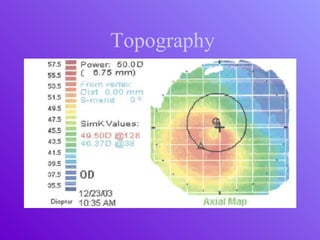
Topography
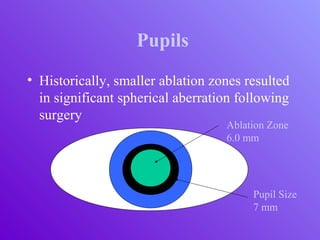
Pupils
• Historically, smaller ablation zones resulted
in significant spherical aberration following
surgery
Ablation Zone
6.0 mm
Pupil Size
7 mm
Pupils
• Current technology reduces the problems
associated with pupil size
– larger ablation zones
– blend zones
a. 8 mm with myopes on VISX
b. 9 mm with hyperopes on VISX
• Glare/halos results from induced HOA’s
regardless of pupil size
• Still considered standard of care
Pachymetry
• Ultrasound is standard
–Central readings necessary
–Utilize intraoperative stromal bed
measurements
• Orbscan tends to be thinner
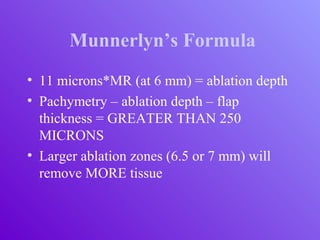
Munnerlyn’s Formula
• 11 microns*MR (at 6 mm) = ablation depth
• Pachymetry – ablation depth – flap
thickness = GREATER THAN 250
MICRONS
• Larger ablation zones (6.5 or 7 mm) will
remove MORE tissue
General eye health
• Dry eye
• Lid disease: Blepharitis, Meibomian gland
dysfunction
• Corneal scars/ABMD/neovascularization
• Acne Rosecea
• Glaucoma with or without field defects
Systemic Disease
• Diabetes with or without DR
• Arthritis
• Thyroid (tendancy for dry eye)
• Medications: more than one psychiatric
med? Watch out
• Personality: more than two drug allergies
or more than three rings
Consent form
• Legal document which describes risks and
benefits of the procedure.
• We do this for all patients at the
preoperative visit.
Day of surgery
• Bring meds: Antibiotic, Steriod and
Valium
• Valium (0.5 mg PO taken 30 minutes prior
to surgery)
• Dress in layers (Suite is cold)
• No perfume or scented lotion
• Testing performed: Machines, consent
discussion and meet with Dr. Duplessie
Making the flap
• Microkeratomes have come a long way
since the ACS
– 3 parts
– Track
• Problematic incision
– Blind incision (some exceptions)
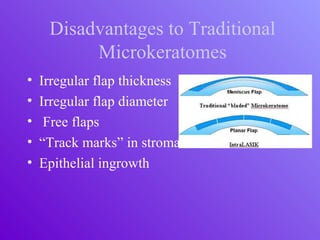
Disadvantages to Traditional
Microkeratomes
• Irregular flap thickness
• Irregular flap diameter
• Free flaps
• “Track marks” in stromal bed
• Epithelial ingrowth
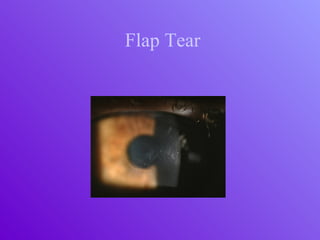
Flap Tear
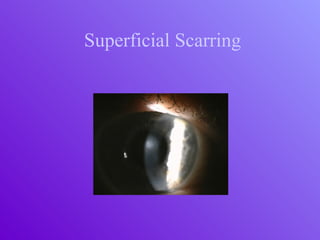
Superficial Scarring
Flap complications Using
Traditional Microkeratomes
• Button-hole flaps
• Thin flaps
• Torn flaps
• Decentered flaps
• Incomplete flaps
The All-Laser Method
• The Intralase FS laser combined with
excimer laser
• CDRH CFR1040 class IIIb ophthalmic laser
• Long wavelength 1053 nm not absorbed by
tissue
• Indicated for the use in patient’s requiring
lamellar resection of the cornea
Mechanism of Action
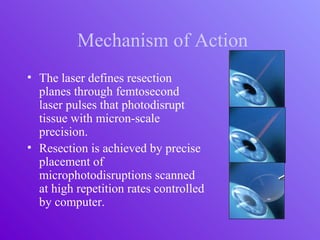
• The laser defines resection
planes through femtosecond
laser pulses that photodisrupt
tissue with micron-scale
precision.
• Resection is achieved by precise
placement of
microphotodisruptions scanned
at high repetition rates controlled
by computer.
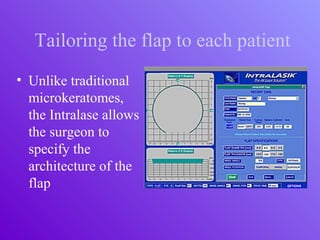
Tailoring the flap to each patient
• Unlike traditional
microkeratomes,
the Intralase allows
the surgeon to
specify the
architecture of the
flap
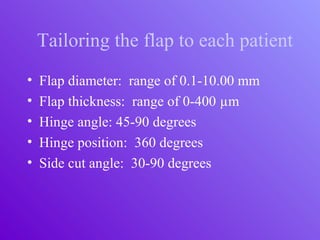
Tailoring the flap to each patient
• Flap diameter: range of 0.1-10.00 mm
• Flap thickness: range of 0-400 µm
• Hinge angle: 45-90 degrees
• Hinge position: 360 degrees
• Side cut angle: 30-90 degrees
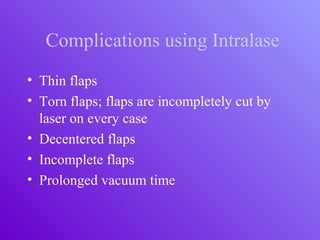
Complications using Intralase
• Thin flaps
• Torn flaps; flaps are incompletely cut by
laser on every case
• Decentered flaps
• Incomplete flaps
• Prolonged vacuum time
Resurface the eye
• Typical limits :
– Myopia 10D
– Hyperopia 4D
– Astigmatism 4D
• Wavefront or no wavefront????
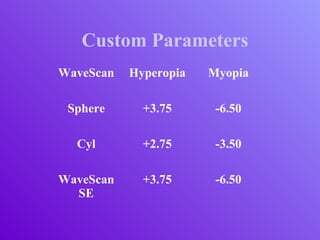
Custom Parameters
WaveScan Hyperopia Myopia
Sphere +3.75 -6.50
Cyl +2.75 -3.50
WaveScan
SE
+3.75 -6.50
Review Post-op instructions
• Steriod/Antibiotic: Tobradex 4x/day x 5
days
– Artificial tears FREQUENTLY – Q15min
while awake week #1, Q30 min week#2 then
hourly
• Gel QHS as needed for AM dryness
Common Side Effects
• Dry eye
• Night glare (warn Custom patients)
• Hyperopia treatment within first month:
• Soft CL EW with Acular (NOT Acular LS)
QID
– RTO 2 weeks
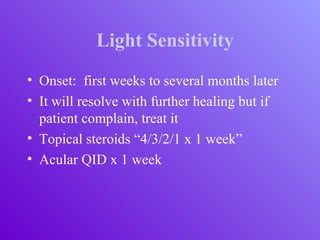
Light Sensitivity
• Onset: first weeks to several months later
• It will resolve with further healing but if
patient complain, treat it
• Topical steroids “4/3/2/1 x 1 week”
• Acular QID x 1 week
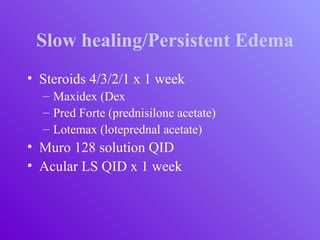
Slow healing/Persistent Edema
• Steroids 4/3/2/1 x 1 week
– Maxidex (Dex
– Pred Forte (prednisilone acetate)
– Lotemax (loteprednal acetate)
• Muro 128 solution QID
• Acular LS QID x 1 week
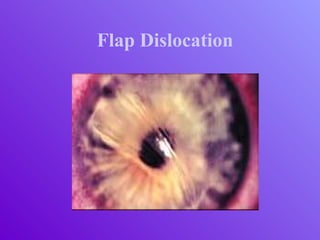
Flap Dislocation
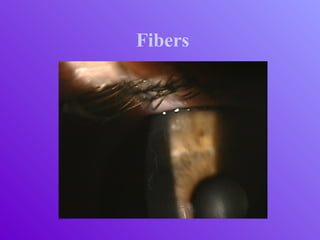
Fibers
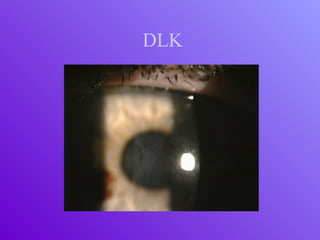
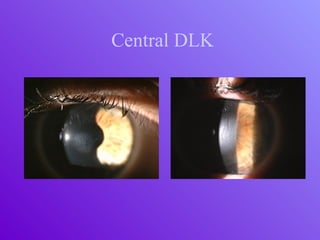
Diffuse lamellar keratitits
• Typically at edge, moves centrally
• Treat immediately! Heavy steroids – Pred
preferred
• May require relifting and cleaning
• If stria develop, long term visual importance
1. Tissue destruction
2. Distortion of vison and loss of BVA
3. Hyperopia shift
• Monitor closely in patients with abrasions, flap
trauma
DLK
Central DLK
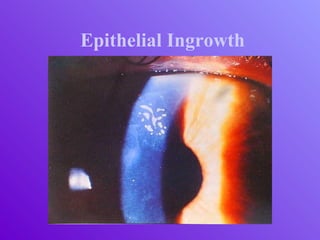
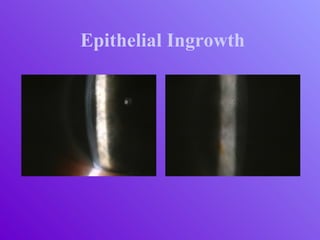
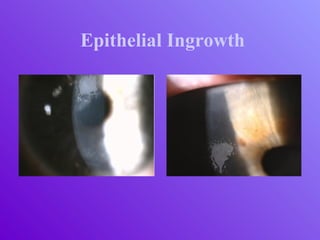
Epithelial Ingrowth
Epithelial Ingrowth
Epithelial Ingrowth
Enhancements
“Touch ups”
• 20/40 or less
• Significant improvement subjectively?
• Warn low myopes about loss of vision at
near if over 40
• Rule out ectasia in high myopes/thin
pachemetry
• Warn patient they may be more
uncomfortable after numbing drops wear off
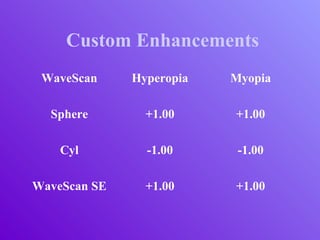
Custom Enhancements
WaveScan Hyperopia Myopia
Sphere +1.00 +1.00
Cyl -1.00 -1.00
WaveScan SE +1.00 +1.00
Monovision
• Patients who have worn it in the past are
most successful
• Trial frame: if like trial, will be successful
• If don’t like TF, go distance OU
• Deep monovison causes anisometropia in
spectacles

Refractive surgery basics, LASIK

  • 1.
  • 2.
    The Preoperative Visit •REFRACTION: –Manifest with binocular balance –Cycloplegic Refraction • Tropicamide vs. cyclogel
  • 3.
    Keratometry/Topography • Not toflat and not to steep • Plan: MR*0.6 = anticipated change in myopic refraction with excimer treatment (less than 36 is contraindication) • Plan: MR*1.0 = anticipated change in hyperopic excimer treatment (more than 50 is contraindication) • Rule out corneal distortion/KC/CL warpage
  • 4.
  • 5.
    Pupils • Historically, smallerablation zones resulted in significant spherical aberration following surgery Ablation Zone 6.0 mm Pupil Size 7 mm
  • 6.
    Pupils • Current technologyreduces the problems associated with pupil size – larger ablation zones – blend zones a. 8 mm with myopes on VISX b. 9 mm with hyperopes on VISX • Glare/halos results from induced HOA’s regardless of pupil size • Still considered standard of care
  • 7.
    Pachymetry • Ultrasound isstandard –Central readings necessary –Utilize intraoperative stromal bed measurements • Orbscan tends to be thinner
  • 8.
    Munnerlyn’s Formula • 11microns*MR (at 6 mm) = ablation depth • Pachymetry – ablation depth – flap thickness = GREATER THAN 250 MICRONS • Larger ablation zones (6.5 or 7 mm) will remove MORE tissue
  • 9.
    General eye health •Dry eye • Lid disease: Blepharitis, Meibomian gland dysfunction • Corneal scars/ABMD/neovascularization • Acne Rosecea • Glaucoma with or without field defects
  • 10.
    Systemic Disease • Diabeteswith or without DR • Arthritis • Thyroid (tendancy for dry eye) • Medications: more than one psychiatric med? Watch out • Personality: more than two drug allergies or more than three rings
  • 11.
    Consent form • Legaldocument which describes risks and benefits of the procedure. • We do this for all patients at the preoperative visit.
  • 12.
    Day of surgery •Bring meds: Antibiotic, Steriod and Valium • Valium (0.5 mg PO taken 30 minutes prior to surgery) • Dress in layers (Suite is cold) • No perfume or scented lotion • Testing performed: Machines, consent discussion and meet with Dr. Duplessie
  • 13.
    Making the flap •Microkeratomes have come a long way since the ACS – 3 parts – Track • Problematic incision – Blind incision (some exceptions)
  • 14.
    Disadvantages to Traditional Microkeratomes •Irregular flap thickness • Irregular flap diameter • Free flaps • “Track marks” in stromal bed • Epithelial ingrowth
  • 15.
  • 16.
  • 17.
    Flap complications Using TraditionalMicrokeratomes • Button-hole flaps • Thin flaps • Torn flaps • Decentered flaps • Incomplete flaps
  • 18.
    The All-Laser Method •The Intralase FS laser combined with excimer laser • CDRH CFR1040 class IIIb ophthalmic laser • Long wavelength 1053 nm not absorbed by tissue • Indicated for the use in patient’s requiring lamellar resection of the cornea
  • 19.
    Mechanism of Action •The laser defines resection planes through femtosecond laser pulses that photodisrupt tissue with micron-scale precision. • Resection is achieved by precise placement of microphotodisruptions scanned at high repetition rates controlled by computer.
  • 20.
    Tailoring the flapto each patient • Unlike traditional microkeratomes, the Intralase allows the surgeon to specify the architecture of the flap
  • 21.
    Tailoring the flapto each patient • Flap diameter: range of 0.1-10.00 mm • Flap thickness: range of 0-400 µm • Hinge angle: 45-90 degrees • Hinge position: 360 degrees • Side cut angle: 30-90 degrees
  • 22.
    Complications using Intralase •Thin flaps • Torn flaps; flaps are incompletely cut by laser on every case • Decentered flaps • Incomplete flaps • Prolonged vacuum time
  • 23.
    Resurface the eye •Typical limits : – Myopia 10D – Hyperopia 4D – Astigmatism 4D • Wavefront or no wavefront????
  • 24.
    Custom Parameters WaveScan HyperopiaMyopia Sphere +3.75 -6.50 Cyl +2.75 -3.50 WaveScan SE +3.75 -6.50
  • 25.
    Review Post-op instructions •Steriod/Antibiotic: Tobradex 4x/day x 5 days – Artificial tears FREQUENTLY – Q15min while awake week #1, Q30 min week#2 then hourly • Gel QHS as needed for AM dryness
  • 26.
    Common Side Effects •Dry eye • Night glare (warn Custom patients) • Hyperopia treatment within first month: • Soft CL EW with Acular (NOT Acular LS) QID – RTO 2 weeks
  • 27.
    Light Sensitivity • Onset:first weeks to several months later • It will resolve with further healing but if patient complain, treat it • Topical steroids “4/3/2/1 x 1 week” • Acular QID x 1 week
  • 28.
    Slow healing/Persistent Edema •Steroids 4/3/2/1 x 1 week – Maxidex (Dex – Pred Forte (prednisilone acetate) – Lotemax (loteprednal acetate) • Muro 128 solution QID • Acular LS QID x 1 week
  • 29.
  • 30.
  • 31.
    Diffuse lamellar keratitits •Typically at edge, moves centrally • Treat immediately! Heavy steroids – Pred preferred • May require relifting and cleaning • If stria develop, long term visual importance 1. Tissue destruction 2. Distortion of vison and loss of BVA 3. Hyperopia shift • Monitor closely in patients with abrasions, flap trauma
  • 32.
  • 33.
  • 34.
  • 35.
  • 36.
  • 37.
    Enhancements “Touch ups” • 20/40or less • Significant improvement subjectively? • Warn low myopes about loss of vision at near if over 40 • Rule out ectasia in high myopes/thin pachemetry • Warn patient they may be more uncomfortable after numbing drops wear off
  • 38.
    Custom Enhancements WaveScan HyperopiaMyopia Sphere +1.00 +1.00 Cyl -1.00 -1.00 WaveScan SE +1.00 +1.00
  • 39.
    Monovision • Patients whohave worn it in the past are most successful • Trial frame: if like trial, will be successful • If don’t like TF, go distance OU • Deep monovison causes anisometropia in spectacles