5. Characterization and Examination of Sewages
Characteristics of Sewage
• Wastewater contains many different substances
that can be used to characterize it.
• The specific substances and amounts or
concentrations of each will vary depending on
the source.
• Wastewater is characterized in terms of its
physical, chemical, and biological characteristics.
A.Physical Characteristics
1. Turbidity
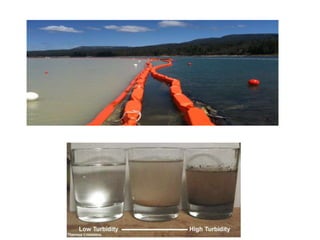
• Sewage is normally turbid with floating matter
like fecal matter, pieces of paper, cigarette-ends,
match-sticks, greases, vegetable debris, fruit
skins, soaps, etc.
• The turbidity increases as sewage becomes
stronger.
• The degree of turbidity can be measured and
tested by turbidity rods or by turbid-meters
2. Color
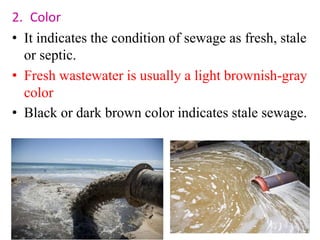
• It indicates the condition of sewage as fresh, stale
or septic.
• Fresh wastewater is usually a light brownish-gray
color
• Black or dark brown color indicates stale sewage.
3. Odor
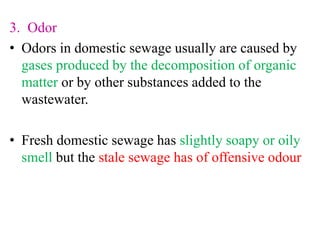
• Odors in domestic sewage usually are caused by
gases produced by the decomposition of organic
matter or by other substances added to the
wastewater.
• Fresh domestic sewage has slightly soapy or oily
smell but the stale sewage has of offensive odour
4. Temperature
• Temp. of sewage is measured by means of ordinary
thermometers, which could be able to read up to
0.1C.
• The temp. of wastewater is commonly higher than
that of the water supply because of the addition of
warm water from households and industrial plants.
• The ideal temperature of sewage for the biological
activities is 20°c.
B. Chemical Characteristics
1. Solids (Total Solids, Suspended Solids and Settleable Solids)
• Most pollutants found in wastewater can be classified as
solids.
• Sewage normally contains water (99.9%), it only contains
about 0.05 to 0.1 percent (i.e. 500 to 1000 mg/l) of total
solids.
• Suspended solids are those solids which remain floating in
sewage.
• Dissolved solids are those which remain dissolved in
sewage just as salt in water.
• Colloidal solids are finely divided solids remaining
either in solution or in suspension.
• Settleable solids are that portion of solid matter
which settles out, if sewage is allowed to remain
undisturbed for a period of 2 hours.
The total amount of solids (S1 mg/L):
• In a given sewage S1can be determined by
evaporating a known volume of sewage sample, and
weighing the dry residue left.
• The mass of the residue divided by the volume of the
sample evaporated will represent the total solids in
mg/l, S1.
The suspended solids (S2) : solids which are retained
by a filter of 1µm pores
• They are also called filterable solids.
• Their quantity can be determined by passing a
known volume of sewage sample through a glass-
fiber filter apparatus, and weighing the dry residue
left
• The mass of the residue divided by the volume of
sample filtered will represent the suspended
solids, (S2), in mg/l.
• Non-filterable solids (S3) :
• The difference between the total solids (S1)
and the suspended solids (S2) will represent
nothing but dissolved solids plus colloidal
• S3 = S1 - S2
Volatile suspended solids (S4)
• the total suspended solids (S2) may either be volatile
or fixed.
• In order to determine their proportion, the filtered dry
residue is burnt and ignited at about 550c in an
electric muffle furnace for about 15 to 20 minutes.
• Loss of weight due to ignition will represent the
volatile solids in the sample volume filtered through
the filter.
Fixed solids (S5):
• The difference S2 - S4 = S5 will evidently represent
the fixed solids
2. Alkalinity
• This is a measure of the wastewater’s capability to
neutralize acids.
• It is measured in terms of bicarbonate, carbonate,
and hydroxide alkalinity.
• Alkalinity is essential to buffer (hold the neutral pH)
of the wastewater during the biological treatment
processes.
3. pH
• This is a method of expressing the acid condition
of the wastewater.
• For proper treatment, wastewater pH should
normally be in the range of 6.5 to 9.0.
• pH is important to measure the efficiency of
certain treatment methods depends upon the
availability of a suitable pH value.
4. Chloride Contents
• Chlorides commonly found in municipal sewage
and are derived from the kitchen wastes, human
feces, and urinary discharges, etc.
• The normal chloride content of domestic sewage is
120mg/l
• large amounts of chlorides may enter from
industries like: ice cream plants, meat salting, etc.,
thus, increasing the chloride contents of sewage.
5. Dissolved gases
• These are gases that are dissolved in wastewater.
• The specific gases and normal concentrations are
based upon the composition of the wastewater.
• Typical domestic wastewater contains O2 in
relatively low concentrations, CO2, and H2S (if
septic conditions exist).
6. Nitrogen compounds
• The presence of nitrogen in sewage indicates the
presence of organic matter, and may occur in one
or more of the following forms:
(a) Free ammonia, called ammonia nitrogen;
(b) Albuminoid nitrogen, called Organic nitrogen;
(c) Nitrites; and
(d) Nitrates
7. Phosphorus
• P is essential to biological activity and must be
present in at least minimum quantities
• Excessive amounts can cause stream damage and
excessive algal growth.
• Phosphorus will normally be in the range of 6 to
20mg/L.
8. Presence of Fats, Oils and Greases:
– These are derived in sewage from the discharges of
animals and vegetable matter, or from the industries
like garages, kitchens of hotels and restaurants, etc
– Such matter form scum on the top of the
sedimentation tanks and clog the voids of the filtering
media.
– They thus interfere with the normal treatment
methods, and hence need proper detection and
removal.
9. Sulphides, Sulphates and Hydrogen Sulphide
Gas
10. Dissolved Oxygen (DO)
11. Bio-Chemical Oxygen Demand (BOD)
12. Chemical Oxygen Demand (COD)
13. Total Organic Carbon
C. Biological Characteristics
• The bacterial characteristics of sewage are due to
the presence of bacteria and other living micro-
organisms, such as algae, fungi, protozoa, etc.
• They are useful and helpful in bringing oxidation
and decomposition of sewage.
• A little number of bacteria, however, is disease
producing pathogens,
Biochemical Oxygen Demand (BOD)
• BOD is used as a measure of the quantity of
oxygen required for oxidation of biodegradable
organic matter
• The greater the BOD, the more rapidly oxygen is
depleted in the water body
– The consequences of high BOD; the aquatic
organisms become stressed, suffocate, and die
• Oxygen demand of wastewaters is exerted by three
classes of materials:
– Carbonaceous organic materials usable as a source of food
by aerobic organisms
– oxidizable nitrogen derived from NO2, NH3, and organic
nitrogen compounds which serve as food for specific
bacteria
– Chemical reducing compounds, e.g., ferrous ion (Fe2+),
sulfites (SO3
2-), and sulfide (S2-) which are oxidized by
dissolved oxygen.
• The complete oxidation of organic matter takes
about 2-3 months.
– The oxidation process proceeds in two stages.
– The first stage carboneous matter is oxidized
– The second stage the nitrogen matter is oxidized.
• However, it is found that nearly 70 to 80 percent
of total BOD is satisfied within 5 days at a
temperature of 20°
• Hence the BOD5, BOD at 5 days period,
incubated at 20C is taken as standard value in
actual practice.
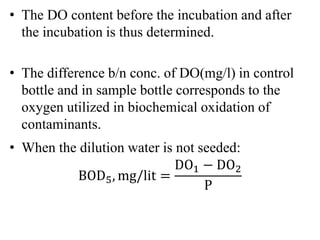
• The DO content before the incubation and after
the incubation is thus determined.
• The difference b/n conc. of DO(mg/l) in control
bottle and in sample bottle corresponds to the
oxygen utilized in biochemical oxidation of
contaminants.
• When the dilution water is not seeded:
BOD5, mg/lit =
DO1 − DO2
P
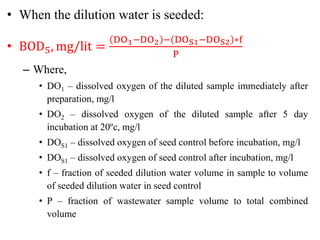
• When the dilution water is seeded:
• BOD5, mg/lit =
DO1−DO2 − DOS1−DOS2 ∗f
P
– Where,
• DO1 – dissolved oxygen of the diluted sample immediately after
preparation, mg/l
• DO2 – dissolved oxygen of the diluted sample after 5 day
incubation at 20ºc, mg/l
• DOS1 – dissolved oxygen of seed control before incubation, mg/l
• DOS1 – dissolved oxygen of seed control after incubation, mg/l
• f – fraction of seeded dilution water volume in sample to volume
of seeded dilution water in seed control
• P – fraction of wastewater sample volume to total combined
volume
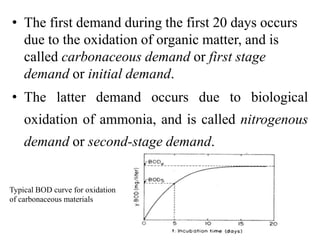
• The first demand during the first 20 days occurs
due to the oxidation of organic matter, and is
called carbonaceous demand or first stage
demand or initial demand.
• The latter demand occurs due to biological
oxidation of ammonia, and is called nitrogenous
demand or second-stage demand.
Typical BOD curve for oxidation
of carbonaceous materials
Ratio of COD and BOD
• BODu is lower than COD obtained by the
standard dichromate oxidation method. Because:
– many organic compounds which are oxidized by
K2Cr2O7 are not biochemically oxidizable
– certain inorganic ions such as (S2-), (S2O3
2-), (SO3
2-),
(NO2
-), and (Fe2+) are oxidized by K2Cr2O7, thus
accounting for inorganic COD which is not detected
by the BOD test.
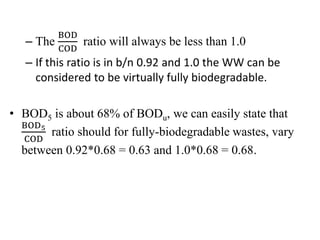
– The
BOD
COD
ratio will always be less than 1.0
– If this ratio is in b/n 0.92 and 1.0 the WW can be
considered to be virtually fully biodegradable.
• BOD5 is about 68% of BODu, we can easily state that
BOD5
COD
ratio should for fully-biodegradable wastes, vary
between 0.92*0.68 = 0.63 and 1.0*0.68 = 0.68.
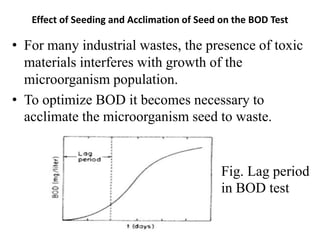
Effect of Seeding and Acclimation of Seed on the BOD Test
• For many industrial wastes, the presence of toxic
materials interferes with growth of the
microorganism population.
• To optimize BOD it becomes necessary to
acclimate the microorganism seed to waste.
Fig. Lag period
in BOD test
Effect of Presence of Algae on the BOD Test
• Presence of algae in the wastewater being tested
affects the BOD test.
• If the sample is incubated in the presence of
light, low BOD values are obtained owing to
production of oxygen by photosynthesis, which
satisfies part of the oxygen demand.
– if incubation is performed in darkness, algae survive
for a while.
– short-term BOD determinations show the effect of
oxygen on them.
– After a period in the dark, algae die and algal cells
contribute to the increase
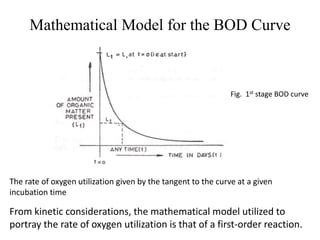
Mathematical Model for the BOD Curve
From kinetic considerations, the mathematical model utilized to
portray the rate of oxygen utilization is that of a first-order reaction.
Fig. 1st stage BOD curve
The rate of oxygen utilization given by the tangent to the curve at a given
incubation time
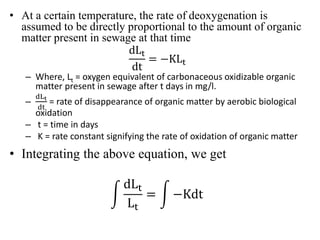
• At a certain temperature, the rate of deoxygenation is
assumed to be directly proportional to the amount of organic
matter present in sewage at that time
dLt
dt
= −KLt
– Where, Lt = oxygen equivalent of carbonaceous oxidizable organic
matter present in sewage after t days in mg/l.
–
dLt
dt
= rate of disappearance of organic matter by aerobic biological
oxidation
– t = time in days
– K = rate constant signifying the rate of oxidation of organic matter
• Integrating the above equation, we get
dLt
Lt
= −Kdt
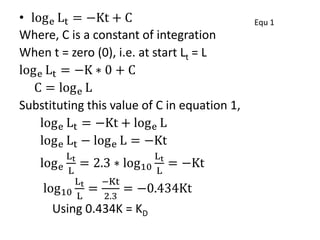
• loge Lt = −Kt + C Equ 1
Where, C is a constant of integration
When t = zero (0), i.e. at start Lt = L
loge Lt = −K ∗ 0 + C
C = loge L
Substituting this value of C in equation 1,
loge Lt = −Kt + loge L
loge Lt − loge L = −Kt
loge
Lt
L
= 2.3 ∗ log10
Lt
L
= −Kt
log10
Lt
L
=
−Kt
2.3
= −0.434Kt
Using 0.434K = KD
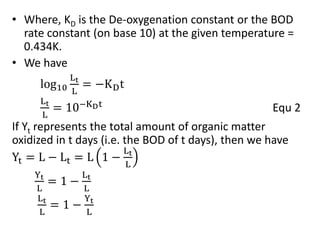
• Where, KD is the De-oxygenation constant or the BOD
rate constant (on base 10) at the given temperature =
0.434K.
• We have
log10
Lt
L
= −KDt
Lt
L
= 10−KDt Equ 2
If Yt represents the total amount of organic matter
oxidized in t days (i.e. the BOD of t days), then we have
Yt = L − Lt = L 1 −
Lt
L
Yt
L
= 1 −
Lt
L
Lt
L
= 1 −
Yt
L
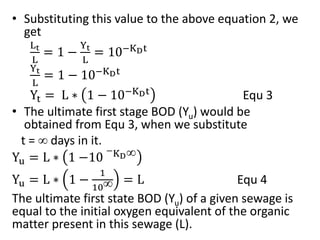
• Substituting this value to the above equation 2, we
get
Lt
L
= 1 −
Yt
L
= 10−KDt
Yt
L
= 1 − 10−KDt
Yt = L ∗ 1 − 10−KDt
Equ 3
• The ultimate first stage BOD (Yu) would be
obtained from Equ 3, when we substitute
t =  days in it.
Yu = L ∗ 1 −10
−KD
Yu = L ∗ 1 −
1
10 = L Equ 4
The ultimate first state BOD (Yu) of a given sewage is
equal to the initial oxygen equivalent of the organic
matter present in this sewage (L).
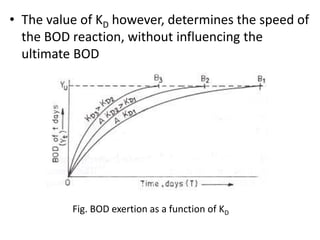
• The value of KD however, determines the speed of
the BOD reaction, without influencing the
ultimate BOD
Fig. BOD exertion as a function of KD
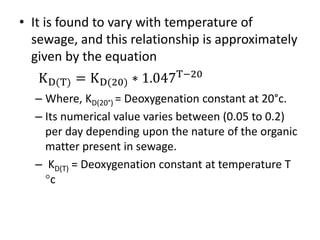
• It is found to vary with temperature of
sewage, and this relationship is approximately
given by the equation
KD(T) = KD(20) ∗ 1.047T−20
– Where, KD(20°) = Deoxygenation constant at 20°c.
– Its numerical value varies between (0.05 to 0.2)
per day depending upon the nature of the organic
matter present in sewage.
– KD(T) = Deoxygenation constant at temperature T
c
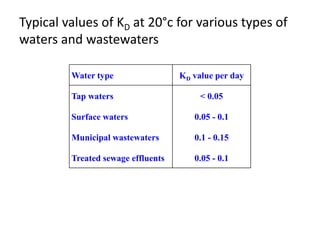
Typical values of KD at 20°c for various types of
waters and wastewaters
Water type KD value per day
Tap waters < 0.05
Surface waters 0.05 - 0.1
Municipal wastewaters 0.1 - 0.15
Treated sewage effluents 0.05 - 0.1
Laboratory estimation of KD value
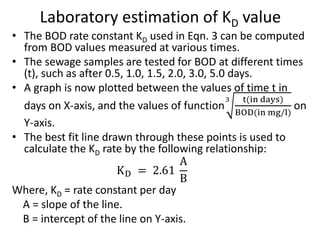
• The BOD rate constant KD used in Eqn. 3 can be computed
from BOD values measured at various times.
• The sewage samples are tested for BOD at different times
(t), such as after 0.5, 1.0, 1.5, 2.0, 3.0, 5.0 days.
• A graph is now plotted between the values of time t in
days on X-axis, and the values of function
3 t(in days)
BOD(in mg/l)
on
Y-axis.
• The best fit line drawn through these points is used to
calculate the KD rate by the following relationship:
KD = 2.61
A
B
Where, KD = rate constant per day
A = slope of the line.
B = intercept of the line on Y-axis.
Examples
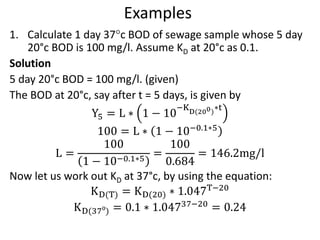
1. Calculate 1 day 37c BOD of sewage sample whose 5 day
20°c BOD is 100 mg/l. Assume KD at 20°c as 0.1.
Solution
5 day 20°c BOD = 100 mg/l. (given)
The BOD at 20°c, say after t = 5 days, is given by
Y5 = L ∗ 1 − 10
−KD(200)
∗t
100 = L ∗ 1 − 10−0.1∗5
L =
100
1 − 10−0.1∗5
=
100
0.684
= 146.2mg/l
Now let us work out KD at 37°c, by using the equation:
KD(T) = KD(20) ∗ 1.047T−20
KD(37⁰) = 0.1 ∗ 1.04737−20
= 0.24
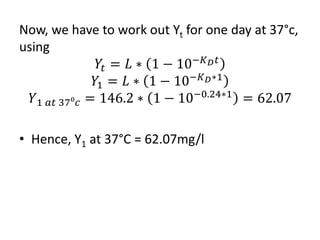
Now, we have to work out Yt for one day at 37°c,
using
𝑌𝑡 = 𝐿 ∗ 1 − 10−𝐾𝐷𝑡
𝑌1 = 𝐿 ∗ 1 − 10−𝐾𝐷∗1
𝑌1 𝑎𝑡 37⁰𝑐 = 146.2 ∗ 1 − 10−0.24∗1
= 62.07
• Hence, Y1 at 37°C = 62.07mg/l
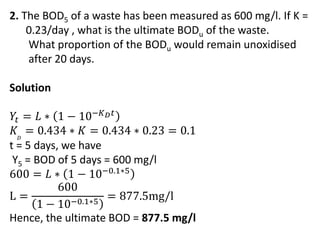
2. The BOD5 of a waste has been measured as 600 mg/l. If K =
0.23/day , what is the ultimate BODu of the waste.
What proportion of the BODu would remain unoxidised
after 20 days.
Solution
𝑌𝑡 = 𝐿 ∗ 1 − 10−𝐾𝐷𝑡
𝐾𝐷
= 0.434 ∗ 𝐾 = 0.434 ∗ 0.23 = 0.1
t = 5 days, we have
Y5 = BOD of 5 days = 600 mg/l
600 = 𝐿 ∗ 1 − 10−0.1∗5
L =
600
1 − 10−0.1∗5
= 877.5mg/l
Hence, the ultimate BOD = 877.5 mg/l
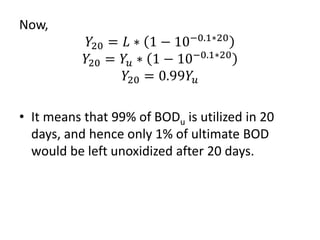
Now,
𝑌20 = 𝐿 ∗ 1 − 10−0.1∗20
𝑌20 = 𝑌𝑢 ∗ 1 − 10−0.1∗20
𝑌20 = 0.99𝑌𝑢
• It means that 99% of BODu is utilized in 20
days, and hence only 1% of ultimate BOD
would be left unoxidized after 20 days.
Chemical Oxygen Demand (COD)
• COD measures the total quantity of oxygen required for
oxidation of organics into CO2 and H2O .
• The oxygen required to oxidize the organic matter present
in a given wastewater can be theoretically computed, if the
organics present in wastewater are known.
• if the chemical formulas and the concentrations of the
chemical compounds present in water are known:
– the theoretical oxygen demand of each of these compounds by
writing the balanced reaction for the compound with O2 to
produce CO2, H2O and oxidized inorganic components.
– it is virtually impossible to know the details of the organic
compounds present in any natural raw water or a waste water.
• The COD of a raw water or a wastewater is
determined by performing a laboratory test on
the given wastewater with a strong oxidant like
dichromate solution
• The laboratory determination of COD use a
strong oxidants K2Cr2O7 or KMnO4 solution
– to stabilize the organic matter
– to determine the molecular oxygen used from the
oxidant solution in oxidizing the organic matter
present in the given wastewater.
• Experimentally:
– a known quantity of wastewater is mixed with a
known quantity of standard solution of potassium
dichromate
– the mixture is heated
– The organic matter is oxidized by K2Cr2O7 in the
presence of H2SO4
– The resulting solution of K2Cr2O7 is titrated with
standard ferrous ammonium sulphate
[Fe(NH4)2.(SO4)2.6H2O)],
– the oxygen used in oxidizing the wastewater is
determined.
– This is called the COD and is a measure of organic
matter present in sewage.
• The advantage of COD measurements
– COD Can be obtained very quickly (within 3 hours)
• Disadvantage
– COD do not give any information on the
proportion of the wastewater that can be oxidized
by bacteria, nor on the rate at which bio-oxidation
occurs.
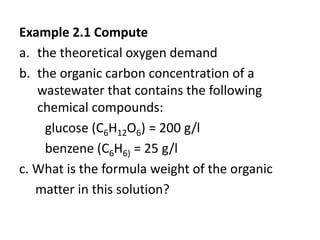
Example 2.1 Compute
a. the theoretical oxygen demand
b. the organic carbon concentration of a
wastewater that contains the following
chemical compounds:
glucose (C6H12O6) = 200 g/l
benzene (C6H6) = 25 g/l
c. What is the formula weight of the organic
matter in this solution?
Solution
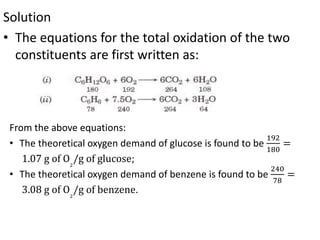
• The equations for the total oxidation of the two
constituents are first written as:
From the above equations:
• The theoretical oxygen demand of glucose is found to be
192
180
=
1.07 g of O2
/g of glucose;
• The theoretical oxygen demand of benzene is found to be
240
78
=
3.08 g of O2
/g of benzene.
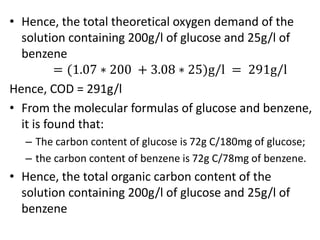
• Hence, the total theoretical oxygen demand of the
solution containing 200g/l of glucose and 25g/l of
benzene
= (1.07 ∗ 200 + 3.08 ∗ 25)g/l = 291g/l
Hence, COD = 291g/l
• From the molecular formulas of glucose and benzene,
it is found that:
– The carbon content of glucose is 72g C/180mg of glucose;
– the carbon content of benzene is 72g C/78mg of benzene.
• Hence, the total organic carbon content of the
solution containing 200g/l of glucose and 25g/l of
benzene
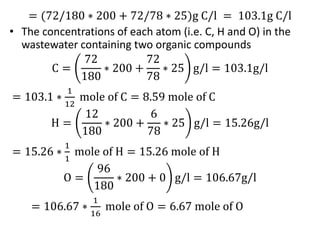
= (72/180 ∗ 200 + 72/78 ∗ 25)g C/l = 103.1g C/l
• The concentrations of each atom (i.e. C, H and O) in the
wastewater containing two organic compounds
C =
72
180
∗ 200 +
72
78
∗ 25 g/l = 103.1g/l
= 103.1 ∗
1
12
mole of C = 8.59 mole of C
H =
12
180
∗ 200 +
6
78
∗ 25 g/l = 15.26g/l
= 15.26 ∗
1
1
mole of H = 15.26 mole of H
O =
96
180
∗ 200 + 0 g/l = 106.67g/l
= 106.67 ∗
1
16
mole of O = 6.67 mole of O
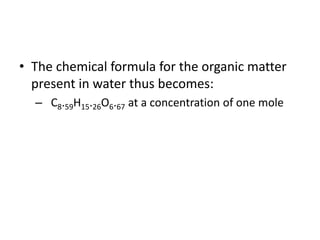
• The chemical formula for the organic matter
present in water thus becomes:
– C8.59H15.26O6.67 at a concentration of one mole

Chapter 2.pptx

  • 1.
    5. Characterization andExamination of Sewages Characteristics of Sewage • Wastewater contains many different substances that can be used to characterize it. • The specific substances and amounts or concentrations of each will vary depending on the source. • Wastewater is characterized in terms of its physical, chemical, and biological characteristics.
  • 2.
    A.Physical Characteristics 1. Turbidity •Sewage is normally turbid with floating matter like fecal matter, pieces of paper, cigarette-ends, match-sticks, greases, vegetable debris, fruit skins, soaps, etc. • The turbidity increases as sewage becomes stronger. • The degree of turbidity can be measured and tested by turbidity rods or by turbid-meters
  • 4.
    2. Color • Itindicates the condition of sewage as fresh, stale or septic. • Fresh wastewater is usually a light brownish-gray color • Black or dark brown color indicates stale sewage.
  • 5.
    3. Odor • Odorsin domestic sewage usually are caused by gases produced by the decomposition of organic matter or by other substances added to the wastewater. • Fresh domestic sewage has slightly soapy or oily smell but the stale sewage has of offensive odour
  • 6.
    4. Temperature • Temp.of sewage is measured by means of ordinary thermometers, which could be able to read up to 0.1C. • The temp. of wastewater is commonly higher than that of the water supply because of the addition of warm water from households and industrial plants. • The ideal temperature of sewage for the biological activities is 20°c.
  • 7.
    B. Chemical Characteristics 1.Solids (Total Solids, Suspended Solids and Settleable Solids) • Most pollutants found in wastewater can be classified as solids. • Sewage normally contains water (99.9%), it only contains about 0.05 to 0.1 percent (i.e. 500 to 1000 mg/l) of total solids. • Suspended solids are those solids which remain floating in sewage. • Dissolved solids are those which remain dissolved in sewage just as salt in water.
  • 8.
    • Colloidal solidsare finely divided solids remaining either in solution or in suspension. • Settleable solids are that portion of solid matter which settles out, if sewage is allowed to remain undisturbed for a period of 2 hours. The total amount of solids (S1 mg/L): • In a given sewage S1can be determined by evaporating a known volume of sewage sample, and weighing the dry residue left. • The mass of the residue divided by the volume of the sample evaporated will represent the total solids in mg/l, S1.
  • 9.
    The suspended solids(S2) : solids which are retained by a filter of 1µm pores • They are also called filterable solids. • Their quantity can be determined by passing a known volume of sewage sample through a glass- fiber filter apparatus, and weighing the dry residue left • The mass of the residue divided by the volume of sample filtered will represent the suspended solids, (S2), in mg/l.
  • 10.
    • Non-filterable solids(S3) : • The difference between the total solids (S1) and the suspended solids (S2) will represent nothing but dissolved solids plus colloidal • S3 = S1 - S2
  • 11.
    Volatile suspended solids(S4) • the total suspended solids (S2) may either be volatile or fixed. • In order to determine their proportion, the filtered dry residue is burnt and ignited at about 550c in an electric muffle furnace for about 15 to 20 minutes. • Loss of weight due to ignition will represent the volatile solids in the sample volume filtered through the filter.
  • 12.
    Fixed solids (S5): •The difference S2 - S4 = S5 will evidently represent the fixed solids 2. Alkalinity • This is a measure of the wastewater’s capability to neutralize acids. • It is measured in terms of bicarbonate, carbonate, and hydroxide alkalinity. • Alkalinity is essential to buffer (hold the neutral pH) of the wastewater during the biological treatment processes.
  • 13.
    3. pH • Thisis a method of expressing the acid condition of the wastewater. • For proper treatment, wastewater pH should normally be in the range of 6.5 to 9.0. • pH is important to measure the efficiency of certain treatment methods depends upon the availability of a suitable pH value.
  • 14.
    4. Chloride Contents •Chlorides commonly found in municipal sewage and are derived from the kitchen wastes, human feces, and urinary discharges, etc. • The normal chloride content of domestic sewage is 120mg/l • large amounts of chlorides may enter from industries like: ice cream plants, meat salting, etc., thus, increasing the chloride contents of sewage.
  • 15.
    5. Dissolved gases •These are gases that are dissolved in wastewater. • The specific gases and normal concentrations are based upon the composition of the wastewater. • Typical domestic wastewater contains O2 in relatively low concentrations, CO2, and H2S (if septic conditions exist).
  • 16.
    6. Nitrogen compounds •The presence of nitrogen in sewage indicates the presence of organic matter, and may occur in one or more of the following forms: (a) Free ammonia, called ammonia nitrogen; (b) Albuminoid nitrogen, called Organic nitrogen; (c) Nitrites; and (d) Nitrates
  • 17.
    7. Phosphorus • Pis essential to biological activity and must be present in at least minimum quantities • Excessive amounts can cause stream damage and excessive algal growth. • Phosphorus will normally be in the range of 6 to 20mg/L.
  • 18.
    8. Presence ofFats, Oils and Greases: – These are derived in sewage from the discharges of animals and vegetable matter, or from the industries like garages, kitchens of hotels and restaurants, etc – Such matter form scum on the top of the sedimentation tanks and clog the voids of the filtering media. – They thus interfere with the normal treatment methods, and hence need proper detection and removal.
  • 19.
    9. Sulphides, Sulphatesand Hydrogen Sulphide Gas 10. Dissolved Oxygen (DO) 11. Bio-Chemical Oxygen Demand (BOD) 12. Chemical Oxygen Demand (COD) 13. Total Organic Carbon
  • 20.
    C. Biological Characteristics •The bacterial characteristics of sewage are due to the presence of bacteria and other living micro- organisms, such as algae, fungi, protozoa, etc. • They are useful and helpful in bringing oxidation and decomposition of sewage. • A little number of bacteria, however, is disease producing pathogens,
  • 21.
    Biochemical Oxygen Demand(BOD) • BOD is used as a measure of the quantity of oxygen required for oxidation of biodegradable organic matter • The greater the BOD, the more rapidly oxygen is depleted in the water body – The consequences of high BOD; the aquatic organisms become stressed, suffocate, and die
  • 22.
    • Oxygen demandof wastewaters is exerted by three classes of materials: – Carbonaceous organic materials usable as a source of food by aerobic organisms – oxidizable nitrogen derived from NO2, NH3, and organic nitrogen compounds which serve as food for specific bacteria – Chemical reducing compounds, e.g., ferrous ion (Fe2+), sulfites (SO3 2-), and sulfide (S2-) which are oxidized by dissolved oxygen.
  • 23.
    • The completeoxidation of organic matter takes about 2-3 months. – The oxidation process proceeds in two stages. – The first stage carboneous matter is oxidized – The second stage the nitrogen matter is oxidized. • However, it is found that nearly 70 to 80 percent of total BOD is satisfied within 5 days at a temperature of 20° • Hence the BOD5, BOD at 5 days period, incubated at 20C is taken as standard value in actual practice.
  • 24.
    • The DOcontent before the incubation and after the incubation is thus determined. • The difference b/n conc. of DO(mg/l) in control bottle and in sample bottle corresponds to the oxygen utilized in biochemical oxidation of contaminants. • When the dilution water is not seeded: BOD5, mg/lit = DO1 − DO2 P
  • 25.
    • When thedilution water is seeded: • BOD5, mg/lit = DO1−DO2 − DOS1−DOS2 ∗f P – Where, • DO1 – dissolved oxygen of the diluted sample immediately after preparation, mg/l • DO2 – dissolved oxygen of the diluted sample after 5 day incubation at 20ºc, mg/l • DOS1 – dissolved oxygen of seed control before incubation, mg/l • DOS1 – dissolved oxygen of seed control after incubation, mg/l • f – fraction of seeded dilution water volume in sample to volume of seeded dilution water in seed control • P – fraction of wastewater sample volume to total combined volume
  • 26.
    • The firstdemand during the first 20 days occurs due to the oxidation of organic matter, and is called carbonaceous demand or first stage demand or initial demand. • The latter demand occurs due to biological oxidation of ammonia, and is called nitrogenous demand or second-stage demand. Typical BOD curve for oxidation of carbonaceous materials
  • 27.
    Ratio of CODand BOD • BODu is lower than COD obtained by the standard dichromate oxidation method. Because: – many organic compounds which are oxidized by K2Cr2O7 are not biochemically oxidizable – certain inorganic ions such as (S2-), (S2O3 2-), (SO3 2-), (NO2 -), and (Fe2+) are oxidized by K2Cr2O7, thus accounting for inorganic COD which is not detected by the BOD test.
  • 28.
    – The BOD COD ratio willalways be less than 1.0 – If this ratio is in b/n 0.92 and 1.0 the WW can be considered to be virtually fully biodegradable. • BOD5 is about 68% of BODu, we can easily state that BOD5 COD ratio should for fully-biodegradable wastes, vary between 0.92*0.68 = 0.63 and 1.0*0.68 = 0.68.
  • 29.
    Effect of Seedingand Acclimation of Seed on the BOD Test • For many industrial wastes, the presence of toxic materials interferes with growth of the microorganism population. • To optimize BOD it becomes necessary to acclimate the microorganism seed to waste. Fig. Lag period in BOD test
  • 30.
    Effect of Presenceof Algae on the BOD Test • Presence of algae in the wastewater being tested affects the BOD test. • If the sample is incubated in the presence of light, low BOD values are obtained owing to production of oxygen by photosynthesis, which satisfies part of the oxygen demand. – if incubation is performed in darkness, algae survive for a while. – short-term BOD determinations show the effect of oxygen on them. – After a period in the dark, algae die and algal cells contribute to the increase
  • 31.
    Mathematical Model forthe BOD Curve From kinetic considerations, the mathematical model utilized to portray the rate of oxygen utilization is that of a first-order reaction. Fig. 1st stage BOD curve The rate of oxygen utilization given by the tangent to the curve at a given incubation time
  • 32.
    • At acertain temperature, the rate of deoxygenation is assumed to be directly proportional to the amount of organic matter present in sewage at that time dLt dt = −KLt – Where, Lt = oxygen equivalent of carbonaceous oxidizable organic matter present in sewage after t days in mg/l. – dLt dt = rate of disappearance of organic matter by aerobic biological oxidation – t = time in days – K = rate constant signifying the rate of oxidation of organic matter • Integrating the above equation, we get dLt Lt = −Kdt
  • 33.
    • loge Lt= −Kt + C Equ 1 Where, C is a constant of integration When t = zero (0), i.e. at start Lt = L loge Lt = −K ∗ 0 + C C = loge L Substituting this value of C in equation 1, loge Lt = −Kt + loge L loge Lt − loge L = −Kt loge Lt L = 2.3 ∗ log10 Lt L = −Kt log10 Lt L = −Kt 2.3 = −0.434Kt Using 0.434K = KD
  • 34.
    • Where, KDis the De-oxygenation constant or the BOD rate constant (on base 10) at the given temperature = 0.434K. • We have log10 Lt L = −KDt Lt L = 10−KDt Equ 2 If Yt represents the total amount of organic matter oxidized in t days (i.e. the BOD of t days), then we have Yt = L − Lt = L 1 − Lt L Yt L = 1 − Lt L Lt L = 1 − Yt L
  • 35.
    • Substituting thisvalue to the above equation 2, we get Lt L = 1 − Yt L = 10−KDt Yt L = 1 − 10−KDt Yt = L ∗ 1 − 10−KDt Equ 3 • The ultimate first stage BOD (Yu) would be obtained from Equ 3, when we substitute t =  days in it. Yu = L ∗ 1 −10 −KD Yu = L ∗ 1 − 1 10 = L Equ 4 The ultimate first state BOD (Yu) of a given sewage is equal to the initial oxygen equivalent of the organic matter present in this sewage (L).
  • 36.
    • The valueof KD however, determines the speed of the BOD reaction, without influencing the ultimate BOD Fig. BOD exertion as a function of KD
  • 37.
    • It isfound to vary with temperature of sewage, and this relationship is approximately given by the equation KD(T) = KD(20) ∗ 1.047T−20 – Where, KD(20°) = Deoxygenation constant at 20°c. – Its numerical value varies between (0.05 to 0.2) per day depending upon the nature of the organic matter present in sewage. – KD(T) = Deoxygenation constant at temperature T c
  • 38.
    Typical values ofKD at 20°c for various types of waters and wastewaters Water type KD value per day Tap waters < 0.05 Surface waters 0.05 - 0.1 Municipal wastewaters 0.1 - 0.15 Treated sewage effluents 0.05 - 0.1
  • 39.
    Laboratory estimation ofKD value • The BOD rate constant KD used in Eqn. 3 can be computed from BOD values measured at various times. • The sewage samples are tested for BOD at different times (t), such as after 0.5, 1.0, 1.5, 2.0, 3.0, 5.0 days. • A graph is now plotted between the values of time t in days on X-axis, and the values of function 3 t(in days) BOD(in mg/l) on Y-axis. • The best fit line drawn through these points is used to calculate the KD rate by the following relationship: KD = 2.61 A B Where, KD = rate constant per day A = slope of the line. B = intercept of the line on Y-axis.
  • 40.
    Examples 1. Calculate 1day 37c BOD of sewage sample whose 5 day 20°c BOD is 100 mg/l. Assume KD at 20°c as 0.1. Solution 5 day 20°c BOD = 100 mg/l. (given) The BOD at 20°c, say after t = 5 days, is given by Y5 = L ∗ 1 − 10 −KD(200) ∗t 100 = L ∗ 1 − 10−0.1∗5 L = 100 1 − 10−0.1∗5 = 100 0.684 = 146.2mg/l Now let us work out KD at 37°c, by using the equation: KD(T) = KD(20) ∗ 1.047T−20 KD(37⁰) = 0.1 ∗ 1.04737−20 = 0.24
  • 41.
    Now, we haveto work out Yt for one day at 37°c, using 𝑌𝑡 = 𝐿 ∗ 1 − 10−𝐾𝐷𝑡 𝑌1 = 𝐿 ∗ 1 − 10−𝐾𝐷∗1 𝑌1 𝑎𝑡 37⁰𝑐 = 146.2 ∗ 1 − 10−0.24∗1 = 62.07 • Hence, Y1 at 37°C = 62.07mg/l
  • 42.
    2. The BOD5of a waste has been measured as 600 mg/l. If K = 0.23/day , what is the ultimate BODu of the waste. What proportion of the BODu would remain unoxidised after 20 days. Solution 𝑌𝑡 = 𝐿 ∗ 1 − 10−𝐾𝐷𝑡 𝐾𝐷 = 0.434 ∗ 𝐾 = 0.434 ∗ 0.23 = 0.1 t = 5 days, we have Y5 = BOD of 5 days = 600 mg/l 600 = 𝐿 ∗ 1 − 10−0.1∗5 L = 600 1 − 10−0.1∗5 = 877.5mg/l Hence, the ultimate BOD = 877.5 mg/l
  • 43.
    Now, 𝑌20 = 𝐿∗ 1 − 10−0.1∗20 𝑌20 = 𝑌𝑢 ∗ 1 − 10−0.1∗20 𝑌20 = 0.99𝑌𝑢 • It means that 99% of BODu is utilized in 20 days, and hence only 1% of ultimate BOD would be left unoxidized after 20 days.
  • 44.
    Chemical Oxygen Demand(COD) • COD measures the total quantity of oxygen required for oxidation of organics into CO2 and H2O . • The oxygen required to oxidize the organic matter present in a given wastewater can be theoretically computed, if the organics present in wastewater are known. • if the chemical formulas and the concentrations of the chemical compounds present in water are known: – the theoretical oxygen demand of each of these compounds by writing the balanced reaction for the compound with O2 to produce CO2, H2O and oxidized inorganic components. – it is virtually impossible to know the details of the organic compounds present in any natural raw water or a waste water.
  • 45.
    • The CODof a raw water or a wastewater is determined by performing a laboratory test on the given wastewater with a strong oxidant like dichromate solution • The laboratory determination of COD use a strong oxidants K2Cr2O7 or KMnO4 solution – to stabilize the organic matter – to determine the molecular oxygen used from the oxidant solution in oxidizing the organic matter present in the given wastewater.
  • 46.
    • Experimentally: – aknown quantity of wastewater is mixed with a known quantity of standard solution of potassium dichromate – the mixture is heated – The organic matter is oxidized by K2Cr2O7 in the presence of H2SO4 – The resulting solution of K2Cr2O7 is titrated with standard ferrous ammonium sulphate [Fe(NH4)2.(SO4)2.6H2O)], – the oxygen used in oxidizing the wastewater is determined. – This is called the COD and is a measure of organic matter present in sewage.
  • 47.
    • The advantageof COD measurements – COD Can be obtained very quickly (within 3 hours) • Disadvantage – COD do not give any information on the proportion of the wastewater that can be oxidized by bacteria, nor on the rate at which bio-oxidation occurs.
  • 48.
    Example 2.1 Compute a.the theoretical oxygen demand b. the organic carbon concentration of a wastewater that contains the following chemical compounds: glucose (C6H12O6) = 200 g/l benzene (C6H6) = 25 g/l c. What is the formula weight of the organic matter in this solution?
  • 49.
    Solution • The equationsfor the total oxidation of the two constituents are first written as: From the above equations: • The theoretical oxygen demand of glucose is found to be 192 180 = 1.07 g of O2 /g of glucose; • The theoretical oxygen demand of benzene is found to be 240 78 = 3.08 g of O2 /g of benzene.
  • 50.
    • Hence, thetotal theoretical oxygen demand of the solution containing 200g/l of glucose and 25g/l of benzene = (1.07 ∗ 200 + 3.08 ∗ 25)g/l = 291g/l Hence, COD = 291g/l • From the molecular formulas of glucose and benzene, it is found that: – The carbon content of glucose is 72g C/180mg of glucose; – the carbon content of benzene is 72g C/78mg of benzene. • Hence, the total organic carbon content of the solution containing 200g/l of glucose and 25g/l of benzene
  • 51.
    = (72/180 ∗200 + 72/78 ∗ 25)g C/l = 103.1g C/l • The concentrations of each atom (i.e. C, H and O) in the wastewater containing two organic compounds C = 72 180 ∗ 200 + 72 78 ∗ 25 g/l = 103.1g/l = 103.1 ∗ 1 12 mole of C = 8.59 mole of C H = 12 180 ∗ 200 + 6 78 ∗ 25 g/l = 15.26g/l = 15.26 ∗ 1 1 mole of H = 15.26 mole of H O = 96 180 ∗ 200 + 0 g/l = 106.67g/l = 106.67 ∗ 1 16 mole of O = 6.67 mole of O
  • 52.
    • The chemicalformula for the organic matter present in water thus becomes: – C8.59H15.26O6.67 at a concentration of one mole