Sanjivani Rural Education Society’s
Sanjivani College of Engineering, Kopargaon – 423601
(An Autonomous Institute, Affiliated to SPPU, Pune)
ISO 9001:2015 Certified, Approved by AICTE, Accredited by NBA and NAAC (A Grade)
Department of Civil Engineering
Course Title: Environmental Engineering – II (401001)
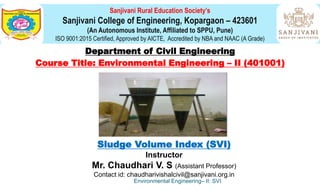
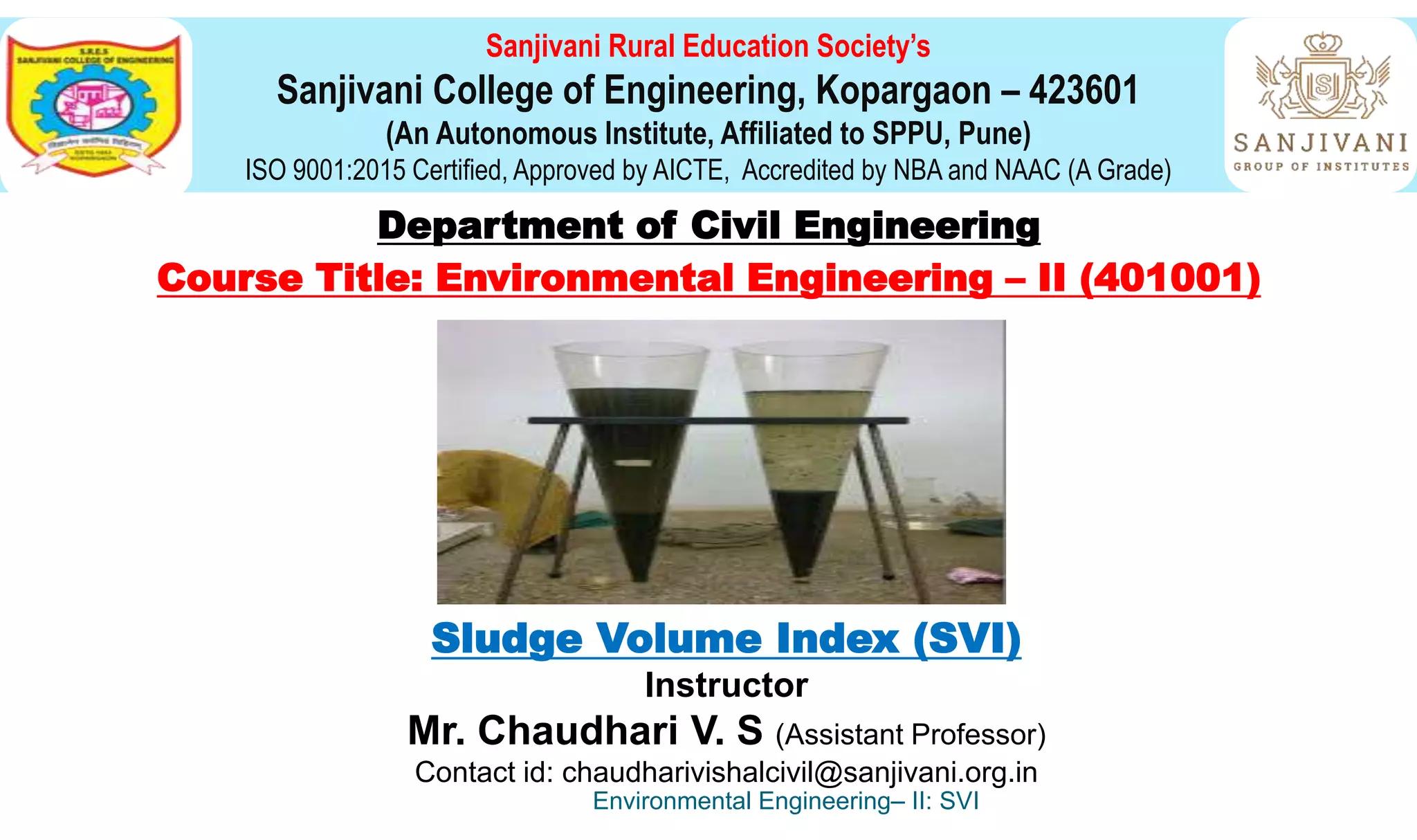
Sludge Volume Index (SVI)
Instructor
Mr. Chaudhari V. S (Assistant Professor)
Contact id: chaudharivishalcivil@sanjivani.org.in
Environmental Engineering– II: SVI
Introduction:-
 Sludge volume is an important parameter used for monitoring efficient operation of
aeration systems. SVI is the volume in ml, occupied by 1 gm of mixed liquor sample for
SVI test is drawn from outlet of an aeration tank of an activated sludge process-
conventional or modified.
Importance of solids determination:-
 SVI is used for determining the quantity of sludge produced in an aeration unit and
hence its efficiency.
 It is used for determining the recirculation ratio necessary for maintain a specified
MLSS concentration in the aerator.
 It is also used for estimating suspended solids concentration in recirculated sludge.
Environmental Engineering– II: SVI
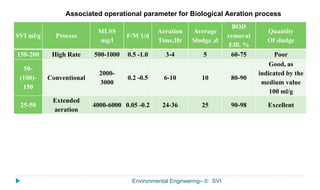
Associated operational parameter for Biological Aeration process
SVI ml/g Process
MLSS
mg/l
F/M 1/d
Aeration
Time,Hr
Average
Sludge ,d
BOD
removal
Effi. %
Quantity
Of sludge
150-200 High Rate 500-1000 0.5 -1.0 3-4 5 60-75 Poor
50-
(100)-
150
Conventional
2000-
3000
0.2 -0.5 6-10 10 80-90
Good, as
indicated by the
medium value
100 ml/g
25-50
Extended
aeration
4000-6000 0.05 -0.2 24-36 25 90-98 Excellent
Environmental Engineering– II: SVI
Sludge Bulking:-
If SVI is more than 200 ml/gm sludge produced in a biological aeration system is said
to be bulked. Bulked sludge indicates failure of the process. Sludge bulking is a major
operational problem; which increases effluent BOD and decreases process efficiency.
Causes of sludge bulking
a) Poor characteristics of influent waste water
1) Frequent variation in quantity and quality of influent.
2) Low pH (Filamentous organisms such as Beggiatoa & Sphaerotilus grow below pH 5.
These multicellular organisms get water-entrained and remain suspended without settling
down in S.S.T)
3) Low temperature resulting in decreasing bacterial activity.
4) Staleness or septicity of influent.
5) Low nutrient (The common BOD: N: P weight ratio required for biological treatment is
100 : 5 : 1)
6) High carbohydrates contribute to sludge bulking.
Environmental Engineering– II: SVI
b) Poor plant design and operation.
1) Sufficient aeration.
2) Insufficient mixing of recirculated sludge with influent waste water.
3) Organic over loading (high F/M).
4) In sufficient hydraulic retention tank or aeration tank.
5) In sufficient sludge retention time.
6) Improper recirculation of sludge resulting in fluctuating MLSS in the aerator.
7) Retention of sludge in SST for too long promoting an aerobic condition contributed to
sludge bulking.
c) Emergency control measures
1) Controlled chlorination of bulk sludge to kill multicellular organism only.
2) Reaeration of return sludge on recycle line
d) Long term control measures:-
1) Modification and improvement of influent characteristics.
2) Modification and improvement of plant design and operational parameters.
Environmental Engineering– II: SVI
Determination of SVI
Principle
SVI determination is based on estimating the volume of sludge settled in 30 minutes per
gram of MLSS.
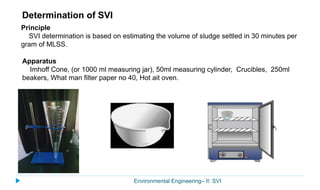
Apparatus
Imhoff Cone, (or 1000 ml measuring jar), 50ml measuring cylinder, Crucibles, 250ml
beakers, What man filter paper no 40, Hot ait oven.
Environmental Engineering– II: SVI
Procedure
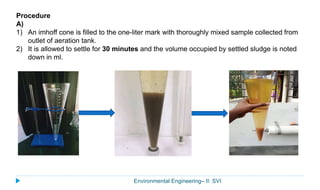
A)
1) An imhoff cone is filled to the one-liter mark with thoroughly mixed sample collected from
outlet of aeration tank.
2) It is allowed to settle for 30 minutes and the volume occupied by settled sludge is noted
down in ml.
Environmental Engineering– II: SVI
B)
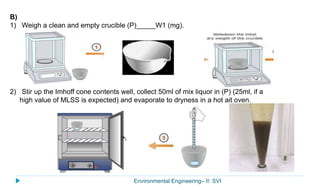
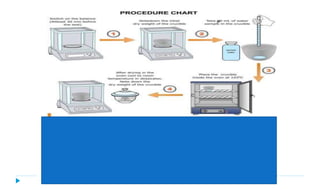
1) Weigh a clean and empty crucible (P)_____W1 (mg).
2) Stir up the Imhoff cone contents well, collect 50ml of mix liquor in (P) (25ml, if a
high value of MLSS is expected) and evaporate to dryness in a hot ait oven.
Environmental Engineering– II: SVI
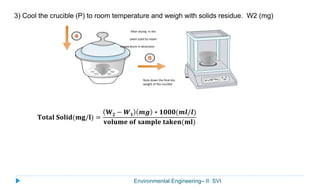
3) Cool the crucible (P) to room temperature and weigh with solids residue. W2 (mg)
After drying in the
oven cool to room
temperature in dessicator
Note down the final dry
weight of the crucible
𝐓𝐨𝐭𝐚𝐥 𝐒𝐨𝐥𝐢𝐝(𝐦𝐠/𝐥) =
𝐖 𝟐 − 𝑾 𝟏 𝒎𝒈 ∗ 𝟏𝟎𝟎𝟎(𝒎𝒍/𝒍)
𝐯𝐨𝐥𝐮𝐦𝐞 𝐨𝐟 𝐬𝐚𝐦𝐩𝐥𝐞 𝐭𝐚𝐤𝐞𝐧(𝐦𝐥)
Environmental Engineering– II: BOD
50
Environmental Engineering– II: SVI
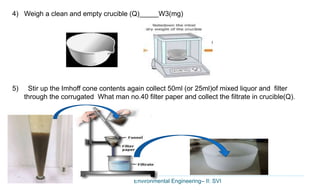
4) Weigh a clean and empty crucible (Q)_____W3(mg)
5) Stir up the Imhoff cone contents again collect 50ml (or 25ml)of mixed liquor and filter
through the corrugated What man no.40 filter paper and collect the filtrate in crucible(Q).
Environmental Engineering– II: SVI
6) The filtrate is evaporated to dryness in hot air oven for about eight hour at 1030 to1050c. It is
then allowed to cool in desiccator & weighed accurately (W4)
Dissolved 𝐒𝐨𝐥𝐢𝐝(𝐦𝐠/𝐥) =
𝐖 𝟒
−𝑾 𝟑
𝒎𝒈 ∗𝟏𝟎𝟎𝟎(𝒎𝒍/𝒍)
𝐯𝐨𝐥𝐮𝐦𝐞 𝐨𝐟 𝐬𝐚𝐦𝐩𝐥𝐞 𝐭𝐚𝐤𝐞𝐧(𝐦𝐥)
Mixed Liquor Suspended Solids (MLSS) = MLTS – MLDS
SVI, ml/g = [V (ml/l) ×1000(mg/g)] / MLSS (mg/g)]
Environmental Engineering– II: SVI
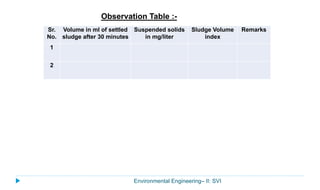
Observation Table :-
Sr.
No.
Volume in ml of settled
sludge after 30 minutes
Suspended solids
in mg/liter
Sludge Volume
index
Remarks
1
2
Environmental Engineering– II: SVI

Sludge Volume Index (SVI)

  • 1.
    Sanjivani Rural EducationSociety’s Sanjivani College of Engineering, Kopargaon – 423601 (An Autonomous Institute, Affiliated to SPPU, Pune) ISO 9001:2015 Certified, Approved by AICTE, Accredited by NBA and NAAC (A Grade) Department of Civil Engineering Course Title: Environmental Engineering – II (401001) Sludge Volume Index (SVI) Instructor Mr. Chaudhari V. S (Assistant Professor) Contact id: chaudharivishalcivil@sanjivani.org.in Environmental Engineering– II: SVI
  • 2.
    Environmental Engineering– II:SVI Introduction:-  Sludge volume is an important parameter used for monitoring efficient operation of aeration systems. SVI is the volume in ml, occupied by 1 gm of mixed liquor sample for SVI test is drawn from outlet of an aeration tank of an activated sludge process- conventional or modified. Importance of solids determination:-  SVI is used for determining the quantity of sludge produced in an aeration unit and hence its efficiency.  It is used for determining the recirculation ratio necessary for maintain a specified MLSS concentration in the aerator.  It is also used for estimating suspended solids concentration in recirculated sludge.
  • 3.
    Environmental Engineering– II:SVI Associated operational parameter for Biological Aeration process SVI ml/g Process MLSS mg/l F/M 1/d Aeration Time,Hr Average Sludge ,d BOD removal Effi. % Quantity Of sludge 150-200 High Rate 500-1000 0.5 -1.0 3-4 5 60-75 Poor 50- (100)- 150 Conventional 2000- 3000 0.2 -0.5 6-10 10 80-90 Good, as indicated by the medium value 100 ml/g 25-50 Extended aeration 4000-6000 0.05 -0.2 24-36 25 90-98 Excellent
  • 4.
    Environmental Engineering– II:SVI Sludge Bulking:- If SVI is more than 200 ml/gm sludge produced in a biological aeration system is said to be bulked. Bulked sludge indicates failure of the process. Sludge bulking is a major operational problem; which increases effluent BOD and decreases process efficiency. Causes of sludge bulking a) Poor characteristics of influent waste water 1) Frequent variation in quantity and quality of influent. 2) Low pH (Filamentous organisms such as Beggiatoa & Sphaerotilus grow below pH 5. These multicellular organisms get water-entrained and remain suspended without settling down in S.S.T) 3) Low temperature resulting in decreasing bacterial activity. 4) Staleness or septicity of influent. 5) Low nutrient (The common BOD: N: P weight ratio required for biological treatment is 100 : 5 : 1) 6) High carbohydrates contribute to sludge bulking.
  • 5.
    Environmental Engineering– II:SVI b) Poor plant design and operation. 1) Sufficient aeration. 2) Insufficient mixing of recirculated sludge with influent waste water. 3) Organic over loading (high F/M). 4) In sufficient hydraulic retention tank or aeration tank. 5) In sufficient sludge retention time. 6) Improper recirculation of sludge resulting in fluctuating MLSS in the aerator. 7) Retention of sludge in SST for too long promoting an aerobic condition contributed to sludge bulking. c) Emergency control measures 1) Controlled chlorination of bulk sludge to kill multicellular organism only. 2) Reaeration of return sludge on recycle line d) Long term control measures:- 1) Modification and improvement of influent characteristics. 2) Modification and improvement of plant design and operational parameters.
  • 6.
    Environmental Engineering– II:SVI Determination of SVI Principle SVI determination is based on estimating the volume of sludge settled in 30 minutes per gram of MLSS. Apparatus Imhoff Cone, (or 1000 ml measuring jar), 50ml measuring cylinder, Crucibles, 250ml beakers, What man filter paper no 40, Hot ait oven.
  • 7.
    Environmental Engineering– II:SVI Procedure A) 1) An imhoff cone is filled to the one-liter mark with thoroughly mixed sample collected from outlet of aeration tank. 2) It is allowed to settle for 30 minutes and the volume occupied by settled sludge is noted down in ml.
  • 8.
    Environmental Engineering– II:SVI B) 1) Weigh a clean and empty crucible (P)_____W1 (mg). 2) Stir up the Imhoff cone contents well, collect 50ml of mix liquor in (P) (25ml, if a high value of MLSS is expected) and evaporate to dryness in a hot ait oven.
  • 9.
    Environmental Engineering– II:SVI 3) Cool the crucible (P) to room temperature and weigh with solids residue. W2 (mg) After drying in the oven cool to room temperature in dessicator Note down the final dry weight of the crucible 𝐓𝐨𝐭𝐚𝐥 𝐒𝐨𝐥𝐢𝐝(𝐦𝐠/𝐥) = 𝐖 𝟐 − 𝑾 𝟏 𝒎𝒈 ∗ 𝟏𝟎𝟎𝟎(𝒎𝒍/𝒍) 𝐯𝐨𝐥𝐮𝐦𝐞 𝐨𝐟 𝐬𝐚𝐦𝐩𝐥𝐞 𝐭𝐚𝐤𝐞𝐧(𝐦𝐥)
  • 10.
  • 11.
    Environmental Engineering– II:SVI 4) Weigh a clean and empty crucible (Q)_____W3(mg) 5) Stir up the Imhoff cone contents again collect 50ml (or 25ml)of mixed liquor and filter through the corrugated What man no.40 filter paper and collect the filtrate in crucible(Q).
  • 12.
    Environmental Engineering– II:SVI 6) The filtrate is evaporated to dryness in hot air oven for about eight hour at 1030 to1050c. It is then allowed to cool in desiccator & weighed accurately (W4) Dissolved 𝐒𝐨𝐥𝐢𝐝(𝐦𝐠/𝐥) = 𝐖 𝟒 −𝑾 𝟑 𝒎𝒈 ∗𝟏𝟎𝟎𝟎(𝒎𝒍/𝒍) 𝐯𝐨𝐥𝐮𝐦𝐞 𝐨𝐟 𝐬𝐚𝐦𝐩𝐥𝐞 𝐭𝐚𝐤𝐞𝐧(𝐦𝐥) Mixed Liquor Suspended Solids (MLSS) = MLTS – MLDS SVI, ml/g = [V (ml/l) ×1000(mg/g)] / MLSS (mg/g)]
  • 13.
    Environmental Engineering– II:SVI Observation Table :- Sr. No. Volume in ml of settled sludge after 30 minutes Suspended solids in mg/liter Sludge Volume index Remarks 1 2
  • 14.