Pedagogical Approaches
within the MSLS Programme at
BTH

BTH staff,

June 2012
Sustainability Innovation Education

10 years ago:
 Integrating environmental aspects into
  Mechanical Engineering
 Educated staff about sustainable development
 A mandatory basic course in sustainable
  development was developed and give to all
  students at Mechanical Engineering.
 Build-up research field “Sustainable Product
  Innovation”
Recognition of our Sustainability Education

                   Report published in May
                    2009

                   Ranked BTH #1 in Sweden
                    and #3 in Europe for
                    engineering education for
                    Sustainable Development
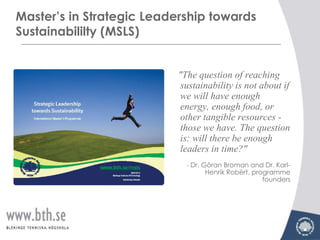
Master’s in Strategic Leadership towards
Sustainabililty (MSLS)


                           "The question of reaching
                            sustainability is not about if
                            we will have enough
                            energy, enough food, or
                            other tangible resources -
                            those we have. The question
                            is: will there be enough
                            leaders in time?"
                             - Dr. Göran Broman and Dr. Karl-
                                  Henrik Robèrt, programme
                                                    founders
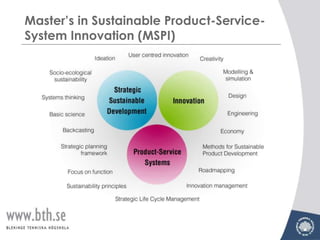
Master’s in Sustainable Product-Service-
System Innovation (MSPI)


                    Innovation


       Strategic
      Sustainable
      Development                Innovation
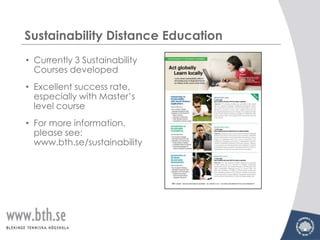
Sustainability Distance Education
• Currently 3 Sustainability
  Courses developed
• Excellent success rate,
  especially with Master’s
  level course
• For more information,
  please see:
  www.bth.se/sustainability
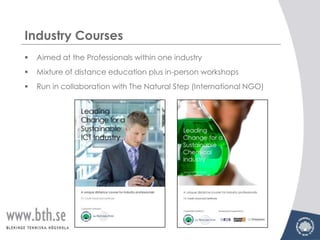
Industry Courses
   Aimed at the Professionals within one industry
   Mixture of distance education plus in-person workshops
   Run in collaboration with The Natural Step (International NGO)
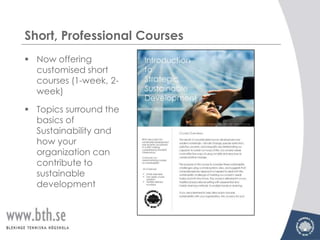
Short, Professional Courses
 Now offering
  customised short
  courses (1-week, 2-
  week)

 Topics surround the
  basics of
  Sustainability and
  how your
  organization can
  contribute to
  sustainable
  development
Aspects of the MSLS programme

   Period structure

   2 themes

   Learning loops

   Role of the staff

   ”The invitation”
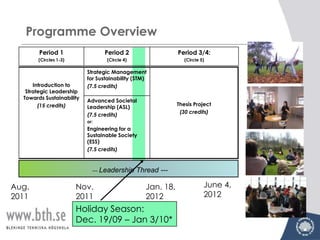
Programme Overview
        Period 1                  Period 2                    Period 3/4:
       (Circles 1-3)               (Circle 4)                    (Circle 5)

                           Strategic Management
                           for Sustainability (STM)
      Introduction to      (7.5 credits)
   Strategic Leadership
  Towards Sustainability
                           Advanced Societal
        (15 credits)                                          Thesis Project
                           Leadership (ASL)
                                                               (30 credits)
                           (7.5 credits)
                           or:
                           Engineering for a
                           Sustainable Society
                           (ESS)
                           (7.5 credits)


                             --- Leadership     Thread ---

Aug.                   Nov.                        Jan. 18,               June 4,
2011                   2011                        2012                   2012
                       Holiday Season:
                       Dec. 19/09 – Jan 3/10*
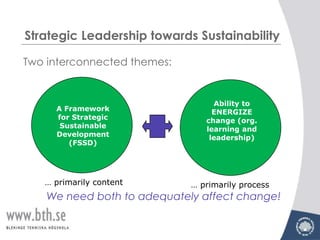
Strategic Leadership towards Sustainability

Two interconnected themes:


                                  Ability to
     A Framework                  ENERGIZE
     for Strategic              change (org.
      Sustainable               learning and
     Development                 leadership)
        (FSSD)


   … primarily content       … primarily process
    We need both to adequately affect change!
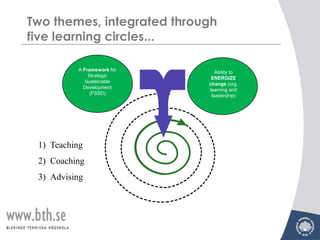
Two themes, integrated through
five learning circles...

          A Framework for
                               Ability to
              Strategic
                             ENERGIZE
             Sustainable
                            change (org.
            Development     learning and
               (FSSD)
                             leadership)


 1) Teaching
 2) Coaching
 3) Advising
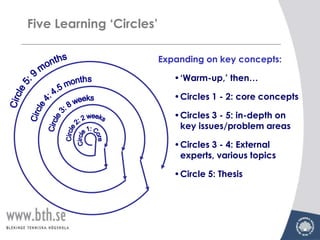
Five Learning ‘Circles’

                          Expanding on key concepts:

                             •‘Warm-up,’ then…

                             •Circles 1 - 2: core concepts

                             •Circles 3 - 5: in-depth on
                              key issues/problem areas

                             •Circles 3 - 4: External
                              experts, various topics

                             •Circle 5: Thesis
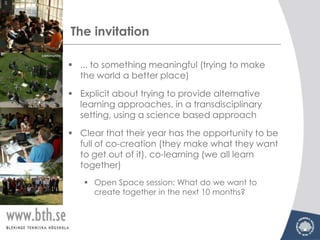
The invitation

 ... to something meaningful (trying to make
  the world a better place)

 Explicit about trying to provide alternative
  learning approaches, in a transdisciplinary
  setting, using a science based approach

 Clear that their year has the opportunity to be
  full of co-creation (they make what they want
  to get out of it), co-learning (we all learn
  together)
    Open Space session: What do we want to
     create together in the next 10 months?
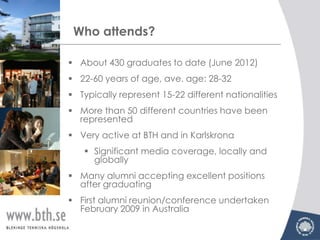
Who attends?

 About 430 graduates to date (June 2012)
 22-60 years of age, ave. age: 28-32
 Typically represent 15-22 different nationalities
 More than 50 different countries have been
  represented
 Very active at BTH and in Karlskrona
    Significant media coverage, locally and
     globally
 Many alumni accepting excellent positions
  after graduating
 First alumni reunion/conference undertaken
  February 2009 in Australia
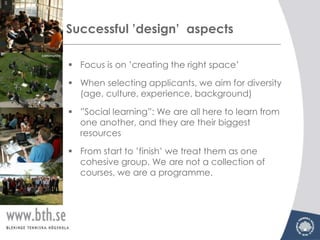
Successful ’design’ aspects

 Focus is on ’creating the right space’

 When selecting applicants, we aim for diversity
  (age, culture, experience, background)

 ”Social learning”: We are all here to learn from
  one another, and they are their biggest
  resources

 From start to ’finish’ we treat them as one
  cohesive group. We are not a collection of
  courses, we are a programme.
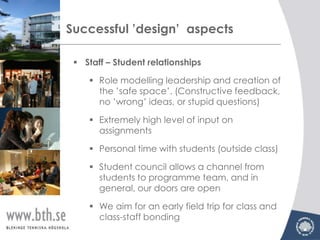
Successful ’design’ aspects

  Staff – Student relationships

     Role modelling leadership and creation of
      the ’safe space’. (Constructive feedback,
      no ’wrong’ ideas, or stupid questions)

     Extremely high level of input on
      assignments

     Personal time with students (outside class)

     Student council allows a channel from
      students to programme team, and in
      general, our doors are open

     We aim for an early field trip for class and
      class-staff bonding
Successful ’design’ aspects

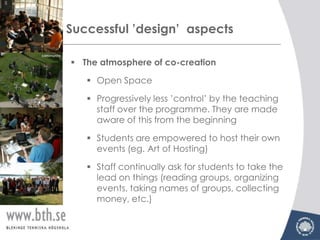
 The atmosphere of co-creation

    Open Space

    Progressively less ’control’ by the teaching
     staff over the programme. They are made
     aware of this from the beginning

    Students are empowered to host their own
     events (eg. Art of Hosting)

    Staff continually ask for students to take the
     lead on things (reading groups, organizing
     events, taking names of groups, collecting
     money, etc.)
Successful ’design’ aspects
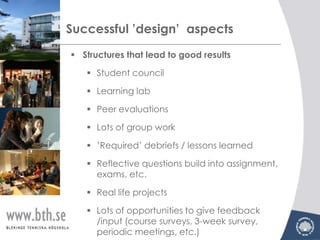
 Structures that lead to good results

    Student council

    Learning lab

    Peer evaluations

    Lots of group work

    ’Required’ debriefs / lessons learned

    Reflective questions build into assignment,
     exams, etc.

    Real life projects

    Lots of opportunities to give feedback
     /input (course surveys, 3-week survey,
     periodic meetings, etc.)
Successful ’design’ aspects

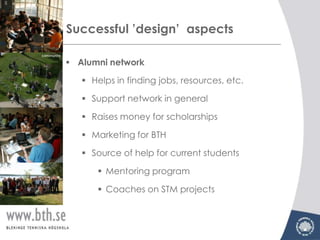
 Alumni network

    Helps in finding jobs, resources, etc.

    Support network in general

    Raises money for scholarships

    Marketing for BTH

    Source of help for current students

       Mentoring program

       Coaches on STM projects
Other?

 Sustainability group   Extra care/touch with
  has an ambition to be   incoming/ applying
  world-class             students

 Well connected with    Marketing via Twitter,
  research / education    Facebook, alumni
                          networks, WiserEarth,
 We are mostly alumni,   Blogs, videos, etc.
  quite young,
  international, and
  therefore can relate
  to what they are
  going through
Current Challenges
    Empowering people can lead to lots of ambitious
     students  lots of commitments
    There seems to be never enough time (see above),
     especially for marketing and admission process
    We have a diverse and growing staff with no time for
     coordination / management. There are many projects
     on the go.
    Tuition fees impacted the numbers and mix of the
     students
    We have requests for partnerships, but don’t yet have
     a good way to engage (or the time)
    Students feel overworked (is this the content or the
     extra-curricular?)
    We are lacking Africa viewpoints
    Most staff have a ’western’ mindset
    Staff retention has been hard

Msls presentation to elizabeth june2012

  • 1.
    Pedagogical Approaches within theMSLS Programme at BTH BTH staff, June 2012
  • 2.
    Sustainability Innovation Education 10years ago:  Integrating environmental aspects into Mechanical Engineering  Educated staff about sustainable development  A mandatory basic course in sustainable development was developed and give to all students at Mechanical Engineering.  Build-up research field “Sustainable Product Innovation”
  • 3.
    Recognition of ourSustainability Education  Report published in May 2009  Ranked BTH #1 in Sweden and #3 in Europe for engineering education for Sustainable Development
  • 4.
    Master’s in StrategicLeadership towards Sustainabililty (MSLS) "The question of reaching sustainability is not about if we will have enough energy, enough food, or other tangible resources - those we have. The question is: will there be enough leaders in time?" - Dr. Göran Broman and Dr. Karl- Henrik Robèrt, programme founders
  • 5.
    Master’s in SustainableProduct-Service- System Innovation (MSPI) Innovation Strategic Sustainable Development Innovation
  • 6.
    Sustainability Distance Education •Currently 3 Sustainability Courses developed • Excellent success rate, especially with Master’s level course • For more information, please see: www.bth.se/sustainability
  • 7.
    Industry Courses  Aimed at the Professionals within one industry  Mixture of distance education plus in-person workshops  Run in collaboration with The Natural Step (International NGO)
  • 8.
    Short, Professional Courses Now offering customised short courses (1-week, 2- week)  Topics surround the basics of Sustainability and how your organization can contribute to sustainable development
  • 9.
    Aspects of theMSLS programme  Period structure  2 themes  Learning loops  Role of the staff  ”The invitation”
  • 10.
    Programme Overview Period 1 Period 2 Period 3/4: (Circles 1-3) (Circle 4) (Circle 5) Strategic Management for Sustainability (STM) Introduction to (7.5 credits) Strategic Leadership Towards Sustainability Advanced Societal (15 credits) Thesis Project Leadership (ASL) (30 credits) (7.5 credits) or: Engineering for a Sustainable Society (ESS) (7.5 credits) --- Leadership Thread --- Aug. Nov. Jan. 18, June 4, 2011 2011 2012 2012 Holiday Season: Dec. 19/09 – Jan 3/10*
  • 11.
    Strategic Leadership towardsSustainability Two interconnected themes: Ability to A Framework ENERGIZE for Strategic change (org. Sustainable learning and Development leadership) (FSSD) … primarily content … primarily process We need both to adequately affect change!
  • 12.
    Two themes, integratedthrough five learning circles... A Framework for Ability to Strategic ENERGIZE Sustainable change (org. Development learning and (FSSD) leadership) 1) Teaching 2) Coaching 3) Advising
  • 13.
    Five Learning ‘Circles’ Expanding on key concepts: •‘Warm-up,’ then… •Circles 1 - 2: core concepts •Circles 3 - 5: in-depth on key issues/problem areas •Circles 3 - 4: External experts, various topics •Circle 5: Thesis
  • 14.
    The invitation  ...to something meaningful (trying to make the world a better place)  Explicit about trying to provide alternative learning approaches, in a transdisciplinary setting, using a science based approach  Clear that their year has the opportunity to be full of co-creation (they make what they want to get out of it), co-learning (we all learn together)  Open Space session: What do we want to create together in the next 10 months?
  • 15.
    Who attends?  About430 graduates to date (June 2012)  22-60 years of age, ave. age: 28-32  Typically represent 15-22 different nationalities  More than 50 different countries have been represented  Very active at BTH and in Karlskrona  Significant media coverage, locally and globally  Many alumni accepting excellent positions after graduating  First alumni reunion/conference undertaken February 2009 in Australia
  • 16.
    Successful ’design’ aspects Focus is on ’creating the right space’  When selecting applicants, we aim for diversity (age, culture, experience, background)  ”Social learning”: We are all here to learn from one another, and they are their biggest resources  From start to ’finish’ we treat them as one cohesive group. We are not a collection of courses, we are a programme.
  • 17.
    Successful ’design’ aspects  Staff – Student relationships  Role modelling leadership and creation of the ’safe space’. (Constructive feedback, no ’wrong’ ideas, or stupid questions)  Extremely high level of input on assignments  Personal time with students (outside class)  Student council allows a channel from students to programme team, and in general, our doors are open  We aim for an early field trip for class and class-staff bonding
  • 18.
    Successful ’design’ aspects The atmosphere of co-creation  Open Space  Progressively less ’control’ by the teaching staff over the programme. They are made aware of this from the beginning  Students are empowered to host their own events (eg. Art of Hosting)  Staff continually ask for students to take the lead on things (reading groups, organizing events, taking names of groups, collecting money, etc.)
  • 19.
    Successful ’design’ aspects Structures that lead to good results  Student council  Learning lab  Peer evaluations  Lots of group work  ’Required’ debriefs / lessons learned  Reflective questions build into assignment, exams, etc.  Real life projects  Lots of opportunities to give feedback /input (course surveys, 3-week survey, periodic meetings, etc.)
  • 20.
    Successful ’design’ aspects Alumni network  Helps in finding jobs, resources, etc.  Support network in general  Raises money for scholarships  Marketing for BTH  Source of help for current students  Mentoring program  Coaches on STM projects
  • 21.
    Other?  Sustainability group  Extra care/touch with has an ambition to be incoming/ applying world-class students  Well connected with  Marketing via Twitter, research / education Facebook, alumni networks, WiserEarth,  We are mostly alumni, Blogs, videos, etc. quite young, international, and therefore can relate to what they are going through
  • 22.
    Current Challenges  Empowering people can lead to lots of ambitious students  lots of commitments  There seems to be never enough time (see above), especially for marketing and admission process  We have a diverse and growing staff with no time for coordination / management. There are many projects on the go.  Tuition fees impacted the numbers and mix of the students  We have requests for partnerships, but don’t yet have a good way to engage (or the time)  Students feel overworked (is this the content or the extra-curricular?)  We are lacking Africa viewpoints  Most staff have a ’western’ mindset  Staff retention has been hard

Editor's Notes

  • #2 Approach: something around how we would like to learn from other programmes about what they do and how we can improve, so we are showing what we do as a first step and hope that leads into a conversation around what others do and how we can learn from each other????
  • #5 First programme offering in 2004/2005Now beginning our 6th year of studies~ 60 students per year,
  • #6 First programme will be offered in 20102 year programme – Master of Science degreeApproximately 30 students per year, hopefully from a variety of different cultures and backgroundsWill appeal to Engineers, Industrial and Product Designers, and Industrial Economists