
Section 1 ,Group – 2
FT   12113   Anuja
FT   12102   Abhay
FT   12189   Pramod
FT   12127   Harendra
FT   12168   Tushar
FT   12104   Abhilash


                        PAAATH Group 2,Section 1            1
OBJECTIVE


• Value pricing

• Reduction in list price

• Pricing or costing

• Customer reaction

• Effect and risks post price change

• Approach for LDL or Coffee


                       PAAATH Group 2,Section 1   2
Value Pricing

• The concept of value pricing is basically about
  giving the customer a product on the basis of
  his perception of its value.
• Value being subjective, perception of value
  varies from customer to customer.
• The same product will have different
  intonations for different customers, with
  resultant varying values.


                            PAAATH Group 2,Section 1   3
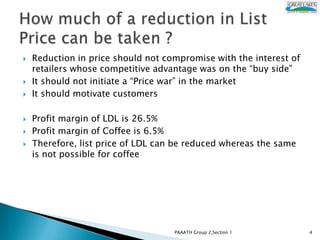
   Reduction in price should not compromise with the interest of
    retailers whose competitive advantage was on the “buy side”
   It should not initiate a “Price war” in the market
   It should motivate customers

   Profit margin of LDL is 26.5%
   Profit margin of Coffee is 6.5%
   Therefore, list price of LDL can be reduced whereas the same
    is not possible for coffee


                                    PAAATH Group 2,Section 1        4
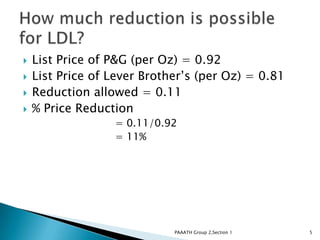
   List Price of P&G (per Oz) = 0.92
   List Price of Lever Brother’s (per Oz) = 0.81
   Reduction allowed = 0.11
   % Price Reduction
                  = 0.11/0.92
                  = 11%


                             PAAATH Group 2,Section 1   5
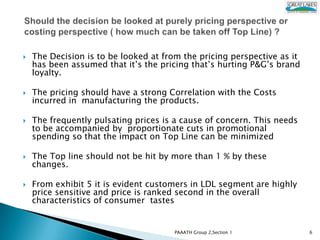
   The Decision is to be looked at from the pricing perspective as it
    has been assumed that it’s the pricing that’s hurting P&G’s brand
    loyalty.

   The pricing should have a strong Correlation with the Costs
    incurred in manufacturing the products.

   The frequently pulsating prices is a cause of concern. This needs
    to be accompanied by proportionate cuts in promotional
    spending so that the impact on Top Line can be minimized

   The Top line should not be hit by more than 1 % by these
    changes.

   From exhibit 5 it is evident customers in LDL segment are highly
    price sensitive and price is ranked second in the overall
    characteristics of consumer tastes.


                                       PAAATH Group 2,Section 1          6
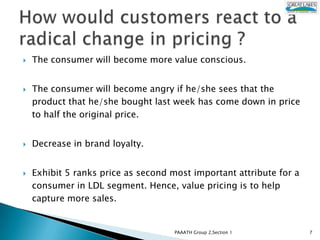
   The consumer will become more value conscious.


   The consumer will become angry if he/she sees that the
    product that he/she bought last week has come down in price
    to half the original price.


   Decrease in brand loyalty.


   Exhibit 5 ranks price as second most important attribute for a
    consumer in LDL segment. Hence, value pricing is to help
    capture more sales.


                                     PAAATH Group 2,Section 1        7
   Reduction in the Topline

   Compromise with the interest of the retailers

   Brand Dilution

   Frustration to loyal customers

   Price war

   Arbitrage.


                                     PAAATH Group 2,Section 1   8
   Approach for the both the products should be different:


    ◦ For LDL, the profit margin is high.
    ◦ Therefore, the price can be reduced


    ◦ For Coffee, the profit margin is low
    ◦ Therefore, the concentration should be on cost reduction


                                            PAAATH Group 2,Section 1   9
PAAATH Group 2,Section 1   10

P&G Case Analysis

  • 1.
    Section 1 ,Group– 2 FT 12113 Anuja FT 12102 Abhay FT 12189 Pramod FT 12127 Harendra FT 12168 Tushar FT 12104 Abhilash PAAATH Group 2,Section 1 1
  • 2.
    OBJECTIVE • Value pricing •Reduction in list price • Pricing or costing • Customer reaction • Effect and risks post price change • Approach for LDL or Coffee PAAATH Group 2,Section 1 2
  • 3.
    Value Pricing • Theconcept of value pricing is basically about giving the customer a product on the basis of his perception of its value. • Value being subjective, perception of value varies from customer to customer. • The same product will have different intonations for different customers, with resultant varying values. PAAATH Group 2,Section 1 3
  • 4.
    Reduction in price should not compromise with the interest of retailers whose competitive advantage was on the “buy side”  It should not initiate a “Price war” in the market  It should motivate customers  Profit margin of LDL is 26.5%  Profit margin of Coffee is 6.5%  Therefore, list price of LDL can be reduced whereas the same is not possible for coffee PAAATH Group 2,Section 1 4
  • 5.
    List Price of P&G (per Oz) = 0.92  List Price of Lever Brother’s (per Oz) = 0.81  Reduction allowed = 0.11  % Price Reduction = 0.11/0.92 = 11% PAAATH Group 2,Section 1 5
  • 6.
    The Decision is to be looked at from the pricing perspective as it has been assumed that it’s the pricing that’s hurting P&G’s brand loyalty.  The pricing should have a strong Correlation with the Costs incurred in manufacturing the products.  The frequently pulsating prices is a cause of concern. This needs to be accompanied by proportionate cuts in promotional spending so that the impact on Top Line can be minimized  The Top line should not be hit by more than 1 % by these changes.  From exhibit 5 it is evident customers in LDL segment are highly price sensitive and price is ranked second in the overall characteristics of consumer tastes. PAAATH Group 2,Section 1 6
  • 7.
    The consumer will become more value conscious.  The consumer will become angry if he/she sees that the product that he/she bought last week has come down in price to half the original price.  Decrease in brand loyalty.  Exhibit 5 ranks price as second most important attribute for a consumer in LDL segment. Hence, value pricing is to help capture more sales. PAAATH Group 2,Section 1 7
  • 8.
    Reduction in the Topline  Compromise with the interest of the retailers  Brand Dilution  Frustration to loyal customers  Price war  Arbitrage. PAAATH Group 2,Section 1 8
  • 9.
    Approach for the both the products should be different: ◦ For LDL, the profit margin is high. ◦ Therefore, the price can be reduced ◦ For Coffee, the profit margin is low ◦ Therefore, the concentration should be on cost reduction PAAATH Group 2,Section 1 9
  • 10.

Editor's Notes

  • #4 Value pricing is defined by offering your product at a fair and reasonableprice that makes sense to the purchasing customer. as the name itself suggest price of the product/ service is set according to value perceived by the customer. Value is subjective. Value is a benefit but a benefit is not necessarily of value to all customers. For example, a vendor offers free installation and free updates for his software. Customer-A considers "free installation" as "value"' because he has no technical knowledge and this will save him time and effort. Customer-B rates the free installation as "nice to have" but the drawcard or "value" is the free updates that will save him money in the long run. Customers do not assign value to the same benefits.Source - http://wiki.answers.com/Q/What_is_Value_PricingValue based pricing, or Value optimized pricing is a business strategy. It sets selling prices primarily, but not exclusively, on the perceived value to the customer, rather than on the actual cost of the product, the market price, competitors prices, or the historical price.[1] The goal of value-based pricing is to better align price with value delivered. Price for any individual customer can be customized to reflect the specific value delivered. Examples could include metrics such as number of users and the value per users, number of annual transactions and the value per transaction, size of revenues and the impact on revenues, cost savings, or other measurements. Value based pricing is intended to make companies become more competitive and more profitable than using simpler pricing methods. It can also be used in product development and product management to configure products to maximize value for specific customers.Source - http://en.wikipedia.org/wiki/Value-based_pricingCustomers do not buy features and benefits, they buy VALUE. Value is subjective. Value is a benefit but a benefit is not necessarily of value to all customers. For example, a vendor offers free installation and free updates for his software. Customer-A considers "free installation" as "value"’ because he has no technical knowledge and this will save him time and effort. Customer-B rates the free installation as "nice to have" but the drawcard or "value" is the free updates that will save him money in the long run. Customers do not assign value to the same benefits.Behind value-pricing strategies there are a few important concepts:Customers are value conscious rather than price conscious e.g. some customers will pay extra for prompt delivery.Customers assign a personal value to a product or service e.g. a teenager is willing to pay a premium price for a concert performed by his idol.The selling price is based on customers’ perceived value rather than on the vendor’s costs e.g. an ebook costs less to produce than a paperback but readers will pay more for it because of the value placed on format and instant delivery. When customers evaluate competing products, they are usually comparing value. To increase the value of your products, you can either add benefits or reduce the perceived risk factors rather than resorting to reducing your price. Source - http://www.smallbusinessbrief.com/articles/marketing/000876.html