JOEL JACOB 21
SIROSH PRAKASH 40
OBJECTIVE
What is echo sounder
Working of echo sounder
Components
errors
TABLE OF CONTENTS
 What is echo sounder
 working of echo sounder
 Components
 Transducer and placement
 Recorder
 bibliography
What is an echo sounder
 Device used to measure depth of water
 short pulse sound energy transmitted
vertically down
 Time taken for it to echo back is used to
determine depth
 Time taken (t ) = (2 x d) / v or d =(v x t)/2
 Factors affecting echo sounder : Temp of water
, pressure ,salinity
WORKING OF ECHO SOUNDER
(Marinegyaan.com)
 Recorder sends pulse to pulse generator, it creates
electrical pulses (frequency vary)(5-600 hz)
 Through transmitter pulses passed on to the
transducer which convert electrical to sound pulses.
 These pulses travel to the bottom of the sea and are
reflected back to the transducer
 Transducer converts sound energy back to electrical
and sends it to receiver
 It is received ,amplified and sent to recorder
 The recorder records the obtained data
TRANDUCER
 Works on magnetostriction effect, to produce pulses
 it Change length when placed in magnetic field
 Placed in an AC field, causes vibrations, sound pulses
created
(Marinegyaan.com)
Placement of transducer
 Must be away from
 noises and vibrations(aft)
 Bow waves, aeration & bubbles , turbulence causes
 Placed 1/4th L from aft
 Echo sounders(ipad).mp4
(Marinegyaan.com)
RECORDER
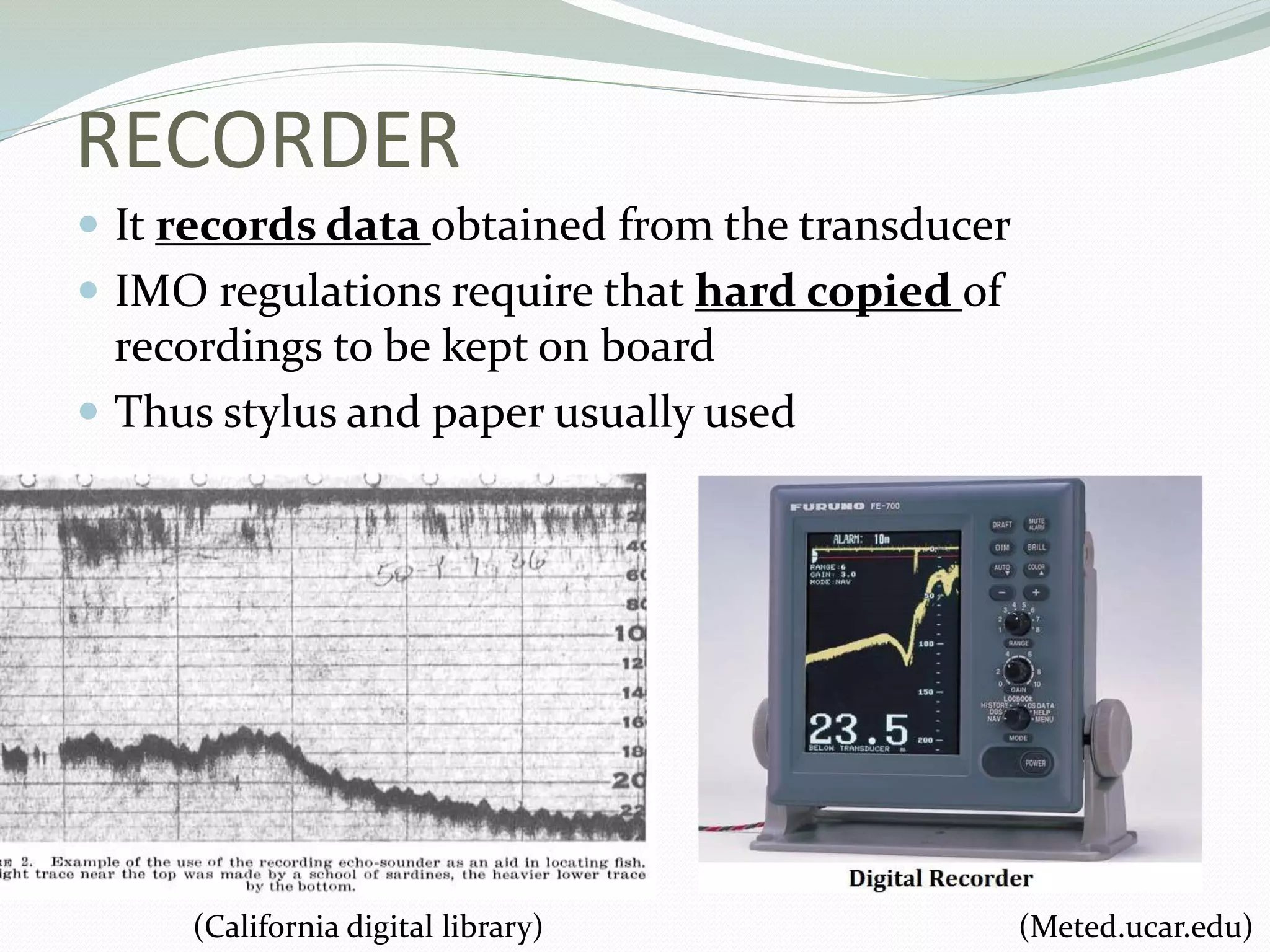
 It records data obtained from the transducer
 IMO regulations require that hard copied of
recordings to be kept on board
 Thus stylus and paper usually used
(Meted.ucar.edu)(California digital library)
ERRORS
 Change in velocity of sound due to salinity changes of
seas
 Bubbles and aeration causes errors
 Multiple echoes in shallow waters
 Pythagoras error and slanted distance
(cram.com)
(Seafloor.otterlabs.org)
CONCLUSION
 Definition and uses of echo sounder
 Its working and components
 The errors associated with its calculations
BIBLIOGRAPHY
 marinegyaan.com
 YouTube
Echosounder

Echosounder

  • 1.
  • 2.
    OBJECTIVE What is echosounder Working of echo sounder Components errors
  • 3.
    TABLE OF CONTENTS What is echo sounder  working of echo sounder  Components  Transducer and placement  Recorder  bibliography
  • 4.
    What is anecho sounder  Device used to measure depth of water  short pulse sound energy transmitted vertically down  Time taken for it to echo back is used to determine depth  Time taken (t ) = (2 x d) / v or d =(v x t)/2  Factors affecting echo sounder : Temp of water , pressure ,salinity
  • 5.
    WORKING OF ECHOSOUNDER (Marinegyaan.com)
  • 6.
     Recorder sendspulse to pulse generator, it creates electrical pulses (frequency vary)(5-600 hz)  Through transmitter pulses passed on to the transducer which convert electrical to sound pulses.  These pulses travel to the bottom of the sea and are reflected back to the transducer  Transducer converts sound energy back to electrical and sends it to receiver  It is received ,amplified and sent to recorder  The recorder records the obtained data
  • 7.
    TRANDUCER  Works onmagnetostriction effect, to produce pulses  it Change length when placed in magnetic field  Placed in an AC field, causes vibrations, sound pulses created (Marinegyaan.com)
  • 8.
    Placement of transducer Must be away from  noises and vibrations(aft)  Bow waves, aeration & bubbles , turbulence causes  Placed 1/4th L from aft  Echo sounders(ipad).mp4 (Marinegyaan.com)
  • 9.
    RECORDER  It recordsdata obtained from the transducer  IMO regulations require that hard copied of recordings to be kept on board  Thus stylus and paper usually used (Meted.ucar.edu)(California digital library)
  • 10.
    ERRORS  Change invelocity of sound due to salinity changes of seas  Bubbles and aeration causes errors  Multiple echoes in shallow waters  Pythagoras error and slanted distance (cram.com) (Seafloor.otterlabs.org)
  • 11.
    CONCLUSION  Definition anduses of echo sounder  Its working and components  The errors associated with its calculations
  • 12.