PRESENTED BY
Course Title – TROPICAL FISH STOICK ASSISMENT
[FRM 504]
COURSE INSTRUCTOR
GEAR SELECTIVITY
• AADIL HUSSAIN • Dr. F.A Bhat
GEAR SELECTIVITY
Most fishing gears, for example trawl gears, are selective
for the larger sizes, while some gears (gill nets) are
selective for a certain length range only, thus excluding
the capture of very small and very large fish. This
property of fishing gear is called "gear selectivity ".
FISHING SELECTIVITY
• Fishing selectivity can be defined as the ability to target and
capture fish by species, size or sex during harvesting operations,
allowing all incidental by–catch to be released unharmed.
• Selectivity play a major role in the development of a sustainable
and economically viable fishery. The results of selectivity
experiments can be befitted to the fishermen to allow them to
capture only targeted fishes and ensures the essential return of
juvenile fishes.
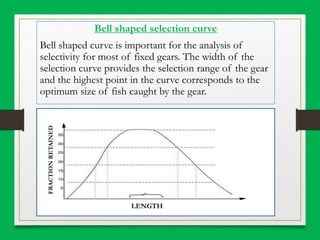
Bell shaped selection curve
Bell shaped curve is important for the analysis of
selectivity for most of fixed gears. The width of the
selection curve provides the selection range of the gear
and the highest point in the curve corresponds to the
optimum size of fish caught by the gear.
FRACTIONRETAINED
LENGTH
Sigmoid shaped selection curve
• In the fixed gear, the entry of larger fish is prevented but it permits the
escapement of smaller fish in relation to size. By contrast, mobile gears
allow all the smaller size fish to escape through meshes and larger fish
become more susceptible to selection.
• As size of fish increase, the percentage of fish retained also increases.
The selection process produces “S” shaped selectivity curve.
• The point where 50% of the fishes are retained and 50% escape, is
known as the 50% selection size L_{50}. The steepness of the curve
indicates the efficiency of the selection access.
• A shallow curve that gradually changes between L_{25} and L_{75}
depicts a poor selection access, whereas a curve that very quickly
changes from 0% to 100% selection (a vertical line) indicates
optimum selection. The small selection range produces a vertical line
selection and this is said to approach “Knife edge” pattern.
Gill Net selectivity
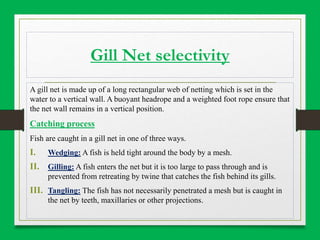
A gill net is made up of a long rectangular web of netting which is set in the
water to a vertical wall. A buoyant headrope and a weighted foot rope ensure that
the net wall remains in a vertical position.
Catching process
Fish are caught in a gill net in one of three ways.
I. Wedging: A fish is held tight around the body by a mesh.
II. Gilling: A fish enters the net but it is too large to pass through and is
prevented from retreating by twine that catches the fish behind its gills.
III. Tangling: The fish has not necessarily penetrated a mesh but is caught in
the net by teeth, maxillaries or other projections.
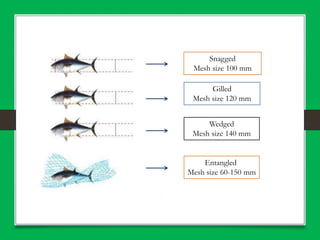
Entangled
Mesh size 60-150 mm
Snagged
Mesh size 100 mm
Wedged
Mesh size 140 mm
Gilled
Mesh size 120 mm
Factors influencing the selectivity
to Gill nets
 Planning an experiment involves prior knowledge of the factors that
can affect gear selectivity. Some of them, as those related to the gear,
are easy to control, in opposition to those related to the fish or to
environmental conditions.
A. Gear parameters
a. Gang and net dimensions
b. Mesh size (Use the given one) - The smallest fish caught has a
maximum girth equal to the perimeter of the mesh, the largest fish
caught has a head girth equal to the perimeter of the mesh. Fish
between these two sizes are caught.
c. Hanging ratio
Continued…
d. Vertical slack (defined as the ratio between the stretched
length of the inner and the outer netting, in trammels
and semi - trammel nets). It can be controlled by the
height of the walls in a trammel net.
e. Twine characteristics (material, construction, thickness,
colour, flexibility...)
f. Floatation and weight
g. Soaking time
h. Arrangement of nets in the fleet - sequence and joining
between nets; interaction between nets
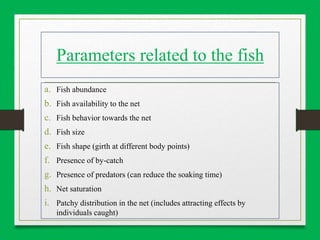
Parameters related to the fish
a. Fish abundance
b. Fish availability to the net
c. Fish behavior towards the net
d. Fish size
e. Fish shape (girth at different body points)
f. Presence of by-catch
g. Presence of predators (can reduce the soaking time)
h. Net saturation
i. Patchy distribution in the net (includes attracting effects by
individuals caught)
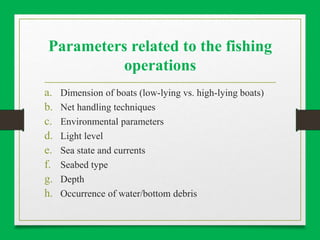
Parameters related to the fishing
operations
a. Dimension of boats (low-lying vs. high-lying boats)
b. Net handling techniques
c. Environmental parameters
d. Light level
e. Sea state and currents
f. Seabed type
g. Depth
h. Occurrence of water/bottom debris
THANK YOU

Fishing Gear selectivity

  • 1.
    PRESENTED BY Course Title– TROPICAL FISH STOICK ASSISMENT [FRM 504] COURSE INSTRUCTOR GEAR SELECTIVITY • AADIL HUSSAIN • Dr. F.A Bhat
  • 2.
    GEAR SELECTIVITY Most fishinggears, for example trawl gears, are selective for the larger sizes, while some gears (gill nets) are selective for a certain length range only, thus excluding the capture of very small and very large fish. This property of fishing gear is called "gear selectivity ".
  • 3.
    FISHING SELECTIVITY • Fishingselectivity can be defined as the ability to target and capture fish by species, size or sex during harvesting operations, allowing all incidental by–catch to be released unharmed. • Selectivity play a major role in the development of a sustainable and economically viable fishery. The results of selectivity experiments can be befitted to the fishermen to allow them to capture only targeted fishes and ensures the essential return of juvenile fishes.
  • 4.
    Bell shaped selectioncurve Bell shaped curve is important for the analysis of selectivity for most of fixed gears. The width of the selection curve provides the selection range of the gear and the highest point in the curve corresponds to the optimum size of fish caught by the gear. FRACTIONRETAINED LENGTH
  • 5.
    Sigmoid shaped selectioncurve • In the fixed gear, the entry of larger fish is prevented but it permits the escapement of smaller fish in relation to size. By contrast, mobile gears allow all the smaller size fish to escape through meshes and larger fish become more susceptible to selection. • As size of fish increase, the percentage of fish retained also increases. The selection process produces “S” shaped selectivity curve. • The point where 50% of the fishes are retained and 50% escape, is known as the 50% selection size L_{50}. The steepness of the curve indicates the efficiency of the selection access. • A shallow curve that gradually changes between L_{25} and L_{75} depicts a poor selection access, whereas a curve that very quickly changes from 0% to 100% selection (a vertical line) indicates optimum selection. The small selection range produces a vertical line selection and this is said to approach “Knife edge” pattern.
  • 6.
    Gill Net selectivity Agill net is made up of a long rectangular web of netting which is set in the water to a vertical wall. A buoyant headrope and a weighted foot rope ensure that the net wall remains in a vertical position. Catching process Fish are caught in a gill net in one of three ways. I. Wedging: A fish is held tight around the body by a mesh. II. Gilling: A fish enters the net but it is too large to pass through and is prevented from retreating by twine that catches the fish behind its gills. III. Tangling: The fish has not necessarily penetrated a mesh but is caught in the net by teeth, maxillaries or other projections.
  • 7.
    Entangled Mesh size 60-150mm Snagged Mesh size 100 mm Wedged Mesh size 140 mm Gilled Mesh size 120 mm
  • 8.
    Factors influencing theselectivity to Gill nets  Planning an experiment involves prior knowledge of the factors that can affect gear selectivity. Some of them, as those related to the gear, are easy to control, in opposition to those related to the fish or to environmental conditions. A. Gear parameters a. Gang and net dimensions b. Mesh size (Use the given one) - The smallest fish caught has a maximum girth equal to the perimeter of the mesh, the largest fish caught has a head girth equal to the perimeter of the mesh. Fish between these two sizes are caught. c. Hanging ratio
  • 9.
    Continued… d. Vertical slack(defined as the ratio between the stretched length of the inner and the outer netting, in trammels and semi - trammel nets). It can be controlled by the height of the walls in a trammel net. e. Twine characteristics (material, construction, thickness, colour, flexibility...) f. Floatation and weight g. Soaking time h. Arrangement of nets in the fleet - sequence and joining between nets; interaction between nets
  • 10.
    Parameters related tothe fish a. Fish abundance b. Fish availability to the net c. Fish behavior towards the net d. Fish size e. Fish shape (girth at different body points) f. Presence of by-catch g. Presence of predators (can reduce the soaking time) h. Net saturation i. Patchy distribution in the net (includes attracting effects by individuals caught)
  • 11.
    Parameters related tothe fishing operations a. Dimension of boats (low-lying vs. high-lying boats) b. Net handling techniques c. Environmental parameters d. Light level e. Sea state and currents f. Seabed type g. Depth h. Occurrence of water/bottom debris
  • 12.