Shell fish Parasitic
disease
Term paper
Parasitic disease of fin fish and shell fish (AAH-
502)
To- Proff. K. Riji. John
Head of the department
Department of Aquatic Animal Health
management
FC&RI
By – Harapriya Behera
Id no- I-17-TN-03-002-M-F-048
-
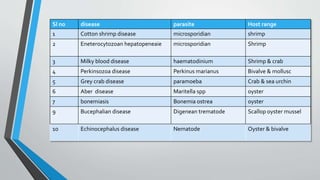
Sl no disease parasite Host range
1 Cotton shrimp disease microsporidian shrimp
2 Eneterocytozoan hepatopeneaie microsporidian Shrimp
3 Milky blood disease haematodinium Shrimp & crab
4 Perkinsozoa disease Perkinus marianus Bivalve & mollusc
5 Grey crab disease paramoeba Crab & sea urchin
6 Aber disease Maritella spp oyster
7 bonemiasis Bonemia ostrea oyster
9 Bucephalian disease Digenean trematode Scallop oyster mussel
1o Echinocephalus disease Nematode Oyster & bivalve
1.Cotton shrimp disease
.
Such microsporidian-infected
prawns are known as ‘cotton
shrimp’, ‘milky white’ or ‘chalky
white’ prawns.
These diseases are highly
pathogenic and cause epizootics in
feral crustacean populations
Host species
• Marine and freshwater crustacean
• lobsters
• crabs. &
• crayfishes.
Taxonomic affiliation
Agmasoma spp.,
Amesoma spp.,
Pleistophora spp.,
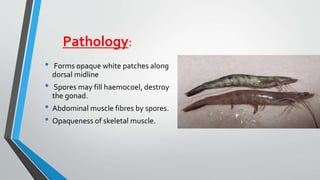
Pathology:
• Forms opaque white patches along
dorsal midline
• Spores may fill haemocoel, destroy
the gonad.
• Abdominal muscle fibres by spores.
• Opaqueness of skeletal muscle.
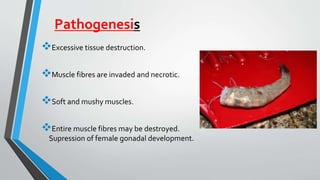
Pathogenesis
Excessive tissue destruction.
Muscle fibres are invaded and necrotic.
Soft and mushy muscles.
Entire muscle fibres may be destroyed.
Supression of female gonadal development.
Prevention:
• Affected animals should be destroyed and buried with lime away from the
farms. After harvesting, the pond bottom should be throughly dried to kill
the spores of the microsporadia.
• Control : Not known
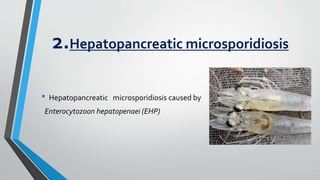
2.Hepatopancreatic microsporidiosis
• Hepatopancreatic microsporidiosis caused by
Enterocytozoon hepatopenaei (EHP)
Aetiology
• Enterocytozoon hepatopenaei
• Genus Enterocytozoonidae
• It has ovoid spores and size of approximately 0.7–1.1 mm that shows 5–6 internal coils of the
filament.
Host range : Enterocytozoon hepatopenaei is a microsporidian causes
disease in:-
Penaeus (Penaeus) monodon
Litopenaeus vannamei
Marsupenaeus japonicus
Geographic distribution:
EHP was first detected in P. monodon inThailand in 2004,
Vietnam
Australia
Indonesia
India
Pathology
• Retarded growth(10-40%) in the
• Absence of other gross signs of disease,
• Do not feed due to damage of hp tubules.
• White feces
• Hp tubule epithelial cells show the presence of cytoplasmic, basophilic inclusions
containing clusters of elliptical to somewhat ovoid spores of 1.1 ± 0.2 by 0.6-0.7 ±
0.1 µm.
• Sometimes free spores released from lysed cells may be seen in the tubule lumens;
Histopathology:
Prevention& control:-
1. Disinfection by chloric acid 200ppm.
2. Avoid of live feeding. If given then pasteurization of feed at 70˚c for 15 min
should be done.
3. SPF broodstock should be taken.
4. Disinfection all the equipment NaOH at 2.5% solution for 3hrs.
5. Pond bottom should treated with Calcium oxide (CaO) (6tons/ha)
6. No chemotherapeutics
3)Milky blood disease
Hematodinium infection may spread more easily
within these polyculture ponds,
In china causing severe economic loss.
Host range:-
1. Chinese swimming crabs (portunus trituberculatus)
2. Mud crabs (scylla serrata)
3. Ridgetail white prawn (exopalaemon carinicauda)
4. Clams
Geographical distribution:-
1. China
2. Europe
3. America
Outbreaks:-
salinities above 15 ppt
water temperatures (above 20°C for at least 1 month)
Pathology:
Diseased shrimp were lethargic
The carapaces showed the typical “cooked” color of shrimps or crabs,
the whitish muscle in walking legs and claws.
The hemolymph appeared milky and failed to clot
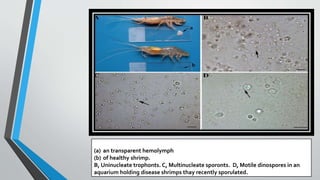
.Three forms of the parasite were frequently observed in the hemolymph,
whitish dicolouration of the gills (g) and opaque
haemolymph (h) pooled in the carapace of a specimen
heavily infected with Hematodinium sp. (top specimen) in
comparison to an uninfected crab.
The specimen at the top of the image was
heavily infected with Hematodinium sp. and
the other specimen was not infected with
this parasite.
(a) an transparent hemolymph
(b) of healthy shrimp.
B, Uninucleate trophonts. C, Multinucleate sporonts. D, Motile dinospores in an
aquarium holding disease shrimps thay recently sporulated.
Effect of parasite on host:
. necrosis or loss of epithelial cells and trabecular cells Of gill.
Gill lamellae were distended and filled with parasites
The hemal spaces among hepatopancreatic tubules were filled with large
number of parasites..
In crabs, the myocardium was devoid of spongy connective tissue and filled
with parasites.
Histopathology of ridgetail white prawns Exopalaemon carinicauda infected with Hematodinium sp.
A, Gill stem were enlarged, and filaments filled with massive number of parasites.
B,The hemal space among hepatopancreatic tubules were enlarged and filled with parasite cells.
C,Tissues in the myocardium were devoid of spongy connective tissue, the heart muscle lost its normal dense
appearance due to invasion of parasite cells.
D,The intact structure of muscle fiber in claws wa distorted because of infiltration of parasite cells.
Electron microscopy of Hematodinium sp. infecting ridgetail white prawn Exopalaemon carinicauda.
A, General ultrastructure of Hematodinium-like parasites in hemolymph. Scale
bar=4 μm.
B, Ultrastructures ofuninucleate,multinucleate sporonts, and dinospores in hemolymph.Note the
flagellum(arrow)of dinospores and the typical “9+2” pattern (insert) of the
flagellum. Scale bar=3 μm..
Control :-
• Culling heavily infected crabs
• Proper disposal of infected crabs
• Culling or removing dead animals
• Limiting transportation of live animals
• Avoid polyculture
4)Perkinus spp.
It is similar to a dinoflagellate. Of 2 to
4 micrometers long
It is known as a prevalent pathogen of oysters, causing
massive mortality.
Dermo or perkinsosis.
Characterized by the degradation of oyster tissues.
it share features with both dinoflagellates and
apicomplexans, be assigned to the phylum Perkinsozoa
Chesapeake Bay
a) Puerto Rico,
b) Cuba
c) Brazil.
d) East coast of N. America
e) Pacific coast of mexico
American oyster Crassostrea virginica
Blue mussel Mytilus edulis
Mangrove oyster Crassostrea rhizophorae
Pacific oyster Crassostrea gigas
Sand gaper mussel Mya arenaria
Geographical distribution:- Host range:-
1) Trphozoite
2) Enlarged
trphozoites
3) & 4) dividing
tropozoites
4) Mother cell found
with daughter
trphozoites
a) grow and develop a
cytoplasmic vacuole
(b). Mature trophozoites
(c) Dividing tropozoites
develops into a large
prezoosporangium
(d, mother tropozoites with
(e) daughter tropozoites
(f). On liberation into the
marine environment, the
prezoosporangium
develops a discharge tube
(g) and undergoes
palintomy
(h), resulting in the
formation of numerous
biflagellated zoospores
(i) capable of initiating a
new infection
Host–parasite relationships
Gross signs of ‘dermo’ low-oxygen “dead zones”
emaciation ,gapping,
pale appearance of the digestive gland,
shrinkage of the mantle away from the outer edge of the shell,
inhibition of gonadal development,
abscesses
Shrinkage of mantle from outer edgePus like appearance
Prevention and control
Cyclohexamide (1 μg/ml/week for 45 days
However, chemical treatment is impractical in the field.
Control of the disease depends on isolation and manipulation of seed stock
and recommended the following procedures: avoid use of infected seed
stocks;
Ray’s fluid thioglycollate medium (RFTM) . For disinfection prior culture.
Harvest early if beds become infected; and
fallow beds after harvest to allow all infected oysters to die before replanting
5)Grey crab disease
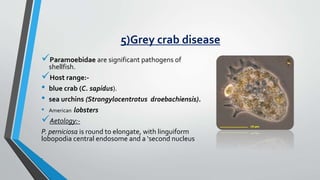
Paramoebidae are significant pathogens of
shellfish.
Host range:-
• blue crab (C. sapidus).
• sea urchins (Strongylocentrotus droebachiensis).
• American lobsters
Aetology:-
P. perniciosa is round to elongate, with linguiform
lobopodia central endosome and a ‘second nucleus
.
Clinical signs and diagnosis of infection
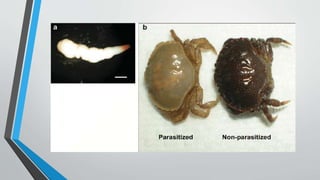
In blue crabs, signs of infection include :-
• greyish discoloration of the ventral exoskeleton.
• General sluggishness,
• absence of clotting of the haemolymph &
Characteristic signs of paramoebiasis in sea urchins included:-
• Muscle necrosis,
• general infiltration of coelomocytes,
• Reddish-brown discoloration &
• poor attachment
Pathogenesis
tissue displacement of connective tissues and haemal spaces, occurs
along the infections midgut, antennal gland andY organ in light.
lysis of haemocytes;
anoxia and nutrient deficiency.
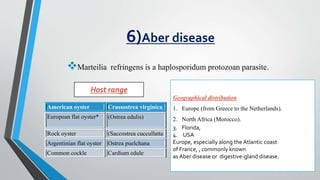
6)Aber disease
Marteilia refringens is a haplosporidum protozoan parasite.
Geographical distribution
1. Europe (from Greece to the Netherlands).
2. North Africa (Morocco).
3. Florida,
4. USA
Europe, especially along the Atlantic coast
of France, , commonly known
as Aber disease or digestive-gland disease.
American oyster Crassostrea virginica
European flat oyster* (Ostrea edulis)
Rock oyster (Saccostrea cuccullatta
Argentinian flat oyster Ostrea puelchana
Common cockle Cardium edule
Host range
Pathogenesis:-
.
• Sporangia are observed free in the lumen
of the digestive tract.
• Refringent granules appear in the course
of sporulation.
Pathology:-
• Emaciation
• Discoloration of the digestive gland,
• Cessation of growth,
• Tissue necrosis and mortalities
Healthy flat oyster Infected Flat oyster
Schematic drawing to scale of the sporulation process of Marteilia spp., sporangiosorus (or primary cell);
NS, nucleus of sporangiosorus; SP, sporangial primordium (or secondary cell); NSP, nucleus of sporangial
primordium; St, sporont; SpP, spore primordium (or tertiary cell); MSp, mature spore; R, refringent
bodies; N1, nucleus of outermost sporoplasm; N2, nucleus of middle
sporoplasm; N3, nucleus of innermost sporoplasm.
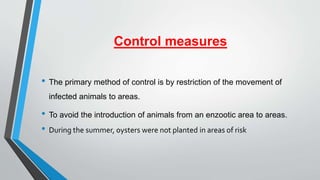
Control measures
• The primary method of control is by restriction of the movement of
infected animals to areas.
• To avoid the introduction of animals from an enzootic area to areas.
• During the summer, oysters were not planted in areas of risk
7)BONAMIASIS
• commonly called a microcell
because of its small size(2-3μm); is a
lethal pathogen of flat oysters (O.
edulis), In which it causes a disease
called bonamiasis.
European flat oyster, Ostrea edulis.
Australian flat oyster Ostrea angasi
• In Europe, distribution of the parasite is along the
Atlantic coast from Spain to Denmark.
• In the USA it is found on the Atlantic coast in Maine
and the Pacific coast from California to
Washington. England, France, Ireland, Holland,
Pathology
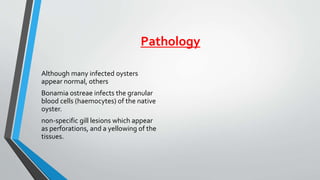
Although many infected oysters
appear normal, others
Bonamia ostreae infects the granular
blood cells (haemocytes) of the native
oyster.
non-specific gill lesions which appear
as perforations, and a yellowing of the
tissues.
control and prevention
Resistant species, such as pacific oysters, are now being cultured in areas.
destruction of infected stocks
restricting movement of flat oysters.
measure must be taken as early as possible.
8)Polychaetes
caused by- Polydora ciliata
Host range:-
• Blue mussel
• Brown mussel
Pathology:-
• Nacreous blisters produced
• atrophy and detachment of the adductor muscle
• mud blisters in the shell
• yellowish abscesses in the adductor muscle
• mud blisters may interfere with shucking and this reduces the commercial
value of oysters to be served on the half-shell.
Burrow into oyster
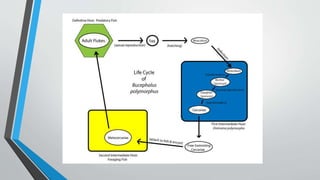
9)Trematode
 Host species
Sporocysts and cercariae in
• Mytilus edulis,
• Mytilus galloprovincialis
• bivalve species
• Gallo mussels
• Hooked mussels (Ischadium
recurvum).
• Brown mussel (perna perna
 Geographic distribution
• Northwestern Europe
• Atlantic Canada.
• west coast of North America
• Usa
• Gulf of mexico
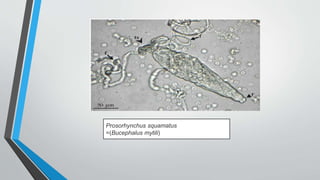
Prosorhynchus squamatus
=(Bucephalus mytili)
Pathology:-
• In mussels, sporocysts of Bucephalus mytili) occur in the vascular system.
• alteration in haemolymph components,
• reduction in growth rate
• weakness in respect of valve closure and attachment to the substrate
• sporocyst infiltrates in gonad.
• occlusion of the haemal sinuses and
• gradual destruction and replacement of molluscan tissue by the sporocyst
10)Phylum- Arthropoda
Bopyrus spp. Mytilicola spp.
These copepods have a direct life cycle.
Host range
• Japanese red prawns (Penaeopsis akayebi)
• Epipenaeon japonicus,
• grooved tiger prawns (Penaeus semisulcatus),
• bivalves
Pathology:-
• Slight decrease in host growth
• Small changes in the host’s secondary sexual characters
• Reduce reproductive capability of female prawn
• Reside in the intestinal tract of a widevariety of bivalves
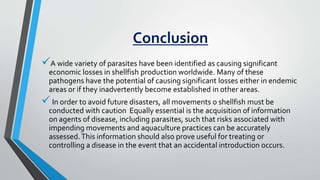
Conclusion
A wide variety of parasites have been identified as causing significant
economic losses in shellfish production worldwide. Many of these
pathogens have the potential of causing significant losses either in endemic
areas or if they inadvertently become established in other areas.
In order to avoid future disasters, all movements o shellfish must be
conducted with caution Equally essential is the acquisition of information
on agents of disease, including parasites, such that risks associated with
impending movements and aquaculture practices can be accurately
assessed.This information should also prove useful for treating or
controlling a disease in the event that an accidental introduction occurs.
Reference
• Parasitic Diseases of Shellfish Susan M. Bower Fisheries and Oceans
Canada, Sciences Branch, Pacific Biological Station, Nanaimo, British
Columbia, CanadaV9T 6N7Aquatic Animal Disease
• Significant to Asia–Pacific Identification Field Guide
• Haplosporidian Diseases of Imported Oysters, Ostrea edulis, in Dutch
Estuaries PAUL van BANNIN
• Fisheries Research Services
• DFO - BucephalidTrematode Disease of Mussels
• www.dfo-mpo.gc.ca/science/aah-saa/diseases-maladies/bucephmu-
eng.html
Shell fish parasitic disease

Shell fish parasitic disease

  • 1.
    Shell fish Parasitic disease Termpaper Parasitic disease of fin fish and shell fish (AAH- 502) To- Proff. K. Riji. John Head of the department Department of Aquatic Animal Health management FC&RI By – Harapriya Behera Id no- I-17-TN-03-002-M-F-048 -
  • 2.
    Sl no diseaseparasite Host range 1 Cotton shrimp disease microsporidian shrimp 2 Eneterocytozoan hepatopeneaie microsporidian Shrimp 3 Milky blood disease haematodinium Shrimp & crab 4 Perkinsozoa disease Perkinus marianus Bivalve & mollusc 5 Grey crab disease paramoeba Crab & sea urchin 6 Aber disease Maritella spp oyster 7 bonemiasis Bonemia ostrea oyster 9 Bucephalian disease Digenean trematode Scallop oyster mussel 1o Echinocephalus disease Nematode Oyster & bivalve
  • 3.
    1.Cotton shrimp disease . Suchmicrosporidian-infected prawns are known as ‘cotton shrimp’, ‘milky white’ or ‘chalky white’ prawns. These diseases are highly pathogenic and cause epizootics in feral crustacean populations
  • 4.
    Host species • Marineand freshwater crustacean • lobsters • crabs. & • crayfishes. Taxonomic affiliation Agmasoma spp., Amesoma spp., Pleistophora spp.,
  • 5.
    Pathology: • Forms opaquewhite patches along dorsal midline • Spores may fill haemocoel, destroy the gonad. • Abdominal muscle fibres by spores. • Opaqueness of skeletal muscle.
  • 6.
    Pathogenesis Excessive tissue destruction. Musclefibres are invaded and necrotic. Soft and mushy muscles. Entire muscle fibres may be destroyed. Supression of female gonadal development.
  • 7.
    Prevention: • Affected animalsshould be destroyed and buried with lime away from the farms. After harvesting, the pond bottom should be throughly dried to kill the spores of the microsporadia. • Control : Not known
  • 8.
    2.Hepatopancreatic microsporidiosis • Hepatopancreaticmicrosporidiosis caused by Enterocytozoon hepatopenaei (EHP)
  • 9.
    Aetiology • Enterocytozoon hepatopenaei •Genus Enterocytozoonidae • It has ovoid spores and size of approximately 0.7–1.1 mm that shows 5–6 internal coils of the filament.
  • 10.
    Host range :Enterocytozoon hepatopenaei is a microsporidian causes disease in:- Penaeus (Penaeus) monodon Litopenaeus vannamei Marsupenaeus japonicus Geographic distribution: EHP was first detected in P. monodon inThailand in 2004, Vietnam Australia Indonesia India
  • 11.
    Pathology • Retarded growth(10-40%)in the • Absence of other gross signs of disease, • Do not feed due to damage of hp tubules. • White feces • Hp tubule epithelial cells show the presence of cytoplasmic, basophilic inclusions containing clusters of elliptical to somewhat ovoid spores of 1.1 ± 0.2 by 0.6-0.7 ± 0.1 µm. • Sometimes free spores released from lysed cells may be seen in the tubule lumens;
  • 13.
  • 14.
    Prevention& control:- 1. Disinfectionby chloric acid 200ppm. 2. Avoid of live feeding. If given then pasteurization of feed at 70˚c for 15 min should be done. 3. SPF broodstock should be taken. 4. Disinfection all the equipment NaOH at 2.5% solution for 3hrs. 5. Pond bottom should treated with Calcium oxide (CaO) (6tons/ha) 6. No chemotherapeutics
  • 15.
    3)Milky blood disease Hematodiniuminfection may spread more easily within these polyculture ponds, In china causing severe economic loss.
  • 16.
    Host range:- 1. Chineseswimming crabs (portunus trituberculatus) 2. Mud crabs (scylla serrata) 3. Ridgetail white prawn (exopalaemon carinicauda) 4. Clams Geographical distribution:- 1. China 2. Europe 3. America Outbreaks:- salinities above 15 ppt water temperatures (above 20°C for at least 1 month)
  • 17.
    Pathology: Diseased shrimp werelethargic The carapaces showed the typical “cooked” color of shrimps or crabs, the whitish muscle in walking legs and claws. The hemolymph appeared milky and failed to clot .Three forms of the parasite were frequently observed in the hemolymph,
  • 18.
    whitish dicolouration ofthe gills (g) and opaque haemolymph (h) pooled in the carapace of a specimen heavily infected with Hematodinium sp. (top specimen) in comparison to an uninfected crab. The specimen at the top of the image was heavily infected with Hematodinium sp. and the other specimen was not infected with this parasite.
  • 19.
    (a) an transparenthemolymph (b) of healthy shrimp. B, Uninucleate trophonts. C, Multinucleate sporonts. D, Motile dinospores in an aquarium holding disease shrimps thay recently sporulated.
  • 20.
    Effect of parasiteon host: . necrosis or loss of epithelial cells and trabecular cells Of gill. Gill lamellae were distended and filled with parasites The hemal spaces among hepatopancreatic tubules were filled with large number of parasites.. In crabs, the myocardium was devoid of spongy connective tissue and filled with parasites.
  • 21.
    Histopathology of ridgetailwhite prawns Exopalaemon carinicauda infected with Hematodinium sp. A, Gill stem were enlarged, and filaments filled with massive number of parasites. B,The hemal space among hepatopancreatic tubules were enlarged and filled with parasite cells. C,Tissues in the myocardium were devoid of spongy connective tissue, the heart muscle lost its normal dense appearance due to invasion of parasite cells. D,The intact structure of muscle fiber in claws wa distorted because of infiltration of parasite cells.
  • 22.
    Electron microscopy ofHematodinium sp. infecting ridgetail white prawn Exopalaemon carinicauda. A, General ultrastructure of Hematodinium-like parasites in hemolymph. Scale bar=4 μm. B, Ultrastructures ofuninucleate,multinucleate sporonts, and dinospores in hemolymph.Note the flagellum(arrow)of dinospores and the typical “9+2” pattern (insert) of the flagellum. Scale bar=3 μm..
  • 23.
    Control :- • Cullingheavily infected crabs • Proper disposal of infected crabs • Culling or removing dead animals • Limiting transportation of live animals • Avoid polyculture
  • 24.
    4)Perkinus spp. It issimilar to a dinoflagellate. Of 2 to 4 micrometers long It is known as a prevalent pathogen of oysters, causing massive mortality. Dermo or perkinsosis. Characterized by the degradation of oyster tissues. it share features with both dinoflagellates and apicomplexans, be assigned to the phylum Perkinsozoa
  • 25.
    Chesapeake Bay a) PuertoRico, b) Cuba c) Brazil. d) East coast of N. America e) Pacific coast of mexico American oyster Crassostrea virginica Blue mussel Mytilus edulis Mangrove oyster Crassostrea rhizophorae Pacific oyster Crassostrea gigas Sand gaper mussel Mya arenaria Geographical distribution:- Host range:-
  • 26.
    1) Trphozoite 2) Enlarged trphozoites 3)& 4) dividing tropozoites 4) Mother cell found with daughter trphozoites
  • 27.
    a) grow anddevelop a cytoplasmic vacuole (b). Mature trophozoites (c) Dividing tropozoites develops into a large prezoosporangium (d, mother tropozoites with (e) daughter tropozoites (f). On liberation into the marine environment, the prezoosporangium develops a discharge tube (g) and undergoes palintomy (h), resulting in the formation of numerous biflagellated zoospores (i) capable of initiating a new infection
  • 28.
    Host–parasite relationships Gross signsof ‘dermo’ low-oxygen “dead zones” emaciation ,gapping, pale appearance of the digestive gland, shrinkage of the mantle away from the outer edge of the shell, inhibition of gonadal development, abscesses
  • 29.
    Shrinkage of mantlefrom outer edgePus like appearance
  • 30.
    Prevention and control Cyclohexamide(1 μg/ml/week for 45 days However, chemical treatment is impractical in the field. Control of the disease depends on isolation and manipulation of seed stock and recommended the following procedures: avoid use of infected seed stocks; Ray’s fluid thioglycollate medium (RFTM) . For disinfection prior culture. Harvest early if beds become infected; and fallow beds after harvest to allow all infected oysters to die before replanting
  • 31.
    5)Grey crab disease Paramoebidaeare significant pathogens of shellfish. Host range:- • blue crab (C. sapidus). • sea urchins (Strongylocentrotus droebachiensis). • American lobsters Aetology:- P. perniciosa is round to elongate, with linguiform lobopodia central endosome and a ‘second nucleus .
  • 32.
    Clinical signs anddiagnosis of infection In blue crabs, signs of infection include :- • greyish discoloration of the ventral exoskeleton. • General sluggishness, • absence of clotting of the haemolymph & Characteristic signs of paramoebiasis in sea urchins included:- • Muscle necrosis, • general infiltration of coelomocytes, • Reddish-brown discoloration & • poor attachment
  • 34.
    Pathogenesis tissue displacement ofconnective tissues and haemal spaces, occurs along the infections midgut, antennal gland andY organ in light. lysis of haemocytes; anoxia and nutrient deficiency.
  • 35.
    6)Aber disease Marteilia refringensis a haplosporidum protozoan parasite. Geographical distribution 1. Europe (from Greece to the Netherlands). 2. North Africa (Morocco). 3. Florida, 4. USA Europe, especially along the Atlantic coast of France, , commonly known as Aber disease or digestive-gland disease. American oyster Crassostrea virginica European flat oyster* (Ostrea edulis) Rock oyster (Saccostrea cuccullatta Argentinian flat oyster Ostrea puelchana Common cockle Cardium edule Host range
  • 36.
    Pathogenesis:- . • Sporangia areobserved free in the lumen of the digestive tract. • Refringent granules appear in the course of sporulation. Pathology:- • Emaciation • Discoloration of the digestive gland, • Cessation of growth, • Tissue necrosis and mortalities
  • 37.
    Healthy flat oysterInfected Flat oyster
  • 38.
    Schematic drawing toscale of the sporulation process of Marteilia spp., sporangiosorus (or primary cell); NS, nucleus of sporangiosorus; SP, sporangial primordium (or secondary cell); NSP, nucleus of sporangial primordium; St, sporont; SpP, spore primordium (or tertiary cell); MSp, mature spore; R, refringent bodies; N1, nucleus of outermost sporoplasm; N2, nucleus of middle sporoplasm; N3, nucleus of innermost sporoplasm.
  • 39.
    Control measures • Theprimary method of control is by restriction of the movement of infected animals to areas. • To avoid the introduction of animals from an enzootic area to areas. • During the summer, oysters were not planted in areas of risk
  • 40.
    7)BONAMIASIS • commonly calleda microcell because of its small size(2-3μm); is a lethal pathogen of flat oysters (O. edulis), In which it causes a disease called bonamiasis.
  • 41.
    European flat oyster,Ostrea edulis. Australian flat oyster Ostrea angasi • In Europe, distribution of the parasite is along the Atlantic coast from Spain to Denmark. • In the USA it is found on the Atlantic coast in Maine and the Pacific coast from California to Washington. England, France, Ireland, Holland,
  • 42.
    Pathology Although many infectedoysters appear normal, others Bonamia ostreae infects the granular blood cells (haemocytes) of the native oyster. non-specific gill lesions which appear as perforations, and a yellowing of the tissues.
  • 43.
    control and prevention Resistantspecies, such as pacific oysters, are now being cultured in areas. destruction of infected stocks restricting movement of flat oysters. measure must be taken as early as possible.
  • 44.
    8)Polychaetes caused by- Polydoraciliata Host range:- • Blue mussel • Brown mussel
  • 45.
    Pathology:- • Nacreous blistersproduced • atrophy and detachment of the adductor muscle • mud blisters in the shell • yellowish abscesses in the adductor muscle • mud blisters may interfere with shucking and this reduces the commercial value of oysters to be served on the half-shell.
  • 46.
  • 47.
    9)Trematode  Host species Sporocystsand cercariae in • Mytilus edulis, • Mytilus galloprovincialis • bivalve species • Gallo mussels • Hooked mussels (Ischadium recurvum). • Brown mussel (perna perna  Geographic distribution • Northwestern Europe • Atlantic Canada. • west coast of North America • Usa • Gulf of mexico
  • 48.
  • 49.
    Pathology:- • In mussels,sporocysts of Bucephalus mytili) occur in the vascular system. • alteration in haemolymph components, • reduction in growth rate • weakness in respect of valve closure and attachment to the substrate • sporocyst infiltrates in gonad. • occlusion of the haemal sinuses and • gradual destruction and replacement of molluscan tissue by the sporocyst
  • 51.
    10)Phylum- Arthropoda Bopyrus spp.Mytilicola spp. These copepods have a direct life cycle. Host range • Japanese red prawns (Penaeopsis akayebi) • Epipenaeon japonicus, • grooved tiger prawns (Penaeus semisulcatus), • bivalves
  • 52.
    Pathology:- • Slight decreasein host growth • Small changes in the host’s secondary sexual characters • Reduce reproductive capability of female prawn • Reside in the intestinal tract of a widevariety of bivalves
  • 53.
    Conclusion A wide varietyof parasites have been identified as causing significant economic losses in shellfish production worldwide. Many of these pathogens have the potential of causing significant losses either in endemic areas or if they inadvertently become established in other areas. In order to avoid future disasters, all movements o shellfish must be conducted with caution Equally essential is the acquisition of information on agents of disease, including parasites, such that risks associated with impending movements and aquaculture practices can be accurately assessed.This information should also prove useful for treating or controlling a disease in the event that an accidental introduction occurs.
  • 54.
    Reference • Parasitic Diseasesof Shellfish Susan M. Bower Fisheries and Oceans Canada, Sciences Branch, Pacific Biological Station, Nanaimo, British Columbia, CanadaV9T 6N7Aquatic Animal Disease • Significant to Asia–Pacific Identification Field Guide • Haplosporidian Diseases of Imported Oysters, Ostrea edulis, in Dutch Estuaries PAUL van BANNIN • Fisheries Research Services • DFO - BucephalidTrematode Disease of Mussels • www.dfo-mpo.gc.ca/science/aah-saa/diseases-maladies/bucephmu- eng.html