This document provides an overview of petroleum engineering and related topics. It discusses:
- The definition and chemistry of hydrocarbons and how petroleum is formed from the remains of ancient organisms.
- How petroleum migrates and can accumulate in reservoirs trapped by impermeable rock layers.
- The different types of hydrocarbon molecules and traps that can form reservoirs.
- The roles of reservoir engineers in evaluating fields, modeling reservoirs, and planning development to maximize oil and gas recovery.
Overview of petroleum, hydrocarbon types, formation, migration, reservoirs and petroleum engineering. Key concepts include source rocks, traps, and reservoir characteristics. Focus on petroleum engineering fields, including reservoir and production engineering, and techniques for maximizing hydrocarbon recovery.
Discusses specialization in production engineering, surveillance, and simulation modeling to enhance recovery and optimize resources.
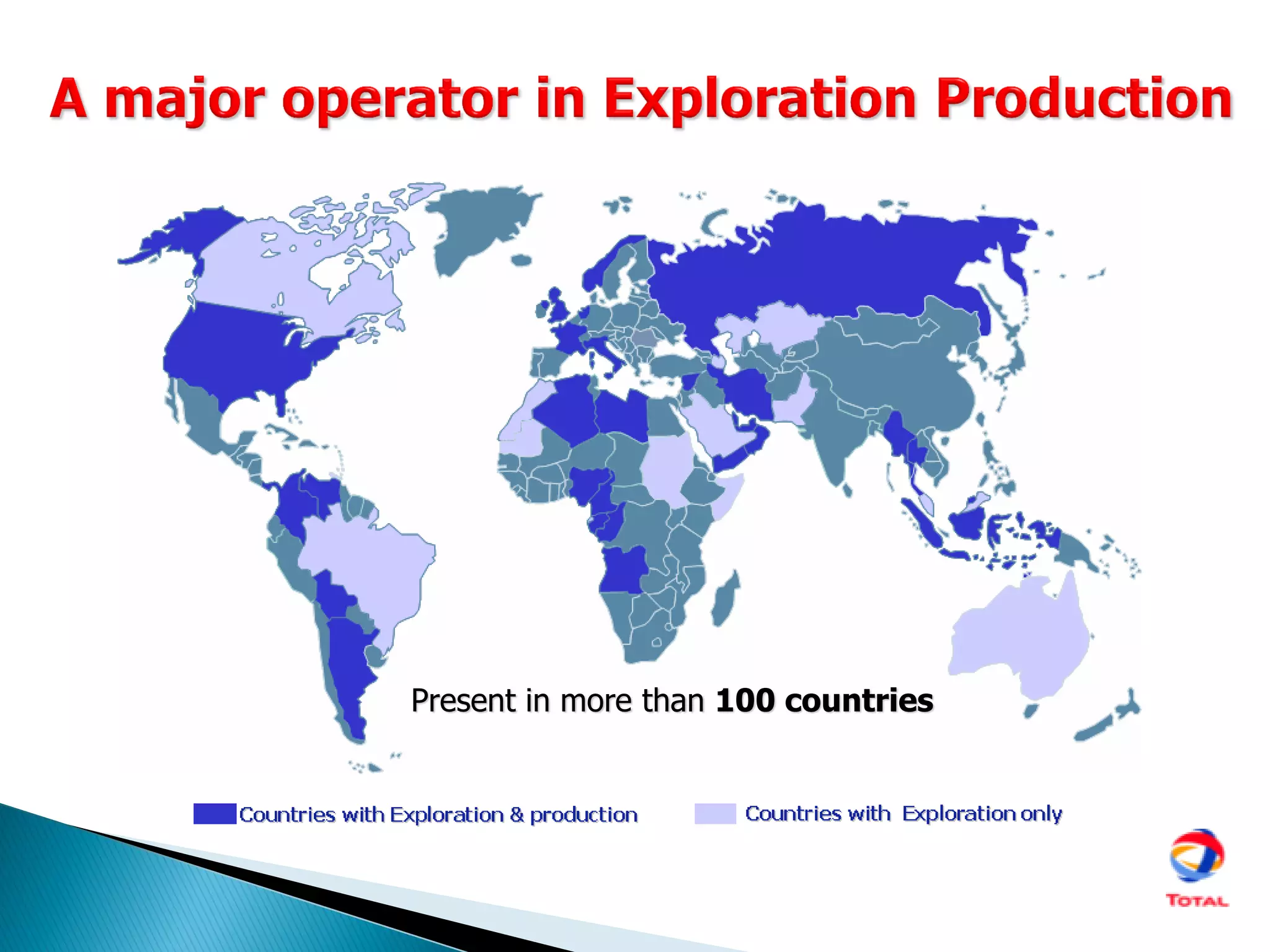
Outlines organizational aspects and the global reach of the petroleum industry, emphasizing diverse operations and regional focus.
Highlights corporate values such as collaboration, empathy, boldness, and solidarity essential for success in the petroleum sector.
Introduction toPetroleum
• Definitions
• Chemistry
• History
• Formation
• Accumulation
• Traps
• Conventional and Non-Conventional oil reservoirs
• Petroleum Industry
Petroleum Engineering
Reservoir Engineering
Total E&P in two words
3.
A hydrocarbon isan organic compound consisting entirely
of hydrogen and carbon and other bonded compounds.
Petroleum is a mix of naturally occurring, flammable liquid
found in rock formations in the Earth consisting of a
complex mixture of hydrocarbons of various molecular
weights, plus other organic compounds.
• When petroleum comes straight out of the ground as a
liquid it is called crude oil if dark and viscous, and
condensate if clear and volatile.
4.
The alkanes,also known as paraffins, are saturated hydrocarbons
with straight or branched chains which contain only carbon and
hydrogen and have the general formula CnH2n+2.
The cycloalkanes, also known as naphthenes, are saturated
hydrocarbons which have one or more carbon rings to which
hydrogen atoms are attached according to the formula CnH2n.
The aromatic hydrocarbons are unsaturated hydrocarbons which
have one or more planar six-carbon rings called benzene rings, to
which hydrogen atoms are attached with the formula CnHn.
Asphaltenes consist primarily of carbon, hydrogen, nitrogen, oxygen,
and sulfur, as well as trace amounts of vanadium and nickel. The C:H
ratio is approximately 1:1.2, depending on the asphalting source.
Four different types of hydrocarbon molecules appear in crude oil:
5.
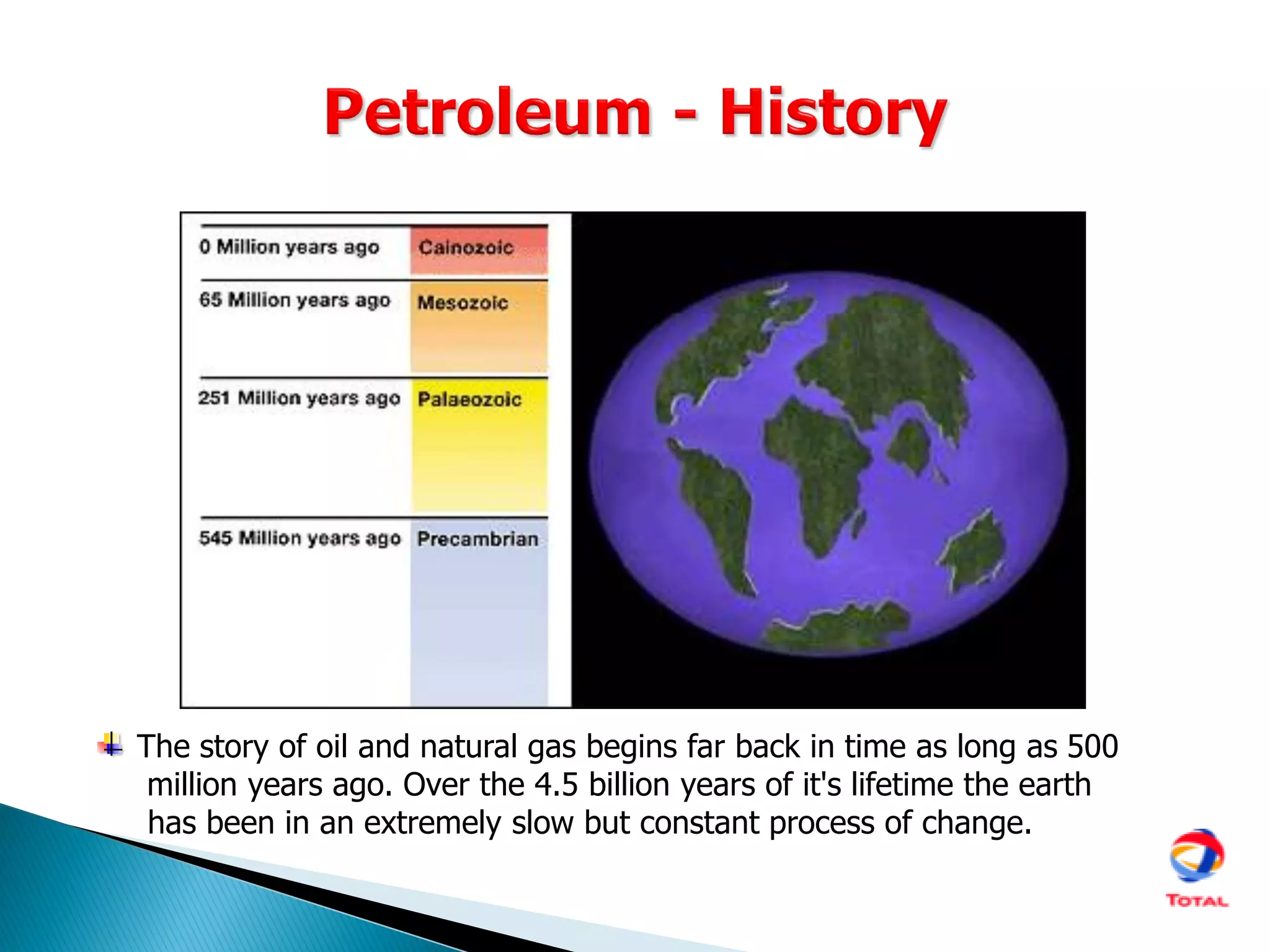
The story ofoil and natural gas begins far back in time as long as 500
million years ago. Over the 4.5 billion years of it's lifetime the earth
has been in an extremely slow but constant process of change.
6.
Biological originof petroleum from organically rich source rocks
Migration of oil and gas from source to trap
Reservoir rocks that hold the gas or oil
Traps and seals that allow accumulation and concentration.
The Petroleum Systems approach has four elements:
7.
Formation of petroleumoccurs from hydrocarbon pyrolysis, in a variety
of mostly endothermic reactions at high temperature and/or pressure.
8.
• In ancientseas, plants, animals and microorganisms abounded.
• When they died they sank to the bottom of the sea where they
usually became a source of food for scavengers and decomposers.
• In certain circumstances, such as highly acidic conditions or lack of
oxygen, the remains of the dead organisms did not fully decay and
the accumulated material became mixed with silt and clay, to form a
sedimentary deposit.
• Today's oil formed from the preserved remains of prehistoric
zooplankton and algae, which had settled to a sea or lake bottom in
large quantities under anoxic conditions (the remains of prehistoric
terrestrial plants, on the other hand, tended to form coal).
9.
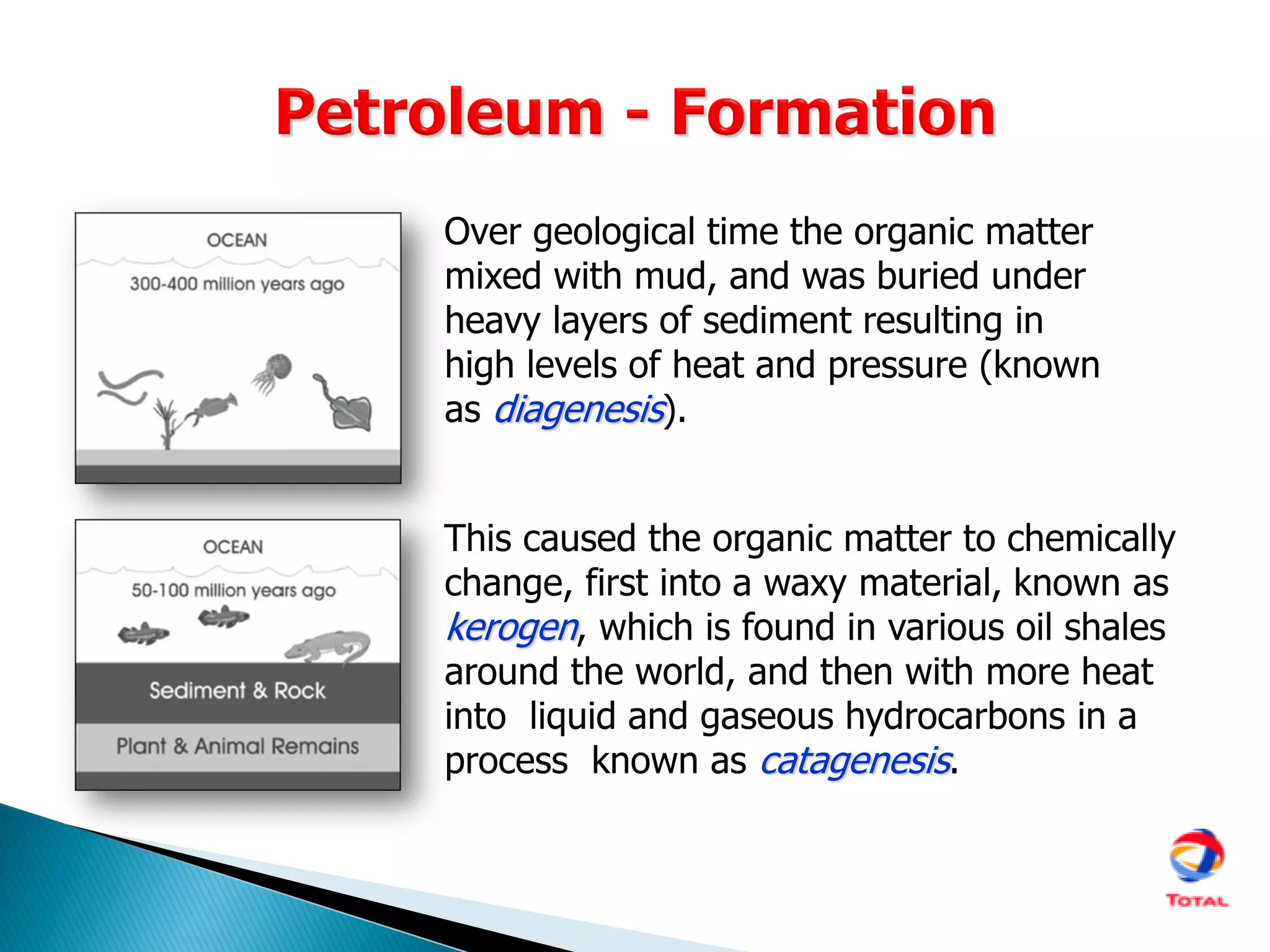
Over geological timethe organic matter
mixed with mud, and was buried under
heavy layers of sediment resulting in
high levels of heat and pressure (known
as diagenesis).
This caused the organic matter to chemically
change, first into a waxy material, known as
kerogen, which is found in various oil shales
around the world, and then with more heat
into liquid and gaseous hydrocarbons in a
process known as catagenesis.
• Hydrocarbons tendto migrate upwards through the rock
unless prevented by an impermeable layer of rock (cap
rock).
• As rock layers are often not uniformly horizontal, this
migration of fluids is to the highest contained part of a
geological structure, known as a trap.
• The rock in which the oil or gas lies is called the reservoir,
while the rock in which it originated is called the source
rock.
14.
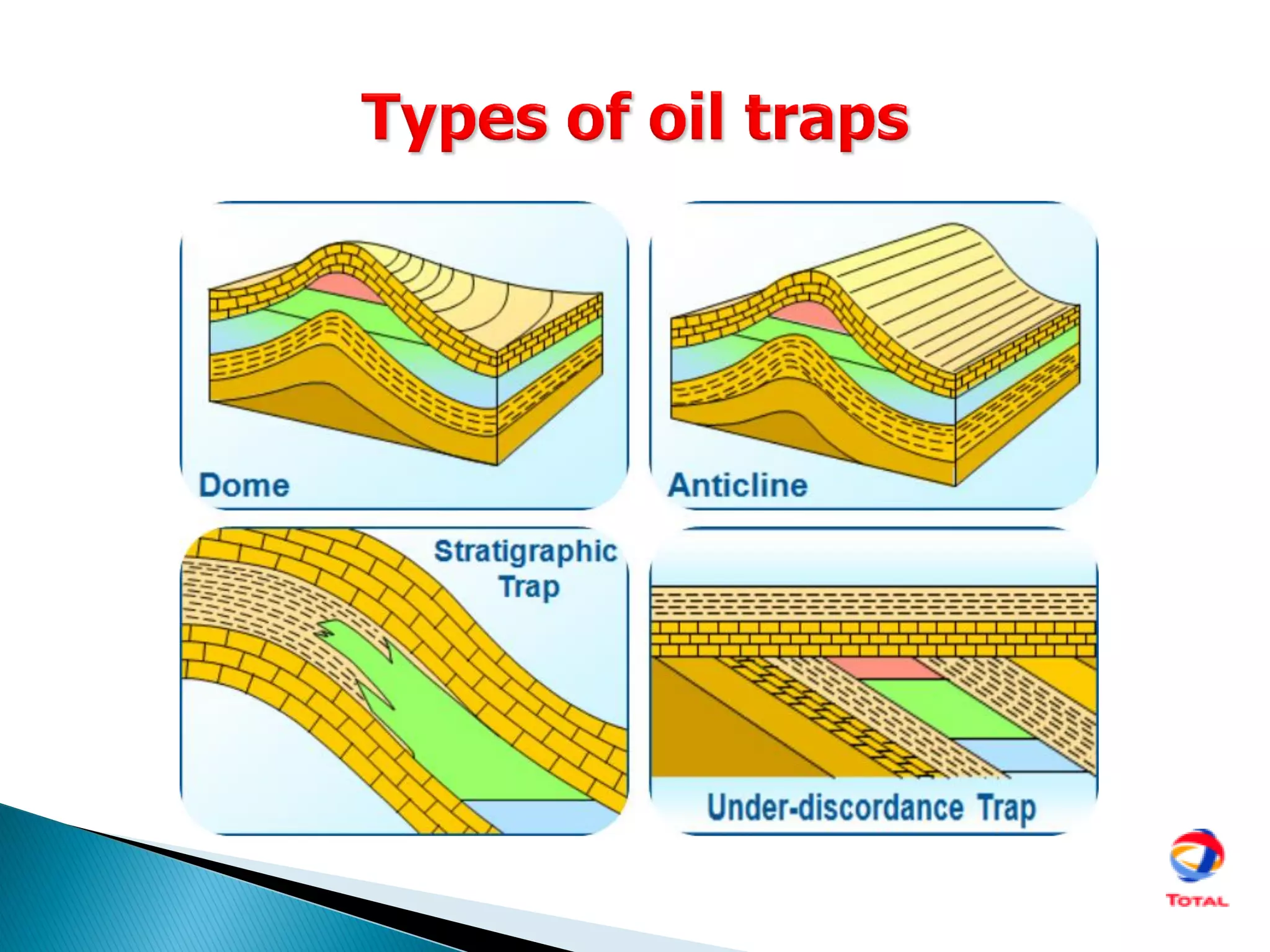
There aretwo types of traps - Structural and Stratigraphic
• Structural Traps
Formed by a deformation in the rock layer that contains the
hydrocarbons.
Main Types: Domes, anticlines, and fault traps.
Tectonic forces created these structures after sedimentation and
lithification.
• Stratigraphic Traps
Formed when other beds seal a reservoir bed or when the permeability
changes (facies change) within the reservoir bed itself.
A stratigraphic trap accumulates oil due to changes of rock character
rather than faulting or folding of the rock.
The term "stratigraphy" basically means "the study of the rocks and
their variations".
16.
Three conditions mustbe present for oil reservoirs to form:
A source rock rich in hydrocarbon material buried
deep enough for subterranean heat to cook it into oil.
A porous and permeable reservoir rock for it to
accumulate in.
A cap rock (seal) or other mechanism that prevents it
from escaping to the surface.
17.
Oil sands arereservoirs of partially biodegraded oil still in the
process of escaping and being biodegraded, but they contain
so much migrating oil that, although most of it has escaped,
vast amounts are still present.
Oil shales are source rocks that have not been exposed to
heat or pressure long enough to convert their trapped
hydrocarbons into crude oil.
Technically speaking, oil shales are not really shales and do
not really contain oil, but are usually relatively hard rocks
called marls containing a waxy substance called kerogen.
18.
The petroleumindustry is involved in the global processes of
exploration, extraction, refining, transporting (often with oil tankers
and pipelines), and marketing petroleum products.
The largest volume products of the industry are fuel oil and gasoline
(petrol). Petroleum is also the raw material for many chemical
products, including pharmaceuticals, solvents, fertilizers, pesticides,
and plastics.
The industry is usually divided into three major components:
upstream, midstream and downstream. Midstream operations are
usually included in the downstream category.
• Petroleum is vital to many industries, and is of importance to the
maintenance of industrialized civilization itself, and thus is critical
concern to many nations.
19.
Petroleum engineering isan engineering discipline
concerned with the subsurface activities related to the
production of hydrocarbons, which can be either crude
oil or natural gas.
• Petroleum engineering has become a technical
profession that involves extracting oil in increasingly
difficult situations as the "low hanging fruit" of the
world's oil fields are found and depleted.
20.
• Petroleum engineeringrequires a good knowledge of many
other related disciplines, such as:
Petroleum engineering focuses on estimation of the
recoverable volume of hydrocarbon resource using a detailed
understanding of the physical behavior of oil, water and gas
within porous rock at very high pressure.
Reservoir simulation
Well engineering
Artificial lift systems
Oil & gas facilities engineering
Geophysics
Petroleum geology
Drilling
Formation evaluation
Economics
21.
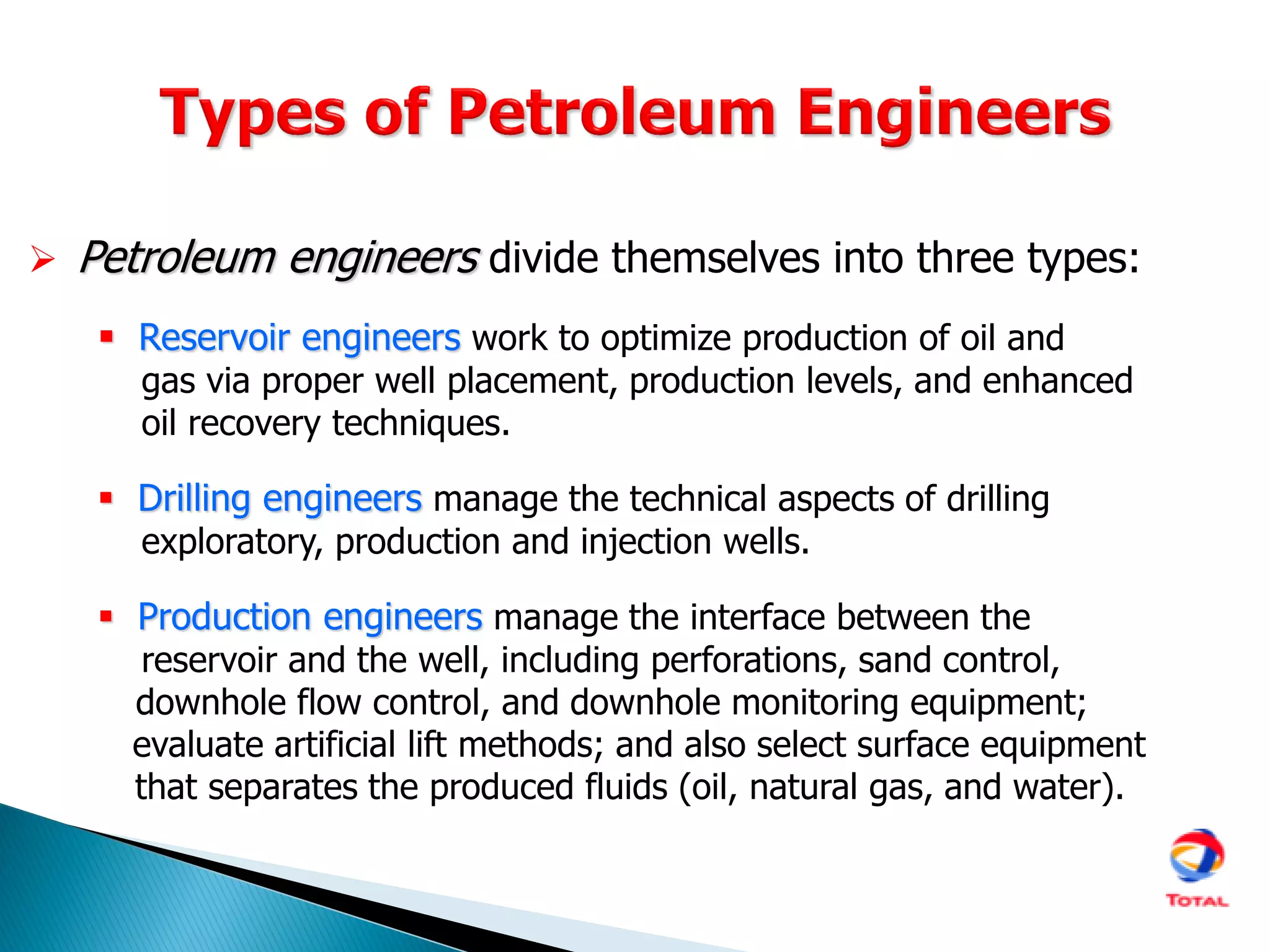
Petroleum engineersdivide themselves into three types:
Reservoir engineers work to optimize production of oil and
gas via proper well placement, production levels, and enhanced
oil recovery techniques.
Drilling engineers manage the technical aspects of drilling
exploratory, production and injection wells.
Production engineers manage the interface between the
reservoir and the well, including perforations, sand control,
downhole flow control, and downhole monitoring equipment;
evaluate artificial lift methods; and also select surface equipment
that separates the produced fluids (oil, natural gas, and water).
22.
Reservoir engineering isa branch of petroleum
engineering, that applies scientific principles to the
drainage problems arising during the development and
production of oil and gas reservoirs so as to obtain a
high economic recovery.
• The working tools of the reservoir engineer are:
Subsurface geology
Applied mathematics
The basic laws of physics and chemistry governing the
behavior of liquid and vapor phases of crude oil, natural
gas, and water in reservoir rock.
23.
Evaluate availablewell & reservoir data.
Make the best predictions possible to help
determine the recovery potential and
commerciality of a field.
Can become involved during the
exploration phase or after the field has
been discovered and delineated to
determine the reserves and plan
development.
Analyze cash flow projections - based on
hydrocarbon recovery estimations for the
field over time, price hydrocarbon will sell
for & upfront field development
investment.
24.
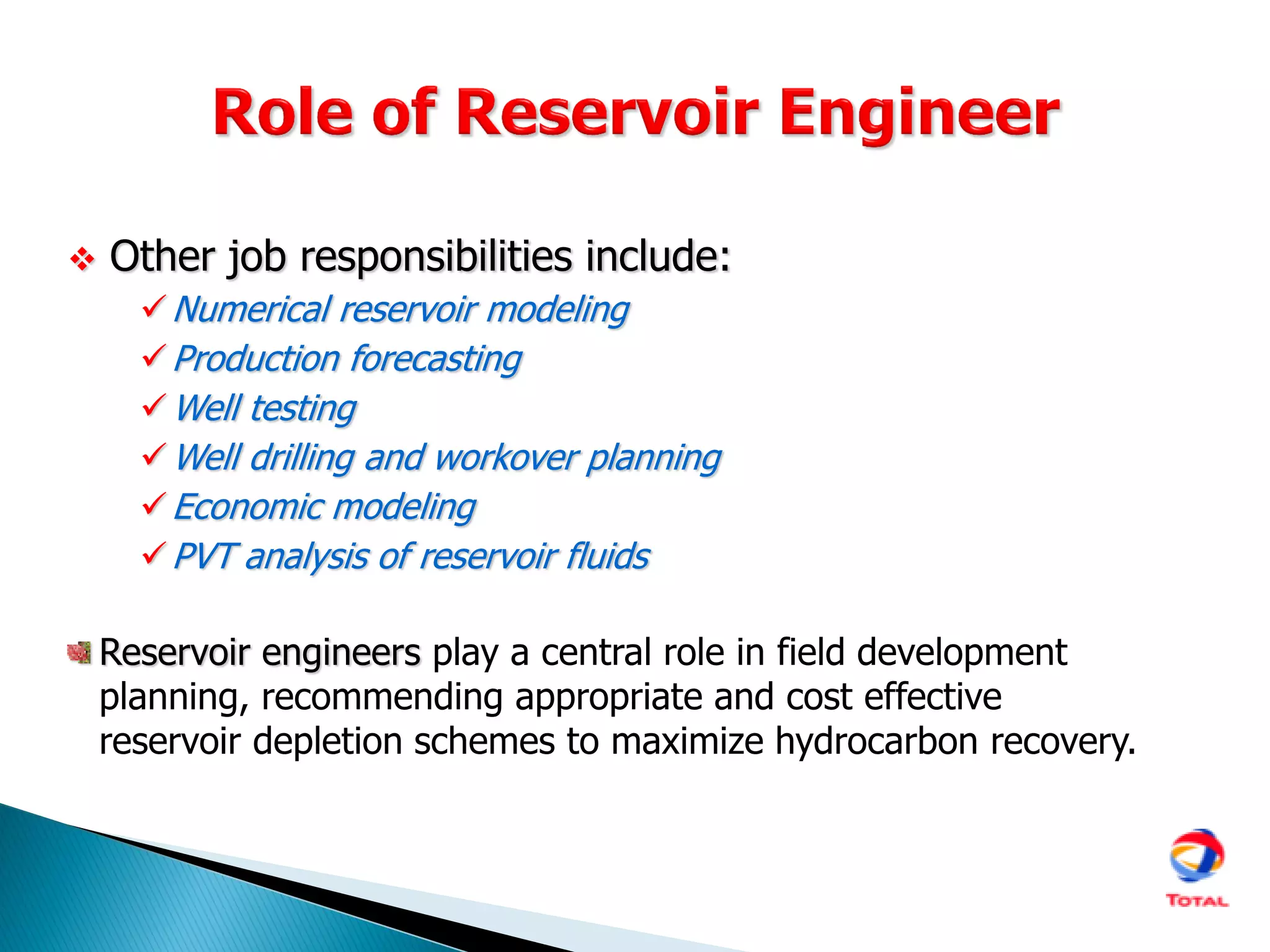
Other jobresponsibilities include:
Numerical reservoir modeling
Production forecasting
Well testing
Well drilling and workover planning
Economic modeling
PVT analysis of reservoir fluids
Reservoir engineers play a central role in field development
planning, recommending appropriate and cost effective
reservoir depletion schemes to maximize hydrocarbon recovery.
25.
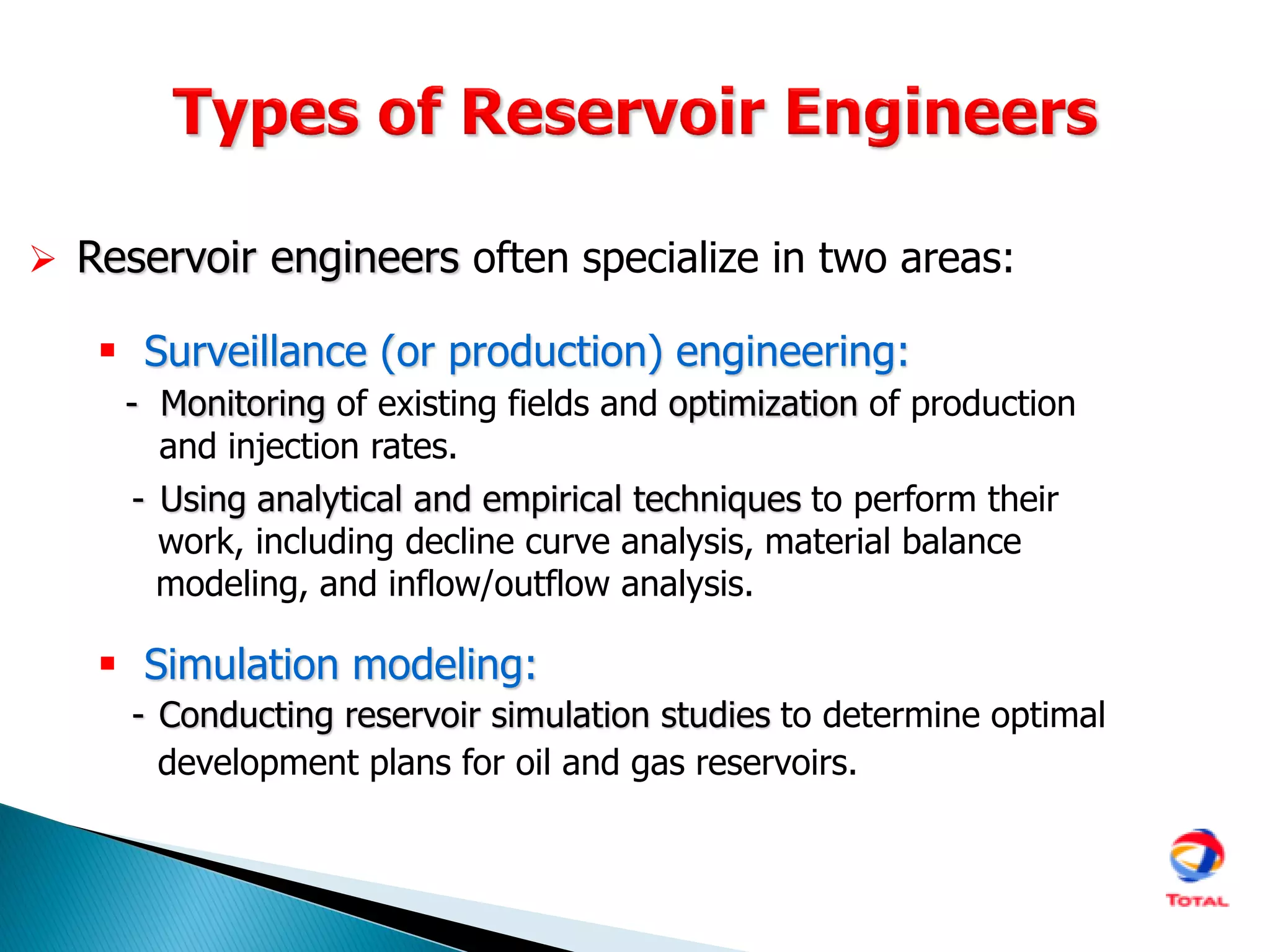
Reservoir engineersoften specialize in two areas:
Surveillance (or production) engineering:
- Monitoring of existing fields and optimization of production
and injection rates.
- Using analytical and empirical techniques to perform their
work, including decline curve analysis, material balance
modeling, and inflow/outflow analysis.
Simulation modeling:
- Conducting reservoir simulation studies to determine optimal
development plans for oil and gas reservoirs.
27.
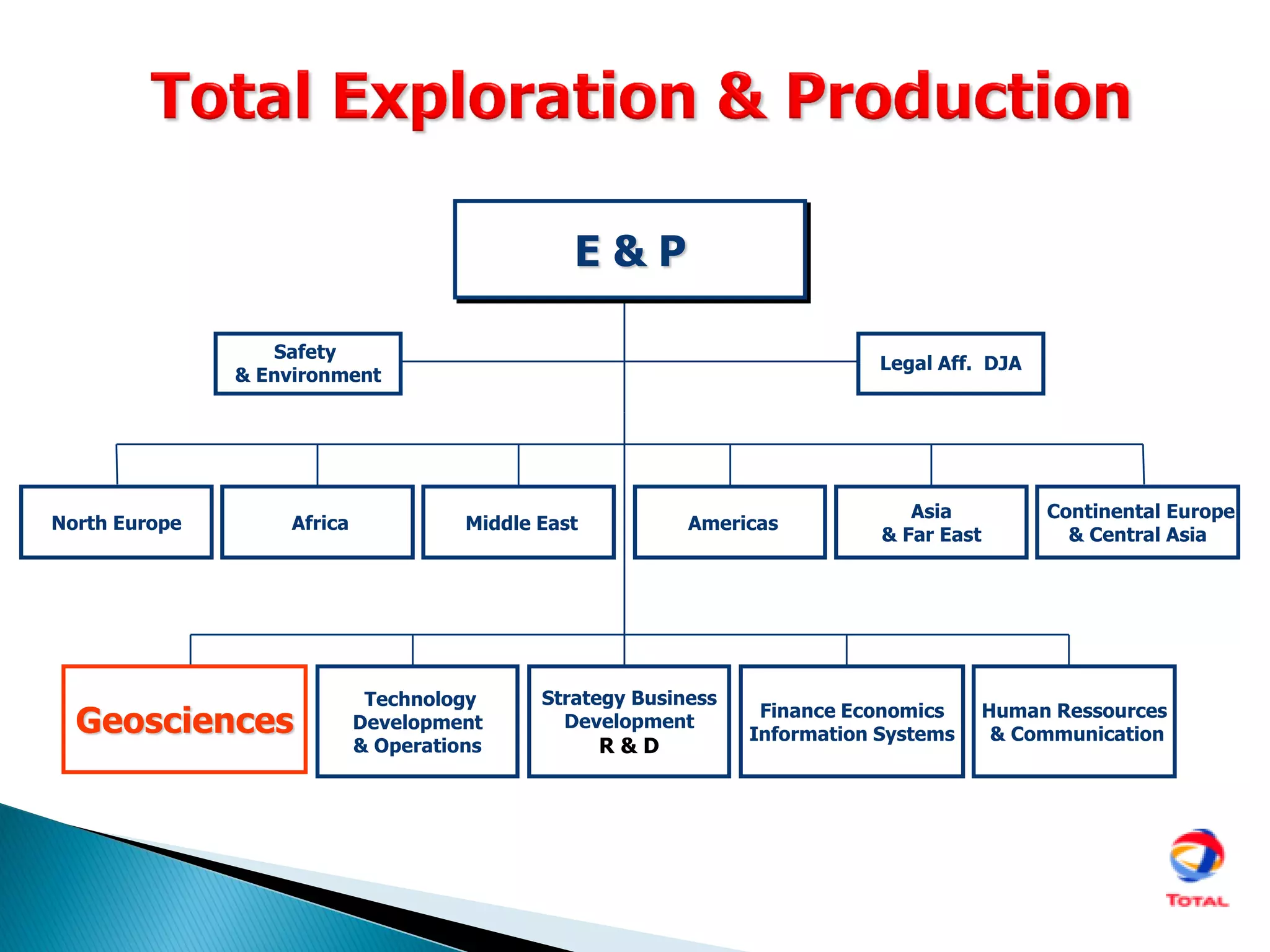
E & P
Safety
&Environment
Legal Aff. DJA
Geosciences
Technology
Development
& Operations
Strategy Business
Development
R & D
Finance Economics
Information Systems
Human Ressources
& Communication
Continental Europe
& Central Asia
Asia
& Far East
AmericasMiddle EastAfricaNorth Europe
28.
Administration and
Cost Control
InformationSystems
Assistance
.
Geoscience
Technologies
TG
New Business
PN
Field Reserves
Development
VDG
Exploration
Coordination
CAE
Training
Technical Image
Geosciences
29.
Reserve growth
Production growth
Technical costs decrease
Technical excellency
The Geoscience Technology Division « TG » contributes
to E&P ’s targets worldwide:
GSR / TG - Technologies to the service of E&P
TRANSVERSAL: ourcapacity to work together – upstream,
downstream and chemicals and using our different specialities
LISTENING: empathy, attention to others, understanding the
logic of others, respecting others, understanding the needs of our
interlocutors, the countries in which we work, finding solutions that
satisfy their needs
BOLDNESS : controlled risk taking, innovation in R&D, in
relationship with contractors and investors. Courage is daring to
propose, to imagine, to invent, to arbitrate and to ACT.
SOLIDARITY : our jobs are difficult, exposed, often unjustly
criticized. We must have a team spirit. Solidarity means sharing
this project and its values.
This “TOTAL” behaviour will differentiate us from our competitors
and allow our successful growth in a new environment













![OVERVIEW OF THE OIL & GAS EXPLORATION AND [Autosaved]](https://cdn.slidesharecdn.com/ss_thumbnails/f980b2ed-b37b-4c91-b049-14cec3820fe3-150826222206-lva1-app6891-thumbnail.jpg?width=640&height=640&fit=bounds)


