PERVASIVE DEVELOPMENTAL
DISORDER
1
OBJECTIVES
Introduction
Classification of PDD
Symptomatology
Management-Treatment
Homoeopathic approach
2
Defined as….
 A collection of disorders characterized by gross
deficits in many areas of cognitive, emotional
and social development. These result from
severe and pervasive impairment of social
interaction and communication skills.
(American Psychiatric Association, 2000)
3
• PDD, otherwise known as early
infantile autism or childhood
autism.
• Characterized by the inability of
the children to communicate
and interact socially.
4
SYMPTOMS
• Difficulty with verbal communication,
including problems using and understanding
language.
• Difficulty with non-verbal communication
• Difficulty with social interaction, including
relating to people and to his or her
surroundings.
• Unusual ways of playing with toys and other
objects.
5
 Difficulty adjusting to changes in routine or
familiar surroundings.
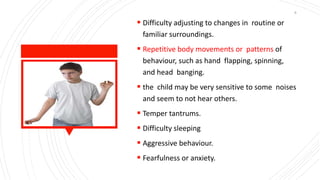
 Repetitive body movements or patterns of
behaviour, such as hand flapping, spinning,
and head banging.
 the child may be very sensitive to some noises
and seem to not hear others.
 Temper tantrums.
 Difficulty sleeping
 Aggressive behaviour.
 Fearfulness or anxiety.
6
Classification
Autism
Childhood disintegrative disorder
Rett syndrome :
Asperger’s Disorder:
Pervasive development disorder, not
otherwise specified (PDD-NOS):
7
Management
 A plan of care for a child with a PDD may
include:
 Special education: Education is structured to
meet the child's unique educational needs. The
goal is always to provide the “least restrictive
environment,” which refers to an education
setting that is as similar as possible to that of
peers without such needs.
• Behaviour modification: This may include
strategies for supporting
 Positive behaviour by the child.
8
• Speech, physical, or occupational
therapy: These therapies are
designed to increase the child's
functional abilities.
• Medication: There are no drugs to treat
the PDDs themselves.
• Medications may be used, however,
to treat specific symptoms such as
anxiety, hyperactivity, and behaviour
that may result in injury.
9
Treatment
 Family/caretaker education
 Cognitive/academic interventions
 Speech and Occupational Therapy
 Social skills training
 Applied Behavioral Analysis
 Treat comorbid Axis I disorders
 SSRIs for anxiety & depression
 Antipsychotics for agitation, aggression, &
stereotypies
10
Homoeopathic
approach
Somato psychic diseases
Acute mental diseases
Doubtful origin
Psychosomatic diseases
11
REFERENCES
 OXFORD TEXTBOOK OF PSYCHIATRY- Micheal
Gelder et al
 PSYCHIATRY- Tasman et al
 SYNOPSIS OF PSYCHIATRY- Kaplan & sadock
 TEXTBOOK OF POSTGRADUATE PSYCHIATRY-
vyas and Niraj Ahuja
 DSM 5
 ICD 10
12
Thank you
13

Pervasive Developmental Disorder

  • 1.
  • 2.
  • 3.
    Defined as….  Acollection of disorders characterized by gross deficits in many areas of cognitive, emotional and social development. These result from severe and pervasive impairment of social interaction and communication skills. (American Psychiatric Association, 2000) 3
  • 4.
    • PDD, otherwiseknown as early infantile autism or childhood autism. • Characterized by the inability of the children to communicate and interact socially. 4
  • 5.
    SYMPTOMS • Difficulty withverbal communication, including problems using and understanding language. • Difficulty with non-verbal communication • Difficulty with social interaction, including relating to people and to his or her surroundings. • Unusual ways of playing with toys and other objects. 5
  • 6.
     Difficulty adjustingto changes in routine or familiar surroundings.  Repetitive body movements or patterns of behaviour, such as hand flapping, spinning, and head banging.  the child may be very sensitive to some noises and seem to not hear others.  Temper tantrums.  Difficulty sleeping  Aggressive behaviour.  Fearfulness or anxiety. 6
  • 7.
    Classification Autism Childhood disintegrative disorder Rettsyndrome : Asperger’s Disorder: Pervasive development disorder, not otherwise specified (PDD-NOS): 7
  • 8.
    Management  A planof care for a child with a PDD may include:  Special education: Education is structured to meet the child's unique educational needs. The goal is always to provide the “least restrictive environment,” which refers to an education setting that is as similar as possible to that of peers without such needs. • Behaviour modification: This may include strategies for supporting  Positive behaviour by the child. 8
  • 9.
    • Speech, physical,or occupational therapy: These therapies are designed to increase the child's functional abilities. • Medication: There are no drugs to treat the PDDs themselves. • Medications may be used, however, to treat specific symptoms such as anxiety, hyperactivity, and behaviour that may result in injury. 9
  • 10.
    Treatment  Family/caretaker education Cognitive/academic interventions  Speech and Occupational Therapy  Social skills training  Applied Behavioral Analysis  Treat comorbid Axis I disorders  SSRIs for anxiety & depression  Antipsychotics for agitation, aggression, & stereotypies 10
  • 11.
    Homoeopathic approach Somato psychic diseases Acutemental diseases Doubtful origin Psychosomatic diseases 11
  • 12.
    REFERENCES  OXFORD TEXTBOOKOF PSYCHIATRY- Micheal Gelder et al  PSYCHIATRY- Tasman et al  SYNOPSIS OF PSYCHIATRY- Kaplan & sadock  TEXTBOOK OF POSTGRADUATE PSYCHIATRY- vyas and Niraj Ahuja  DSM 5  ICD 10 12
  • 13.