PERVASIVE
DEVELOPMENTAL
DISORDERS / AUTISTIC
SPECTRUM DISORDERS
Presenter- Dr.D.Raj Kiran
Chairperson- Dr.Keshava Pai
Case vignette
• A child by name Donald, 5yrs of age brought by
his parents. He seemed to be self satisfied. Has
no apparent affection when patted. He does not
observe the fact that anyone comes or goes,
never seems glad to see father or mother or any
playmate. He seems almost to draw into his shell
& live within himself. When left alone with a child
of same age, he never interacted with him nor
played with him. He seldom comes to anyone
when called.
Ref- Leo Kanner. Autistic disturbance of affective contact. Pathology, 217-250.
2
Headings
• Introduction
• History
• Nosology
• Prevalence
• Etiology- Psychological & Biological theories
• Individual disorders
• Treatment
3
Why the name PDD ???
• Pervasive- development is disturbed over a range
of different domains, rather than delineated
difficulties of specific developmental disorders or
cognitive problems of MR.
• Developmental- suffer from disturbances in
normative unfolding of multiple developmental
competencies.
3Willemsen-Swinkels, Buitelaar, PCNA 25 (2002) 811-836.
Introduction
• The word Autism comes from the Greek word "autos,"
meaning "self."
• Three Cardinal features of Pervasive developmental
Disorders/ Autistic spectrum disorders
1. Qualitative impairment in social interaction.
2. Qualitative impairment in Verbal & Nonverbal
communication.
3. Restricted range of Interests.
5
Ref- Yosuke Kita, Toru Hosokawa. History of autistic spectrum
disorders: historical controversy over the diagnosis. Journal of
Japanese psychiatry; 59; vol 2; 2011
• First person to use the term
“autismus” (german).
• „Autismus‟- to lose
relationship with external
world & lead a life of one‟s
own world.
• Refer to one group of
symptoms of dementia
praecox.
6
History- Eugen Bleuler
Ref- Yosuke Kita, Toru Hosokawa. History of autistic spectrum
disorders: historical controversy over the diagnosis. Journal of
Japanese psychiatry; 59; vol 2; 2011
• In 1908, reported 6
cases.
• Coined the term
“dementia infantilis”.
• Later termed as
Childhood
Disintegrative Disorder
(CDD) / Heller‟s
Syndrome.
7
History- Theodor Heller
Ref- Yosuke Kita, Toru Hosokawa. History of autistic spectrum
disorders: historical controversy over the diagnosis. Journal of
Japanese psychiatry; 59; vol 2; 2011
• In 1943, published a
case report of 11 cases
entitled “Autistic
Disturbances of
Affective Contact”.
• First time used the term
Autism for clinical group
of children.
• Later named Early
Infantile Autism.
8
History- Leo Kanner
Ref- Yosuke Kita, Toru Hosokawa. History of autistic spectrum
disorders: historical controversy over the diagnosis. Journal of
Japanese psychiatry; 59; vol 2; 2011
• In 1944, published a
case report entitled “
Die Autistischen
Psychopathen im
Kindesalter” (German).
• Proposed the term
“Autistic Psychopathy”.
• Late termed as
Asperger„s syndrome.
9
History- Hans Asperger
Ref- Yosuke Kita, Toru Hosokawa. History of autistic spectrum
disorders: historical controversy over the diagnosis. Journal of
Japanese psychiatry; 59; vol 2; 2011
History- Andreas Rett
• In 1966, described a
clinical condition
characterized by
wringing of hands.
• It later came to be
known as Rett‟s
syndrome.
10
Ref- Yosuke Kita, Toru Hosokawa. History of autistic spectrum
disorders: historical controversy over the diagnosis. Journal of
Japanese psychiatry; 59; vol 2; 2011
History- Lorna Wing
• In 1988, Proposed the
concept of Autistic
Spectrum Disorders.
• She is a mother of
Autistic daughter.
• Founded National
Autistic Society, UK.
11
Ref- Yosuke Kita, Toru Hosokawa. History of autistic spectrum
disorders: historical controversy over the diagnosis. Journal of
Japanese psychiatry; 59; vol 2; 2011
Nosology
• DSM
– I & II- Continuum of Schizophrenia
– III- Concept of autism was introduced but lacked the
developmental orientation. CDD was not included.
– III R- Set of 16 criteria were introduced, Multiaxial
placement of autism & PDD, condition was moved to
Axis II, diagnostic concept was broadened to Autistic
disorder & PDD NOS.
• ICD 9- Infantile autism was included in the category of
psychosis with onset in childhood
Ref- F R Volkmar, A Klin, R T Schultz, Mattew, State. Pervasive developmental
disorders. Chapter 41,Kaplan & Sadock‟s Comprehensive textbook of psychiatry vol 2,
page 3540- 3559.
12
Nosology- PDD
DSM IV TR
• 299.00 Autistic disorder.
• 299.80 Rett‟s syndrome.
• 299.10 CDD.
• 299.80 Asperger‟s
syndrome.
• 299.80 PDD NOS
(including Atypical
Autism).
ICD 10 (F84)
• F84.0 Childhood Autism
• F84.1 Atypical Autism
• F84.2 Rett‟s Syndrome
• F84.3 Other CDD
• F84.4 Overactive dis
• F84.5 Asperger‟s
Syndrome
• F84.8 Other PDD
• F84.9 PDD Unspecified
DSM IV TR page- 69-84, ICD 10 page- 252- 259. 13
Nosology- ASD
DSM V
• Autistic Disorder.
• CDD.
• Asperger‟s Syndrome.
• PDD NOS.
• ASD Severity criteria of
levels- 1(mild),
2(moderate), 3(severe) in
two symptom domains.
ICD 11 (proposed draft)
• Autism.
• Disintegrative Disorder.
• Social reciprocity
disorder.
• Rett‟s Syndrome.
Ref- H Kurita. How to deal with the transition from Pervasive Developmental Disorders in DSM-
IV to Autism Spectrum Disorder in DSM-V. editorial, Psychiatry and Clinical
Neurosciences2011;65: 609–610 http://apps.who.int/classifications/icd11/browse/
14
Prevalence
• Increase in prevalence in recent decades.
• The various causes could be due to-
 Increasing reference of children to specialist services.
 “Diagnostic Switching”.
 Decreased age at diagnosis.
 Repeat surveys in same geographical area.
 Changes in diagnostic criteria.
 Improved awareness.
 Service availability.
Ref- ERIC FOMBONNE. Epidemiology of Pervasive Developmental Disorders. PEDIATRIC
RESEARCH . Vol. 65, No. 6, 2009 . 15
Prevalence
• All PDDs- 63.7 / 10,000.
• Autistic disorder- 20.6 / 10,000. M: F= 4-5 :1.
• Asperger‟s syndrome- 6 / 10,000. M: F= 9 :1.
• Rett‟s syndrome- 1/ 15,000 to 1/ 22,000. Reported
only in females.
• CDD- 2 / 1 lac. M > F.
• PDD NOS- 37.1 / 10,000.
Ref- ERIC FOMBONNE. Epidemiology of Pervasive Developmental Disorders.
PEDIATRIC RESEARCH . Vol. 65, No. 6, 2009 . 16
Why PDD M>F ???
• Same picture in ADHD, CD, SLD, dyslexia.
• Various theories proposed are-
1. Extreme Male Brain theory- F have stronger drive to
empathize, M have stronger drive to systemize.
2. Fetal Testosterone(fT) theory.
3. X linked theory.
4. Y linked theory.
5. Autosomal penetrance theory- reduced penetrance in
females.
Ref- Simon Baron-Cohen et al. Why Are Autism Spectrum Conditions More Prevalent in
Males?. Plos biology, June 2011 | Volume 9 | Issue 6 | e1001081 17
Etiology
1. Psychological theories
1. Refrigerator mother theory.
2. Theory of Mind Hypothesis.
3. The Enactive Mind Hypothesis.
4. Theory of Executive Dysfunction.
5. Weak Central Coherence Theory.
2. Biological theories
1. Genetic.
2. Neuroanatomical.
3. Neurochemical.
18
Ref- G Rajendrana, P Mitchell. Cognitive theories of autism. Developmental Review,
27 (2). pp. 224-260. ISSN 0273-2297.
Refrigerator mother theory
Ref- G Rajendrana, P Mitchell. Cognitive theories of autism. Developmental Review,
27 (2). pp. 224-260. ISSN 0273-2297. 19
• Proposed by Bruno Bettelheim.
• Mothers of children with autism are
psychologically cold & aloof → so
respond abnormally & psychologically
harmful to normal child behaviors.
• There is negativity & rejection in child →
perceived as hostility & threat → leads to
withdrawal.
• This becomes a vicious cycle.
Theory of Mind (ToM)
• Forwarded by Premack &
Woodruff (1978).
• Tasks involve reasoning
about misleading contents of
containers & the unexpected
locations of objects.
• States that individuals with
autism fail to “impute mental
status to themselves &
others”.
20
Sally Anne Task
Ref- G Rajendrana, P Mitchell. Cognitive theories of autism. Developmental Review,
27 (2). pp. 224-260. ISSN 0273-2297.
Theory of Executive Dysfunction
• Executive Functioning- Ability to maintain an
appropriate problem-solving set for attainment of
a future goal.
• Includes behaviours- planning, impulse control,
maintenance, organized search, flexibility of
thought and action.
• EF tasks assess- Inhibition, Intentionality &
Executive Memory.
• Studies found 50-96% autistics not able to
perform EF tasks.
21Ref- G Rajendrana, P Mitchell. Cognitive theories of autism. Developmental Review,
27 (2). pp. 224-260. ISSN 0273-2297.
Theory of Executive Dysfunction
• Windows task- A child had to learn to inhibit their
pre potent response to point to chocolate located
in one of two boxes. In order to win chocolate
child has to point to empty box.
• Autistic child is unable to resist to point to box with
chocolates.
• That is they act impulsively.
• Sally Anne task can also be explained in similar
way.
22Ref- G Rajendrana, P Mitchell. Cognitive theories of autism. Developmental Review,
27 (2). pp. 224-260. ISSN 0273-2297.
Weak Central Coherence theory
• Suggested by Prof Uta Firth (1989).
• “A weakness in the operation of
central systems that are normally
responsible for drawing together
individual pieces of information to
establish meaning, resulting in a
cognitive bias towards processing
local parts of information rather than
the overall context”.
23
Ref- K Plaisted. Towards an understanding of the mechanisms of weak central coherence
effects: experiments in visual configural learning and auditory perception. Phil. Trans. R. Soc.
Lond. B (2003) 358, 375–386
Prof Uta Firth
Genetics
• Monozygotic twins- 60%.
• 1st degree relatives- 20-80 folds increase.
• Heterogeneous genetic disorder.
• Autism represents a behavioral phenotype.
• It is a result of damage to one or more specific
functional systems of brain.
• Notable association with HLA-DRB1 alleles.
Ref- A L Relss, C Felnstein,K N Rosenbaum. Autism and Genetic Disorders.
Schizophrenia bulletin, vol 12, no 4, 1986. 24
Genetics
1. Chromosomal disorders- Fragile X Syndrome
(FMR1 gene). 47XXY, 48XXYY, 47XYY, 47XXX,
Large Y chromosome, Trisomy 21.
2. Single gene disorders- Phenylketonuria,
Neurolipidosis, Hurler‟s syndrome, Histidinemia,
Oculocutaneous Albinism, Neurofibromatosis,
Tuberous Sclerosis, Noonan‟s Syndrome.
3. Disorders of Unknown aetiology- Cornelia de
lange syndrome, William‟s syndrome, Moebius
syndrome, Marshall Smith syndrome.
25Ref- A L Relss, C Felnstein,K N Rosenbaum. Autism and Genetic Disorders.
Schizophrenia bulletin, vol 12, no 4, 1986.
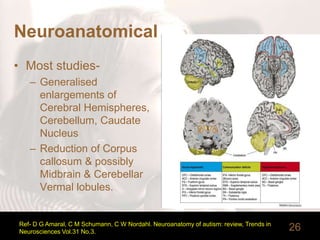
Neuroanatomical
• Most studies-
– Generalised
enlargements of
Cerebral Hemispheres,
Cerebellum, Caudate
Nucleus
– Reduction of Corpus
callosum & possibly
Midbrain & Cerebellar
Vermal lobules.
Ref- D G Amaral, C M Schumann, C W Nordahl. Neuroanatomy of autism: review, Trends in
Neurosciences Vol.31 No.3. 26
Neurochemical
• Wide array of transmitter have been studied.
• Serotonin, Dopamine, Norepinephrine, ACh,
Oxytocin, Endogenous Opioids, Cortisol,
Glutamate, and GABA.
• Serotonin-
– Appears to have more empirical evidence for its role in
autism.
– Evidence for this is acute depletion of dietary
tryptophan led to worsening of autistic symptomatology.
Ref- K S L Lam et al. Neurochemical correlates of autistic disorder: A review of the literature
Research in Developmental Disabilities 27 (2006) 254–289. 27
Neurochemical
• Dopamine-
– Observed that some DA blockers have been effective in
treating some aspects of autism.
– Animal research also shows that stereotypies &
hyperactivity can be induced by ↑ DA.
• Norepinephrine-
– Studies show ↑ NE in autistic than controls.
– Benefits from NE agonists or antagonists has been
sparsely reported.
28Ref- K S L Lam et al. Neurochemical correlates of autistic disorder: A review of the literature
Research in Developmental Disabilities 27 (2006) 254–289.
Autistic disorder- c/f
• Marked abnormality / impairment in development
in Social interaction,
• Marked abnormality / impairment in
Communication,
• Restricted repertoire of activity & interests.
• Disturbance prior to 3 years of age.
• If there is a period of normal development it
cannot extend beyond 3 years.
Ref- DSM IV TR page- 69-84
30
Autistic disorder- c/f
• Impairment in reciprocal social interaction-
1. Nonverbal behaviours (e.g., eye-to-eye gaze, facial
expression, body postures and gestures).
2. Peer relationships appropriate to developmental level.
3. Spontaneous seeking to share enjoyment, interests,
or achievements with other people (e.g., showing,
bringing, or pointing out objects they find interesting).
4. Social or emotional reciprocity (e.g., simple social play
or games, preferring solitary activities, or involving
others in activities only as tools or "mechanical" aids).
31Ref- DSM IV TR page- 69-84
Autistic disorder- c/f
• Impairment in Communication-
– Delay in, or total lack of the development of spoken
language (MC presenting complaint).
– Who speak, may have marked impairment in the ability
to initiate or sustain a conversation with others.
– Stereotyped and repetitive use of language or
idiosyncratic language.
– Lack of varied, spontaneous make-believe play or
social imitative play appropriate to developmental level.
When speech does develop, the pitch, intonation, rate,
rhythm, or stress may be abnormal.
32Ref- DSM IV TR page- 69-84
Autistic disorder- c/f
• Restricted, repetitive & stereotyped patterns of
behaviour, interests & activities
– Preoccupation with one or more stereotyped and
restricted patterns of interest that is abnormal.
– Inflexible adherence to specific, non-functional routines
or rituals.
– Stereotyped and repetitive motor mannerisms.
– A persistent preoccupation with parts of objects.
Display a markedly restricted range of interests and are
often preoccupied with one narrow interest.
33Ref- DSM IV TR page- 69-84
Imaginary City- Urville
Created by French Autistic savant Gilles Trehin
34
Asperger’s Syndrome
• Developmental disability.
• Impairments in social relationships.
• Restrictive, repetitive patterns of behaviour,
interests, and activities.
• But no impairment in language & communication.
• Part of a continuum of autism, with AS placed on
the milder end of the spectrum.
• They have special interests which are typically
narrow & unusual focussed areas.
Ref- Herman van Engeland and Jan K. Buitelaar. Chapter 46: Autistic spectrum disorders.
Rutter‟s child & adolescent psychiatry, 5th edition, Blackwell publishers. Pg 759- 781. 35
Asperger’s Syndrome- c/f
• Socially isolated but not withdrawn, approaching
others in an inappropriate & eccentric manner.
• Speech- poor prosody, inflection & intonation not
as rigid & monotonic as in autism. It may be
tangential & circumstantial. The patient may talk
incessantly.
• They typically amass a lot of factual information,
without understanding of the broader phenomena
involved.
36
Ref- DSM IV TR page- 69-84
Asperger’s Syndrome
• Hans Asperger initially described a positive
outcome to his patients, who were able to use
their special talents for employment. But there are
no systemic long term follow up studies.
• Treatment
– Supportive.
– Great extent overlaps with treatment guidelines
of autism without mental retardation.
37
Childhood Disintegrative Disorder
• Marked regression in multiple areas of
development after several years of development.
• Aetiology-
– Cause is yet to be established.
– Association with Addison-Schilder,
metachromatic leukodystrophy, pertusis,
neurolipidosis, and seizures.
– ??? Genetic or Chromosomal abnormalities.
Ref- M A Bray, T J Kehle, L A Theodore. Case study of CDD- Hellers syndrome. Psychology in
the Schools, Vol. 39(1), 2002. 38
CDD c/f
• Both CDD and Autistic Disorder essentially have the
same criteria for diagnosis.
• Hallmark of CDD- ubiquitous loss of speech,
progressive deterioration of daily living skills,
behaviour problems.
• Normal development- minimum of 2 years.
• Onset- between 2 & 10 years.
• Some individuals with CDD appear clinically more
autistic than those with autistic disorder.
39Ref- Herman van Engeland and Jan K. Buitelaar. Chapter 46: Autistic spectrum disorders.
Rutter‟s child & adolescent psychiatry, 5th edition, Blackwell publishers. Pg 759- 781.
CDD Rx
• Addressing the special needs.
• Approaches designed for autistic children are as
effective in treating children with CDD.
• Early intervention enhances the efficacy .
• Most children with CDD undergo deterioration
subsequent to the preschool years.
40Ref- Herman van Engeland and Jan K. Buitelaar. Chapter 46: Autistic spectrum disorders.
Rutter‟s child & adolescent psychiatry, 5th edition, Blackwell publishers. Pg 759- 781.
Rett’s Syndrome
• Postnatal progressive neurodevelopmental
disorder in Girls.
• 99% sporadic.
• Loss of MeCP2 function.
• Mutations in MeCP2 in 95% of classic cases.
Most arise de novo & often involve C to T
transition at CpG dinucleotides.
• Other mutations- R133C (mild), R270X.
Ref- Maria chahrour, H Y Zoghbi. The Story of Rett Syndrome: From Clinic to
Neurobiology. Neuron 56. Nov 8, 2007. 41
Rett’s Syndrome- c/f
Ref- Maria chahrour, H Y Zoghbi. The Story of Rett Syndrome: From Clinic to
Neurobiology. Neuron 56. Nov 8, 2007. 42
Rett’s Syndrome
• Prognosis
– Progressive neurodegenerative condition.
– Adults may be non ambulatory due to motor problems
& scoliosis.
– Increased risk of sudden death.
• Treatment-
– No specific treatment.
– Special education, Behaviour modification, Physical &
Respiratory therapies may be helpful.
43
Ref- Maria chahrour, H Y Zoghbi. The Story of Rett Syndrome: From Clinic to
Neurobiology. Neuron 56. Nov 8, 2007.
Atypical Autism
• Differs from autism in terms
– Age of onset or
– failure to fulfil all three sets of diagnostic criteria.
• Arises in retarded individuals whose very low level
of functioning provides little scope for exhibition of
the specific deviant behaviours required for the
diagnosis.
• It also occurs in individual with a specific
developmental disorder of receptive language.
44
PDD Unspecified
• Residual category that should be used for
disorders which fit the general description for PDD
but in which a lack of adequate information, or
contradictory findings, means that the criteria for
any of the other F84 codes cannot be met.
45
ASD- Rx
Ref- Anne Bowker• Nadia M. D‟Angelo• Robin Hicks• Kerry Wells. Treatments for Autism:
Parental Choices and Perceptions of Changes J Autism Dev Disord (2011) 41:1373–1382. 46
1st
2nd
3rd
4th
5th
6th
Applied Behavior Analysis(ABA)
Ref- Joel E. Ringdahl, Todd Kopelman, and Terry S. Falcomata. Chapter 2
Applied Behavior Analysis and Its Application to Autism and Autism Related Disorders.
Springer publishers.15-32.
47
• Symptoms can be grossly divided into-
– Behavior of excess- vocal & motor stereotypy, rigidity.
– Behavior of deficit- delay in communication, peer
relation, independent functioning.
• Many of these are addressed by ABA.
• It is based on Operant conditioning by Skinner.
• It is a process through which the environment and
behaviour interact to shape the behavioural
repertoire of an individual.
ABA concepts
• There are several concepts upon which ABA
treatment is based.
• They have been divided into-
• Consequence based approaches- punishment,
reinforcement.
• Antecedent based approaches.
• Combined approaches.
48
Ref- Joel E. Ringdahl, Todd Kopelman, and Terry S. Falcomata. Chapter 2
Applied Behavior Analysis and Its Application to Autism and Autism Related Disorders.
Springer publishers.15-32.
Consequence based approaches
• Positive punishment- An aversive stimulus is
presented (positive = presented) contingent on
the target behaviour & results in a decreased
likelihood of future responding.
• Negative punishment- A stimulus is removed
(negative = removed) contingent on the target
behaviour & results in a decreased likelihood of
future responding.
• Drawbacks- no new behavior learnt, desired
behavior only in presence of punisher etc..,
49
Ref- Joel E. Ringdahl, Todd Kopelman, and Terry S. Falcomata. Chapter 2
Applied Behavior Analysis and Its Application to Autism and Autism Related Disorders.
Springer publishers.15-32.
Consequence based approaches
• Token economy- refers to the delivery of a
conditioned reinforcer that can later be
exchanged for another reinforcer.
• Extinction- the reinforcement for a particular
response is withdrawn, unreinforced the behavior
disappears.
• Differential reinforcement- giving positive
reinforcement for desired behavior & withholding it
in the absence.
50Ref- Joel E. Ringdahl, Todd Kopelman, and Terry S. Falcomata. Chapter 2
Applied Behavior Analysis and Its Application to Autism and Autism Related Disorders.
Consequence based approaches
• Shaping- use of prompts & successive
approximations.
• Behavioural chains- they are collections of
discrete responses that are performed in rapid
and accurate sequences.
• Forward chaining- responses in a behavioural
chain are taught and reinforced in their naturally
occurring order.
• Backward chaining- reverse order reinforcement.
51
Ref- Joel E. Ringdahl, Todd Kopelman, and Terry S. Falcomata. Chapter 2
Applied Behavior Analysis and Its Application to Autism and Autism Related Disorders.
Springer publishers.15-32.
Antecedent approaches
• These focus on manipulating antecedent relevant
target behavior.
• These include-
1. Establishing operations- deprivation & satiation.
2. Stimulus control procedures.
3. Prompt procedures.
4. Procedures that provide choice making
opportunities.
52
Ref- Joel E. Ringdahl, Todd Kopelman, and Terry S. Falcomata. Chapter 2
Applied Behavior Analysis and Its Application to Autism and Autism Related Disorders.
Springer publishers.15-32.
Catherine Maurice- Behavioral
intervention for autism children
• It is divided into three levels
1. Beginning curriculum.
2. Intermediate curriculum.
3. Advanced curriculum.
• Each curriculum has 6 skills
except advanced which has
9 skills-
1. Attending skills
2. Imitation skills
3. Receptive language skills
4. Expressive language skills
5. Pre academic/ academic
skills
6. Self help skills
7. Abstract language
8. Social skills
9. School readiness
“If they can't learn the way we teach, we teach the way they learn” ― O. Ivar Lovaas
(Author of “ME BOOK”) 53
Catherine Maurice- Behavioral
intervention for autism children
• Attending skills- sits in chair independently,
sustains eye contact, eye contact during
conversation.
• Imitation skills- imitates gross motor movements,
imitates gross motor movements from standing
position, imitates complex sequences.
• Receptive language- follow 1 step instruction,
identifies room, follow 3 step command.
"Don‟t underestimate persons with autism, try to understand."
54
Catherine Maurice- Behavioral
intervention for autism children
• Expressive language- labels objects, labels
places, names items in a category.
• Pre academic skills- identify colors, matches
identical words, spells simple words.
• Self help skills- drink from cup, puts on shirt,
brushes teeth.
• Abstract language- answers why..? Question.
• Social skills- imitates action of peer.
• School readiness- waits turn.
"My son has autism, but autism doesn't have him."
55
Catherine Maurice- Behavioral
intervention for autism children
• For example- “maintaining eye contact”
1. Make child sit on a chair facing you.
2. Give the command “look at me” every 5-10sec.
3. Reward the child with praise & food for correctly looking at the
face.
4. If child does not visually attend then look away for 5sec & then
repeat the same command again.
5. Prompt eye contact by holding a piece of food between vision of
child & you. Then repeat the command.
6. When eye contact occurs, gradually & systemically fade the
prompt.
7. To increase the duration of eye contact gradually delay giving of
food while maintaining eye contact with praise.
"Though devastating at first, Autism isn't the end of the world. It's the beginning of a whole new
one." 56
Medications
• Risperidone(0.5–1.5 mg)- decreasing irritability,
temper tantrums, hyperactivity, aggression and
self-injurious behaviour.
• Fluoxetine- reducing compulsive and repetitive
behaviours, stereotypies and rituals.
• Methylphenidate(0.125-0.5mg/kg/day)ADHD.
• Lithium and Valproic acid- Affective instability,
impulsivity and aggression.
• Buspirone(10-45mg/kg/day)- improving anxiety,
temper tantrums and aggression.
Ref- Herman van Engeland and Jan K. Buitelaar. Chapter 46: Autistic spectrum disorders.
Rutter‟s child & adolescent psychiatry, 5th edition, Blackwell publishers. Pg 759- 781. 57
Take home message
• No one theory explains these disorders. Still a lot
scope for research to explain etiology.
• No one treatment fits all these disorders.
• Treatment should be tailored according to the
individual needs.
• Outcome seems to be improved with earlier
detection & intervention.
• Self help skills should be major aim of treatment
programs.
58
• World Autism Awareness Day-
2nd April every year.
• Theme- “Autism. More common
than you think”…
• Films on autism….
59
5/9/2013
60
THANK YOU

Pervasive Developmental Disorders

  • 1.
    PERVASIVE DEVELOPMENTAL DISORDERS / AUTISTIC SPECTRUMDISORDERS Presenter- Dr.D.Raj Kiran Chairperson- Dr.Keshava Pai
  • 2.
    Case vignette • Achild by name Donald, 5yrs of age brought by his parents. He seemed to be self satisfied. Has no apparent affection when patted. He does not observe the fact that anyone comes or goes, never seems glad to see father or mother or any playmate. He seems almost to draw into his shell & live within himself. When left alone with a child of same age, he never interacted with him nor played with him. He seldom comes to anyone when called. Ref- Leo Kanner. Autistic disturbance of affective contact. Pathology, 217-250. 2
  • 3.
    Headings • Introduction • History •Nosology • Prevalence • Etiology- Psychological & Biological theories • Individual disorders • Treatment 3
  • 4.
    Why the namePDD ??? • Pervasive- development is disturbed over a range of different domains, rather than delineated difficulties of specific developmental disorders or cognitive problems of MR. • Developmental- suffer from disturbances in normative unfolding of multiple developmental competencies. 3Willemsen-Swinkels, Buitelaar, PCNA 25 (2002) 811-836.
  • 5.
    Introduction • The wordAutism comes from the Greek word "autos," meaning "self." • Three Cardinal features of Pervasive developmental Disorders/ Autistic spectrum disorders 1. Qualitative impairment in social interaction. 2. Qualitative impairment in Verbal & Nonverbal communication. 3. Restricted range of Interests. 5 Ref- Yosuke Kita, Toru Hosokawa. History of autistic spectrum disorders: historical controversy over the diagnosis. Journal of Japanese psychiatry; 59; vol 2; 2011
  • 6.
    • First personto use the term “autismus” (german). • „Autismus‟- to lose relationship with external world & lead a life of one‟s own world. • Refer to one group of symptoms of dementia praecox. 6 History- Eugen Bleuler Ref- Yosuke Kita, Toru Hosokawa. History of autistic spectrum disorders: historical controversy over the diagnosis. Journal of Japanese psychiatry; 59; vol 2; 2011
  • 7.
    • In 1908,reported 6 cases. • Coined the term “dementia infantilis”. • Later termed as Childhood Disintegrative Disorder (CDD) / Heller‟s Syndrome. 7 History- Theodor Heller Ref- Yosuke Kita, Toru Hosokawa. History of autistic spectrum disorders: historical controversy over the diagnosis. Journal of Japanese psychiatry; 59; vol 2; 2011
  • 8.
    • In 1943,published a case report of 11 cases entitled “Autistic Disturbances of Affective Contact”. • First time used the term Autism for clinical group of children. • Later named Early Infantile Autism. 8 History- Leo Kanner Ref- Yosuke Kita, Toru Hosokawa. History of autistic spectrum disorders: historical controversy over the diagnosis. Journal of Japanese psychiatry; 59; vol 2; 2011
  • 9.
    • In 1944,published a case report entitled “ Die Autistischen Psychopathen im Kindesalter” (German). • Proposed the term “Autistic Psychopathy”. • Late termed as Asperger„s syndrome. 9 History- Hans Asperger Ref- Yosuke Kita, Toru Hosokawa. History of autistic spectrum disorders: historical controversy over the diagnosis. Journal of Japanese psychiatry; 59; vol 2; 2011
  • 10.
    History- Andreas Rett •In 1966, described a clinical condition characterized by wringing of hands. • It later came to be known as Rett‟s syndrome. 10 Ref- Yosuke Kita, Toru Hosokawa. History of autistic spectrum disorders: historical controversy over the diagnosis. Journal of Japanese psychiatry; 59; vol 2; 2011
  • 11.
    History- Lorna Wing •In 1988, Proposed the concept of Autistic Spectrum Disorders. • She is a mother of Autistic daughter. • Founded National Autistic Society, UK. 11 Ref- Yosuke Kita, Toru Hosokawa. History of autistic spectrum disorders: historical controversy over the diagnosis. Journal of Japanese psychiatry; 59; vol 2; 2011
  • 12.
    Nosology • DSM – I& II- Continuum of Schizophrenia – III- Concept of autism was introduced but lacked the developmental orientation. CDD was not included. – III R- Set of 16 criteria were introduced, Multiaxial placement of autism & PDD, condition was moved to Axis II, diagnostic concept was broadened to Autistic disorder & PDD NOS. • ICD 9- Infantile autism was included in the category of psychosis with onset in childhood Ref- F R Volkmar, A Klin, R T Schultz, Mattew, State. Pervasive developmental disorders. Chapter 41,Kaplan & Sadock‟s Comprehensive textbook of psychiatry vol 2, page 3540- 3559. 12
  • 13.
    Nosology- PDD DSM IVTR • 299.00 Autistic disorder. • 299.80 Rett‟s syndrome. • 299.10 CDD. • 299.80 Asperger‟s syndrome. • 299.80 PDD NOS (including Atypical Autism). ICD 10 (F84) • F84.0 Childhood Autism • F84.1 Atypical Autism • F84.2 Rett‟s Syndrome • F84.3 Other CDD • F84.4 Overactive dis • F84.5 Asperger‟s Syndrome • F84.8 Other PDD • F84.9 PDD Unspecified DSM IV TR page- 69-84, ICD 10 page- 252- 259. 13
  • 14.
    Nosology- ASD DSM V •Autistic Disorder. • CDD. • Asperger‟s Syndrome. • PDD NOS. • ASD Severity criteria of levels- 1(mild), 2(moderate), 3(severe) in two symptom domains. ICD 11 (proposed draft) • Autism. • Disintegrative Disorder. • Social reciprocity disorder. • Rett‟s Syndrome. Ref- H Kurita. How to deal with the transition from Pervasive Developmental Disorders in DSM- IV to Autism Spectrum Disorder in DSM-V. editorial, Psychiatry and Clinical Neurosciences2011;65: 609–610 http://apps.who.int/classifications/icd11/browse/ 14
  • 15.
    Prevalence • Increase inprevalence in recent decades. • The various causes could be due to-  Increasing reference of children to specialist services.  “Diagnostic Switching”.  Decreased age at diagnosis.  Repeat surveys in same geographical area.  Changes in diagnostic criteria.  Improved awareness.  Service availability. Ref- ERIC FOMBONNE. Epidemiology of Pervasive Developmental Disorders. PEDIATRIC RESEARCH . Vol. 65, No. 6, 2009 . 15
  • 16.
    Prevalence • All PDDs-63.7 / 10,000. • Autistic disorder- 20.6 / 10,000. M: F= 4-5 :1. • Asperger‟s syndrome- 6 / 10,000. M: F= 9 :1. • Rett‟s syndrome- 1/ 15,000 to 1/ 22,000. Reported only in females. • CDD- 2 / 1 lac. M > F. • PDD NOS- 37.1 / 10,000. Ref- ERIC FOMBONNE. Epidemiology of Pervasive Developmental Disorders. PEDIATRIC RESEARCH . Vol. 65, No. 6, 2009 . 16
  • 17.
    Why PDD M>F??? • Same picture in ADHD, CD, SLD, dyslexia. • Various theories proposed are- 1. Extreme Male Brain theory- F have stronger drive to empathize, M have stronger drive to systemize. 2. Fetal Testosterone(fT) theory. 3. X linked theory. 4. Y linked theory. 5. Autosomal penetrance theory- reduced penetrance in females. Ref- Simon Baron-Cohen et al. Why Are Autism Spectrum Conditions More Prevalent in Males?. Plos biology, June 2011 | Volume 9 | Issue 6 | e1001081 17
  • 18.
    Etiology 1. Psychological theories 1.Refrigerator mother theory. 2. Theory of Mind Hypothesis. 3. The Enactive Mind Hypothesis. 4. Theory of Executive Dysfunction. 5. Weak Central Coherence Theory. 2. Biological theories 1. Genetic. 2. Neuroanatomical. 3. Neurochemical. 18 Ref- G Rajendrana, P Mitchell. Cognitive theories of autism. Developmental Review, 27 (2). pp. 224-260. ISSN 0273-2297.
  • 19.
    Refrigerator mother theory Ref-G Rajendrana, P Mitchell. Cognitive theories of autism. Developmental Review, 27 (2). pp. 224-260. ISSN 0273-2297. 19 • Proposed by Bruno Bettelheim. • Mothers of children with autism are psychologically cold & aloof → so respond abnormally & psychologically harmful to normal child behaviors. • There is negativity & rejection in child → perceived as hostility & threat → leads to withdrawal. • This becomes a vicious cycle.
  • 20.
    Theory of Mind(ToM) • Forwarded by Premack & Woodruff (1978). • Tasks involve reasoning about misleading contents of containers & the unexpected locations of objects. • States that individuals with autism fail to “impute mental status to themselves & others”. 20 Sally Anne Task Ref- G Rajendrana, P Mitchell. Cognitive theories of autism. Developmental Review, 27 (2). pp. 224-260. ISSN 0273-2297.
  • 21.
    Theory of ExecutiveDysfunction • Executive Functioning- Ability to maintain an appropriate problem-solving set for attainment of a future goal. • Includes behaviours- planning, impulse control, maintenance, organized search, flexibility of thought and action. • EF tasks assess- Inhibition, Intentionality & Executive Memory. • Studies found 50-96% autistics not able to perform EF tasks. 21Ref- G Rajendrana, P Mitchell. Cognitive theories of autism. Developmental Review, 27 (2). pp. 224-260. ISSN 0273-2297.
  • 22.
    Theory of ExecutiveDysfunction • Windows task- A child had to learn to inhibit their pre potent response to point to chocolate located in one of two boxes. In order to win chocolate child has to point to empty box. • Autistic child is unable to resist to point to box with chocolates. • That is they act impulsively. • Sally Anne task can also be explained in similar way. 22Ref- G Rajendrana, P Mitchell. Cognitive theories of autism. Developmental Review, 27 (2). pp. 224-260. ISSN 0273-2297.
  • 23.
    Weak Central Coherencetheory • Suggested by Prof Uta Firth (1989). • “A weakness in the operation of central systems that are normally responsible for drawing together individual pieces of information to establish meaning, resulting in a cognitive bias towards processing local parts of information rather than the overall context”. 23 Ref- K Plaisted. Towards an understanding of the mechanisms of weak central coherence effects: experiments in visual configural learning and auditory perception. Phil. Trans. R. Soc. Lond. B (2003) 358, 375–386 Prof Uta Firth
  • 24.
    Genetics • Monozygotic twins-60%. • 1st degree relatives- 20-80 folds increase. • Heterogeneous genetic disorder. • Autism represents a behavioral phenotype. • It is a result of damage to one or more specific functional systems of brain. • Notable association with HLA-DRB1 alleles. Ref- A L Relss, C Felnstein,K N Rosenbaum. Autism and Genetic Disorders. Schizophrenia bulletin, vol 12, no 4, 1986. 24
  • 25.
    Genetics 1. Chromosomal disorders-Fragile X Syndrome (FMR1 gene). 47XXY, 48XXYY, 47XYY, 47XXX, Large Y chromosome, Trisomy 21. 2. Single gene disorders- Phenylketonuria, Neurolipidosis, Hurler‟s syndrome, Histidinemia, Oculocutaneous Albinism, Neurofibromatosis, Tuberous Sclerosis, Noonan‟s Syndrome. 3. Disorders of Unknown aetiology- Cornelia de lange syndrome, William‟s syndrome, Moebius syndrome, Marshall Smith syndrome. 25Ref- A L Relss, C Felnstein,K N Rosenbaum. Autism and Genetic Disorders. Schizophrenia bulletin, vol 12, no 4, 1986.
  • 26.
    Neuroanatomical • Most studies- –Generalised enlargements of Cerebral Hemispheres, Cerebellum, Caudate Nucleus – Reduction of Corpus callosum & possibly Midbrain & Cerebellar Vermal lobules. Ref- D G Amaral, C M Schumann, C W Nordahl. Neuroanatomy of autism: review, Trends in Neurosciences Vol.31 No.3. 26
  • 27.
    Neurochemical • Wide arrayof transmitter have been studied. • Serotonin, Dopamine, Norepinephrine, ACh, Oxytocin, Endogenous Opioids, Cortisol, Glutamate, and GABA. • Serotonin- – Appears to have more empirical evidence for its role in autism. – Evidence for this is acute depletion of dietary tryptophan led to worsening of autistic symptomatology. Ref- K S L Lam et al. Neurochemical correlates of autistic disorder: A review of the literature Research in Developmental Disabilities 27 (2006) 254–289. 27
  • 28.
    Neurochemical • Dopamine- – Observedthat some DA blockers have been effective in treating some aspects of autism. – Animal research also shows that stereotypies & hyperactivity can be induced by ↑ DA. • Norepinephrine- – Studies show ↑ NE in autistic than controls. – Benefits from NE agonists or antagonists has been sparsely reported. 28Ref- K S L Lam et al. Neurochemical correlates of autistic disorder: A review of the literature Research in Developmental Disabilities 27 (2006) 254–289.
  • 30.
    Autistic disorder- c/f •Marked abnormality / impairment in development in Social interaction, • Marked abnormality / impairment in Communication, • Restricted repertoire of activity & interests. • Disturbance prior to 3 years of age. • If there is a period of normal development it cannot extend beyond 3 years. Ref- DSM IV TR page- 69-84 30
  • 31.
    Autistic disorder- c/f •Impairment in reciprocal social interaction- 1. Nonverbal behaviours (e.g., eye-to-eye gaze, facial expression, body postures and gestures). 2. Peer relationships appropriate to developmental level. 3. Spontaneous seeking to share enjoyment, interests, or achievements with other people (e.g., showing, bringing, or pointing out objects they find interesting). 4. Social or emotional reciprocity (e.g., simple social play or games, preferring solitary activities, or involving others in activities only as tools or "mechanical" aids). 31Ref- DSM IV TR page- 69-84
  • 32.
    Autistic disorder- c/f •Impairment in Communication- – Delay in, or total lack of the development of spoken language (MC presenting complaint). – Who speak, may have marked impairment in the ability to initiate or sustain a conversation with others. – Stereotyped and repetitive use of language or idiosyncratic language. – Lack of varied, spontaneous make-believe play or social imitative play appropriate to developmental level. When speech does develop, the pitch, intonation, rate, rhythm, or stress may be abnormal. 32Ref- DSM IV TR page- 69-84
  • 33.
    Autistic disorder- c/f •Restricted, repetitive & stereotyped patterns of behaviour, interests & activities – Preoccupation with one or more stereotyped and restricted patterns of interest that is abnormal. – Inflexible adherence to specific, non-functional routines or rituals. – Stereotyped and repetitive motor mannerisms. – A persistent preoccupation with parts of objects. Display a markedly restricted range of interests and are often preoccupied with one narrow interest. 33Ref- DSM IV TR page- 69-84
  • 34.
    Imaginary City- Urville Createdby French Autistic savant Gilles Trehin 34
  • 35.
    Asperger’s Syndrome • Developmentaldisability. • Impairments in social relationships. • Restrictive, repetitive patterns of behaviour, interests, and activities. • But no impairment in language & communication. • Part of a continuum of autism, with AS placed on the milder end of the spectrum. • They have special interests which are typically narrow & unusual focussed areas. Ref- Herman van Engeland and Jan K. Buitelaar. Chapter 46: Autistic spectrum disorders. Rutter‟s child & adolescent psychiatry, 5th edition, Blackwell publishers. Pg 759- 781. 35
  • 36.
    Asperger’s Syndrome- c/f •Socially isolated but not withdrawn, approaching others in an inappropriate & eccentric manner. • Speech- poor prosody, inflection & intonation not as rigid & monotonic as in autism. It may be tangential & circumstantial. The patient may talk incessantly. • They typically amass a lot of factual information, without understanding of the broader phenomena involved. 36 Ref- DSM IV TR page- 69-84
  • 37.
    Asperger’s Syndrome • HansAsperger initially described a positive outcome to his patients, who were able to use their special talents for employment. But there are no systemic long term follow up studies. • Treatment – Supportive. – Great extent overlaps with treatment guidelines of autism without mental retardation. 37
  • 38.
    Childhood Disintegrative Disorder •Marked regression in multiple areas of development after several years of development. • Aetiology- – Cause is yet to be established. – Association with Addison-Schilder, metachromatic leukodystrophy, pertusis, neurolipidosis, and seizures. – ??? Genetic or Chromosomal abnormalities. Ref- M A Bray, T J Kehle, L A Theodore. Case study of CDD- Hellers syndrome. Psychology in the Schools, Vol. 39(1), 2002. 38
  • 39.
    CDD c/f • BothCDD and Autistic Disorder essentially have the same criteria for diagnosis. • Hallmark of CDD- ubiquitous loss of speech, progressive deterioration of daily living skills, behaviour problems. • Normal development- minimum of 2 years. • Onset- between 2 & 10 years. • Some individuals with CDD appear clinically more autistic than those with autistic disorder. 39Ref- Herman van Engeland and Jan K. Buitelaar. Chapter 46: Autistic spectrum disorders. Rutter‟s child & adolescent psychiatry, 5th edition, Blackwell publishers. Pg 759- 781.
  • 40.
    CDD Rx • Addressingthe special needs. • Approaches designed for autistic children are as effective in treating children with CDD. • Early intervention enhances the efficacy . • Most children with CDD undergo deterioration subsequent to the preschool years. 40Ref- Herman van Engeland and Jan K. Buitelaar. Chapter 46: Autistic spectrum disorders. Rutter‟s child & adolescent psychiatry, 5th edition, Blackwell publishers. Pg 759- 781.
  • 41.
    Rett’s Syndrome • Postnatalprogressive neurodevelopmental disorder in Girls. • 99% sporadic. • Loss of MeCP2 function. • Mutations in MeCP2 in 95% of classic cases. Most arise de novo & often involve C to T transition at CpG dinucleotides. • Other mutations- R133C (mild), R270X. Ref- Maria chahrour, H Y Zoghbi. The Story of Rett Syndrome: From Clinic to Neurobiology. Neuron 56. Nov 8, 2007. 41
  • 42.
    Rett’s Syndrome- c/f Ref-Maria chahrour, H Y Zoghbi. The Story of Rett Syndrome: From Clinic to Neurobiology. Neuron 56. Nov 8, 2007. 42
  • 43.
    Rett’s Syndrome • Prognosis –Progressive neurodegenerative condition. – Adults may be non ambulatory due to motor problems & scoliosis. – Increased risk of sudden death. • Treatment- – No specific treatment. – Special education, Behaviour modification, Physical & Respiratory therapies may be helpful. 43 Ref- Maria chahrour, H Y Zoghbi. The Story of Rett Syndrome: From Clinic to Neurobiology. Neuron 56. Nov 8, 2007.
  • 44.
    Atypical Autism • Differsfrom autism in terms – Age of onset or – failure to fulfil all three sets of diagnostic criteria. • Arises in retarded individuals whose very low level of functioning provides little scope for exhibition of the specific deviant behaviours required for the diagnosis. • It also occurs in individual with a specific developmental disorder of receptive language. 44
  • 45.
    PDD Unspecified • Residualcategory that should be used for disorders which fit the general description for PDD but in which a lack of adequate information, or contradictory findings, means that the criteria for any of the other F84 codes cannot be met. 45
  • 46.
    ASD- Rx Ref- AnneBowker• Nadia M. D‟Angelo• Robin Hicks• Kerry Wells. Treatments for Autism: Parental Choices and Perceptions of Changes J Autism Dev Disord (2011) 41:1373–1382. 46 1st 2nd 3rd 4th 5th 6th
  • 47.
    Applied Behavior Analysis(ABA) Ref-Joel E. Ringdahl, Todd Kopelman, and Terry S. Falcomata. Chapter 2 Applied Behavior Analysis and Its Application to Autism and Autism Related Disorders. Springer publishers.15-32. 47 • Symptoms can be grossly divided into- – Behavior of excess- vocal & motor stereotypy, rigidity. – Behavior of deficit- delay in communication, peer relation, independent functioning. • Many of these are addressed by ABA. • It is based on Operant conditioning by Skinner. • It is a process through which the environment and behaviour interact to shape the behavioural repertoire of an individual.
  • 48.
    ABA concepts • Thereare several concepts upon which ABA treatment is based. • They have been divided into- • Consequence based approaches- punishment, reinforcement. • Antecedent based approaches. • Combined approaches. 48 Ref- Joel E. Ringdahl, Todd Kopelman, and Terry S. Falcomata. Chapter 2 Applied Behavior Analysis and Its Application to Autism and Autism Related Disorders. Springer publishers.15-32.
  • 49.
    Consequence based approaches •Positive punishment- An aversive stimulus is presented (positive = presented) contingent on the target behaviour & results in a decreased likelihood of future responding. • Negative punishment- A stimulus is removed (negative = removed) contingent on the target behaviour & results in a decreased likelihood of future responding. • Drawbacks- no new behavior learnt, desired behavior only in presence of punisher etc.., 49 Ref- Joel E. Ringdahl, Todd Kopelman, and Terry S. Falcomata. Chapter 2 Applied Behavior Analysis and Its Application to Autism and Autism Related Disorders. Springer publishers.15-32.
  • 50.
    Consequence based approaches •Token economy- refers to the delivery of a conditioned reinforcer that can later be exchanged for another reinforcer. • Extinction- the reinforcement for a particular response is withdrawn, unreinforced the behavior disappears. • Differential reinforcement- giving positive reinforcement for desired behavior & withholding it in the absence. 50Ref- Joel E. Ringdahl, Todd Kopelman, and Terry S. Falcomata. Chapter 2 Applied Behavior Analysis and Its Application to Autism and Autism Related Disorders.
  • 51.
    Consequence based approaches •Shaping- use of prompts & successive approximations. • Behavioural chains- they are collections of discrete responses that are performed in rapid and accurate sequences. • Forward chaining- responses in a behavioural chain are taught and reinforced in their naturally occurring order. • Backward chaining- reverse order reinforcement. 51 Ref- Joel E. Ringdahl, Todd Kopelman, and Terry S. Falcomata. Chapter 2 Applied Behavior Analysis and Its Application to Autism and Autism Related Disorders. Springer publishers.15-32.
  • 52.
    Antecedent approaches • Thesefocus on manipulating antecedent relevant target behavior. • These include- 1. Establishing operations- deprivation & satiation. 2. Stimulus control procedures. 3. Prompt procedures. 4. Procedures that provide choice making opportunities. 52 Ref- Joel E. Ringdahl, Todd Kopelman, and Terry S. Falcomata. Chapter 2 Applied Behavior Analysis and Its Application to Autism and Autism Related Disorders. Springer publishers.15-32.
  • 53.
    Catherine Maurice- Behavioral interventionfor autism children • It is divided into three levels 1. Beginning curriculum. 2. Intermediate curriculum. 3. Advanced curriculum. • Each curriculum has 6 skills except advanced which has 9 skills- 1. Attending skills 2. Imitation skills 3. Receptive language skills 4. Expressive language skills 5. Pre academic/ academic skills 6. Self help skills 7. Abstract language 8. Social skills 9. School readiness “If they can't learn the way we teach, we teach the way they learn” ― O. Ivar Lovaas (Author of “ME BOOK”) 53
  • 54.
    Catherine Maurice- Behavioral interventionfor autism children • Attending skills- sits in chair independently, sustains eye contact, eye contact during conversation. • Imitation skills- imitates gross motor movements, imitates gross motor movements from standing position, imitates complex sequences. • Receptive language- follow 1 step instruction, identifies room, follow 3 step command. "Don‟t underestimate persons with autism, try to understand." 54
  • 55.
    Catherine Maurice- Behavioral interventionfor autism children • Expressive language- labels objects, labels places, names items in a category. • Pre academic skills- identify colors, matches identical words, spells simple words. • Self help skills- drink from cup, puts on shirt, brushes teeth. • Abstract language- answers why..? Question. • Social skills- imitates action of peer. • School readiness- waits turn. "My son has autism, but autism doesn't have him." 55
  • 56.
    Catherine Maurice- Behavioral interventionfor autism children • For example- “maintaining eye contact” 1. Make child sit on a chair facing you. 2. Give the command “look at me” every 5-10sec. 3. Reward the child with praise & food for correctly looking at the face. 4. If child does not visually attend then look away for 5sec & then repeat the same command again. 5. Prompt eye contact by holding a piece of food between vision of child & you. Then repeat the command. 6. When eye contact occurs, gradually & systemically fade the prompt. 7. To increase the duration of eye contact gradually delay giving of food while maintaining eye contact with praise. "Though devastating at first, Autism isn't the end of the world. It's the beginning of a whole new one." 56
  • 57.
    Medications • Risperidone(0.5–1.5 mg)-decreasing irritability, temper tantrums, hyperactivity, aggression and self-injurious behaviour. • Fluoxetine- reducing compulsive and repetitive behaviours, stereotypies and rituals. • Methylphenidate(0.125-0.5mg/kg/day)ADHD. • Lithium and Valproic acid- Affective instability, impulsivity and aggression. • Buspirone(10-45mg/kg/day)- improving anxiety, temper tantrums and aggression. Ref- Herman van Engeland and Jan K. Buitelaar. Chapter 46: Autistic spectrum disorders. Rutter‟s child & adolescent psychiatry, 5th edition, Blackwell publishers. Pg 759- 781. 57
  • 58.
    Take home message •No one theory explains these disorders. Still a lot scope for research to explain etiology. • No one treatment fits all these disorders. • Treatment should be tailored according to the individual needs. • Outcome seems to be improved with earlier detection & intervention. • Self help skills should be major aim of treatment programs. 58
  • 59.
    • World AutismAwareness Day- 2nd April every year. • Theme- “Autism. More common than you think”… • Films on autism…. 59
  • 60.