Autism
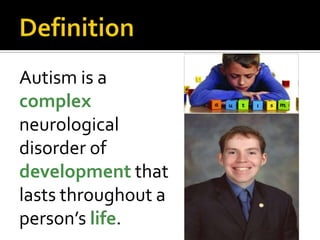
Autism is a
complex
neurological
disorder of
development that
lasts throughout a
person’s life.
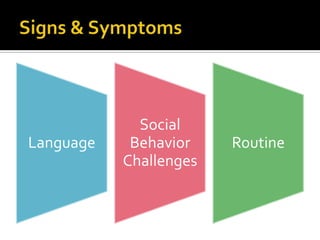
Language
Social
Behavior
Challenges
Routine
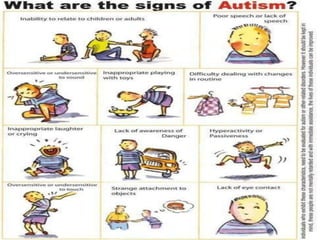
 Communication
 Verbal
▪ Not responding to his/her name
▪ Inability to explain what he/she wants
 Non-Verbal
▪ Not smiling when someone smiles at him/her
▪ Not making eye contact
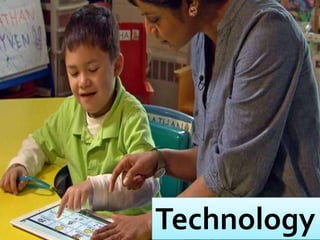
Technology
 Sharing Emotions
 Empathy
 Lack of interest in peers
 Holding a Conversation
 SpendingTime Interacting with Others
 Intense orViolentTantrums
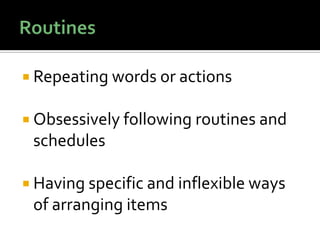
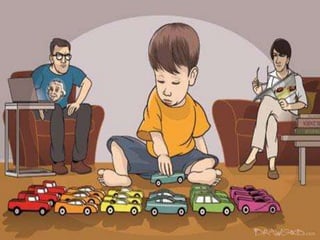
 Repeating words or actions
 Obsessively following routines and
schedules
 Having specific and inflexible ways
of arranging items
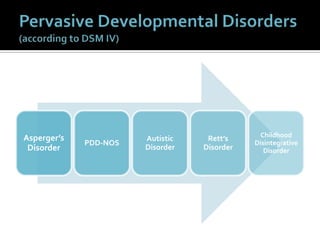
Spectrum
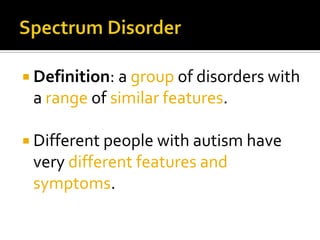
 Definition: a group of disorders with
a range of similar features.
 Different people with autism have
very different features and
symptoms.
Asperger’s
Disorder
PDD-NOS
Autistic
Disorder
Rett’s
Disorder
Childhood
Disintegrative
Disorder
 People withAsperger’s Syndrome have
similar problems as those with autism. These
problems often arise in the areas of social
interaction and communication.
 People with Asperger’s Syndrome are
generally considered to have normal
intelligence and verbal skills, unlike many
people with autism.
 Obsessions are incredibly common among
people with Asperger’s Syndrome.
 Children withAsperger’s Syndrome are
generally able to communicate well.
However, they often have trouble
understanding non-literal language and non-
verbal communication methods.
 Pervasive Developmental Disorder –
Not Otherwise Specified
 “Atypical autism”
 Symptoms may manifest later in life or be slightly
different from that of autism.
 Often, but not always, PDD-NOS symptoms
are milder than autism symptoms.
 No official cure
 BUT, many children with ASDs progress to
the point that they do not show symptoms of
the full syndrome as adults.
 Early diagnosis and interventions have a
strong positive effect on later skills and
symptoms.
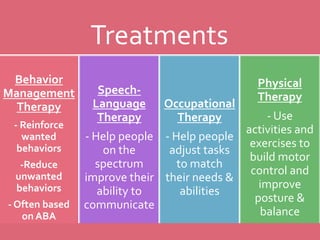
Treatments
Behavior
Management
Therapy
- Reinforce
wanted
behaviors
-Reduce
unwanted
behaviors
- Often based
on ABA
Speech-
Language
Therapy
- Help people
on the
spectrum
improve their
ability to
communicate
Occupational
Therapy
- Help people
adjust tasks
to match
their needs &
abilities
Physical
Therapy
- Use
activities and
exercises to
build motor
control and
improve
posture &
balance
 Public schools must provide free, appropriate
education from age 3 through high school or
age 21.
 Typically, students with ASDs will receive
support from a team of people who create an
Individualized Education Plan (IEP) to help
guide the child’s school experiences.
 All images from Google Images.
 Information paraphrased from Marc
Lombardy, Psy.D.

Autism

  • 1.
  • 2.
    Autism is a complex neurological disorderof development that lasts throughout a person’s life.
  • 4.
  • 5.
     Communication  Verbal ▪Not responding to his/her name ▪ Inability to explain what he/she wants  Non-Verbal ▪ Not smiling when someone smiles at him/her ▪ Not making eye contact
  • 7.
  • 8.
     Sharing Emotions Empathy  Lack of interest in peers  Holding a Conversation  SpendingTime Interacting with Others  Intense orViolentTantrums
  • 9.
     Repeating wordsor actions  Obsessively following routines and schedules  Having specific and inflexible ways of arranging items
  • 11.
  • 12.
     Definition: agroup of disorders with a range of similar features.  Different people with autism have very different features and symptoms.
  • 13.
  • 14.
     People withAsperger’sSyndrome have similar problems as those with autism. These problems often arise in the areas of social interaction and communication.  People with Asperger’s Syndrome are generally considered to have normal intelligence and verbal skills, unlike many people with autism.
  • 15.
     Obsessions areincredibly common among people with Asperger’s Syndrome.  Children withAsperger’s Syndrome are generally able to communicate well. However, they often have trouble understanding non-literal language and non- verbal communication methods.
  • 16.
     Pervasive DevelopmentalDisorder – Not Otherwise Specified  “Atypical autism”  Symptoms may manifest later in life or be slightly different from that of autism.  Often, but not always, PDD-NOS symptoms are milder than autism symptoms.
  • 17.
     No officialcure  BUT, many children with ASDs progress to the point that they do not show symptoms of the full syndrome as adults.  Early diagnosis and interventions have a strong positive effect on later skills and symptoms.
  • 18.
    Treatments Behavior Management Therapy - Reinforce wanted behaviors -Reduce unwanted behaviors - Oftenbased on ABA Speech- Language Therapy - Help people on the spectrum improve their ability to communicate Occupational Therapy - Help people adjust tasks to match their needs & abilities Physical Therapy - Use activities and exercises to build motor control and improve posture & balance
  • 19.
     Public schoolsmust provide free, appropriate education from age 3 through high school or age 21.  Typically, students with ASDs will receive support from a team of people who create an Individualized Education Plan (IEP) to help guide the child’s school experiences.
  • 21.
     All imagesfrom Google Images.  Information paraphrased from Marc Lombardy, Psy.D.