

PERVASIVE DEVELOPMENTAL
DISORDERS
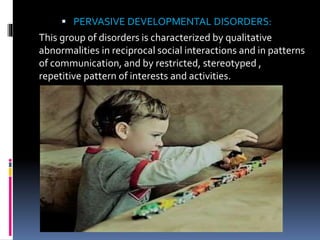
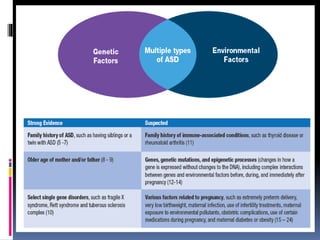
 PERVASIVE DEVELOPMENTAL DISORDERS:
This group of disorders is characterized by qualitative
abnormalities in reciprocal social interactions and in patterns
of communication, and by restricted, stereotyped ,
repetitive pattern of interests and activities.
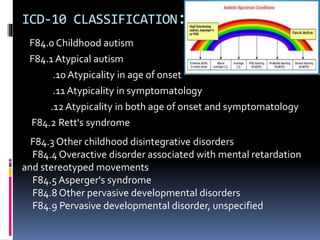
ICD-10 CLASSIFICATION:
F84.0 Childhood autism
F84.1 Atypical autism
.10 Atypicality in age of onset
.11 Atypicality in symptomatology
.12Atypicality in both age of onset and symptomatology
F84.2 Rett's syndrome
F84.3 Other childhood disintegrative disorders
F84.4 Overactive disorder associated with mental retardation
and stereotyped movements
F84.5 Asperger's syndrome
F84.8 Other pervasive developmental disorders
F84.9 Pervasive developmental disorder, unspecified
CHILDHOOD AUTISM
 Derived from autismus – to lose relationship with
external world and lead a life of one’s own world.
 Defined by the presence of abnormal
development that is manifested before the age of
3 years.
 Diagnostic guidelines:
 A) abnormal or impaired development before the age of 3
years in at least one of the following areas:
1) receptive/expressive language as used in social
communication.
2)Development of selective social interactions
3)Functional play
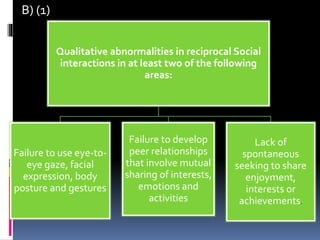
B) (1)
Qualitative abnormalities in reciprocal Social
interactions in at least two of the following
areas:
Failure to use eye-to-
eye gaze, facial
expression, body
posture and gestures
Failure to develop
peer relationships
that involve mutual
sharing of interests,
emotions and
activities
Lack of
spontaneous
seeking to share
enjoyment,
interests or
achievements.
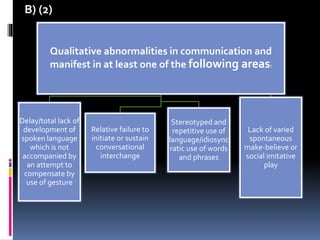
Qualitative abnormalities in communication and
manifest in at least one of the following areas:
Delay/total lack of
development of
spoken language
which is not
accompanied by
an attempt to
compensate by
use of gesture
Relative failure to
initiate or sustain
conversational
interchange
Stereotyped and
repetitive use of
language/idiosync
ratic use of words
and phrases
Lack of varied
spontaneous
make-believe or
social imitative
play
B) (2)
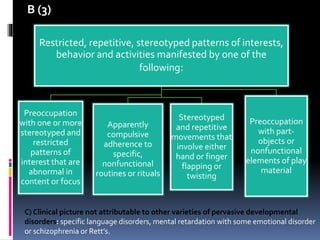
Restricted, repetitive, stereotyped patterns of interests,
behavior and activities manifested by one of the
following:
Preoccupation
with one or more
stereotyped and
restricted
patterns of
interest that are
abnormal in
content or focus
Apparently
compulsive
adherence to
specific,
nonfunctional
routines or rituals
Stereotyped
and repetitive
movements that
involve either
hand or finger
flapping or
twisting
Preoccupation
with part-
objects or
nonfunctional
elements of play
material
B (3)
C) Clinical picture not attributable to other varieties of pervasive developmental
disorders: specific language disorders, mental retardation with some emotional disorder
or schizophrenia or Rett’s.
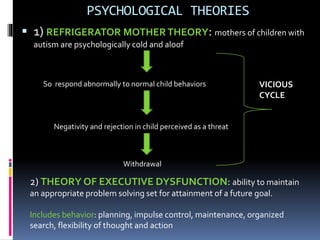
PSYCHOLOGICAL THEORIES
 1) REFRIGERATOR MOTHERTHEORY: mothers of children with
autism are psychologically cold and aloof
So respond abnormally to normal child behaviors
Negativity and rejection in child perceived as a threat
Withdrawal
VICIOUS
CYCLE
2) THEORY OF EXECUTIVE DYSFUNCTION: ability to maintain
an appropriate problem solving set for attainment of a future goal.
Includes behavior: planning, impulse control, maintenance, organized
search, flexibility of thought and action
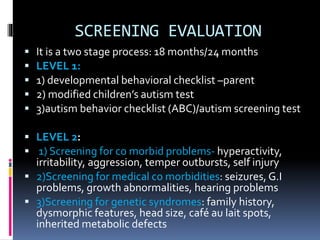
SCREENING EVALUATION
 It is a two stage process: 18 months/24 months
 LEVEL 1:
 1) developmental behavioral checklist –parent
 2) modified children’s autism test
 3)autism behavior checklist (ABC)/autism screening test
 LEVEL 2:
 1) Screening for co morbid problems- hyperactivity,
irritability, aggression, temper outbursts, self injury
 2)Screening for medical co morbidities: seizures, G.I
problems, growth abnormalities, hearing problems
 3)Screening for genetic syndromes: family history,
dysmorphic features, head size, café au lait spots,
inherited metabolic defects
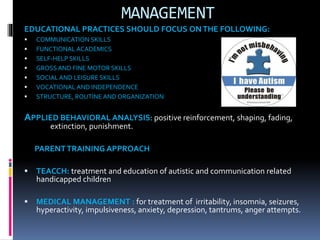
MANAGEMENT
EDUCATIONAL PRACTICES SHOULD FOCUS ONTHE FOLLOWING:
 COMMUNICATION SKILLS
 FUNCTIONAL ACADEMICS
 SELF-HELP SKILLS
 GROSSAND FINE MOTOR SKILLS
 SOCIALAND LEISURE SKILLS
 VOCATIONAL AND INDEPENDENCE
 STRUCTURE, ROUTINE AND ORGANIZATION
APPLIED BEHAVIORAL ANALYSIS: positive reinforcement, shaping, fading,
extinction, punishment.
PARENTTRAINING APPROACH
 TEACCH: treatment and education of autistic and communication related
handicapped children
 MEDICAL MANAGEMENT : for treatment of irritability, insomnia, seizures,
hyperactivity, impulsiveness, anxiety, depression, tantrums, anger attempts.
1. OCCUPATIONAL THERAPY: helps improve independent
function and teaches basic skills( buttoning a shirt, bathing)
2. PHYSICALTHERAPY: involves using exercise and other
physical measures to control body movements
3. PLAYTHERAPY: it is a behavior modification that is used to
improve emotional development, which in turn, improves
social skills and learning.
4. SOCIAL STORIES: can also be used to improve
underdeveloped social skills
5. SPEECHTHERAPY: may be used to help patients gain the
ability to speak
6. PICTURE EXCHANGE COMMUNICATION SYSTEMS (PECS) :
enable the patients to communicate using pictures that
represent ideas, activities or items.
7. COGNITIVE BEHAVIORTHERAPY
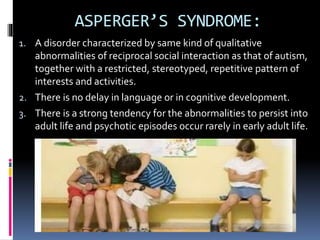
ASPERGER’S SYNDROME:
1. A disorder characterized by same kind of qualitative
abnormalities of reciprocal social interaction as that of autism,
together with a restricted, stereotyped, repetitive pattern of
interests and activities.
2. There is no delay in language or in cognitive development.
3. There is a strong tendency for the abnormalities to persist into
adult life and psychotic episodes occur rarely in early adult life.
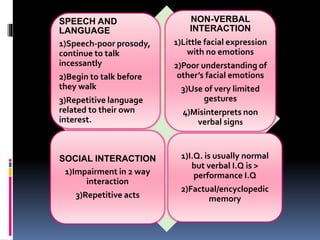
SPEECH AND
LANGUAGE
1)Speech-poor prosody,
continue to talk
incessantly
2)Begin to talk before
they walk
3)Repetitive language
related to their own
interest.
NON-VERBAL
INTERACTION
1)Little facial expression
with no emotions
2)Poor understanding of
other’s facial emotions
3)Use of very limited
gestures
4)Misinterprets non
verbal signs
SOCIAL INTERACTION
1)Impairment in 2 way
interaction
3)Repetitive acts
1)I.Q. is usually normal
but verbal I.Q is >
performance I.Q
2)Factual/encyclopedic
memory
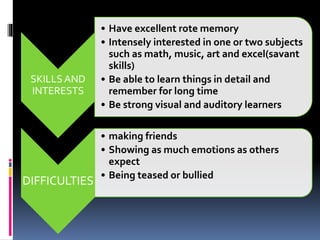
SKILLS AND
INTERESTS
• Have excellent rote memory
• Intensely interested in one or two subjects
such as math, music, art and excel(savant
skills)
• Be able to learn things in detail and
remember for long time
• Be strong visual and auditory learners
DIFFICULTIES
• making friends
• Showing as much emotions as others
expect
• Being teased or bullied
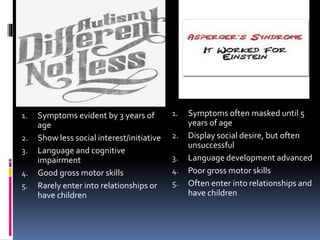
1. Symptoms evident by 3 years of
age
2. Show less social interest/initiative
3. Language and cognitive
impairment
4. Good gross motor skills
5. Rarely enter into relationships or
have children
1. Symptoms often masked until 5
years of age
2. Display social desire, but often
unsuccessful
3. Language development advanced
4. Poor gross motor skills
5. Often enter into relationships and
have children
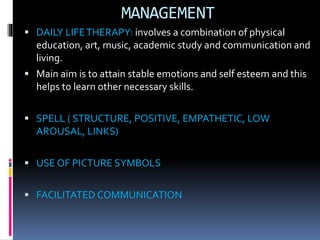
MANAGEMENT
 DAILY LIFETHERAPY: involves a combination of physical
education, art, music, academic study and communication and
living.
 Main aim is to attain stable emotions and self esteem and this
helps to learn other necessary skills.
 SPELL ( STRUCTURE, POSITIVE, EMPATHETIC, LOW
AROUSAL, LINKS)
 USE OF PICTURE SYMBOLS
 FACILITATED COMMUNICATION
RETT’S SYNDROME
 Has been reported only in girls
 Studies show mutation of the MECP 2 gene on x-chromosome
can cause rett’s ( though itself is not diagnostic)
 It is a neuro developmental disorder characterized by normal
early development up to 5 months of age which is followed by
1. deceleration of head and brain growth between 5mon-4 yrs
2. loss of acquired purposeful hand skills
3. Poorly coordinated unstable gait and trunk movements
4. Stereotyped midline hand movements
5. Concurrent communication dysfunction and impaired social
interactions
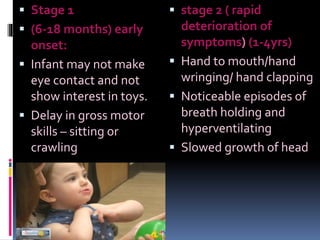
 Stage 1
 (6-18 months) early
onset:
 Infant may not make
eye contact and not
show interest in toys.
 Delay in gross motor
skills – sitting or
crawling
 stage 2 ( rapid
deterioration of
symptoms) (1-4yrs)
 Hand to mouth/hand
wringing/ hand clapping
 Noticeable episodes of
breath holding and
hyperventilating
 Slowed growth of head
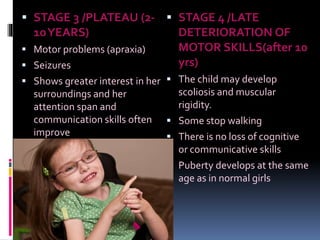
 STAGE 3 /PLATEAU (2-
10YEARS)
 Motor problems (apraxia)
 Seizures
 Shows greater interest in her
surroundings and her
attention span and
communication skills often
improve
 STAGE 4 /LATE
DETERIORATION OF
MOTOR SKILLS(after 10
yrs)
 The child may develop
scoliosis and muscular
rigidity.
 Some stop walking
 There is no loss of cognitive
or communicative skills
 Puberty develops at the same
age as in normal girls
MANAGEMENT
 There is no cure for rett
syndrome.
 Symptomatic treatment
requiring multidisciplinary
approach
MEDICAL MANAGEMENT
 Breathing irregularities
 Motor difficulties
 Anti-epileptics for seizures.
 Regular monitoring for scoliosis
and possible heart abnormalities.
 Braces, splints
OCCUPATIONALTHERAPY
 Train in dressing, feeding,
practicing arts and crafts
 Physiotherapy
 hydrotherapy
 Academic social and vocational
services
 Adequate nutrition for
maintaining adequate weight
ATYPICAL
AUTISM
 Atypicality in age
of onset:
 does not meet
criteria A( evident
> 3 years)
 Meets criteria B
and C
 Atypicality in
symptomatology:
 meets criteria A
 Meets criteria C
 Does not fully
meet criteria B
 Atypicality in
both onset and
symptomatology
OTHER CHILDHOOD DISINTEGRATIVE DISORDERS:
DIAGNOSTIC CRITERIA:
A) development apparently normal up to age of at least 2 years.
B) Definite loss of previously acquired skills at the time of onset of disorder.
C) Qualitatively abnormal social functioning
D) Disorder not attributable to the other varieties of pervasive
developmental disorder- schizophrenia, acquired aphasia, elective mutism
REFERENCES
1) National institute of neurological disorder and
stroke-
http://www.ninds-
nih.gov/disorders/rett/detail_rett.html
2) Indian pediatrics –vol 31
3) centre for disease control and prevention-
http://www.cdc.gov/ncbddd/autism
4) kaplan and saddock’s textbook of psychiatry
5) Diagnostic and statistical manual – 5 th edition
6) https://www.ncbi.nlm.nih.gov/pmc/
Pervasive developmental disorders

Pervasive developmental disorders

  • 1.
  • 2.
     PERVASIVE DEVELOPMENTALDISORDERS: This group of disorders is characterized by qualitative abnormalities in reciprocal social interactions and in patterns of communication, and by restricted, stereotyped , repetitive pattern of interests and activities.
  • 3.
    ICD-10 CLASSIFICATION: F84.0 Childhoodautism F84.1 Atypical autism .10 Atypicality in age of onset .11 Atypicality in symptomatology .12Atypicality in both age of onset and symptomatology F84.2 Rett's syndrome F84.3 Other childhood disintegrative disorders F84.4 Overactive disorder associated with mental retardation and stereotyped movements F84.5 Asperger's syndrome F84.8 Other pervasive developmental disorders F84.9 Pervasive developmental disorder, unspecified
  • 4.
    CHILDHOOD AUTISM  Derivedfrom autismus – to lose relationship with external world and lead a life of one’s own world.  Defined by the presence of abnormal development that is manifested before the age of 3 years.  Diagnostic guidelines:  A) abnormal or impaired development before the age of 3 years in at least one of the following areas: 1) receptive/expressive language as used in social communication. 2)Development of selective social interactions 3)Functional play
  • 5.
    B) (1) Qualitative abnormalitiesin reciprocal Social interactions in at least two of the following areas: Failure to use eye-to- eye gaze, facial expression, body posture and gestures Failure to develop peer relationships that involve mutual sharing of interests, emotions and activities Lack of spontaneous seeking to share enjoyment, interests or achievements.
  • 6.
    Qualitative abnormalities incommunication and manifest in at least one of the following areas: Delay/total lack of development of spoken language which is not accompanied by an attempt to compensate by use of gesture Relative failure to initiate or sustain conversational interchange Stereotyped and repetitive use of language/idiosync ratic use of words and phrases Lack of varied spontaneous make-believe or social imitative play B) (2)
  • 7.
    Restricted, repetitive, stereotypedpatterns of interests, behavior and activities manifested by one of the following: Preoccupation with one or more stereotyped and restricted patterns of interest that are abnormal in content or focus Apparently compulsive adherence to specific, nonfunctional routines or rituals Stereotyped and repetitive movements that involve either hand or finger flapping or twisting Preoccupation with part- objects or nonfunctional elements of play material B (3) C) Clinical picture not attributable to other varieties of pervasive developmental disorders: specific language disorders, mental retardation with some emotional disorder or schizophrenia or Rett’s.
  • 10.
    PSYCHOLOGICAL THEORIES  1)REFRIGERATOR MOTHERTHEORY: mothers of children with autism are psychologically cold and aloof So respond abnormally to normal child behaviors Negativity and rejection in child perceived as a threat Withdrawal VICIOUS CYCLE 2) THEORY OF EXECUTIVE DYSFUNCTION: ability to maintain an appropriate problem solving set for attainment of a future goal. Includes behavior: planning, impulse control, maintenance, organized search, flexibility of thought and action
  • 11.
    SCREENING EVALUATION  Itis a two stage process: 18 months/24 months  LEVEL 1:  1) developmental behavioral checklist –parent  2) modified children’s autism test  3)autism behavior checklist (ABC)/autism screening test  LEVEL 2:  1) Screening for co morbid problems- hyperactivity, irritability, aggression, temper outbursts, self injury  2)Screening for medical co morbidities: seizures, G.I problems, growth abnormalities, hearing problems  3)Screening for genetic syndromes: family history, dysmorphic features, head size, café au lait spots, inherited metabolic defects
  • 12.
    MANAGEMENT EDUCATIONAL PRACTICES SHOULDFOCUS ONTHE FOLLOWING:  COMMUNICATION SKILLS  FUNCTIONAL ACADEMICS  SELF-HELP SKILLS  GROSSAND FINE MOTOR SKILLS  SOCIALAND LEISURE SKILLS  VOCATIONAL AND INDEPENDENCE  STRUCTURE, ROUTINE AND ORGANIZATION APPLIED BEHAVIORAL ANALYSIS: positive reinforcement, shaping, fading, extinction, punishment. PARENTTRAINING APPROACH  TEACCH: treatment and education of autistic and communication related handicapped children  MEDICAL MANAGEMENT : for treatment of irritability, insomnia, seizures, hyperactivity, impulsiveness, anxiety, depression, tantrums, anger attempts.
  • 13.
    1. OCCUPATIONAL THERAPY:helps improve independent function and teaches basic skills( buttoning a shirt, bathing) 2. PHYSICALTHERAPY: involves using exercise and other physical measures to control body movements 3. PLAYTHERAPY: it is a behavior modification that is used to improve emotional development, which in turn, improves social skills and learning. 4. SOCIAL STORIES: can also be used to improve underdeveloped social skills 5. SPEECHTHERAPY: may be used to help patients gain the ability to speak 6. PICTURE EXCHANGE COMMUNICATION SYSTEMS (PECS) : enable the patients to communicate using pictures that represent ideas, activities or items. 7. COGNITIVE BEHAVIORTHERAPY
  • 15.
    ASPERGER’S SYNDROME: 1. Adisorder characterized by same kind of qualitative abnormalities of reciprocal social interaction as that of autism, together with a restricted, stereotyped, repetitive pattern of interests and activities. 2. There is no delay in language or in cognitive development. 3. There is a strong tendency for the abnormalities to persist into adult life and psychotic episodes occur rarely in early adult life.
  • 16.
    SPEECH AND LANGUAGE 1)Speech-poor prosody, continueto talk incessantly 2)Begin to talk before they walk 3)Repetitive language related to their own interest. NON-VERBAL INTERACTION 1)Little facial expression with no emotions 2)Poor understanding of other’s facial emotions 3)Use of very limited gestures 4)Misinterprets non verbal signs SOCIAL INTERACTION 1)Impairment in 2 way interaction 3)Repetitive acts 1)I.Q. is usually normal but verbal I.Q is > performance I.Q 2)Factual/encyclopedic memory
  • 17.
    SKILLS AND INTERESTS • Haveexcellent rote memory • Intensely interested in one or two subjects such as math, music, art and excel(savant skills) • Be able to learn things in detail and remember for long time • Be strong visual and auditory learners DIFFICULTIES • making friends • Showing as much emotions as others expect • Being teased or bullied
  • 18.
    1. Symptoms evidentby 3 years of age 2. Show less social interest/initiative 3. Language and cognitive impairment 4. Good gross motor skills 5. Rarely enter into relationships or have children 1. Symptoms often masked until 5 years of age 2. Display social desire, but often unsuccessful 3. Language development advanced 4. Poor gross motor skills 5. Often enter into relationships and have children
  • 19.
    MANAGEMENT  DAILY LIFETHERAPY:involves a combination of physical education, art, music, academic study and communication and living.  Main aim is to attain stable emotions and self esteem and this helps to learn other necessary skills.  SPELL ( STRUCTURE, POSITIVE, EMPATHETIC, LOW AROUSAL, LINKS)  USE OF PICTURE SYMBOLS  FACILITATED COMMUNICATION
  • 21.
    RETT’S SYNDROME  Hasbeen reported only in girls  Studies show mutation of the MECP 2 gene on x-chromosome can cause rett’s ( though itself is not diagnostic)  It is a neuro developmental disorder characterized by normal early development up to 5 months of age which is followed by 1. deceleration of head and brain growth between 5mon-4 yrs 2. loss of acquired purposeful hand skills 3. Poorly coordinated unstable gait and trunk movements 4. Stereotyped midline hand movements 5. Concurrent communication dysfunction and impaired social interactions
  • 22.
     Stage 1 (6-18 months) early onset:  Infant may not make eye contact and not show interest in toys.  Delay in gross motor skills – sitting or crawling  stage 2 ( rapid deterioration of symptoms) (1-4yrs)  Hand to mouth/hand wringing/ hand clapping  Noticeable episodes of breath holding and hyperventilating  Slowed growth of head
  • 23.
     STAGE 3/PLATEAU (2- 10YEARS)  Motor problems (apraxia)  Seizures  Shows greater interest in her surroundings and her attention span and communication skills often improve  STAGE 4 /LATE DETERIORATION OF MOTOR SKILLS(after 10 yrs)  The child may develop scoliosis and muscular rigidity.  Some stop walking  There is no loss of cognitive or communicative skills  Puberty develops at the same age as in normal girls
  • 24.
    MANAGEMENT  There isno cure for rett syndrome.  Symptomatic treatment requiring multidisciplinary approach MEDICAL MANAGEMENT  Breathing irregularities  Motor difficulties  Anti-epileptics for seizures.  Regular monitoring for scoliosis and possible heart abnormalities.  Braces, splints OCCUPATIONALTHERAPY  Train in dressing, feeding, practicing arts and crafts  Physiotherapy  hydrotherapy  Academic social and vocational services  Adequate nutrition for maintaining adequate weight
  • 25.
    ATYPICAL AUTISM  Atypicality inage of onset:  does not meet criteria A( evident > 3 years)  Meets criteria B and C  Atypicality in symptomatology:  meets criteria A  Meets criteria C  Does not fully meet criteria B  Atypicality in both onset and symptomatology OTHER CHILDHOOD DISINTEGRATIVE DISORDERS: DIAGNOSTIC CRITERIA: A) development apparently normal up to age of at least 2 years. B) Definite loss of previously acquired skills at the time of onset of disorder. C) Qualitatively abnormal social functioning D) Disorder not attributable to the other varieties of pervasive developmental disorder- schizophrenia, acquired aphasia, elective mutism
  • 26.
    REFERENCES 1) National instituteof neurological disorder and stroke- http://www.ninds- nih.gov/disorders/rett/detail_rett.html 2) Indian pediatrics –vol 31 3) centre for disease control and prevention- http://www.cdc.gov/ncbddd/autism 4) kaplan and saddock’s textbook of psychiatry 5) Diagnostic and statistical manual – 5 th edition 6) https://www.ncbi.nlm.nih.gov/pmc/