Program Evaluation and Review
Technique (PERT)
PERT, IT Project Management
1
Faculty Coordinator: Dr. Vibha V
BMS College of Engineering
Program Evaluation and Review Technique
(PERT)
 PERT is a network analysis technique used to estimate project duration
when there is a high degree of uncertainty about the individual activity
duration estimates
 PERT uses probabilistic time estimates
 Duration estimates based on using optimistic, most likely, and pessimistic
estimates of activity durations, or a three-point estimate
 PERT attempts to address the risk associated with duration estimates by
developing schedules that are more realistic
It involves more work than CPM since it requires several
duration estimates
PERT, IT Project Management 2
Program or Project Evaluation
and Review
Technique(PERT)
PERT, IT Project Management 3
CPM / PERT
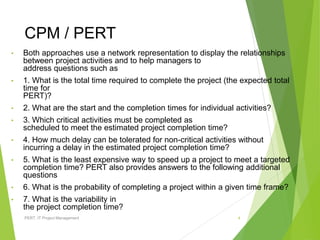
• Both approaches use a network representation to display the relationships
between project activities and to help managers to
address questions such as
• 1. What is the total time required to complete the project (the expected total
time for
PERT)?
• 2. What are the start and the completion times for individual activities?
• 3. Which critical activities must be completed as
scheduled to meet the estimated project completion time?
• 4. How much delay can be tolerated for non-critical activities without
incurring a delay in the estimated project completion time?
• 5. What is the least expensive way to speed up a project to meet a targeted
completion time? PERT also provides answers to the following additional
questions
• 6. What is the probability of completing a project within a given time frame?
• 7. What is the variability in
the project completion time?
PERT, IT Project Management 4
PERT Formula and Example
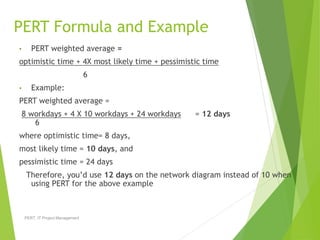
• PERT weighted average =
optimistic time + 4X most likely time + pessimistic time
6
• Example:
PERT weighted average =
8 workdays + 4 X 10 workdays + 24 workdays = 12 days
6
where optimistic time= 8 days,
most likely time = 10 days, and
pessimistic time = 24 days
Therefore, you’d use 12 days on the network diagram instead of 10 when
using PERT for the above example
PERT, IT Project Management 5
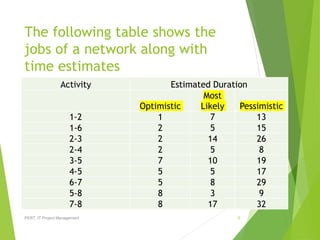
The following table shows the
jobs of a network along with
time estimates
Activity Estimated Duration
Optimistic
Most
Likely Pessimistic
1-2 1 7 13
1-6 2 5 15
2-3 2 14 26
2-4 2 5 8
3-5 7 10 19
4-5 5 5 17
6-7 5 8 29
5-8 8 3 9
7-8 8 17 32
PERT, IT Project Management 6
Task
 Draw Project Network
 Find the expected time and variance of each activity
 Calculate the earliest and latest occurrences of each event
 Calculate expected project length
 Calculate variance and standard deviations of project length
 Fine the probability of the project completing in 40 units of time.
PERT, IT Project Management 7
Estimated activity time
(To+4Tm+Tp)/6
Activity Estimated Duration
Optimist
ic
Most
Likely
Pessimi
stic Te
1-2 1 7 13 7
1-6 2 5 15 6
2-3 2 14 26 14
2-4 2 5 8 5
3-5 7 10 19 11
4-5 5 5 17 7
6-7 5 8 29 11
5-8 8 3 9 5
7-8 8 17 32 18
PERT, IT Project Management 8
Draw the network diagram
PERT, IT Project Management 9
1
2 5
6
3
4
7
8
PERT, IT Project Management 10
PERT, IT Project Management 11

PERT

  • 1.
    Program Evaluation andReview Technique (PERT) PERT, IT Project Management 1 Faculty Coordinator: Dr. Vibha V BMS College of Engineering
  • 2.
    Program Evaluation andReview Technique (PERT)  PERT is a network analysis technique used to estimate project duration when there is a high degree of uncertainty about the individual activity duration estimates  PERT uses probabilistic time estimates  Duration estimates based on using optimistic, most likely, and pessimistic estimates of activity durations, or a three-point estimate  PERT attempts to address the risk associated with duration estimates by developing schedules that are more realistic It involves more work than CPM since it requires several duration estimates PERT, IT Project Management 2
  • 3.
    Program or ProjectEvaluation and Review Technique(PERT) PERT, IT Project Management 3
  • 4.
    CPM / PERT •Both approaches use a network representation to display the relationships between project activities and to help managers to address questions such as • 1. What is the total time required to complete the project (the expected total time for PERT)? • 2. What are the start and the completion times for individual activities? • 3. Which critical activities must be completed as scheduled to meet the estimated project completion time? • 4. How much delay can be tolerated for non-critical activities without incurring a delay in the estimated project completion time? • 5. What is the least expensive way to speed up a project to meet a targeted completion time? PERT also provides answers to the following additional questions • 6. What is the probability of completing a project within a given time frame? • 7. What is the variability in the project completion time? PERT, IT Project Management 4
  • 5.
    PERT Formula andExample • PERT weighted average = optimistic time + 4X most likely time + pessimistic time 6 • Example: PERT weighted average = 8 workdays + 4 X 10 workdays + 24 workdays = 12 days 6 where optimistic time= 8 days, most likely time = 10 days, and pessimistic time = 24 days Therefore, you’d use 12 days on the network diagram instead of 10 when using PERT for the above example PERT, IT Project Management 5
  • 6.
    The following tableshows the jobs of a network along with time estimates Activity Estimated Duration Optimistic Most Likely Pessimistic 1-2 1 7 13 1-6 2 5 15 2-3 2 14 26 2-4 2 5 8 3-5 7 10 19 4-5 5 5 17 6-7 5 8 29 5-8 8 3 9 7-8 8 17 32 PERT, IT Project Management 6
  • 7.
    Task  Draw ProjectNetwork  Find the expected time and variance of each activity  Calculate the earliest and latest occurrences of each event  Calculate expected project length  Calculate variance and standard deviations of project length  Fine the probability of the project completing in 40 units of time. PERT, IT Project Management 7
  • 8.
    Estimated activity time (To+4Tm+Tp)/6 ActivityEstimated Duration Optimist ic Most Likely Pessimi stic Te 1-2 1 7 13 7 1-6 2 5 15 6 2-3 2 14 26 14 2-4 2 5 8 5 3-5 7 10 19 11 4-5 5 5 17 7 6-7 5 8 29 11 5-8 8 3 9 5 7-8 8 17 32 18 PERT, IT Project Management 8
  • 9.
    Draw the networkdiagram PERT, IT Project Management 9 1 2 5 6 3 4 7 8
  • 10.
    PERT, IT ProjectManagement 10
  • 11.
    PERT, IT ProjectManagement 11