The 7 Learning 
Styles 
Esther Castro and Veronica 
Nieto 
EDU 511
People are different 
People learn in different ways and it is 
important to tap the potential of each 
student in the classroom in a way that 
helps them learn. 
It is important to students to be understood 
and be taught in the way they learn so 
they can get the most out of the 
information being taught.
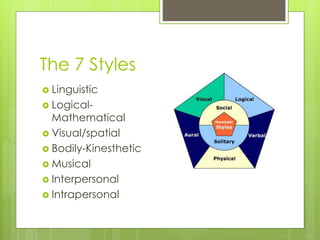
The 7 Styles 
 Linguistic 
 Logical- 
Mathematical 
 Visual/spatial 
 Bodily-Kinesthetic 
 Musical 
 Interpersonal 
 Intrapersonal
Linguistic 
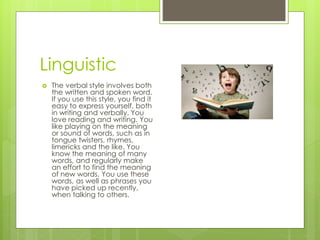
 The verbal style involves both 
the written and spoken word. 
If you use this style, you find it 
easy to express yourself, both 
in writing and verbally. You 
love reading and writing. You 
like playing on the meaning 
or sound of words, such as in 
tongue twisters, rhymes, 
limericks and the like. You 
know the meaning of many 
words, and regularly make 
an effort to find the meaning 
of new words. You use these 
words, as well as phrases you 
have picked up recently, 
when talking to others.
How to be a Linguistic learner. 
 If you are a verbal learner, try the techniques 
that involve speaking and writing. Find ways 
to incorporate more speaking and writing in 
techniques. For example, talk yourself through 
procedures in the simulator, or use recordings 
of your content for repetition. 
 Scripting is also powerful for you. You don't just 
have to write them down. Record your scripts 
using a tape or digital audio recorder (such as 
an MP3 player), and use it later for reviews. 
 Study in groups to hear what the other 
classmates have to say.
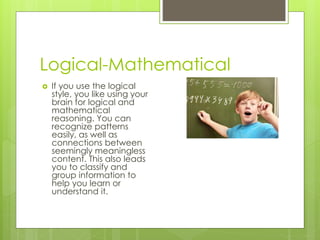
Logical-Mathematical 
 If you use the logical 
style, you like using your 
brain for logical and 
mathematical 
reasoning. You can 
recognize patterns 
easily, as well as 
connections between 
seemingly meaningless 
content. This also leads 
you to classify and 
group information to 
help you learn or 
understand it.
How to be a Logical- 
Mathematical learner. 
While you study, create and use lists by 
extracting key points from your 
material. You may also want to use 
statistics and other analysis to help you 
identify areas you may want to 
concentrate on. 
 Keep these lists on a portable device 
(iPod, tablet, etc.). 
Download Sudoku or other math 
app/games to keep your brain sharp.
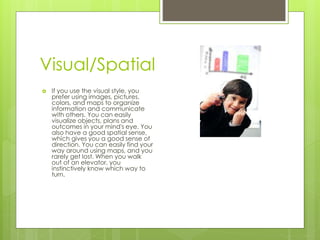
Visual/Spatial 
 If you use the visual style, you 
prefer using images, pictures, 
colors, and maps to organize 
information and communicate 
with others. You can easily 
visualize objects, plans and 
outcomes in your mind's eye. You 
also have a good spatial sense, 
which gives you a good sense of 
direction. You can easily find your 
way around using maps, and you 
rarely get lost. When you walk 
out of an elevator, you 
instinctively know which way to 
turn.
How to be a Visual/Spatial 
learner. 
 Some students rely upon a visual learning style: "Show me and 
I'll understand." Visual learners benefit from diagrams, charts, 
pictures, films, and written directions. 
 Whiteboards are a favorite of the visual learner. 
 Most computers have operating systems that enable the 
student to make diagrams and graphs. 
 With the use of your cell phone or other device a student can 
take a picture and then email it to themselves for later review. 
 Watch youtube videos to see how things are done. Or even 
watch the videos of many different people teaching 
something so that you can visualize it in many different ways.
Bodily-Kinesthetic 
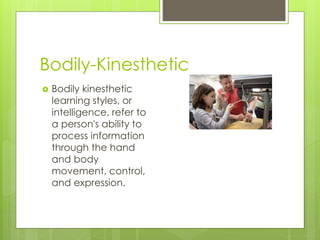
 Bodily kinesthetic 
learning styles, or 
intelligence, refer to 
a person's ability to 
process information 
through the hand 
and body 
movement, control, 
and expression.
How to be a Bodily-Kinesthetic 
learner. 
Use physical objects as much as 
possible. Physically touch objects as 
you learn about what they do. 
Flashcards can help you memorize 
information because you can touch 
and move them around. 
Use an athletic game to learn and 
score points as you go. 
 Find an interactive video game to 
learn information.
Aural- Musical 
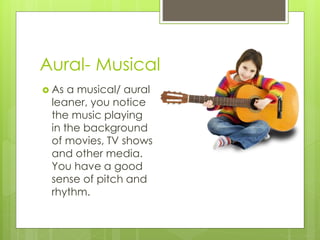
 As a musical/ aural 
leaner, you notice 
the music playing 
in the background 
of movies, TV shows 
and other media. 
You have a good 
sense of pitch and 
rhythm.
How to be a Musical learner. 
 Use sound recordings to provide a background 
and help you get into visualizations. For example, 
use a recording of an aircraft engine running 
normally, playing loudly via a headset, to practice 
flight procedures. Use a recording of the sound of 
wind and water when practicing sailing routines. 
 The internet is full of sound bytes and clips to help 
you make mnemonics. 
 Keep music that either gets you pumped up for a 
project or calms you down before a test on your 
mp3 player.
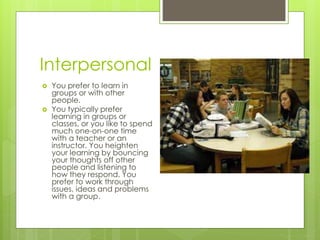
Interpersonal 
 You prefer to learn in 
groups or with other 
people. 
 You typically prefer 
learning in groups or 
classes, or you like to spend 
much one-on-one time 
with a teacher or an 
instructor. You heighten 
your learning by bouncing 
your thoughts off other 
people and listening to 
how they respond. You 
prefer to work through 
issues, ideas and problems 
with a group.
How to be an Interpersonal 
learner. 
 Utilize chat groups or other areas on the 
web where students can bounce ideas 
off each other. 
 Aim to work with others as often as 
possible/attend study groups.
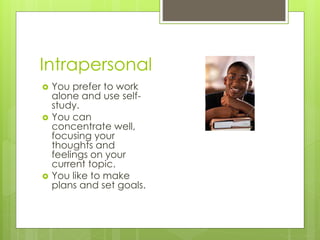
Intrapersonal 
 You prefer to work 
alone and use self-study. 
 You can 
concentrate well, 
focusing your 
thoughts and 
feelings on your 
current topic. 
 You like to make 
plans and set goals.
How to be an Intrapersonal 
learner. 
 Keep a log or journal. Input info into your 
laptop or iPad to keep your notes. 
 Always have your study material (or iPad, 
laptop, etc) nearby for when you want to 
be alone and study. 
 Many novelists are intrapersonal learners 
and like to work on their own and 
formulate their own ideas.
References: 
 Farwell, T. (2011). Visual, auditory, kinesthetic learners. Retrieved Nov.27,2012 from 
http://school.familyeducation.com/intelligence/teaching-methods/38519.html 
 
 Hutton, S. (2011). Helping Auditory Learners Succeed. Retrieved Nov.27,2012 from 
http://www.education.com/magazine/article/auditory_learners/html 
 
 Hutton, S. (2011). Helping Visual Learners Succeed. Retrieved Nov.27,2012 from 
http://www.education.com/magazine/article/Helping_visual_learners/html 
 
 Logsdon, A. (2011). Bodily Kinesthetic Learning Style-Understanding Bodily Kinesthetic 
Learner. Retrieved Nov. 27, 2012 from 
http://learningdisabilities.about.com/od/resourcesresearch/qt/Bodily_kinesthe.html 
 Free Learning Styles Inventory. Retrieved Nov. 27, 2012 from http://www.learning-styles-online. 
com/overview/html 
 
 Silverman, L., Freed, J. (1996). The Visual Spatial Learner. Retrieved Nov.27,2012 from 
http://www.dyslexia.com/library/silver1.html

The 7 Learning Styles

  • 1.
    The 7 Learning Styles Esther Castro and Veronica Nieto EDU 511
  • 2.
    People are different People learn in different ways and it is important to tap the potential of each student in the classroom in a way that helps them learn. It is important to students to be understood and be taught in the way they learn so they can get the most out of the information being taught.
  • 3.
    The 7 Styles  Linguistic  Logical- Mathematical  Visual/spatial  Bodily-Kinesthetic  Musical  Interpersonal  Intrapersonal
  • 4.
    Linguistic  Theverbal style involves both the written and spoken word. If you use this style, you find it easy to express yourself, both in writing and verbally. You love reading and writing. You like playing on the meaning or sound of words, such as in tongue twisters, rhymes, limericks and the like. You know the meaning of many words, and regularly make an effort to find the meaning of new words. You use these words, as well as phrases you have picked up recently, when talking to others.
  • 5.
    How to bea Linguistic learner.  If you are a verbal learner, try the techniques that involve speaking and writing. Find ways to incorporate more speaking and writing in techniques. For example, talk yourself through procedures in the simulator, or use recordings of your content for repetition.  Scripting is also powerful for you. You don't just have to write them down. Record your scripts using a tape or digital audio recorder (such as an MP3 player), and use it later for reviews.  Study in groups to hear what the other classmates have to say.
  • 6.
    Logical-Mathematical  Ifyou use the logical style, you like using your brain for logical and mathematical reasoning. You can recognize patterns easily, as well as connections between seemingly meaningless content. This also leads you to classify and group information to help you learn or understand it.
  • 7.
    How to bea Logical- Mathematical learner. While you study, create and use lists by extracting key points from your material. You may also want to use statistics and other analysis to help you identify areas you may want to concentrate on.  Keep these lists on a portable device (iPod, tablet, etc.). Download Sudoku or other math app/games to keep your brain sharp.
  • 8.
    Visual/Spatial  Ifyou use the visual style, you prefer using images, pictures, colors, and maps to organize information and communicate with others. You can easily visualize objects, plans and outcomes in your mind's eye. You also have a good spatial sense, which gives you a good sense of direction. You can easily find your way around using maps, and you rarely get lost. When you walk out of an elevator, you instinctively know which way to turn.
  • 9.
    How to bea Visual/Spatial learner.  Some students rely upon a visual learning style: "Show me and I'll understand." Visual learners benefit from diagrams, charts, pictures, films, and written directions.  Whiteboards are a favorite of the visual learner.  Most computers have operating systems that enable the student to make diagrams and graphs.  With the use of your cell phone or other device a student can take a picture and then email it to themselves for later review.  Watch youtube videos to see how things are done. Or even watch the videos of many different people teaching something so that you can visualize it in many different ways.
  • 10.
    Bodily-Kinesthetic  Bodilykinesthetic learning styles, or intelligence, refer to a person's ability to process information through the hand and body movement, control, and expression.
  • 11.
    How to bea Bodily-Kinesthetic learner. Use physical objects as much as possible. Physically touch objects as you learn about what they do. Flashcards can help you memorize information because you can touch and move them around. Use an athletic game to learn and score points as you go.  Find an interactive video game to learn information.
  • 12.
    Aural- Musical As a musical/ aural leaner, you notice the music playing in the background of movies, TV shows and other media. You have a good sense of pitch and rhythm.
  • 13.
    How to bea Musical learner.  Use sound recordings to provide a background and help you get into visualizations. For example, use a recording of an aircraft engine running normally, playing loudly via a headset, to practice flight procedures. Use a recording of the sound of wind and water when practicing sailing routines.  The internet is full of sound bytes and clips to help you make mnemonics.  Keep music that either gets you pumped up for a project or calms you down before a test on your mp3 player.
  • 14.
    Interpersonal  Youprefer to learn in groups or with other people.  You typically prefer learning in groups or classes, or you like to spend much one-on-one time with a teacher or an instructor. You heighten your learning by bouncing your thoughts off other people and listening to how they respond. You prefer to work through issues, ideas and problems with a group.
  • 15.
    How to bean Interpersonal learner.  Utilize chat groups or other areas on the web where students can bounce ideas off each other.  Aim to work with others as often as possible/attend study groups.
  • 16.
    Intrapersonal  Youprefer to work alone and use self-study.  You can concentrate well, focusing your thoughts and feelings on your current topic.  You like to make plans and set goals.
  • 17.
    How to bean Intrapersonal learner.  Keep a log or journal. Input info into your laptop or iPad to keep your notes.  Always have your study material (or iPad, laptop, etc) nearby for when you want to be alone and study.  Many novelists are intrapersonal learners and like to work on their own and formulate their own ideas.
  • 18.
    References:  Farwell,T. (2011). Visual, auditory, kinesthetic learners. Retrieved Nov.27,2012 from http://school.familyeducation.com/intelligence/teaching-methods/38519.html   Hutton, S. (2011). Helping Auditory Learners Succeed. Retrieved Nov.27,2012 from http://www.education.com/magazine/article/auditory_learners/html   Hutton, S. (2011). Helping Visual Learners Succeed. Retrieved Nov.27,2012 from http://www.education.com/magazine/article/Helping_visual_learners/html   Logsdon, A. (2011). Bodily Kinesthetic Learning Style-Understanding Bodily Kinesthetic Learner. Retrieved Nov. 27, 2012 from http://learningdisabilities.about.com/od/resourcesresearch/qt/Bodily_kinesthe.html  Free Learning Styles Inventory. Retrieved Nov. 27, 2012 from http://www.learning-styles-online. com/overview/html   Silverman, L., Freed, J. (1996). The Visual Spatial Learner. Retrieved Nov.27,2012 from http://www.dyslexia.com/library/silver1.html