
PERSONALIZED MEDICINE
Presented by-
ROHIT
R.K.S.D.College of Pharmacy,
Kaithal (Hry)
M.Pharma(Pharmaceutics)
CONTENTS
• Introduction
• Definition
• Pharmacogenetics
INTRODUCTION
• The concept of personalized medicine dates
back many hundreds of years.
• Developments in chemistry, histochemistry and
microscopy allowed scientists to begin to
understand the underlying causes of disease.
• Sequencing of the human genome at the turn of
the 21st century set in motion the
transformation of personalized medicine from
an idea to practice.
DEFINITION
The ability to offer :-
• The Right Drug
• To The Right Patient
• For The Right Disease
• At The Right Time
• With The Right Dosage
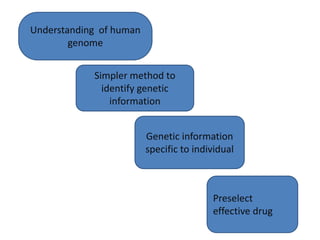
Understanding of human
genome
Simpler method to
identify genetic
information
Genetic information
specific to individual
Preselect
effective drug
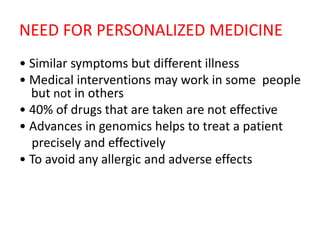
NEED FOR PERSONALIZED MEDICINE
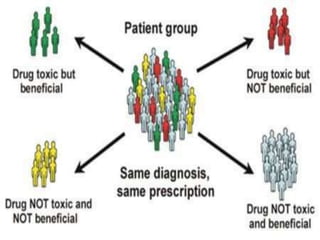
• Similar symptoms but different illness
• Medical interventions may work in some people
but not in others
• 40% of drugs that are taken are not effective
• Advances in genomics helps to treat a patient
precisely and effectively
• To avoid any allergic and adverse effects
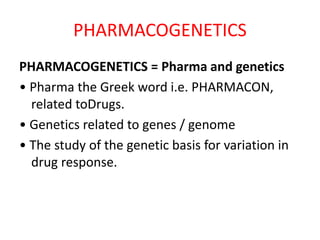
PHARMACOGENETICS
PHARMACOGENETICS = Pharma and genetics
• Pharma the Greek word i.e. PHARMACON,
related toDrugs.
• Genetics related to genes / genome
• The study of the genetic basis for variation in
drug response.
PHARMACOGENETICS VARIATIONS
May be due to :
• Single mutant gene -Genetic Polymorphism
• Polygenic influences
GENETIC POLYMORPHISMS
• When a nucleotide change is very rare, and not
present in many individuals, it is often called a
mutation.
• In contrast to mutation, genetic polymorphism are
usually consider normal variants in population. When
a specific allele occur in at least 1% of the
population, it is said to be genetic polymorphism.
• Allele -Each of two or more alternative form of a
gene that arise by mutation and are found at the
same place on chromosome.
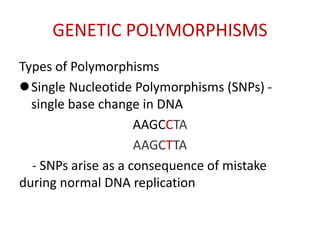
GENETIC POLYMORPHISMS
Types of Polymorphisms
Single Nucleotide Polymorphisms (SNPs) -
single base change in DNA
AAGCCTA
AAGCTTA
- SNPs arise as a consequence of mistake
during normal DNA replication
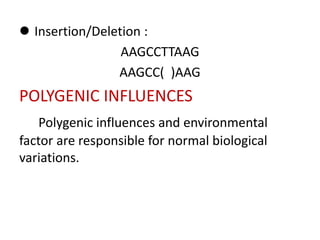
 Insertion/Deletion :
AAGCCTTAAG
AAGCC( )AAG
POLYGENIC INFLUENCES
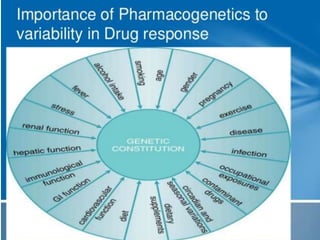
Polygenic influences and environmental
factor are responsible for normal biological
variations.
EXAMPLE OF VARIATIONS
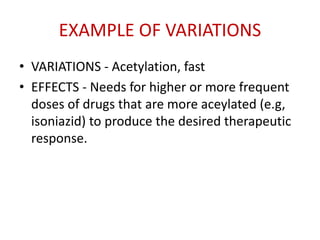
• VARIATIONS - Acetylation, fast
• EFFECTS - Needs for higher or more frequent
doses of drugs that are more aceylated (e.g,
isoniazid) to produce the desired therapeutic
response.
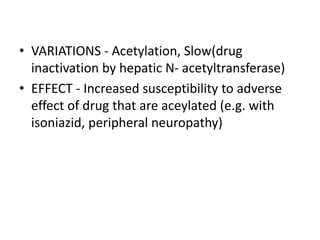
• VARIATIONS - Acetylation, Slow(drug
inactivation by hepatic N- acetyltransferase)
• EFFECT - Increased susceptibility to adverse
effect of drug that are aceylated (e.g. with
isoniazid, peripheral neuropathy)
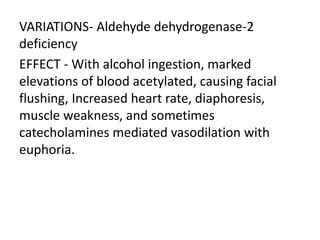
VARIATIONS- Aldehyde dehydrogenase-2
deficiency
EFFECT - With alcohol ingestion, marked
elevations of blood acetylated, causing facial
flushing, Increased heart rate, diaphoresis,
muscle weakness, and sometimes
catecholamines mediated vasodilation with
euphoria.
VARIATIONS - CYP2C9 genetic polymorphisms
EFFECTS - Reduced enzymatic activation of
clopidogeral, resulting in reduced antiplatelet
effect and increased risk of thrombosis in high
risk patient.
VARIATIONS - G6PD deficiency
EFFECT -With use of oxidant drugs, such as
certain antimalarials ( e.g. chloroquine,
primaquine ) increased risk of haemolytic
anemia.
VARIATIONS - Genetic polymorphisms of
CYP2C9 and vitamin k epoxide reductase
EFFECT - Increased action of warfarin, increased
risk of bleeding.
LIMITATIONS OF PHARMACOGENETICS
• Complex targeting due to multiple gene
involvement
• Difficult and time consuming to identify small
variations in gene
• Interaction with other drug and environment
to be determined
THANK YOU

Dosage form for Personalized medicine

  • 1.
    PERSONALIZED MEDICINE Presented by- ROHIT R.K.S.D.Collegeof Pharmacy, Kaithal (Hry) M.Pharma(Pharmaceutics)
  • 2.
  • 3.
    INTRODUCTION • The conceptof personalized medicine dates back many hundreds of years. • Developments in chemistry, histochemistry and microscopy allowed scientists to begin to understand the underlying causes of disease. • Sequencing of the human genome at the turn of the 21st century set in motion the transformation of personalized medicine from an idea to practice.
  • 4.
    DEFINITION The ability tooffer :- • The Right Drug • To The Right Patient • For The Right Disease • At The Right Time • With The Right Dosage
  • 5.
    Understanding of human genome Simplermethod to identify genetic information Genetic information specific to individual Preselect effective drug
  • 7.
    NEED FOR PERSONALIZEDMEDICINE • Similar symptoms but different illness • Medical interventions may work in some people but not in others • 40% of drugs that are taken are not effective • Advances in genomics helps to treat a patient precisely and effectively • To avoid any allergic and adverse effects
  • 8.
    PHARMACOGENETICS PHARMACOGENETICS = Pharmaand genetics • Pharma the Greek word i.e. PHARMACON, related toDrugs. • Genetics related to genes / genome • The study of the genetic basis for variation in drug response.
  • 9.
    PHARMACOGENETICS VARIATIONS May bedue to : • Single mutant gene -Genetic Polymorphism • Polygenic influences
  • 10.
    GENETIC POLYMORPHISMS • Whena nucleotide change is very rare, and not present in many individuals, it is often called a mutation. • In contrast to mutation, genetic polymorphism are usually consider normal variants in population. When a specific allele occur in at least 1% of the population, it is said to be genetic polymorphism. • Allele -Each of two or more alternative form of a gene that arise by mutation and are found at the same place on chromosome.
  • 12.
    GENETIC POLYMORPHISMS Types ofPolymorphisms Single Nucleotide Polymorphisms (SNPs) - single base change in DNA AAGCCTA AAGCTTA - SNPs arise as a consequence of mistake during normal DNA replication
  • 13.
     Insertion/Deletion : AAGCCTTAAG AAGCC()AAG POLYGENIC INFLUENCES Polygenic influences and environmental factor are responsible for normal biological variations.
  • 14.
    EXAMPLE OF VARIATIONS •VARIATIONS - Acetylation, fast • EFFECTS - Needs for higher or more frequent doses of drugs that are more aceylated (e.g, isoniazid) to produce the desired therapeutic response.
  • 15.
    • VARIATIONS -Acetylation, Slow(drug inactivation by hepatic N- acetyltransferase) • EFFECT - Increased susceptibility to adverse effect of drug that are aceylated (e.g. with isoniazid, peripheral neuropathy)
  • 16.
    VARIATIONS- Aldehyde dehydrogenase-2 deficiency EFFECT- With alcohol ingestion, marked elevations of blood acetylated, causing facial flushing, Increased heart rate, diaphoresis, muscle weakness, and sometimes catecholamines mediated vasodilation with euphoria.
  • 17.
    VARIATIONS - CYP2C9genetic polymorphisms EFFECTS - Reduced enzymatic activation of clopidogeral, resulting in reduced antiplatelet effect and increased risk of thrombosis in high risk patient.
  • 18.
    VARIATIONS - G6PDdeficiency EFFECT -With use of oxidant drugs, such as certain antimalarials ( e.g. chloroquine, primaquine ) increased risk of haemolytic anemia. VARIATIONS - Genetic polymorphisms of CYP2C9 and vitamin k epoxide reductase EFFECT - Increased action of warfarin, increased risk of bleeding.
  • 19.
    LIMITATIONS OF PHARMACOGENETICS •Complex targeting due to multiple gene involvement • Difficult and time consuming to identify small variations in gene • Interaction with other drug and environment to be determined
  • 20.