TOPIC :- Personalized medicine & Pharmacogenetics
Submitted by:-
ARAVINDA D
1st sem M pharma
Dept of pharmaceutics
V.V. Puram college of pharmacy
Bangalore-70 Submitted to:-
Dr. KALAVATHY D J
Professor dept of pharmaceutics
V.V. Puram college of pharmacy
Bangalore-70
1
CONTENTS
 INTRODUCTION
 DEFINITION
 PHARMACOGENETICS
 CATEGORIES OF PATIENTS FOR PERSONALIZED MEDICINES
2
INTRODUCTION
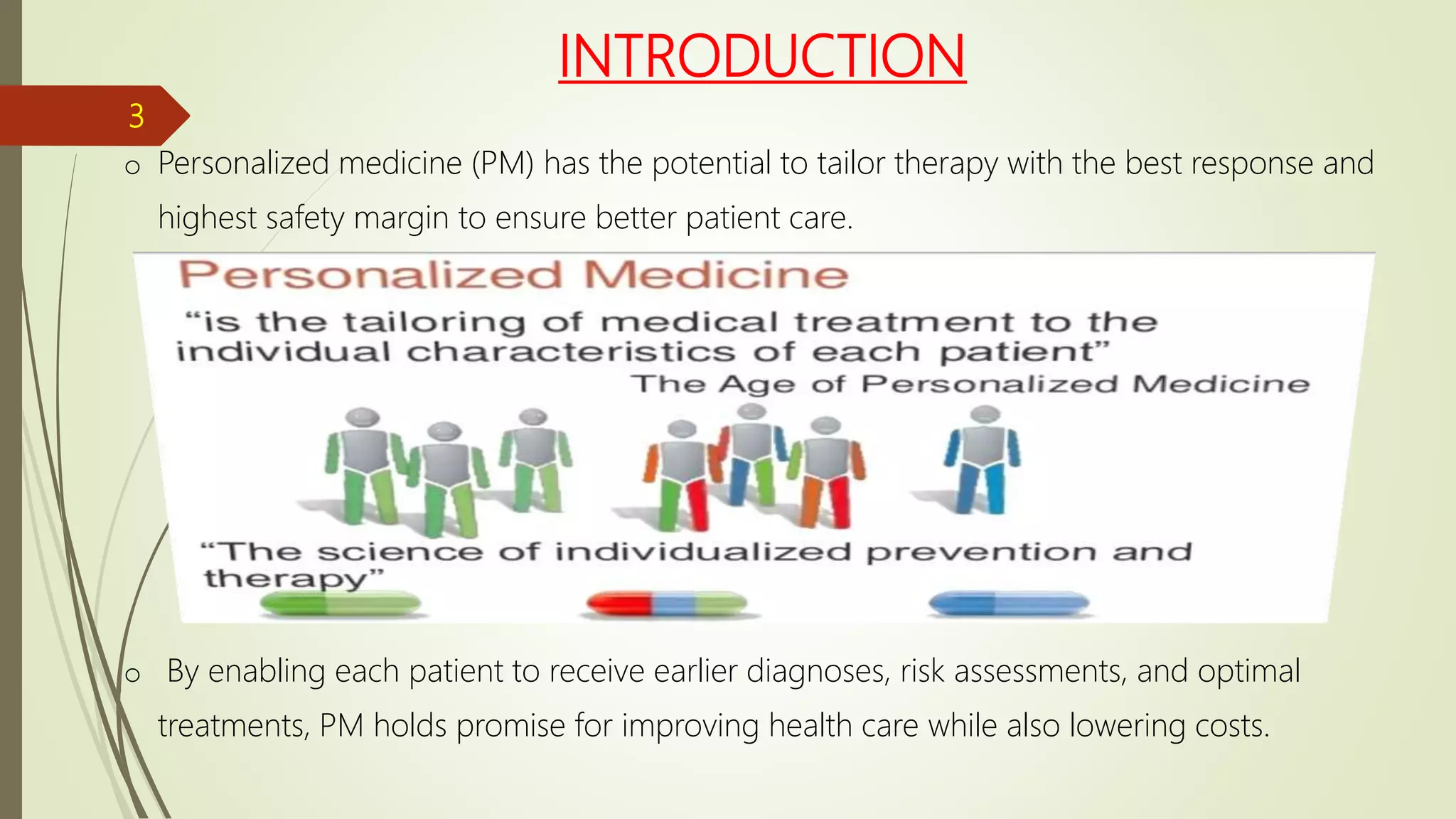
o Personalized medicine (PM) has the potential to tailor therapy with the best response and
highest safety margin to ensure better patient care.
o By enabling each patient to receive earlier diagnoses, risk assessments, and optimal
treatments, PM holds promise for improving health care while also lowering costs.
3
o PM offers a structural model for efficient health care; it is preventive, coordinated, and proven. PM
works best with a network of electronic health records that link clinical and molecular information
to make it easier to help patients and their physicians make appropriate treatment decisions.
o The goals of PM :-
 The Right Drug
 The Right Patient
 The Right Disease
 The Right Time
 The Right Dosage
o Genetic and metabolic data will allow drugs to be tailored to patient subgroups
o PM may be considered an extension of traditional approaches to understanding and
treating disease but with greater precision.
4
o Modern advances in personalized medicine rely on technology that confirms a patients
fundamental biology, DNA, RNA, or protein ,which ultimately leads to confirming disease.
o The concept of personalized medicine can be applied to new and transformative approaches
to health care.
o Personalized medicine is the study of patients' unique environmental influences as well as the
totality of their genetic code-their genome-to tailor personalized risk assessments, diagnoses,
prognoses, and treatments.
5
o It can indicate susceptibility to certain diseases before they become manifest, allowing the
physician and patient to set out a plan for monitoring and prevention.
o PM approaches are becoming “best practice” in hospitals in order to ensure that patients with
serious conditions such as “cancer” are given the optimum therapy from the start.
6
DEFINITION
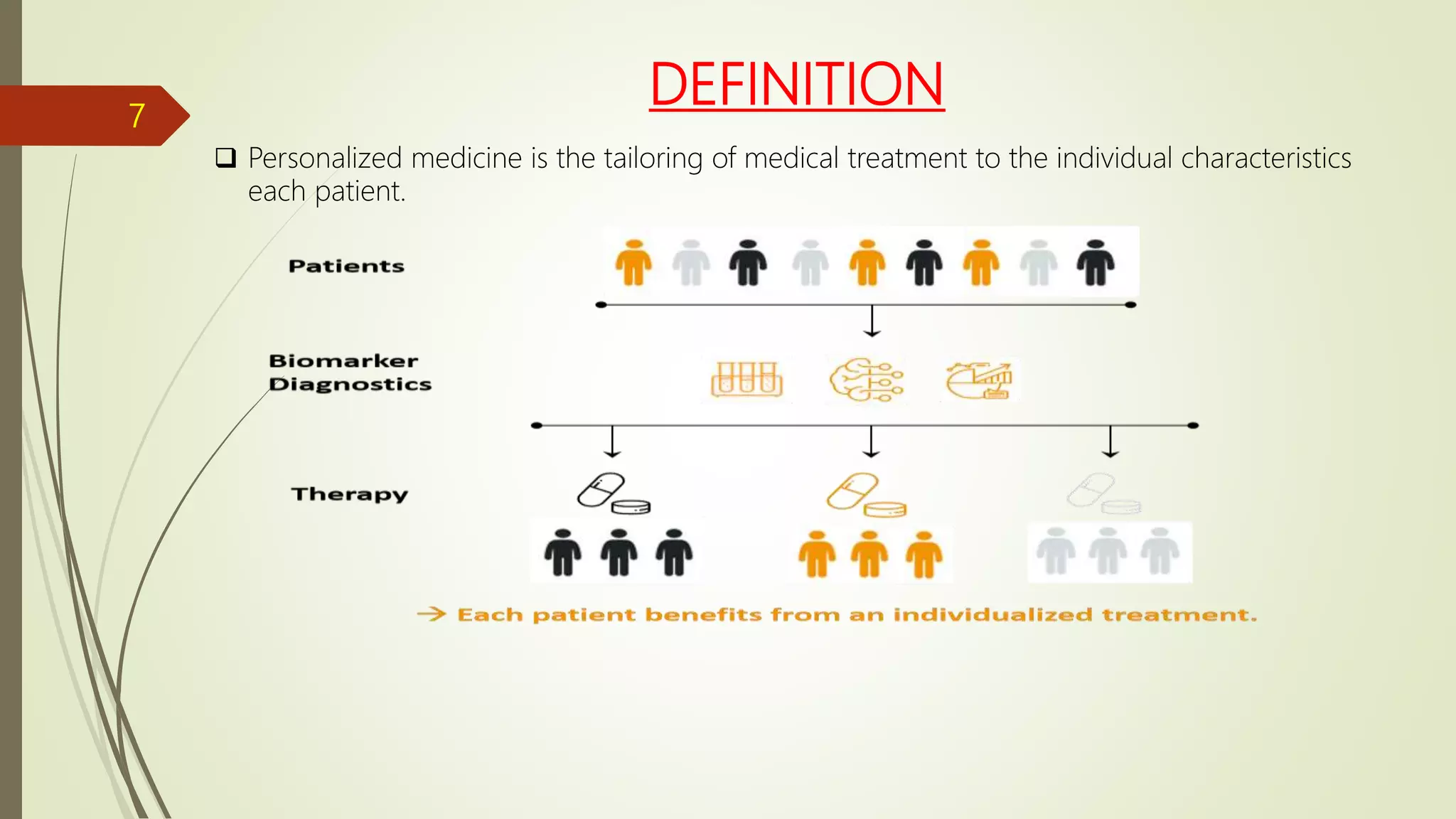
 Personalized medicine is the tailoring of medical treatment to the individual characteristics
each patient.
7
ADVANTAGES
 Directing targeted therapy and reducing trial-and-error prescribing.
 It increases the opportunity to prevent disease.
 It helps to avoid adverse drug reactions.
 Increases the treatment options.
 Improves the quality of life.
 Reveal additional or alternative uses for medicines and drug candidates.
8
DISADVANTAGES
 The response to a medication may be a result of the interactions of multiple
 Greater cost of diagnostic/biomarkers.
 It is more time consuming.
 Re education of health care professionals.
 Need to track individual health information.
9
APPLICATIONS OF PERSONALIZED MEDICINE
 Shift Emphasis in Medicine from Reaction to Prevention.
 Select Optimal Therapy.
 Make Drugs Safer.
 Increase Patient Compliance to Treatment.
 Rescue Drugs Failing Clinical Trials.
 Decreases the drug side effects.
10
PHARMACOGENETICS
 Pharmacogenetics is the study of the genetic difference in a single gene influences
variability in drug responses.
 The goal of pharmacogenetics is to individualize the drug therapy to a
person’s unique genetic makeup .
11
 PHARMACOKINETICS:-
– What the body does to the drug
– dose, dosage regimen, delivery form
– Drug fate: Absorption, distribution, metabolism, and elimination of drugs (ADME)
 Pharmacodynamics:-
– What the drug does to the body
– Biochemical and physiological effects of drugs
– mechanism of drug action
– relationship between drug concentration and effect
 Pharmacokinetics and pharmacodynamics are essential to assess the drug efficacy.
12
13
PHARMACOGENOMICS:-
 Pharmacogenomics involves study of the role of genes and their genetic variation
(DNA,RNA level) in the molecular basis of disease and therefore the resulting
pharmacologic impact of drugs on that disease.
 To determine whether a patient is a rapid or slow metabolizer,the patient is given a
known substrate for that enzyme and the patient’s intrinsic clearance is measured.
14
Pharmacogenetics and Pharmacogenomics
PHARMACOGENETIC :-
It is the study of how genetic difference in a
single gene influences variability in drug response
( efficacy and toxicity).
PHARMACOGENOMICS:-
It is the study of how genetic (genome) difference
in a multiple gene influences variability in drug response
(efficacy and toxicity).
 Pharmacogenetics and pharmacogenomics are expected to play an important role
in the development of better medicines for populations and targeted therapies
with improved benefit/risk ratios for individuals
15
GOALS OF PHARMACOGENOMIC AND PHARMACOGENETICS :-
 PK differences in different phenotypes and genotypes.
 Use genotypes as a covariant for PK/PD in clinical trial analysis
 Explain outliers in PK/PD in clinical trials
 Sort subjects into genotypic categories by clinical effectiveness
 Determine if ADR is relative to certain genotypes
16
GENETIC POLYMORPHISM :-
 It is the natural variations in our genes that play a role in our risk of getting or not
getting certain disease.
 Genetic polymorphisms are defined as the occurrence of multiple alleles at a locus,
where at least two alleles occur with a frequency greater than 1%.
 Polymorphism or genetic variation with a frequency greater than 1% of the
population , in genetic sequences can affect patient therapeutic response or
metabolism of given drug.
17
A MAJOR SOURCES FOR POLYMORPHISM:-
• Single Nucleotide Polymorphisms (SNPs)
– Single base change in DNA
AAGCCTA
AAGCTTA
– SNPs arise as a consequence of mistakes during normal DNA replication.
NORMAL
• Other sources of variation
– Insertions SNPs
– Deletions
– Translocation DELETION
– duplications
INSERTION
TRANSLOCATION
18
GENETIC POLYMORPHISM IN DRUG METABOLISM
DRUG METABOLISM:-
 The metabolism of drugs and other xenobiotics into more hydrophilic metabolites
essential for their elimination from the body, as well as for termination of their
biological and pharmacological activity.
 Drug metabolism or biotransformation reactions are classified as either phase I
functionalization reactions or phase II biosynthetic (conjugation reactions).
 Genetic Polymorphisms in Genes that Can Influence Drug Metabolism by phase 1&
2 enzymes
19
PHASE 1 ENZYMES
ENZYMES SUBSTRATES CLINICAL COSEQUENCES
CYP1A2 Acetaminophen , caffeine , Paraxanthine ,
propranolol
Decreases theophylline
metabolism
CYP1B1 Estrogen metabolites Possible increase in cancer
risk.
CYP2A6 Coumarin , Nicotine , Halothane Decreases the nicotine
metabolism and cigarette
addiction
CYP2C9 Tolbutamide , warfarin , phenytoin , NSAIDS Anticoagulant effect on
warfarin
CYP2C19 Omeprazole , hexobarbital metharbital ,
propranolol , phenytoin
Peptic ulcer responds to
ulcer
20
P450 Enzymes in Drug Metabolism
 The polymorphic P450 (CYP) enzyme superfamily is the most important system
involved in the biotransformation of many endogenous and exogenous
substances including drugs, toxins, and carcinogens.
 Genotyping for CYP polymorphisms provides important genetic information
help to understand the effects of xenobiotics on human body.
 For drug metabolism, the most important polymorphisms are those of the
coding for CYP2C9, CYP2C19, CYP2D6, and CYP3A4/5, which can result in
therapeutic failure or severe adverse reactions.
21
PHASE 2 ENZYMES:-
ENZYME Substrate Clinical Consequence
Glutathione
transferase
(GSTM1, M3, T1)
Busulfan, aminochrome , dopachrome,
adrenochrome, nor adrenochrome
Possible increases cancer risk;
cisplatin induced ototoxicity
Sulfotransferases Steroids, acetaminophen, tamoxifen,
estrogens , dopamine
Possible inc or dec cancer
clinical outcomes in women
receiving tamoxifen for breast
cancer
Thiopurine
methyltransferase
Mercatopurine , thioguanine, azathioprine Thiopurine toxicity and
efficacy, risk of second cancer
22
CATEGORIES OF PATIENTS FOR PERSONALISED MEDICINE
 Based on age group:
Pediatrics
Adults
Geriatrics
 Based on gender:
Male
Female
 Based on body mass
 Based on physiological & pathological conditions
 Based on environmental conditions
 Based on genetic history
23
 REFERANCE :-
 polymorphismaffectingdrugmetabolism-180430092727.pdf
 The Case for Personalized Medicine.pdf
 ptj35_10p560.pdf
 A text book for DDS by Prafull P
.Patil ,BHUSHAN P Gayakwad, Dr Surajj
 Internet source
24
25

PERSONALIZED MEDICINE AND PHARMACOGENETICS

  • 1.
    TOPIC :- Personalizedmedicine & Pharmacogenetics Submitted by:- ARAVINDA D 1st sem M pharma Dept of pharmaceutics V.V. Puram college of pharmacy Bangalore-70 Submitted to:- Dr. KALAVATHY D J Professor dept of pharmaceutics V.V. Puram college of pharmacy Bangalore-70 1
  • 2.
    CONTENTS  INTRODUCTION  DEFINITION PHARMACOGENETICS  CATEGORIES OF PATIENTS FOR PERSONALIZED MEDICINES 2
  • 3.
    INTRODUCTION o Personalized medicine(PM) has the potential to tailor therapy with the best response and highest safety margin to ensure better patient care. o By enabling each patient to receive earlier diagnoses, risk assessments, and optimal treatments, PM holds promise for improving health care while also lowering costs. 3
  • 4.
    o PM offersa structural model for efficient health care; it is preventive, coordinated, and proven. PM works best with a network of electronic health records that link clinical and molecular information to make it easier to help patients and their physicians make appropriate treatment decisions. o The goals of PM :-  The Right Drug  The Right Patient  The Right Disease  The Right Time  The Right Dosage o Genetic and metabolic data will allow drugs to be tailored to patient subgroups o PM may be considered an extension of traditional approaches to understanding and treating disease but with greater precision. 4
  • 5.
    o Modern advancesin personalized medicine rely on technology that confirms a patients fundamental biology, DNA, RNA, or protein ,which ultimately leads to confirming disease. o The concept of personalized medicine can be applied to new and transformative approaches to health care. o Personalized medicine is the study of patients' unique environmental influences as well as the totality of their genetic code-their genome-to tailor personalized risk assessments, diagnoses, prognoses, and treatments. 5
  • 6.
    o It canindicate susceptibility to certain diseases before they become manifest, allowing the physician and patient to set out a plan for monitoring and prevention. o PM approaches are becoming “best practice” in hospitals in order to ensure that patients with serious conditions such as “cancer” are given the optimum therapy from the start. 6
  • 7.
    DEFINITION  Personalized medicineis the tailoring of medical treatment to the individual characteristics each patient. 7
  • 8.
    ADVANTAGES  Directing targetedtherapy and reducing trial-and-error prescribing.  It increases the opportunity to prevent disease.  It helps to avoid adverse drug reactions.  Increases the treatment options.  Improves the quality of life.  Reveal additional or alternative uses for medicines and drug candidates. 8
  • 9.
    DISADVANTAGES  The responseto a medication may be a result of the interactions of multiple  Greater cost of diagnostic/biomarkers.  It is more time consuming.  Re education of health care professionals.  Need to track individual health information. 9
  • 10.
    APPLICATIONS OF PERSONALIZEDMEDICINE  Shift Emphasis in Medicine from Reaction to Prevention.  Select Optimal Therapy.  Make Drugs Safer.  Increase Patient Compliance to Treatment.  Rescue Drugs Failing Clinical Trials.  Decreases the drug side effects. 10
  • 11.
    PHARMACOGENETICS  Pharmacogenetics isthe study of the genetic difference in a single gene influences variability in drug responses.  The goal of pharmacogenetics is to individualize the drug therapy to a person’s unique genetic makeup . 11
  • 12.
     PHARMACOKINETICS:- – Whatthe body does to the drug – dose, dosage regimen, delivery form – Drug fate: Absorption, distribution, metabolism, and elimination of drugs (ADME)  Pharmacodynamics:- – What the drug does to the body – Biochemical and physiological effects of drugs – mechanism of drug action – relationship between drug concentration and effect  Pharmacokinetics and pharmacodynamics are essential to assess the drug efficacy. 12
  • 13.
  • 14.
    PHARMACOGENOMICS:-  Pharmacogenomics involvesstudy of the role of genes and their genetic variation (DNA,RNA level) in the molecular basis of disease and therefore the resulting pharmacologic impact of drugs on that disease.  To determine whether a patient is a rapid or slow metabolizer,the patient is given a known substrate for that enzyme and the patient’s intrinsic clearance is measured. 14
  • 15.
    Pharmacogenetics and Pharmacogenomics PHARMACOGENETIC:- It is the study of how genetic difference in a single gene influences variability in drug response ( efficacy and toxicity). PHARMACOGENOMICS:- It is the study of how genetic (genome) difference in a multiple gene influences variability in drug response (efficacy and toxicity).  Pharmacogenetics and pharmacogenomics are expected to play an important role in the development of better medicines for populations and targeted therapies with improved benefit/risk ratios for individuals 15
  • 16.
    GOALS OF PHARMACOGENOMICAND PHARMACOGENETICS :-  PK differences in different phenotypes and genotypes.  Use genotypes as a covariant for PK/PD in clinical trial analysis  Explain outliers in PK/PD in clinical trials  Sort subjects into genotypic categories by clinical effectiveness  Determine if ADR is relative to certain genotypes 16
  • 17.
    GENETIC POLYMORPHISM :- It is the natural variations in our genes that play a role in our risk of getting or not getting certain disease.  Genetic polymorphisms are defined as the occurrence of multiple alleles at a locus, where at least two alleles occur with a frequency greater than 1%.  Polymorphism or genetic variation with a frequency greater than 1% of the population , in genetic sequences can affect patient therapeutic response or metabolism of given drug. 17
  • 18.
    A MAJOR SOURCESFOR POLYMORPHISM:- • Single Nucleotide Polymorphisms (SNPs) – Single base change in DNA AAGCCTA AAGCTTA – SNPs arise as a consequence of mistakes during normal DNA replication. NORMAL • Other sources of variation – Insertions SNPs – Deletions – Translocation DELETION – duplications INSERTION TRANSLOCATION 18
  • 19.
    GENETIC POLYMORPHISM INDRUG METABOLISM DRUG METABOLISM:-  The metabolism of drugs and other xenobiotics into more hydrophilic metabolites essential for their elimination from the body, as well as for termination of their biological and pharmacological activity.  Drug metabolism or biotransformation reactions are classified as either phase I functionalization reactions or phase II biosynthetic (conjugation reactions).  Genetic Polymorphisms in Genes that Can Influence Drug Metabolism by phase 1& 2 enzymes 19
  • 20.
    PHASE 1 ENZYMES ENZYMESSUBSTRATES CLINICAL COSEQUENCES CYP1A2 Acetaminophen , caffeine , Paraxanthine , propranolol Decreases theophylline metabolism CYP1B1 Estrogen metabolites Possible increase in cancer risk. CYP2A6 Coumarin , Nicotine , Halothane Decreases the nicotine metabolism and cigarette addiction CYP2C9 Tolbutamide , warfarin , phenytoin , NSAIDS Anticoagulant effect on warfarin CYP2C19 Omeprazole , hexobarbital metharbital , propranolol , phenytoin Peptic ulcer responds to ulcer 20
  • 21.
    P450 Enzymes inDrug Metabolism  The polymorphic P450 (CYP) enzyme superfamily is the most important system involved in the biotransformation of many endogenous and exogenous substances including drugs, toxins, and carcinogens.  Genotyping for CYP polymorphisms provides important genetic information help to understand the effects of xenobiotics on human body.  For drug metabolism, the most important polymorphisms are those of the coding for CYP2C9, CYP2C19, CYP2D6, and CYP3A4/5, which can result in therapeutic failure or severe adverse reactions. 21
  • 22.
    PHASE 2 ENZYMES:- ENZYMESubstrate Clinical Consequence Glutathione transferase (GSTM1, M3, T1) Busulfan, aminochrome , dopachrome, adrenochrome, nor adrenochrome Possible increases cancer risk; cisplatin induced ototoxicity Sulfotransferases Steroids, acetaminophen, tamoxifen, estrogens , dopamine Possible inc or dec cancer clinical outcomes in women receiving tamoxifen for breast cancer Thiopurine methyltransferase Mercatopurine , thioguanine, azathioprine Thiopurine toxicity and efficacy, risk of second cancer 22
  • 23.
    CATEGORIES OF PATIENTSFOR PERSONALISED MEDICINE  Based on age group: Pediatrics Adults Geriatrics  Based on gender: Male Female  Based on body mass  Based on physiological & pathological conditions  Based on environmental conditions  Based on genetic history 23
  • 24.
     REFERANCE :- polymorphismaffectingdrugmetabolism-180430092727.pdf  The Case for Personalized Medicine.pdf  ptj35_10p560.pdf  A text book for DDS by Prafull P .Patil ,BHUSHAN P Gayakwad, Dr Surajj  Internet source 24
  • 25.

Editor's Notes

  • #12 Phenotype--observable physical properties of organism Genotype --  genetic makeup of an organism
  • #15 Study of genomes in drug response
  • #19 DNA—AT CG
  • #20 PHASE 1 INCLUDES oxidation, reduction, hydrolysis PHASE 2 INCLUDES acetylation, glucuronidation, sulfation, methylation