DOSAGE FORMS FOR
PERSONALIZED MEDICINE
PRESENTED BY-
 Janvi Lokare (06)
 Alisha Shaikh (12)
 Radhika Vishwakarma (14)
F.Y.M.PHARM
(PHARMACEUTICS)
Dr. L. H. Hiranandani College of Pharmacy, Ulhasnagar-03
06-02-2026
1
CONTENTS
INTRODUCTION
DEFINITION
PHARMACOGENETICS
CATEGORIES OF PATIENTS FOR
PERSONALISED MEDICINES
2
INTRODUCTION
Personalized medicine refers to the application of patient-
specific profiles, incorporating genetic and genomic data
as
3
well as
clinical
individual risks
and environmental factors,to
assess and tailor prevention
and disease-
management strategies
Several terms, including “precision medicine,” “stratified
medicine,” “targeted medicine,” and
“pharmacogenomics,” are sometimes used
interchangeably with “personalized medicine.”
INTRODUCTION
Early Examples of Personalized Medicine
1907: Reuben Ottenberg reports the first known blood
compatibility test for transfusion using blood
typing techniques and cross-matching between donors and
patients to prevent hemolytic transfusion reactions.
1956: The genetic basis for the selective toxicity of fava beans
(“favism”) and the antimalarial drug primaquine is
discovered to be a deficiency in the metabolic enzyme,
glucose-6- phosphate dehydrogenase (G6PD).
1977: Cytochrome P450 2D6, a polymorphic metabolizing
enzyme, is identified as the culprit for causing some
patients to experience an “overdose” or exaggeration
of the duration and intensity of the effects of
debrisoquine, a drug used for
treating hypertension. 4
DEFINITION
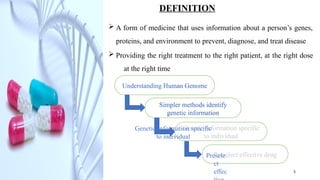
 A form of medicine that uses information about a person’s genes,
proteins, and environment to prevent, diagnose, and treat disease
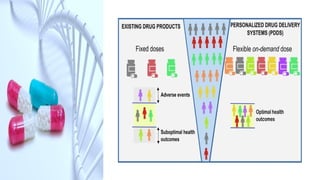
 Providing the right treatment to the right patient, at the right dose
at the right time
Understanding Human Genome
Simpler methods identify
genetic information
Genetic Information specific
to individual
Presele
ct
effec 5
Advantages of personalized medicines
 Provides right drug to the right patient at the right dose
 Improves drug efficacy
 Reduces adverse drug reactions
 Enables dose optimization
 Improves patient safety
 Allows early disease prediction and diagnosis
 Enhances treatment outcomes
 Promotes rational drug use
 Cost-effective by avoiding trial-and-error therapy
 Improves patient compliance
PHARMACOGENETICS
Importance
Maximize drug efficacy
Minimize drug toxicity
Predict patients who will respond to intervention
Aid in new drug development
8
PHARMACOGENETICS
 Pharmacogenetics is the study of influences of a gene on
therapeutic and adverse effects of drugs
 Pharmacogenetics is also defined as the study of
inherited
variation in drug-metabolizing enzymes and drug
responses
Pharmacogenetics
Pharmakon- Drug
Genetikos- Generative
(origin)
9
PHARMACOGENETICS
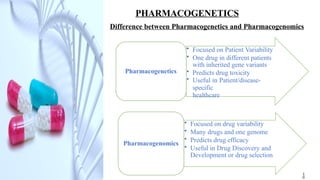
Difference between Pharmacogenetics and Pharmacogenomics
• Focused on Patient Variability
• One drug in different patients
with inherited gene variants
• Predicts drug toxicity
• Useful in Patient/disease-
specific
healthcare
Pharmacogenetics
• Focused on drug variability
• Many drugs and one genome
• Predicts drug efficacy
• Useful in Drug Discovery and
Development or drug selection
Pharmacogenomics
1
0
PHARMACOGENETICS
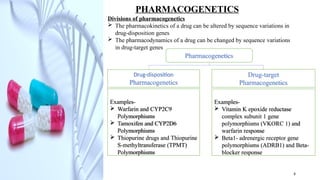
Divisions of pharmacogenetics
 The pharmacokinetics of a drug can be altered by sequence variations in
drug-disposition genes
 The pharmacodynamics of a drug can be changed by sequence variations
in drug-target genes
Pharmacogenetics
Drug-disposition
Pharmacogenetics
Drug-target
Pharmacogenetics
Examples-
 Vitamin K epoxide reductase
complex subunit 1 gene
polymorphisms (VKORC 1) and
warfarin response
 Beta1- adrenergic receptor gene
polymorphisms (ADRB1) and Beta-
blocker response
Examples-
 Warfarin and CYP2C9
Polymorphisms
 Tamoxifen and CYP2D6
Polymorphisms
 Thiopurine drugs and Thiopurine
S-methyltransferase (TPMT)
Polymorphisms
9
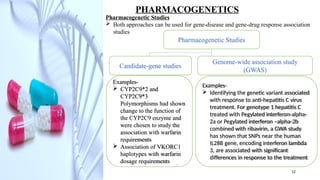
Examples-
 Identifying the genetic variant associated
with response to anti-hepatitis C virus
treatment. For genotype 1 hepatitis C
treated with Pegylated interferon-alpha-
2a or Pegylated interferon –alpha-2b
combined with ribavirin, a GWA study
has shown that SNPs near the human
IL28B gene, encoding interferon lambda
3, are associated with significant
differences in response to the treatment
PHARMACOGENETICS
Pharmacogenetic Studies
 Both approaches can be used for gene-disease and gene-drug response association
studies
Pharmacogenetic Studies
Candidate-gene studies
Genome-wide association study
(GWAS)
Examples-
 CYP2C9*2 and
CYP2C9*3
Polymorphisms had shown
change to the function of
the CYP2C9 enzyme and
were chosen to study the
association with warfarin
requirements
 Association of VKORC1
haplotypes with warfarin
dosage requirements
12
PHARMACOGENETICS
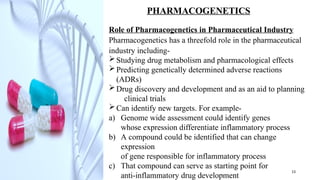
Role of Pharmacogenetics in Pharmaceutical Industry
Pharmacogenetics has a threefold role in the pharmaceutical
industry including-
Studying drug metabolism and pharmacological effects
Predicting genetically determined adverse reactions
(ADRs)
Drug discovery and development and as an aid to planning
clinical trials
Can identify new targets. For example-
a) Genome wide assessment could identify genes
whose expression differentiate inflammatory process
b) A compound could be identified that can change
expression
of gene responsible for inflammatory process
c) That compound can serve as starting point for
anti-inflammatory drug development
13
CATEGORIES OF PATIENTS FOR
PERSONALISED MEDICINE
Patients are mainly classified depending upon the genetic
polymorphism:
 Genetic polymorphism
 Epigenetic and other factors
 Cytochrome P450 genetic polymorphism
 Different families of enzymes polymorphism
Focusing on genomics, we have identified three categories for PM :-
 Optimizing drug response: gene-drug interactions
 Gene-based drug targeting
 Prediction and diagnosis
14
Genetic Polymorphism
Genetic polymorphism refers to the presence of
variations in DNA sequence among individuals within a
population.
These variations can:
 Alter how drugs are absorbed
 Affect drug metabolism
 Change drug action at receptor sites
 Influence drug elimination
Because of genetic polymorphism, the same drug dose
may be:
 Effective in one patient
 Ineffective in another
 Toxic in a third patient
Therefore, identifying genetic polymorphism helps in
selecting the appropriate drug and dose for an
individual.
Epigenetic and Other Factors
Epigenetics involves changes in gene expression without
changes in DNA sequence.These changes are influenced
by external and internal factors.
Important epigenetic and other factors include:
 Age (children and elderly respond differently)
 Gender (hormonal differences affect drug response)
 Body weight and composition
 Diet and lifestyle habits
 Environmental exposure
 Disease conditions like liver or kidney disorders.
These factors influence pharmacokinetics and
pharmacodynamics, making personalized treatment
necessary.
Cytochrome P450 Genetic
Polymorphism Cytochrome P450 enzymes play a crucial role in drug
metabolism, especially in the liver.
Genetic variations in CYP450 enzymes lead to different metabolizer
types:
• Poor metabolizers – slow drug metabolism → toxicity
• Intermediate metabolizers -- Extensive metabolizers – normal
metabolism
• Ultra-rapid metabolizers – fast metabolism → reduced efficacy
Common CYP enzymes include:CYP2D6
• CYP2C9
• CYP2C19
• CYP3A4
Knowing a patient’s CYP450 status helps clinicians to adjust drug dose
and avoid adverse reactions.
Different Families of Enzyme Polymorphism
Some drug-metabolizing enzymes show genetic polymorphism, leading
to variation in drug response and toxicity among individuals.
1. Thiopurine Methyltransferase (TPMT)
TPMT enzyme breaks down thiopurine drugs used in leukemia and autoimmune
disorders. Genetic deficiency of TPMT causes accumulation of thiopurines,
leading to severe toxicity. Therefore, blood testing is done before treatment.
2. UDP- glucuronosyltransferase family-1 member-1 (UGT1A1)Enzyme
UGT1A1 enzyme is responsible for metabolism of irinotecan used in colorectal
cancer. Deficiency of this enzyme leads to toxic drug accumulation causing
bone marrow suppression, infection, or death. Genetic testing helps in dose
customization.
3. Dihydropyrimidine Dehydrogenase (DPYD)
DPYD enzyme metabolizes 5-fluorouracil and related chemotherapy drugs.
Deficiency results in reduced breakdown of 5-FU, leading to severe or fatal
drug reactions.
Focusing on Genomics – Three
Categories for PM :-
Optimizing Drug Response: Uses gene–drug
interaction to improve efficacy and reduce side effects.
Gene-Based Drug Targeting: Targets specific genes;
used in cancer and genetic diseases.
Prediction & Diagnosis: Helps predict disease risk and
enables early, accurate diagnosis.
REFERENCE
1) https://en.wikipedia.org
2) https://www.uptodate.com
3) https://www.slideshare.net
4) http://www.ajhp.org/content/66/7/625.abstract
20
Thank You
21

Dosage Forms for Personalized Medicine.pptx

  • 1.
    DOSAGE FORMS FOR PERSONALIZEDMEDICINE PRESENTED BY-  Janvi Lokare (06)  Alisha Shaikh (12)  Radhika Vishwakarma (14) F.Y.M.PHARM (PHARMACEUTICS) Dr. L. H. Hiranandani College of Pharmacy, Ulhasnagar-03 06-02-2026 1
  • 2.
  • 3.
    INTRODUCTION Personalized medicine refersto the application of patient- specific profiles, incorporating genetic and genomic data as 3 well as clinical individual risks and environmental factors,to assess and tailor prevention and disease- management strategies Several terms, including “precision medicine,” “stratified medicine,” “targeted medicine,” and “pharmacogenomics,” are sometimes used interchangeably with “personalized medicine.”
  • 4.
    INTRODUCTION Early Examples ofPersonalized Medicine 1907: Reuben Ottenberg reports the first known blood compatibility test for transfusion using blood typing techniques and cross-matching between donors and patients to prevent hemolytic transfusion reactions. 1956: The genetic basis for the selective toxicity of fava beans (“favism”) and the antimalarial drug primaquine is discovered to be a deficiency in the metabolic enzyme, glucose-6- phosphate dehydrogenase (G6PD). 1977: Cytochrome P450 2D6, a polymorphic metabolizing enzyme, is identified as the culprit for causing some patients to experience an “overdose” or exaggeration of the duration and intensity of the effects of debrisoquine, a drug used for treating hypertension. 4
  • 5.
    DEFINITION  A formof medicine that uses information about a person’s genes, proteins, and environment to prevent, diagnose, and treat disease  Providing the right treatment to the right patient, at the right dose at the right time Understanding Human Genome Simpler methods identify genetic information Genetic Information specific to individual Presele ct effec 5
  • 6.
    Advantages of personalizedmedicines  Provides right drug to the right patient at the right dose  Improves drug efficacy  Reduces adverse drug reactions  Enables dose optimization  Improves patient safety  Allows early disease prediction and diagnosis  Enhances treatment outcomes  Promotes rational drug use  Cost-effective by avoiding trial-and-error therapy  Improves patient compliance
  • 8.
    PHARMACOGENETICS Importance Maximize drug efficacy Minimizedrug toxicity Predict patients who will respond to intervention Aid in new drug development 8
  • 9.
    PHARMACOGENETICS  Pharmacogenetics isthe study of influences of a gene on therapeutic and adverse effects of drugs  Pharmacogenetics is also defined as the study of inherited variation in drug-metabolizing enzymes and drug responses Pharmacogenetics Pharmakon- Drug Genetikos- Generative (origin) 9
  • 10.
    PHARMACOGENETICS Difference between Pharmacogeneticsand Pharmacogenomics • Focused on Patient Variability • One drug in different patients with inherited gene variants • Predicts drug toxicity • Useful in Patient/disease- specific healthcare Pharmacogenetics • Focused on drug variability • Many drugs and one genome • Predicts drug efficacy • Useful in Drug Discovery and Development or drug selection Pharmacogenomics 1 0
  • 11.
    PHARMACOGENETICS Divisions of pharmacogenetics The pharmacokinetics of a drug can be altered by sequence variations in drug-disposition genes  The pharmacodynamics of a drug can be changed by sequence variations in drug-target genes Pharmacogenetics Drug-disposition Pharmacogenetics Drug-target Pharmacogenetics Examples-  Vitamin K epoxide reductase complex subunit 1 gene polymorphisms (VKORC 1) and warfarin response  Beta1- adrenergic receptor gene polymorphisms (ADRB1) and Beta- blocker response Examples-  Warfarin and CYP2C9 Polymorphisms  Tamoxifen and CYP2D6 Polymorphisms  Thiopurine drugs and Thiopurine S-methyltransferase (TPMT) Polymorphisms 9
  • 12.
    Examples-  Identifying thegenetic variant associated with response to anti-hepatitis C virus treatment. For genotype 1 hepatitis C treated with Pegylated interferon-alpha- 2a or Pegylated interferon –alpha-2b combined with ribavirin, a GWA study has shown that SNPs near the human IL28B gene, encoding interferon lambda 3, are associated with significant differences in response to the treatment PHARMACOGENETICS Pharmacogenetic Studies  Both approaches can be used for gene-disease and gene-drug response association studies Pharmacogenetic Studies Candidate-gene studies Genome-wide association study (GWAS) Examples-  CYP2C9*2 and CYP2C9*3 Polymorphisms had shown change to the function of the CYP2C9 enzyme and were chosen to study the association with warfarin requirements  Association of VKORC1 haplotypes with warfarin dosage requirements 12
  • 13.
    PHARMACOGENETICS Role of Pharmacogeneticsin Pharmaceutical Industry Pharmacogenetics has a threefold role in the pharmaceutical industry including- Studying drug metabolism and pharmacological effects Predicting genetically determined adverse reactions (ADRs) Drug discovery and development and as an aid to planning clinical trials Can identify new targets. For example- a) Genome wide assessment could identify genes whose expression differentiate inflammatory process b) A compound could be identified that can change expression of gene responsible for inflammatory process c) That compound can serve as starting point for anti-inflammatory drug development 13
  • 14.
    CATEGORIES OF PATIENTSFOR PERSONALISED MEDICINE Patients are mainly classified depending upon the genetic polymorphism:  Genetic polymorphism  Epigenetic and other factors  Cytochrome P450 genetic polymorphism  Different families of enzymes polymorphism Focusing on genomics, we have identified three categories for PM :-  Optimizing drug response: gene-drug interactions  Gene-based drug targeting  Prediction and diagnosis 14
  • 15.
    Genetic Polymorphism Genetic polymorphismrefers to the presence of variations in DNA sequence among individuals within a population. These variations can:  Alter how drugs are absorbed  Affect drug metabolism  Change drug action at receptor sites  Influence drug elimination Because of genetic polymorphism, the same drug dose may be:  Effective in one patient  Ineffective in another  Toxic in a third patient Therefore, identifying genetic polymorphism helps in selecting the appropriate drug and dose for an individual.
  • 16.
    Epigenetic and OtherFactors Epigenetics involves changes in gene expression without changes in DNA sequence.These changes are influenced by external and internal factors. Important epigenetic and other factors include:  Age (children and elderly respond differently)  Gender (hormonal differences affect drug response)  Body weight and composition  Diet and lifestyle habits  Environmental exposure  Disease conditions like liver or kidney disorders. These factors influence pharmacokinetics and pharmacodynamics, making personalized treatment necessary.
  • 17.
    Cytochrome P450 Genetic PolymorphismCytochrome P450 enzymes play a crucial role in drug metabolism, especially in the liver. Genetic variations in CYP450 enzymes lead to different metabolizer types: • Poor metabolizers – slow drug metabolism → toxicity • Intermediate metabolizers -- Extensive metabolizers – normal metabolism • Ultra-rapid metabolizers – fast metabolism → reduced efficacy Common CYP enzymes include:CYP2D6 • CYP2C9 • CYP2C19 • CYP3A4 Knowing a patient’s CYP450 status helps clinicians to adjust drug dose and avoid adverse reactions.
  • 18.
    Different Families ofEnzyme Polymorphism Some drug-metabolizing enzymes show genetic polymorphism, leading to variation in drug response and toxicity among individuals. 1. Thiopurine Methyltransferase (TPMT) TPMT enzyme breaks down thiopurine drugs used in leukemia and autoimmune disorders. Genetic deficiency of TPMT causes accumulation of thiopurines, leading to severe toxicity. Therefore, blood testing is done before treatment. 2. UDP- glucuronosyltransferase family-1 member-1 (UGT1A1)Enzyme UGT1A1 enzyme is responsible for metabolism of irinotecan used in colorectal cancer. Deficiency of this enzyme leads to toxic drug accumulation causing bone marrow suppression, infection, or death. Genetic testing helps in dose customization. 3. Dihydropyrimidine Dehydrogenase (DPYD) DPYD enzyme metabolizes 5-fluorouracil and related chemotherapy drugs. Deficiency results in reduced breakdown of 5-FU, leading to severe or fatal drug reactions.
  • 19.
    Focusing on Genomics– Three Categories for PM :- Optimizing Drug Response: Uses gene–drug interaction to improve efficacy and reduce side effects. Gene-Based Drug Targeting: Targets specific genes; used in cancer and genetic diseases. Prediction & Diagnosis: Helps predict disease risk and enables early, accurate diagnosis.
  • 20.
    REFERENCE 1) https://en.wikipedia.org 2) https://www.uptodate.com 3)https://www.slideshare.net 4) http://www.ajhp.org/content/66/7/625.abstract 20
  • 21.