PERSONALISED
MEDICINES
Presented by Alakesh Bharali
Roll no.190520011001
Regd no. 387005219
M. Pharm 1st semester
Girijananda Chowdhury Institute of Pharmaceutical
Sciences(GIPS), Ghy-17
Contents
 Background
 Introduction
 Definition : What is it exactly?
 Need for personalised medicines(PM)
 How personalised medicines work?
 Pharmacogenetics and Pharmacogenomics
 Genetic tests
 Specific examples of Personalised medicines
 Benefits/Advantages of PM
 Limitations
 When will we see PM at local Pharmacy?
 Marketed products
 Future prospective
 Summary
 Conclusion
 References
2
Background
3
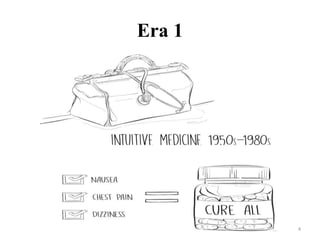
Era 1
4
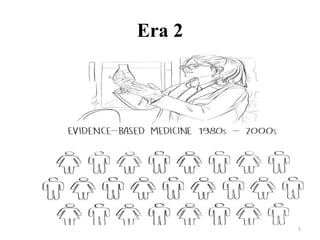
Era 2
5
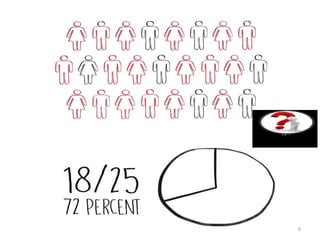
6
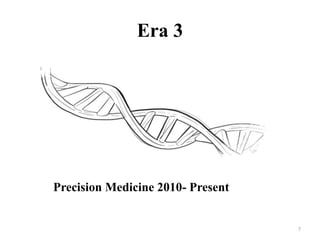
Era 3
7
Precision Medicine 2010- Present
Introduction
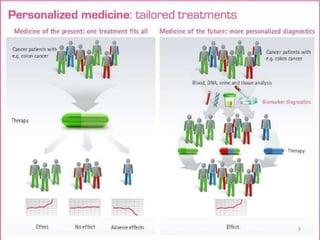
Personalised medicine is the tailoring of medical
treatment to the individual characteristics of each
patient( Sub-population)
Development in chemistry, histochemistry and
microscopy allowed scientists to begin to
understand the underlying causes of diseases
Sequencing of human genomes at the turn of the
21st century set in motion the transformation of
personalised medicine from an idea to a practice
8
9
Definition : What is it exactly?
The use of combined knowledge (genetics or
otherwise) about a person to predict disease,
predict treatment response and to predict disease
susceptibility and thereby improve that person’s
health.
More broadly, “personalized medicine” may be
thought of as the tailoring of medical treatment to
the individual characteristics, needs and
preferences of a patient during all stages of care,
including prevention, diagnosis, treatment and
follow-up.
10
Need for personalised medicines
11
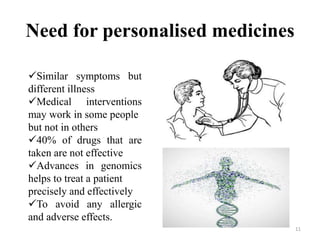
Similar symptoms but
different illness
Medical interventions
may work in some people
but not in others
40% of drugs that are
taken are not effective
Advances in genomics
helps to treat a patient
precisely and effectively
To avoid any allergic
and adverse effects.
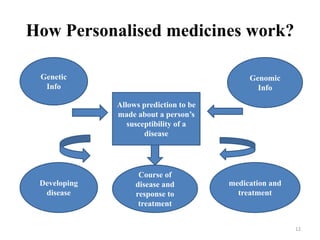
How Personalised medicines work?
12
Allows prediction to be
made about a person’s
susceptibility of a
disease
Genetic
Info
Genomic
Info
Developing
disease
medication and
treatment
Course of
disease and
response to
treatment
Pharmacogenetics and
Pharmacogenomics
Traditional pharmacogenetic approach relies
on studying sequence variations in candidate
genes that are thought to effect drug response
Pharmacogenomics studies encompass the sum
of all the genes ( i.e the genome). It is the
broader study of how genetic variations affect
drug development.
13
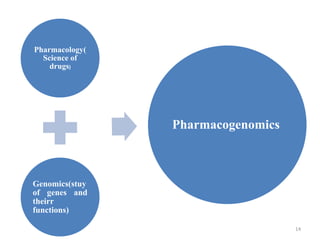
Pharmacology(
Science of
drugs)
Genomics(stuy
of genes and
theirr
functions)
Pharmacogenomics
14
Genetic Tests
1.CYP 450 genotyping test:
 CYP 450:Responsible for metabolising 30 types of
medication
 Test determine how quickly these drugs are eliminated
 Under expression of this CYP 450: Will not break the
medication fast enough allowing drug to accumulate
 Over expression :Will break the medication too fast
before they have a chance to work
Applications:
Anticoagulants, antidepressant, PP inhibitors etc.
15
Contdd..
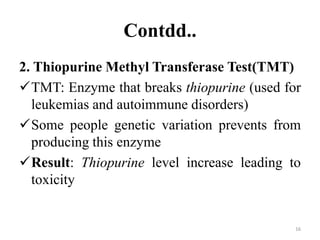
2. Thiopurine Methyl Transferase Test(TMT)
TMT: Enzyme that breaks thiopurine (used for
leukemias and autoimmune disorders)
Some people genetic variation prevents from
producing this enzyme
Result: Thiopurine level increase leading to
toxicity
16
Contd..
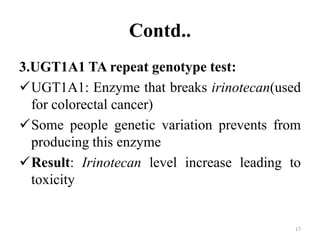
3.UGT1A1 TA repeat genotype test:
UGT1A1: Enzyme that breaks irinotecan(used
for colorectal cancer)
Some people genetic variation prevents from
producing this enzyme
Result: Irinotecan level increase leading to
toxicity
17
Contdd..
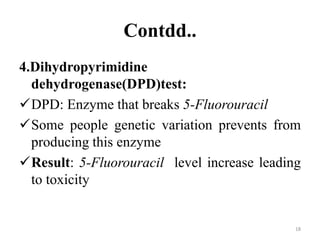
4.Dihydropyrimidine
dehydrogenase(DPD)test:
DPD: Enzyme that breaks 5-Fluorouracil
Some people genetic variation prevents from
producing this enzyme
Result: 5-Fluorouracil level increase leading
to toxicity
18
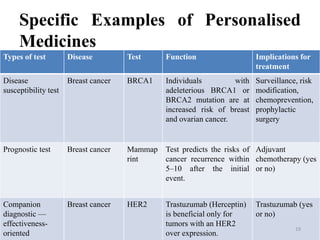
Specific Examples of Personalised
Medicines
Types of test Disease Test Function Implications for
treatment
Disease
susceptibility test
Breast cancer BRCA1 Individuals with
adeleterious BRCA1 or
BRCA2 mutation are at
increased risk of breast
and ovarian cancer.
Surveillance, risk
modification,
chemoprevention,
prophylactic
surgery
Prognostic test Breast cancer Mammap
rint
Test predicts the risks of
cancer recurrence within
5–10 after the initial
event.
Adjuvant
chemotherapy (yes
or no)
Companion
diagnostic —
effectiveness-
oriented
Breast cancer HER2 Trastuzumab (Herceptin)
is beneficial only for
tumors with an HER2
over expression.
Trastuzumab (yes
or no)
19
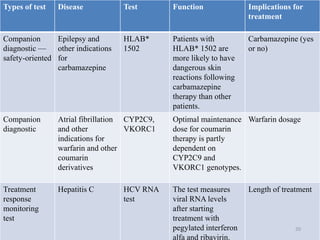
Types of test Disease Test Function Implications for
treatment
Companion
diagnostic —
safety-oriented
Epilepsy and
other indications
for
carbamazepine
HLAB*
1502
Patients with
HLAB* 1502 are
more likely to have
dangerous skin
reactions following
carbamazepine
therapy than other
patients.
Carbamazepine (yes
or no)
Companion
diagnostic
Atrial fibrillation
and other
indications for
warfarin and other
coumarin
derivatives
CYP2C9,
VKORC1
Optimal maintenance
dose for coumarin
therapy is partly
dependent on
CYP2C9 and
VKORC1 genotypes.
Warfarin dosage
Treatment
response
monitoring
test
Hepatitis C HCV RNA
test
The test measures
viral RNA levels
after starting
treatment with
pegylated interferon
alfa and ribavirin.
Length of treatment
20
Benefits of Personalised Medicines
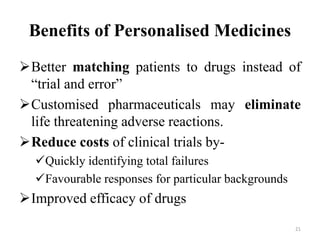
Better matching patients to drugs instead of
“trial and error”
Customised pharmaceuticals may eliminate
life threatening adverse reactions.
Reduce costs of clinical trials by-
Quickly identifying total failures
Favourable responses for particular backgrounds
Improved efficacy of drugs
21
Limitations
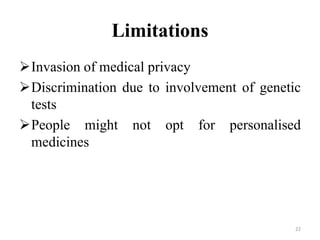
Invasion of medical privacy
Discrimination due to involvement of genetic
tests
People might not opt for personalised
medicines
22
When will we see PM at local
market?
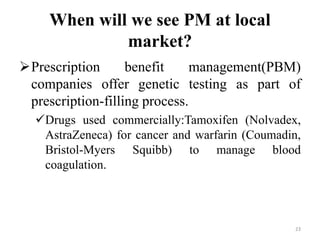
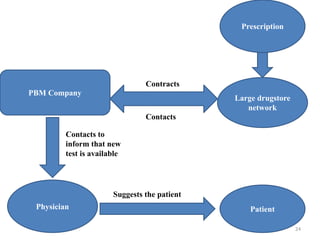
Prescription benefit management(PBM)
companies offer genetic testing as part of
prescription-filling process.
Drugs used commercially:Tamoxifen (Nolvadex,
AstraZeneca) for cancer and warfarin (Coumadin,
Bristol-Myers Squibb) to manage blood
coagulation.
23
PBM Company
Large drugstore
network
Prescription
Physician Patient
Contracts
Contacts
Contacts to
inform that new
test is available
Suggests the patient
24
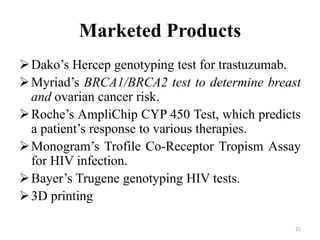
Marketed Products
Dako’s Hercep genotyping test for trastuzumab.
Myriad’s BRCA1/BRCA2 test to determine breast
and ovarian cancer risk.
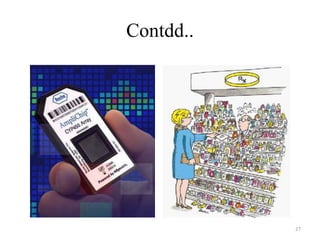
Roche’s AmpliChip CYP 450 Test, which predicts
a patient’s response to various therapies.
Monogram’s Trofile Co-Receptor Tropism Assay
for HIV infection.
Bayer’s Trugene genotyping HIV tests.
3D printing
25
Future prospective
One day, Patients will say, “I'm not an average
patient. I am who I am. You need to understand
who I am before you prescribe whatever
treatment you plan to prescribe.” or “Don’t
comment me without knowing me”
When that day comes, we’ll no longer have to
talk about personalized medicine
26
Contdd..
27
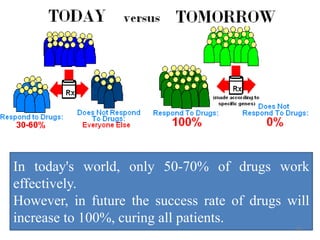
In today's world, only 50-70% of drugs work
effectively.
However, in future the success rate of drugs will
increase to 100%, curing all patients.
28
In your wallet May be by 2050..
29
Summary
30
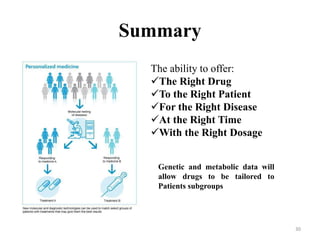
The ability to offer:
The Right Drug
To the Right Patient
For the Right Disease
At the Right Time
With the Right Dosage
Genetic and metabolic data will
allow drugs to be tailored to
Patients subgroups
Conclusion
 IS PERSONALISED MEDICINES REALLY PERSONALISED???
 Yes or NO??
 Yes: Because of the word “personalised”( as per wikipedia)
 No: Because refers to the subpopulation and not to the individual
patients ( as per definition of the presidents council)
 National Cancer Institute does not clarify whether or not
personalised medicine focuses on individual or a sub-population.
 What’s the conclusion???
 Looking the current examples of PM, we can conclude that PM is
not truly personalised.
 It aims at sub-population.
 So, there’s not a sharp definitions of PM. Above definitions are just
supported by majority.
31
References
 Mancinelli L, Cronin M, Sadee W. Pharmacogenomics: The promise
of personalized medicine. AAPS Pharm Sci 200;2(1):E4.
 F. Randy Vogenberg., Carol Isaacson Barash., Michael Pursel.,
Personalized Medicine Part 1: Evolution and Development into
Theranostics., Vol. 35 No. 10., (2010).
 Moinak Banerjee., Is pharmacogenomics a reality? Challenges and
oppurtunities for India., Indian J Hum Genet. 2011 May; 17(Suppl
1): S1–S3. doi: 10.4103/0971-6866.80350
 Leavitt MO, Kucherlapati R. The great promise of personalized
medicine (opinion). Boston Globe, December 26, 2008.
 Hamburg, M.A., and F.S. Collins. 2010. The path to personalized
medicine. The New England Journal of Medicine 363(4): 301–304.
 Lunshof, J.E. 2006. Personalized medicine: New perspectives– new
ethics? Personalized Medicine 3(2): 187–194.
32
Internet Links
 NHMRC. 2011. Personalised medicine and genetics.
National Health and Medical Research Council,
http://www.nhmrc.gov.au/you/health/egenetics/personal
isedmedicine.(Accessed December 25, 2019)
 Personalized Medicine E-Symposium (archived).
Available at: www.pharmacogenomicsociety.org.in
 https://en.m.wikipedia.org/wiki/personalised_medicine
[Accessed December 23, 2019]
 https://www.annualreviews.ord/doi/full/10.1146/annuar
ev-genom (Accessed December 23, 2019)
33
34
THANK YOU

Personalised medicines -pharmacogentics and pharmacogenomics

  • 1.
    PERSONALISED MEDICINES Presented by AlakeshBharali Roll no.190520011001 Regd no. 387005219 M. Pharm 1st semester Girijananda Chowdhury Institute of Pharmaceutical Sciences(GIPS), Ghy-17
  • 2.
    Contents  Background  Introduction Definition : What is it exactly?  Need for personalised medicines(PM)  How personalised medicines work?  Pharmacogenetics and Pharmacogenomics  Genetic tests  Specific examples of Personalised medicines  Benefits/Advantages of PM  Limitations  When will we see PM at local Pharmacy?  Marketed products  Future prospective  Summary  Conclusion  References 2
  • 3.
  • 4.
  • 5.
  • 6.
  • 7.
  • 8.
    Introduction Personalised medicine isthe tailoring of medical treatment to the individual characteristics of each patient( Sub-population) Development in chemistry, histochemistry and microscopy allowed scientists to begin to understand the underlying causes of diseases Sequencing of human genomes at the turn of the 21st century set in motion the transformation of personalised medicine from an idea to a practice 8
  • 9.
  • 10.
    Definition : Whatis it exactly? The use of combined knowledge (genetics or otherwise) about a person to predict disease, predict treatment response and to predict disease susceptibility and thereby improve that person’s health. More broadly, “personalized medicine” may be thought of as the tailoring of medical treatment to the individual characteristics, needs and preferences of a patient during all stages of care, including prevention, diagnosis, treatment and follow-up. 10
  • 11.
    Need for personalisedmedicines 11 Similar symptoms but different illness Medical interventions may work in some people but not in others 40% of drugs that are taken are not effective Advances in genomics helps to treat a patient precisely and effectively To avoid any allergic and adverse effects.
  • 12.
    How Personalised medicineswork? 12 Allows prediction to be made about a person’s susceptibility of a disease Genetic Info Genomic Info Developing disease medication and treatment Course of disease and response to treatment
  • 13.
    Pharmacogenetics and Pharmacogenomics Traditional pharmacogeneticapproach relies on studying sequence variations in candidate genes that are thought to effect drug response Pharmacogenomics studies encompass the sum of all the genes ( i.e the genome). It is the broader study of how genetic variations affect drug development. 13
  • 14.
    Pharmacology( Science of drugs) Genomics(stuy of genesand theirr functions) Pharmacogenomics 14
  • 15.
    Genetic Tests 1.CYP 450genotyping test:  CYP 450:Responsible for metabolising 30 types of medication  Test determine how quickly these drugs are eliminated  Under expression of this CYP 450: Will not break the medication fast enough allowing drug to accumulate  Over expression :Will break the medication too fast before they have a chance to work Applications: Anticoagulants, antidepressant, PP inhibitors etc. 15
  • 16.
    Contdd.. 2. Thiopurine MethylTransferase Test(TMT) TMT: Enzyme that breaks thiopurine (used for leukemias and autoimmune disorders) Some people genetic variation prevents from producing this enzyme Result: Thiopurine level increase leading to toxicity 16
  • 17.
    Contd.. 3.UGT1A1 TA repeatgenotype test: UGT1A1: Enzyme that breaks irinotecan(used for colorectal cancer) Some people genetic variation prevents from producing this enzyme Result: Irinotecan level increase leading to toxicity 17
  • 18.
    Contdd.. 4.Dihydropyrimidine dehydrogenase(DPD)test: DPD: Enzyme thatbreaks 5-Fluorouracil Some people genetic variation prevents from producing this enzyme Result: 5-Fluorouracil level increase leading to toxicity 18
  • 19.
    Specific Examples ofPersonalised Medicines Types of test Disease Test Function Implications for treatment Disease susceptibility test Breast cancer BRCA1 Individuals with adeleterious BRCA1 or BRCA2 mutation are at increased risk of breast and ovarian cancer. Surveillance, risk modification, chemoprevention, prophylactic surgery Prognostic test Breast cancer Mammap rint Test predicts the risks of cancer recurrence within 5–10 after the initial event. Adjuvant chemotherapy (yes or no) Companion diagnostic — effectiveness- oriented Breast cancer HER2 Trastuzumab (Herceptin) is beneficial only for tumors with an HER2 over expression. Trastuzumab (yes or no) 19
  • 20.
    Types of testDisease Test Function Implications for treatment Companion diagnostic — safety-oriented Epilepsy and other indications for carbamazepine HLAB* 1502 Patients with HLAB* 1502 are more likely to have dangerous skin reactions following carbamazepine therapy than other patients. Carbamazepine (yes or no) Companion diagnostic Atrial fibrillation and other indications for warfarin and other coumarin derivatives CYP2C9, VKORC1 Optimal maintenance dose for coumarin therapy is partly dependent on CYP2C9 and VKORC1 genotypes. Warfarin dosage Treatment response monitoring test Hepatitis C HCV RNA test The test measures viral RNA levels after starting treatment with pegylated interferon alfa and ribavirin. Length of treatment 20
  • 21.
    Benefits of PersonalisedMedicines Better matching patients to drugs instead of “trial and error” Customised pharmaceuticals may eliminate life threatening adverse reactions. Reduce costs of clinical trials by- Quickly identifying total failures Favourable responses for particular backgrounds Improved efficacy of drugs 21
  • 22.
    Limitations Invasion of medicalprivacy Discrimination due to involvement of genetic tests People might not opt for personalised medicines 22
  • 23.
    When will wesee PM at local market? Prescription benefit management(PBM) companies offer genetic testing as part of prescription-filling process. Drugs used commercially:Tamoxifen (Nolvadex, AstraZeneca) for cancer and warfarin (Coumadin, Bristol-Myers Squibb) to manage blood coagulation. 23
  • 24.
    PBM Company Large drugstore network Prescription PhysicianPatient Contracts Contacts Contacts to inform that new test is available Suggests the patient 24
  • 25.
    Marketed Products Dako’s Hercepgenotyping test for trastuzumab. Myriad’s BRCA1/BRCA2 test to determine breast and ovarian cancer risk. Roche’s AmpliChip CYP 450 Test, which predicts a patient’s response to various therapies. Monogram’s Trofile Co-Receptor Tropism Assay for HIV infection. Bayer’s Trugene genotyping HIV tests. 3D printing 25
  • 26.
    Future prospective One day,Patients will say, “I'm not an average patient. I am who I am. You need to understand who I am before you prescribe whatever treatment you plan to prescribe.” or “Don’t comment me without knowing me” When that day comes, we’ll no longer have to talk about personalized medicine 26
  • 27.
  • 28.
    In today's world,only 50-70% of drugs work effectively. However, in future the success rate of drugs will increase to 100%, curing all patients. 28
  • 29.
    In your walletMay be by 2050.. 29
  • 30.
    Summary 30 The ability tooffer: The Right Drug To the Right Patient For the Right Disease At the Right Time With the Right Dosage Genetic and metabolic data will allow drugs to be tailored to Patients subgroups
  • 31.
    Conclusion  IS PERSONALISEDMEDICINES REALLY PERSONALISED???  Yes or NO??  Yes: Because of the word “personalised”( as per wikipedia)  No: Because refers to the subpopulation and not to the individual patients ( as per definition of the presidents council)  National Cancer Institute does not clarify whether or not personalised medicine focuses on individual or a sub-population.  What’s the conclusion???  Looking the current examples of PM, we can conclude that PM is not truly personalised.  It aims at sub-population.  So, there’s not a sharp definitions of PM. Above definitions are just supported by majority. 31
  • 32.
    References  Mancinelli L,Cronin M, Sadee W. Pharmacogenomics: The promise of personalized medicine. AAPS Pharm Sci 200;2(1):E4.  F. Randy Vogenberg., Carol Isaacson Barash., Michael Pursel., Personalized Medicine Part 1: Evolution and Development into Theranostics., Vol. 35 No. 10., (2010).  Moinak Banerjee., Is pharmacogenomics a reality? Challenges and oppurtunities for India., Indian J Hum Genet. 2011 May; 17(Suppl 1): S1–S3. doi: 10.4103/0971-6866.80350  Leavitt MO, Kucherlapati R. The great promise of personalized medicine (opinion). Boston Globe, December 26, 2008.  Hamburg, M.A., and F.S. Collins. 2010. The path to personalized medicine. The New England Journal of Medicine 363(4): 301–304.  Lunshof, J.E. 2006. Personalized medicine: New perspectives– new ethics? Personalized Medicine 3(2): 187–194. 32
  • 33.
    Internet Links  NHMRC.2011. Personalised medicine and genetics. National Health and Medical Research Council, http://www.nhmrc.gov.au/you/health/egenetics/personal isedmedicine.(Accessed December 25, 2019)  Personalized Medicine E-Symposium (archived). Available at: www.pharmacogenomicsociety.org.in  https://en.m.wikipedia.org/wiki/personalised_medicine [Accessed December 23, 2019]  https://www.annualreviews.ord/doi/full/10.1146/annuar ev-genom (Accessed December 23, 2019) 33
  • 34.