Personality Traits
In a
Corporate Environment
By
Rohan.S.Telang
Parag Bora
Gaurav Lunavat
Akshay Bora
Supriya
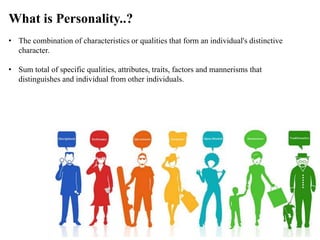
What is Personality..?
• The combination of characteristics or qualities that form an individual's distinctive
character.
• Sum total of specific qualities, attributes, traits, factors and mannerisms that
distinguishes and individual from other individuals.
Does an organisation benefit from hiring smart
employees.?
Yes…!
Different personality traits can be attributed
to an employees success, and these traits can
be construed as being “smart” contributing
to an organisations success.
Personality Traits
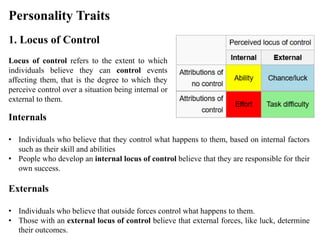
1. Locus of Control
Locus of control refers to the extent to which
individuals believe they can control events
affecting them, that is the degree to which they
perceive control over a situation being internal or
external to them.
Internals
• Individuals who believe that they control what happens to them, based on internal factors
such as their skill and abilities
• People who develop an internal locus of control believe that they are responsible for their
own success.
Externals
• Individuals who believe that outside forces control what happens to them.
• Those with an external locus of control believe that external forces, like luck, determine
their outcomes.
Marc Benioff
CEO, Salesforce.com
• Marc Benioff began cloud-
computing giant Salesforce.com
before anyone else was thinking
about cloud computing.
• Benioff has credited that success to
accuracy, saying “We’ve been deadly
accurate in what’s happened over the
last decade.”
• Clearly a risk taker, Benioff is also
very tolerant of ambiguity and
motivated by achievement
• Crediting his own correct predictions
suggests he has a real internal locus
of control, seeing his success in his
own rightness.
2. Type A Personality
• Type A individuals are ambitious, rigidly organized, highly status-conscious, sensitive,
impatient, take on more than they can handle, want other people to get to the point,
anxious, proactive, and concerned with time management.
• People with Type A
personalities are often
high-achieving
“workaholics” and push
themselves with
deadlines, and hate both
delays and ambivalence.
Jeffery Boyd
CEO, Priceline.com
• Jeffery Boyd took over Priceline.com
in 2002 taking a failing business with
a promising product and turning it
into the market leader.
• Boyd tried out a bold new strategy
for a failing company, he turned the
site into the Google of holidays
• His desire to almost single-handedly
turn things around suggests a
competitiveness that is consistent
with a Type-A personality
3. Self Efficacy
• Self-efficacy refers to an
individual's belief in his or her
capacity to execute behaviours
necessary to produce specific
performance attainments
• Self-efficacy reflects confidence
in the ability to exert control
over one's own motivation,
behaviour, and social
environment.
• View challenging problems as tasks to be mastered.
• Develop deeper interest in the activities in which
they participate.
• Form a stronger sense of commitment to their
interests and activities.
• Recover quickly from setback and disappointments.
Warren Buffett
CEO, Berkshire Hathaway
• American business magnate and
investor.
• Referred to as the "Wizard of
Omaha"
• BH Generates US$11 billion every
year in profits.
• Buffett was named the top money
manager of the Twentieth Century.
• Built his fortune through a series of
shrewd buyouts and takeovers.
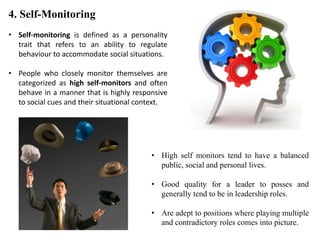
4. Self-Monitoring
• Self-monitoring is defined as a personality
trait that refers to an ability to regulate
behaviour to accommodate social situations.
• People who closely monitor themselves are
categorized as high self-monitors and often
behave in a manner that is highly responsive
to social cues and their situational context.
• High self monitors tend to have a balanced
public, social and personal lives.
• Good quality for a leader to posses and
generally tend to be in leadership roles.
• Are adept to positions where playing multiple
and contradictory roles comes into picture.
5. Machiavellianism
• The employment of
cunning and duplicity in
statecraft or in general
conduct.
• Degree to which an
individual is pragmatic,
maintains emotional
distance, and believes that
ends justify the means.
• High Machs are those who would be considered highly manipulative, not easily
persuaded but persuade others, successful in reaching their goals and tend to win
more.
• Tend to be calm, unattached, calculated and look for ways to exploit loose structures
or vulnerability in people
• High Machs are best matched in professions that reward their 'do whatever it takes'
attitude such as sales or jobs that offer commission for results.
Michael O’Leary
CEO, Ryanair Airlines
• Abrasive management style, ruthless
pursuit of cost-cutting and his
explicitly hostile attitude towards
corporate competitors, airport
authorities, governments, unions and
customers has become a hallmark.
• Impersonated a journalist in an
attempt to find information passed on
to a newspaper following a safety
incident
• False claims on carbon emissions,
later retracted.
• Criticized by a judge for lying in a
court case.
OCEAN: The Big Five
Refers to five broad dimensions used to describe human personality.
Questions…?
Thank You…!

Personality Traits

  • 1.
    Personality Traits In a CorporateEnvironment By Rohan.S.Telang Parag Bora Gaurav Lunavat Akshay Bora Supriya
  • 2.
    What is Personality..? •The combination of characteristics or qualities that form an individual's distinctive character. • Sum total of specific qualities, attributes, traits, factors and mannerisms that distinguishes and individual from other individuals.
  • 3.
    Does an organisationbenefit from hiring smart employees.? Yes…! Different personality traits can be attributed to an employees success, and these traits can be construed as being “smart” contributing to an organisations success.
  • 4.
    Personality Traits 1. Locusof Control Locus of control refers to the extent to which individuals believe they can control events affecting them, that is the degree to which they perceive control over a situation being internal or external to them. Internals • Individuals who believe that they control what happens to them, based on internal factors such as their skill and abilities • People who develop an internal locus of control believe that they are responsible for their own success. Externals • Individuals who believe that outside forces control what happens to them. • Those with an external locus of control believe that external forces, like luck, determine their outcomes.
  • 5.
    Marc Benioff CEO, Salesforce.com •Marc Benioff began cloud- computing giant Salesforce.com before anyone else was thinking about cloud computing. • Benioff has credited that success to accuracy, saying “We’ve been deadly accurate in what’s happened over the last decade.” • Clearly a risk taker, Benioff is also very tolerant of ambiguity and motivated by achievement • Crediting his own correct predictions suggests he has a real internal locus of control, seeing his success in his own rightness.
  • 6.
    2. Type APersonality • Type A individuals are ambitious, rigidly organized, highly status-conscious, sensitive, impatient, take on more than they can handle, want other people to get to the point, anxious, proactive, and concerned with time management. • People with Type A personalities are often high-achieving “workaholics” and push themselves with deadlines, and hate both delays and ambivalence.
  • 8.
    Jeffery Boyd CEO, Priceline.com •Jeffery Boyd took over Priceline.com in 2002 taking a failing business with a promising product and turning it into the market leader. • Boyd tried out a bold new strategy for a failing company, he turned the site into the Google of holidays • His desire to almost single-handedly turn things around suggests a competitiveness that is consistent with a Type-A personality
  • 9.
    3. Self Efficacy •Self-efficacy refers to an individual's belief in his or her capacity to execute behaviours necessary to produce specific performance attainments • Self-efficacy reflects confidence in the ability to exert control over one's own motivation, behaviour, and social environment. • View challenging problems as tasks to be mastered. • Develop deeper interest in the activities in which they participate. • Form a stronger sense of commitment to their interests and activities. • Recover quickly from setback and disappointments.
  • 10.
    Warren Buffett CEO, BerkshireHathaway • American business magnate and investor. • Referred to as the "Wizard of Omaha" • BH Generates US$11 billion every year in profits. • Buffett was named the top money manager of the Twentieth Century. • Built his fortune through a series of shrewd buyouts and takeovers.
  • 11.
    4. Self-Monitoring • Self-monitoringis defined as a personality trait that refers to an ability to regulate behaviour to accommodate social situations. • People who closely monitor themselves are categorized as high self-monitors and often behave in a manner that is highly responsive to social cues and their situational context. • High self monitors tend to have a balanced public, social and personal lives. • Good quality for a leader to posses and generally tend to be in leadership roles. • Are adept to positions where playing multiple and contradictory roles comes into picture.
  • 12.
    5. Machiavellianism • Theemployment of cunning and duplicity in statecraft or in general conduct. • Degree to which an individual is pragmatic, maintains emotional distance, and believes that ends justify the means. • High Machs are those who would be considered highly manipulative, not easily persuaded but persuade others, successful in reaching their goals and tend to win more. • Tend to be calm, unattached, calculated and look for ways to exploit loose structures or vulnerability in people • High Machs are best matched in professions that reward their 'do whatever it takes' attitude such as sales or jobs that offer commission for results.
  • 13.
    Michael O’Leary CEO, RyanairAirlines • Abrasive management style, ruthless pursuit of cost-cutting and his explicitly hostile attitude towards corporate competitors, airport authorities, governments, unions and customers has become a hallmark. • Impersonated a journalist in an attempt to find information passed on to a newspaper following a safety incident • False claims on carbon emissions, later retracted. • Criticized by a judge for lying in a court case.
  • 14.
    OCEAN: The BigFive Refers to five broad dimensions used to describe human personality.
  • 16.