PERSONALITY
DISORDERS
Abnormal Psychology
Defining Abnormality
 Distress
 Impairment
 Risk to Self or to Other People
 Socially & Culturally Unacceptable
Behaviour
Distress
 Experience of emotional or physical
pain
Impairment
 Reduction of a person’s ability to
function at an optimal or even average
level
Risk to Self or Other People
 Threat to the well-being of the person
Socially and Culturally Unacceptable
Behaviour
 Deviation from expected norms in a given
culture
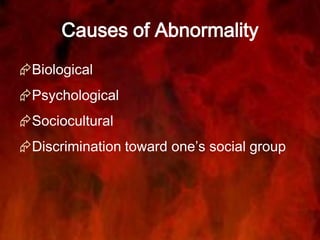
Causes of Abnormality
Biological
Psychological
Sociocultural
Discrimination toward one’s social group
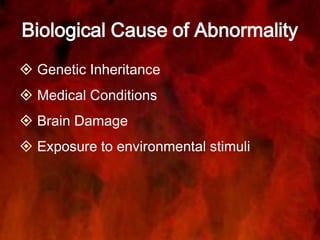
Biological Cause of Abnormality
 Genetic Inheritance
 Medical Conditions
 Brain Damage
 Exposure to environmental stimuli
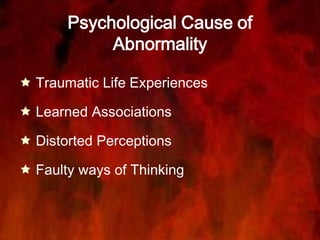
Psychological Cause of
Abnormality
 Traumatic Life Experiences
 Learned Associations
 Distorted Perceptions
 Faulty ways of Thinking
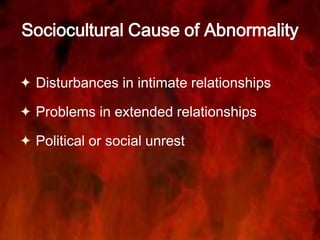
Sociocultural Cause of Abnormality
 Disturbances in intimate relationships
 Problems in extended relationships
 Political or social unrest
PERSONALITY DISORDERS
Involves a long-lasting maladaptive pattern
of inner experience and behaviour, dating
back to adolescence or young adulthood,
that is manifested in at least two of the
following areas:
(1)Cognition, (2) Affectivity, (3) Interpersonal
Functioning and (4) Impulse Control.
This inflexible pattern is evident in various
personal and social situations and causes
distress or impairment.
The pattern is stable and long duration, with
an onset that can be traced back to
adolescence or early adulthood.
Diagnostic Features of Personality
Disorder
1. Cognition- ways of perceiving self, other
people and events
2. Affectivity- range, intensity and
appropriateness of emotional expression
3. Interpersonal Functioning
4. Impulse Control
Personality Disorders
 Antisocial Personality Disorder
 Borderline Personality Disorder
 Histrionic Personality Disorder
 Narcissistic Personality Disorder
 Paranoid Personality Disorder
 Schizoid Personality Disorder
 Schizotypal Personality Disorder
 Avoidant Personality Disorder
 Dependent Personality Disorder
 Obsessive-compulsive Personality
Disorder
Antisocial Personality Disorder
Diagnostic Feature
This diagnosis is assigned to adults, who
are as children showed evidence of conduct
disorder and who , from the age of 15, have
shown a pervasive pattern of disregard for
and violation of the rights of others, as
disregard for and violation of the rights of
others, as indicated by three or more of the
following:
Repeated engagement in behaviours that are
grounds for arrest
Deceitfulness, such a lying, using false
identities or conning others for personal profit
or pleasure
Impulsivity, or failure to plan ahead
Irritability & aggressiveness, such as
repeated fights or assaults
Reckless disregard for the safety of self &
others
Consistent irresponsibility, such as repeated
failure to keep a job or honor financial
obligations
Lack of remorse, such as being indifferent to
or rationalizing one’s hurtful or dishonest
behavior
JOHN WAYNE GACY
TED BUNDY
LUIS GARAVITO
Borderline Personality Disorder
Diagnostic Feature
This diagnosis is assigned to people who show
recurrent impulsivity and a pervasive pattern of
instability of interpersonal relationships, self-
image and affects, as indicated by five or more
of the following:
Frantic efforts to avoid real or imagined
abandonment
A pattern of unstable and intense interpersonal
relationships characterized by changes between
idealizing and devaluing others
Identity disturbances- unstable self-image or
sense of self
Impulsivity in at least 2 areas, such as
spending, sex, substance abuse and reckless
driving
Recurrent suicidal behavior, gestures or
threats of self mutilating behavior
Emotional instability, such as intense episodes
of sadness, irritability or anxiety, usually
lasting a few hours and sometimes several
days
Chronic feeling of emptiness
Inappropriate, intense anger or difficulty
controlling anger, such as frequent displays of
temper, constant anger or recurrent physical
fights
Occasional stress-related paranoid thinking or
dissociative symptoms
Histrionic Personality Disorder
Diagnostic Feature
This diagnosis is given to people who show a
pervasive pattern of excessive emotionality and
attention seeking, as indicated by five or more
of the following:
 Discomfort when not the center of attention
 Interactions characterized by inappropriate
sexually seductive or provocative behavior
 Rapid shifts and shallow expression of
emotions
 Used of physical appearance to draw
attention
 Speech that is excessively impressionistic and
lacking in detail
 Self-dramatization , theatricality, and
exaggerated expression of emotion
 High suggestibility
 Misinterpretation of relationships as
being more intimate than they are
Narcissistic Personality Disorder
Diagnostic Feature
This diagnosis applies to people who show a
pervasive pattern of grandiosity, need for
admiration and lack of empathy, as evidence by
5 or more of the following:
∞ Grandiose sense of self importance
∞ Preoccupation with fantasies o success,
power, brilliance, beauty or ideal love
∞ Belief that they are so “special” that they
should associate only with other special
people, who can understand then
∞ Need for excessive admiration
∞ Sense of entitlement
∞ Exploitive interpersonal style
∞ Lack of empathy
∞ Envy of others or belief that others are
envious
∞ Arrogant behaviors and attitudes
Paranoid Personality Disorder
Diagnostic Feature
People with this personality disorder show
pervasive distrust and suspiciousness of others
whose motives they interpret as malevolent, as
indicated by four or more of the following:
 Unjustified suspicion that others are exploiting,
harming of deceiving them
 Preoccupation with unjustified doubts about
others’ loyalty and trustworthiness
 Reluctance to confide in others, for fear the
information will be used against them
 Tendency to read hidden demeaning or
threatening meanings into harmless remarks or
events
 Tendency to bear grudges
 Perception of personal attacks that are not
apparent to others and tendency to respond
with angry counterattacks
 Recurrent unjustified suspicions about the
faithfulness of spouse or sexual partner
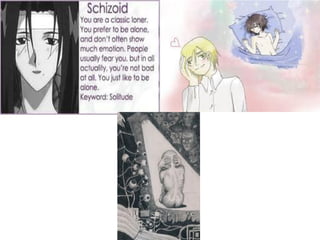
Schizoid Personality Disorder
Diagnostic Features
This diagnosis applies to people who show a
pervasive pattern of detachment from
relationships and a restricted emotional range,
as indicated by 4 or more of the following:
 Lack of desire for enjoyment of close relationships
 Strong preference for solitary activities
 Little or no interest in sexual experiences with
another person
 Lack of pleasure in few, if any activities
 Lack of close friends or confidants, other than
immediate relatives
 Indifference to praise to criticism
 Emotional coldness, detachment, or flat
emotionally
Schizotypal Personality Disorder
Diagnostic Behavior
This diagnosis is given to people who show a
pervasive pattern of social and interpersonal
deficits marked by acute discomfort with, and
reduced capacity for, close relationships and who
experience cognitive or perceptual distortions and
behavioral eccentricities as indicated by five or
more of the following:
 Ideas of reference
 Odd beliefs or magical thinking, which
influences their behavior (magic, mind-
reading)
 Unusual perceptual experiences, including
bodily illusions
 Odd thinking and speech
 Suspiciousness or paranoid ideation
 Inappropriate or constricted affect
 Behavior or appearance that is odd or eccentric
 Lack of close friends or confidants other than
immediate relatives
 Excessive social anxiety that tends to be
associated with paranoid fears
Avoidant Personality Disorder
Diagnostic Feature
This diagnosis applies to people with a pattern
of social inhibition, feelings of inadequacy and
hypersensitivity to negative evaluation, as
indicated by four or more of the following:
 Avoidance of activities that involves
significant interpersonal contact because of
fears of criticism, disapproval or rejection
 Unwillingness to get involved with others
unless certain of being liked
 Restraint within intimate relationships due to
the fear of being shamed or ridiculed
 Preoccupation with being criticized or rejected
in social situations
 Inhibition in new interpersonal situations
because of feelings of inadequacy
 Self-view as socially inept, personally
unappealing, or inferior to others
 Reluctance to take personal risks or new
activities due to fear of being embarrassed
Dependent Personality Disorder
Diagnostic Feature
People with this disorder have a pervasive and
excessive need to be taken care of, which leads to
their submissive, clinging behavior and fears of
separation, as indicated by 5 or more of the
following:
 Difficulty making everyday decisions without
advice and reassurance
 Need for others to assume responsibility for
most major areas of life
 Difficulty expressing disagreement with others
due to fear of loss of support or approval
 Difficulty initiating projects or tasks because of
low self confidence in judgment or abilities
 Tendency to go to excessive lengths to obtain
nurturance and support the point of
volunteering to do the things that are
unpleasant
 Feelings of discomfort or helplessness when
alone due to fear of being unable to care for
themselves
 Pursuit of another relationship as a source of
care and support immediately following the end
of a close relationship
 Preoccupation with fears of being left to take
care of themselves
Obsessive-Compulsive
Personality Disorder
Diagnostic Feature
This diagnosis applies to people with a pervasive
pattern of preoccupation with orderliness,
perfectionism, and mental and interpersonal
control, at the expense of flexibility, openness and
efficiency, as indicated by four or more of the
following:
Ω Preoccupation with details, rules, order,
organization, or schedules to such an extent that
the major point of activity is lost
Ω Perfectionism that interferes with task
completion
Ω Excessive devotion to work and productivity to
the exclusion of leisure activities and friendships
(not due to economic necessity)
Ω Tendency to be over conscientiousness, scrupulous, and
inflexible about matters of morality, ethics, or values
(not due to culture or religion)
Ω Inability to discard worn-out or worthless objects
Ω Reluctance to delegate tasks to others unless they agree
on exact way of doing things
Ω Miserly spending style toward self and others
Ω Rigidity and stubbornness
THANK YOU

Personality disorders

  • 1.
  • 3.
    Defining Abnormality  Distress Impairment  Risk to Self or to Other People  Socially & Culturally Unacceptable Behaviour
  • 4.
    Distress  Experience ofemotional or physical pain Impairment  Reduction of a person’s ability to function at an optimal or even average level
  • 5.
    Risk to Selfor Other People  Threat to the well-being of the person Socially and Culturally Unacceptable Behaviour  Deviation from expected norms in a given culture
  • 6.
  • 7.
    Biological Cause ofAbnormality  Genetic Inheritance  Medical Conditions  Brain Damage  Exposure to environmental stimuli
  • 8.
    Psychological Cause of Abnormality Traumatic Life Experiences  Learned Associations  Distorted Perceptions  Faulty ways of Thinking
  • 9.
    Sociocultural Cause ofAbnormality  Disturbances in intimate relationships  Problems in extended relationships  Political or social unrest
  • 10.
    PERSONALITY DISORDERS Involves along-lasting maladaptive pattern of inner experience and behaviour, dating back to adolescence or young adulthood, that is manifested in at least two of the following areas: (1)Cognition, (2) Affectivity, (3) Interpersonal Functioning and (4) Impulse Control.
  • 11.
    This inflexible patternis evident in various personal and social situations and causes distress or impairment. The pattern is stable and long duration, with an onset that can be traced back to adolescence or early adulthood.
  • 12.
    Diagnostic Features ofPersonality Disorder 1. Cognition- ways of perceiving self, other people and events 2. Affectivity- range, intensity and appropriateness of emotional expression 3. Interpersonal Functioning 4. Impulse Control
  • 13.
    Personality Disorders  AntisocialPersonality Disorder  Borderline Personality Disorder  Histrionic Personality Disorder  Narcissistic Personality Disorder
  • 14.
     Paranoid PersonalityDisorder  Schizoid Personality Disorder  Schizotypal Personality Disorder  Avoidant Personality Disorder  Dependent Personality Disorder  Obsessive-compulsive Personality Disorder
  • 15.
    Antisocial Personality Disorder DiagnosticFeature This diagnosis is assigned to adults, who are as children showed evidence of conduct disorder and who , from the age of 15, have shown a pervasive pattern of disregard for and violation of the rights of others, as disregard for and violation of the rights of others, as indicated by three or more of the following:
  • 16.
    Repeated engagement inbehaviours that are grounds for arrest Deceitfulness, such a lying, using false identities or conning others for personal profit or pleasure Impulsivity, or failure to plan ahead Irritability & aggressiveness, such as repeated fights or assaults
  • 17.
    Reckless disregard forthe safety of self & others Consistent irresponsibility, such as repeated failure to keep a job or honor financial obligations Lack of remorse, such as being indifferent to or rationalizing one’s hurtful or dishonest behavior
  • 18.
    JOHN WAYNE GACY TEDBUNDY LUIS GARAVITO
  • 19.
    Borderline Personality Disorder DiagnosticFeature This diagnosis is assigned to people who show recurrent impulsivity and a pervasive pattern of instability of interpersonal relationships, self- image and affects, as indicated by five or more of the following:
  • 20.
    Frantic efforts toavoid real or imagined abandonment A pattern of unstable and intense interpersonal relationships characterized by changes between idealizing and devaluing others Identity disturbances- unstable self-image or sense of self
  • 21.
    Impulsivity in atleast 2 areas, such as spending, sex, substance abuse and reckless driving Recurrent suicidal behavior, gestures or threats of self mutilating behavior Emotional instability, such as intense episodes of sadness, irritability or anxiety, usually lasting a few hours and sometimes several days
  • 22.
    Chronic feeling ofemptiness Inappropriate, intense anger or difficulty controlling anger, such as frequent displays of temper, constant anger or recurrent physical fights Occasional stress-related paranoid thinking or dissociative symptoms
  • 24.
    Histrionic Personality Disorder DiagnosticFeature This diagnosis is given to people who show a pervasive pattern of excessive emotionality and attention seeking, as indicated by five or more of the following:
  • 25.
     Discomfort whennot the center of attention  Interactions characterized by inappropriate sexually seductive or provocative behavior  Rapid shifts and shallow expression of emotions  Used of physical appearance to draw attention  Speech that is excessively impressionistic and lacking in detail
  • 26.
     Self-dramatization ,theatricality, and exaggerated expression of emotion  High suggestibility  Misinterpretation of relationships as being more intimate than they are
  • 28.
    Narcissistic Personality Disorder DiagnosticFeature This diagnosis applies to people who show a pervasive pattern of grandiosity, need for admiration and lack of empathy, as evidence by 5 or more of the following:
  • 29.
    ∞ Grandiose senseof self importance ∞ Preoccupation with fantasies o success, power, brilliance, beauty or ideal love ∞ Belief that they are so “special” that they should associate only with other special people, who can understand then ∞ Need for excessive admiration
  • 30.
    ∞ Sense ofentitlement ∞ Exploitive interpersonal style ∞ Lack of empathy ∞ Envy of others or belief that others are envious ∞ Arrogant behaviors and attitudes
  • 32.
    Paranoid Personality Disorder DiagnosticFeature People with this personality disorder show pervasive distrust and suspiciousness of others whose motives they interpret as malevolent, as indicated by four or more of the following:
  • 33.
     Unjustified suspicionthat others are exploiting, harming of deceiving them  Preoccupation with unjustified doubts about others’ loyalty and trustworthiness  Reluctance to confide in others, for fear the information will be used against them  Tendency to read hidden demeaning or threatening meanings into harmless remarks or events
  • 34.
     Tendency tobear grudges  Perception of personal attacks that are not apparent to others and tendency to respond with angry counterattacks  Recurrent unjustified suspicions about the faithfulness of spouse or sexual partner
  • 36.
    Schizoid Personality Disorder DiagnosticFeatures This diagnosis applies to people who show a pervasive pattern of detachment from relationships and a restricted emotional range, as indicated by 4 or more of the following:
  • 37.
     Lack ofdesire for enjoyment of close relationships  Strong preference for solitary activities  Little or no interest in sexual experiences with another person  Lack of pleasure in few, if any activities  Lack of close friends or confidants, other than immediate relatives  Indifference to praise to criticism  Emotional coldness, detachment, or flat emotionally
  • 39.
    Schizotypal Personality Disorder DiagnosticBehavior This diagnosis is given to people who show a pervasive pattern of social and interpersonal deficits marked by acute discomfort with, and reduced capacity for, close relationships and who experience cognitive or perceptual distortions and behavioral eccentricities as indicated by five or more of the following:
  • 40.
     Ideas ofreference  Odd beliefs or magical thinking, which influences their behavior (magic, mind- reading)  Unusual perceptual experiences, including bodily illusions  Odd thinking and speech
  • 41.
     Suspiciousness orparanoid ideation  Inappropriate or constricted affect  Behavior or appearance that is odd or eccentric  Lack of close friends or confidants other than immediate relatives  Excessive social anxiety that tends to be associated with paranoid fears
  • 43.
    Avoidant Personality Disorder DiagnosticFeature This diagnosis applies to people with a pattern of social inhibition, feelings of inadequacy and hypersensitivity to negative evaluation, as indicated by four or more of the following:
  • 44.
     Avoidance ofactivities that involves significant interpersonal contact because of fears of criticism, disapproval or rejection  Unwillingness to get involved with others unless certain of being liked  Restraint within intimate relationships due to the fear of being shamed or ridiculed
  • 45.
     Preoccupation withbeing criticized or rejected in social situations  Inhibition in new interpersonal situations because of feelings of inadequacy  Self-view as socially inept, personally unappealing, or inferior to others  Reluctance to take personal risks or new activities due to fear of being embarrassed
  • 47.
    Dependent Personality Disorder DiagnosticFeature People with this disorder have a pervasive and excessive need to be taken care of, which leads to their submissive, clinging behavior and fears of separation, as indicated by 5 or more of the following:
  • 48.
     Difficulty makingeveryday decisions without advice and reassurance  Need for others to assume responsibility for most major areas of life  Difficulty expressing disagreement with others due to fear of loss of support or approval  Difficulty initiating projects or tasks because of low self confidence in judgment or abilities
  • 49.
     Tendency togo to excessive lengths to obtain nurturance and support the point of volunteering to do the things that are unpleasant  Feelings of discomfort or helplessness when alone due to fear of being unable to care for themselves  Pursuit of another relationship as a source of care and support immediately following the end of a close relationship  Preoccupation with fears of being left to take care of themselves
  • 51.
    Obsessive-Compulsive Personality Disorder Diagnostic Feature Thisdiagnosis applies to people with a pervasive pattern of preoccupation with orderliness, perfectionism, and mental and interpersonal control, at the expense of flexibility, openness and efficiency, as indicated by four or more of the following:
  • 52.
    Ω Preoccupation withdetails, rules, order, organization, or schedules to such an extent that the major point of activity is lost Ω Perfectionism that interferes with task completion Ω Excessive devotion to work and productivity to the exclusion of leisure activities and friendships (not due to economic necessity)
  • 53.
    Ω Tendency tobe over conscientiousness, scrupulous, and inflexible about matters of morality, ethics, or values (not due to culture or religion) Ω Inability to discard worn-out or worthless objects Ω Reluctance to delegate tasks to others unless they agree on exact way of doing things Ω Miserly spending style toward self and others Ω Rigidity and stubbornness
  • 55.