CONSUMER
 LEARNING

    Katherine S. Chin
Consumer Learning

► process that continually evolves and
changes as a result of newly acquired
knowledge or through actual experience.

► knowledge or experience may be
acquired through reading, thinking,
observation, discussion, action or
interaction.
Learning      occurs     when      an
individual would show a relative
and permanent change of behavior
in a situation as a result of practice
and experience and as a product of
knowledge.
Classical Conditioning
 also called Pavlovian conditioning,
created by Ivan Pavlov

 a theory he tested with a help of a
dog and a bell
Classical Conditioning
 is a form of learning in which one stimulus, the
conditioned stimulus or CS, comes to signal the
occurrence of a second stimulus, the unconditioned
stimulus or US.

 The US is usually a biologically significant
stimulus such as food or pain that elicits a response
from the start; this is called the unconditioned
response or UR.

 The CS usually produces no particular response
at first, but after conditioning it elicits
the conditioned response or CR.
Components of CC
1. Unconditioned Stimulus (UCS)

   A stimulus that without conditioning
   will elicit a predictable response.

2. Unconditioned Response (UCR)
   A response that without
   conditioning will result predictably
   from UCS.
3. Neutral Stimulus (NS)

   A stimulus that does not elicit the
   UR. Also called Orienting Stimulus
   (OS).

4. Conditioned Stimulus (CS)

   A stimulus that will elicit a
   predictable response because of its
   previous pairing with a previously
   occurring reflex.
5. Conditioned Response (CR)

   A predictable response to a stimulus
   that has influence because of its
   previous pairing with a previously
   occurring reflex.
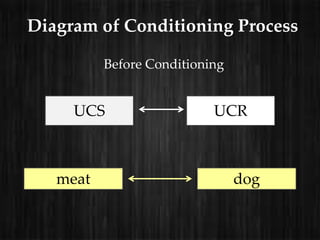
Diagram of Conditioning Process

          Before Conditioning


     UCS                   UCR


   meat                         dog
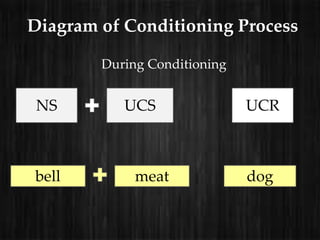
Diagram of Conditioning Process

        During Conditioning


 NS        UCS                UCR


bell         meat             dog
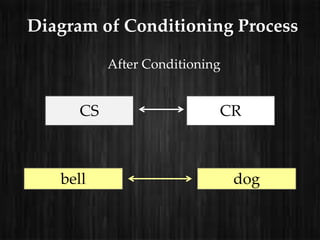
Diagram of Conditioning Process

           After Conditioning


      CS                    CR


   bell                         dog
Use of Classical Conditioning in
     Marketing Techniques

   Creates awareness to the presentation of
stimulus due to the presentation of previous
conditioning stimulus (product) that would
   elicit emotional response in consumers.
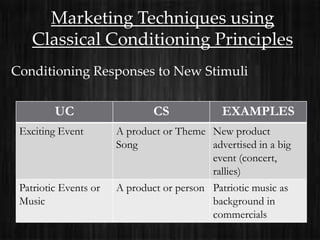
Marketing Techniques using
    Classical Conditioning Principles
Conditioning Responses to New Stimuli

         UC                    CS             EXAMPLES
 Exciting Event        A product or Theme New product
                       Song                advertised in a big
                                           event (concert,
                                           rallies)
 Patriotic Events or   A product or person Patriotic music as
 Music                                     background in
                                           commercials
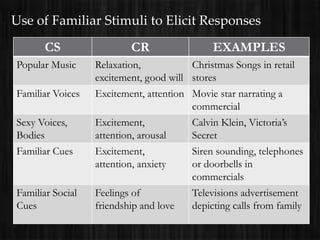
Use of Familiar Stimuli to Elicit Responses
       CS                 CR                 EXAMPLES
Popular Music     Relaxation,           Christmas Songs in retail
                  excitement, good will stores
Familiar Voices   Excitement, attention Movie star narrating a
                                        commercial
Sexy Voices,      Excitement,           Calvin Klein, Victoria’s
Bodies            attention, arousal    Secret
Familiar Cues     Excitement,           Siren sounding, telephones
                  attention, anxiety    or doorbells in
                                        commercials
Familiar Social   Feelings of           Televisions advertisement
Cues              friendship and love   depicting calls from family
OPERANT
CONDITIONING
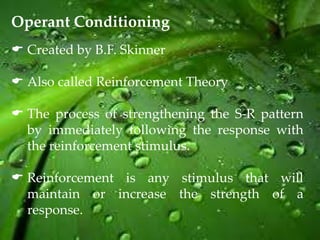
Operant Conditioning
 Created by B.F. Skinner

 Also called Reinforcement Theory

 The process of strengthening the S-R pattern
  by immediately following the response with
  the reinforcement stimulus.

 Reinforcement is any stimulus that will
  maintain or increase the strength of a
  response.
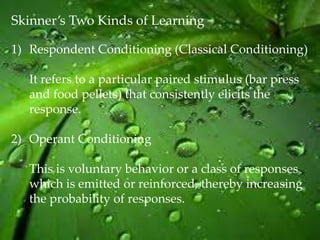
Skinner’s Two Kinds of Learning

1) Respondent Conditioning (Classical Conditioning)

   It refers to a particular paired stimulus (bar press
   and food pellets) that consistently elicits the
   response.

2) Operant Conditioning

   This is voluntary behavior or a class of responses
   which is emitted or reinforced, thereby increasing
   the probability of responses.
Skinner’s Types of Reinforcement
1) Positive (Reward)
   This is a stimulus that when presented, acts to
   strengthen the behavior that it follows.

2) Negative
   This is a stimulus which when presented, acts to
   diminish or extinguish the behavior that follows.
   Extinction is a good example of negative
   reinforcement.

3) Punishment
    a. it is the withdrawal of a positive reinforcer.
    b. it is the presentation of a negative reinforcer or
    aversive stimulus.
Schedules of Reinforcement
1) Ratio – it is based on the number of responses
   emitted. The response is reinforced only to a
   certain proportion of the occasion where it occurs.

Types of Ratio
   a) Fixed Ratio (FR)
      The reinforcement is contingent upon the
      occurrence of a fixed number of responses.

   b) Variable Ratio (VR)
     The number of responses required for
     reinforcement varies about some mean or
     average.
Schedules of Reinforcement
2) Interval- refers to reinforcement given at interval or
passage of time .

Types of Interval
     a) Fixed Interval (FI)
     The reinforcement occurs on a fixed time
     schedule.

      b) Variable Interval (VI)
      The length of time varies about some given
      mean time. Reinforcements becomes available at
      variable intervals.
Thank You

Consumer Learning

  • 1.
    CONSUMER LEARNING Katherine S. Chin
  • 2.
    Consumer Learning ► processthat continually evolves and changes as a result of newly acquired knowledge or through actual experience. ► knowledge or experience may be acquired through reading, thinking, observation, discussion, action or interaction.
  • 3.
    Learning occurs when an individual would show a relative and permanent change of behavior in a situation as a result of practice and experience and as a product of knowledge.
  • 4.
    Classical Conditioning  alsocalled Pavlovian conditioning, created by Ivan Pavlov  a theory he tested with a help of a dog and a bell
  • 5.
    Classical Conditioning  isa form of learning in which one stimulus, the conditioned stimulus or CS, comes to signal the occurrence of a second stimulus, the unconditioned stimulus or US.  The US is usually a biologically significant stimulus such as food or pain that elicits a response from the start; this is called the unconditioned response or UR.  The CS usually produces no particular response at first, but after conditioning it elicits the conditioned response or CR.
  • 6.
    Components of CC 1.Unconditioned Stimulus (UCS) A stimulus that without conditioning will elicit a predictable response. 2. Unconditioned Response (UCR) A response that without conditioning will result predictably from UCS.
  • 7.
    3. Neutral Stimulus(NS) A stimulus that does not elicit the UR. Also called Orienting Stimulus (OS). 4. Conditioned Stimulus (CS) A stimulus that will elicit a predictable response because of its previous pairing with a previously occurring reflex.
  • 8.
    5. Conditioned Response(CR) A predictable response to a stimulus that has influence because of its previous pairing with a previously occurring reflex.
  • 9.
    Diagram of ConditioningProcess Before Conditioning UCS UCR meat dog
  • 10.
    Diagram of ConditioningProcess During Conditioning NS UCS UCR bell meat dog
  • 11.
    Diagram of ConditioningProcess After Conditioning CS CR bell dog
  • 12.
    Use of ClassicalConditioning in Marketing Techniques Creates awareness to the presentation of stimulus due to the presentation of previous conditioning stimulus (product) that would elicit emotional response in consumers.
  • 13.
    Marketing Techniques using Classical Conditioning Principles Conditioning Responses to New Stimuli UC CS EXAMPLES Exciting Event A product or Theme New product Song advertised in a big event (concert, rallies) Patriotic Events or A product or person Patriotic music as Music background in commercials
  • 14.
    Use of FamiliarStimuli to Elicit Responses CS CR EXAMPLES Popular Music Relaxation, Christmas Songs in retail excitement, good will stores Familiar Voices Excitement, attention Movie star narrating a commercial Sexy Voices, Excitement, Calvin Klein, Victoria’s Bodies attention, arousal Secret Familiar Cues Excitement, Siren sounding, telephones attention, anxiety or doorbells in commercials Familiar Social Feelings of Televisions advertisement Cues friendship and love depicting calls from family
  • 15.
  • 17.
    Operant Conditioning  Createdby B.F. Skinner  Also called Reinforcement Theory  The process of strengthening the S-R pattern by immediately following the response with the reinforcement stimulus.  Reinforcement is any stimulus that will maintain or increase the strength of a response.
  • 18.
    Skinner’s Two Kindsof Learning 1) Respondent Conditioning (Classical Conditioning) It refers to a particular paired stimulus (bar press and food pellets) that consistently elicits the response. 2) Operant Conditioning This is voluntary behavior or a class of responses which is emitted or reinforced, thereby increasing the probability of responses.
  • 19.
    Skinner’s Types ofReinforcement 1) Positive (Reward) This is a stimulus that when presented, acts to strengthen the behavior that it follows. 2) Negative This is a stimulus which when presented, acts to diminish or extinguish the behavior that follows. Extinction is a good example of negative reinforcement. 3) Punishment a. it is the withdrawal of a positive reinforcer. b. it is the presentation of a negative reinforcer or aversive stimulus.
  • 22.
    Schedules of Reinforcement 1)Ratio – it is based on the number of responses emitted. The response is reinforced only to a certain proportion of the occasion where it occurs. Types of Ratio a) Fixed Ratio (FR) The reinforcement is contingent upon the occurrence of a fixed number of responses. b) Variable Ratio (VR) The number of responses required for reinforcement varies about some mean or average.
  • 23.
    Schedules of Reinforcement 2)Interval- refers to reinforcement given at interval or passage of time . Types of Interval a) Fixed Interval (FI) The reinforcement occurs on a fixed time schedule. b) Variable Interval (VI) The length of time varies about some given mean time. Reinforcements becomes available at variable intervals.
  • 24.