Personality Disorders
        ANTI-SOCIAL
        BORDERLINE


                        S
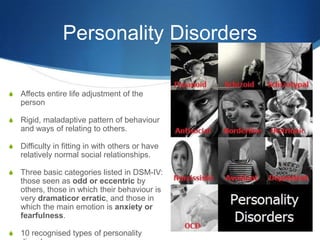
Personality Disorders

S   Affects entire life adjustment of the
    person

S   Rigid, maladaptive pattern of behaviour
    and ways of relating to others.

S   Difficulty in fitting in with others or have
    relatively normal social relationships.

S   Three basic categories listed in DSM-IV:
    those seen as odd or eccentric by
    others, those in which their behaviour is
    very dramaticor erratic, and those in
    which the main emotion is anxiety or
    fearfulness.

S   10 recognised types of personality
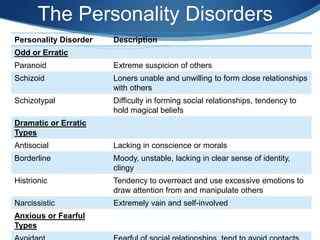
The Personality Disorders
Personality Disorder   Description
Odd or Erratic
Paranoid               Extreme suspicion of others
Schizoid               Loners unable and unwilling to form close relationships
                       with others
Schizotypal            Difficulty in forming social relationships, tendency to
                       hold magical beliefs
Dramatic or Erratic
Types
Antisocial             Lacking in conscience or morals
Borderline             Moody, unstable, lacking in clear sense of identity,
                       clingy
Histrionic             Tendency to overreact and use excessive emotions to
                       draw attention from and manipulate others
Narcissistic           Extremely vain and self-involved
Anxious or Fearful
Types
Antisocial Personality Disorder


S Literally “against society”

S Sometimes called a sociopath, habitually breaks the law,
   disobey rules, tells lies, uses other people without emotional
   concern.

S Stigma of serial killer – but most are not killers!

S Gender difference – three to six times as many males
   diagnosed as females

S Typically evident by age of 15
Criticisms Of ASPD


S DSM-IV-TR considers ASPD and psychopathy to be the same,
  or similar – BUT ASPD is diagnosed via behavior and social
  deviance whereas psychopathy includes affective and
  interpersonal personality factors.

S Nearly 80%–95% of felons will meet criteria for ASPD whereas
  psychopathy is found in only roughly 20% of inmates

S American Psychiatric Association states in the DSM-IV-TR that
  "psychopathy" and "sociopathy" are now obsolete synonyms.
Borderline Personality
                       Disorder
S   Intense and relatively unstable relationships
    with other people

S   Often moody, manipulative, untrusting of
    others, self-mutilating behaviour

S   May engage in excessive spending, drug
    abuse or suicidal behaviour (may be part of
    manipulation used against others in a
    relationship)

S   Confusion over identity issues, in which the
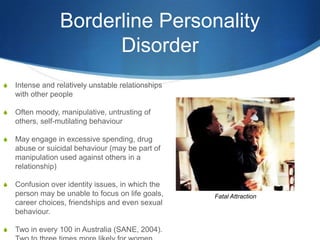
    person may be unable to focus on life goals,    Fatal Attraction
    career choices, friendships and even sexual
    behaviour.

S   Two in every 100 in Australia (SANE, 2004).
Causes


         S
Behavioural - Cognitive


S Specific behaviour learned over time through
  reinforcement, shaping and modeling.

S Belief systems formed by the personality disordered
  person.
Biological


S Close biological relatives of people with disorders (e.g.
   antisocial, schizotypal and borderline) are more likely to have
   these disorders than those who are not related.
S Adoption studies of children whose biological parents had
   antisocial personality disorder show an increased risk for that
   disorder.
S Some research shows a greater risk of schizophrenia in
   relatives of people with schizotypal personality disorder. Only a
   small proportion of people with schizotypal develop full-blown
   schizophrenia.
Diathesis-Stress


S Disturbances in family relationships and communication
  have also been linked to personality disorders and, in
  particular, antisocial personality disorder.

S Childhood abuse, neglect, overly strict parenting, over-
  protective parenting, and parental rejection have all been
  put forth as possible causes.

Personality disorders

  • 1.
    Personality Disorders ANTI-SOCIAL BORDERLINE S
  • 2.
    Personality Disorders S Affects entire life adjustment of the person S Rigid, maladaptive pattern of behaviour and ways of relating to others. S Difficulty in fitting in with others or have relatively normal social relationships. S Three basic categories listed in DSM-IV: those seen as odd or eccentric by others, those in which their behaviour is very dramaticor erratic, and those in which the main emotion is anxiety or fearfulness. S 10 recognised types of personality
  • 3.
    The Personality Disorders PersonalityDisorder Description Odd or Erratic Paranoid Extreme suspicion of others Schizoid Loners unable and unwilling to form close relationships with others Schizotypal Difficulty in forming social relationships, tendency to hold magical beliefs Dramatic or Erratic Types Antisocial Lacking in conscience or morals Borderline Moody, unstable, lacking in clear sense of identity, clingy Histrionic Tendency to overreact and use excessive emotions to draw attention from and manipulate others Narcissistic Extremely vain and self-involved Anxious or Fearful Types
  • 4.
    Antisocial Personality Disorder SLiterally “against society” S Sometimes called a sociopath, habitually breaks the law, disobey rules, tells lies, uses other people without emotional concern. S Stigma of serial killer – but most are not killers! S Gender difference – three to six times as many males diagnosed as females S Typically evident by age of 15
  • 5.
    Criticisms Of ASPD SDSM-IV-TR considers ASPD and psychopathy to be the same, or similar – BUT ASPD is diagnosed via behavior and social deviance whereas psychopathy includes affective and interpersonal personality factors. S Nearly 80%–95% of felons will meet criteria for ASPD whereas psychopathy is found in only roughly 20% of inmates S American Psychiatric Association states in the DSM-IV-TR that "psychopathy" and "sociopathy" are now obsolete synonyms.
  • 6.
    Borderline Personality Disorder S Intense and relatively unstable relationships with other people S Often moody, manipulative, untrusting of others, self-mutilating behaviour S May engage in excessive spending, drug abuse or suicidal behaviour (may be part of manipulation used against others in a relationship) S Confusion over identity issues, in which the person may be unable to focus on life goals, Fatal Attraction career choices, friendships and even sexual behaviour. S Two in every 100 in Australia (SANE, 2004).
  • 7.
  • 8.
    Behavioural - Cognitive SSpecific behaviour learned over time through reinforcement, shaping and modeling. S Belief systems formed by the personality disordered person.
  • 9.
    Biological S Close biologicalrelatives of people with disorders (e.g. antisocial, schizotypal and borderline) are more likely to have these disorders than those who are not related. S Adoption studies of children whose biological parents had antisocial personality disorder show an increased risk for that disorder. S Some research shows a greater risk of schizophrenia in relatives of people with schizotypal personality disorder. Only a small proportion of people with schizotypal develop full-blown schizophrenia.
  • 10.
    Diathesis-Stress S Disturbances infamily relationships and communication have also been linked to personality disorders and, in particular, antisocial personality disorder. S Childhood abuse, neglect, overly strict parenting, over- protective parenting, and parental rejection have all been put forth as possible causes.