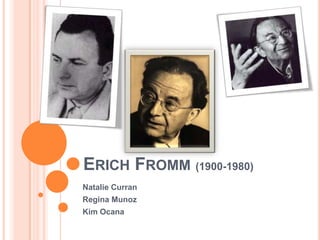
ERICH FROMM (1900-1980)
Natalie Curran
Regina Munoz
Kim Ocana
I. BIOGRAPHY
   born in Frankfurt, Germany, 1900
   only child of orthodox Jewish parents
   studied law but eventually changed his field of study to
    sociology at University of Heidelberg
   Ph.D. in sociology at age 22
   joined the Frankfurt Institute for Social Research, later
    known as the Frankfurt School of Critical Theory
   After completing his training at the Berlin Psychoanalytic
    Institute, he and Frieda Fromm-Reichmann helped to
    found the Frankfurt Psychoanalytic Institute
   1933, fled from Nazis and went to the United States
I. BIOGRAPHY
   1949, he became a professor at the National
    Autonomous University of Mexico, where he
    instituted the department of psychoanalysis.
   Founder and director of the Mexican
    Psychoanalytic Institute
   1974, Fromm moved to Switzerland, where he died
    in 1980.
I. BIOGRAPHY
Contribution to Psychology:
   humanistic philosopher, personality theorist and social
    psychologist
   retained a strong interest in the role of social factors in
    determining personality development
   influenced the field of psychology through his many
    books, theories, and institutions
   Escape from Freedom, in 1941, which had a significant
    psychological, political, and social tone
   His theories on human character were embodied in this
    and his second book, Man for Himself, and were
    expounded upon in his most popular publication, The Art
    of Loving
I. BIOGRAPHY (BOOKS BY FROMM)
   Escape from Freedom (1941)
   Man for Himself (1947)
   The Art of Loving (1956)
   Sigmund Freud's Mission; an Analysis of his Personality and Influence (1959)
   Zen Buddhism and Psychoanalysis (1960)
   May Man Prevail? An Inquiry into the Facts and Fictions of Foreign Policy (1961)
   Marx's Concept of Man (1961)
   Beyond the Chains of Illusion: My Encounter with Marx and Freud (1962)
   Socialist Humanism (1965)
   The Nature of Man (1968)
   The Crisis of Psychoanalysis (1970)
   The Anatomy of Human Destructiveness (1973)
   To Have or to Be? (1976)
   Greatness and Limitation of Freud's Thought (1979)
   The Art of Being (1993)
   The Art of Listening (1994)
   On Being Human (1997)
II. THEORIES
A basic theme in Fromm's thought: We feel lonely
  and isolated because we have become separated
  from nature and from other human beings.


“If I am what I have and if I lose what I have who then
                          am I?”
II. THEORIES

    "Man is the end, and must never be used as a
 means; material production is for man, not man for
 material production; the aim of life is the unfolding
 of man's creative powers; the aim of history is a
 transformation of society into one governed by
 justice and truth---these are the principles on which,
 explicitly and implicitly, all criticism of modern
 Capitalism was based.”
II. THEORIES
The being and having modes

   Two modes are competing for the spirit of humanity
   The having mode relies on the possessions that a
    person has. It is the source of the lust for power and
    leads to isolation and fear.
   The being mode, which depends solely on the fact of
    existence, is the source of productive love and activity
    and leads to solidarity and joy. Responding
    spontaneously and productively and having the courage
    to let go in order to give birth to new ideas.
II. THEORIES
The being and having modes

   Fromm points out that both Jesus and Buddha
    taught that we should not crave possessions. He
    quotes Jesus, "For what is a man advantaged, if he
    gain the whole world, and lose himself, or be cast
    away?" Our real goal should be to be much rather
    than to have much.
II.THEORIES
FREEDOM IN MEDIEVAL AND MODERN SOCIETY
    (reference: Escape from Freedom,1941.)


   "What characterizes medieval society...is its
    lack of individual freedom. Everyone is chained
    to his role in the social order. Had to stay where
    born. Personal, economic, and social life are
    dominated by rules and obligations. But although
    the person was not free, neither was he alone and
    isolated. Was rooted in a socialized whole. Life had
    a meaning which left no place for doubt. A person
    was identical with his role.”
II. THEORIES
FREEDOM IN MEDIEVAL AND MODERN SOCIETY

 Roles. Today we like to say we're a person first,
  and the role comes second.
 In the old day's one's place was given. For example
  in medieval times, the knight and peasant have
  their roles.
 By contrast, in modern society we're not sure what
  our role is. In a sense, freedom is scary. We are
  isolated, alone, and afraid.
II. THEORIES
FREEDOM IN MEDIEVAL AND MODERN SOCIETY

 Capitalism and freedom. Capitalism contributed to
  the growth of freedom, to a critical, responsible self.
  It also made people more alone. Put the individual
  entirely on his own feet. Furthered the process of
  individualization.
 The more man gains freedom, the more he
  becomes an individual.
II. THEORIES
FREEDOM IN MEDIEVAL AND MODERN SOCIETY

   Escape from making choices. Much of Fromm's
    work had to do with how a person tries to escape
    from having to choose. We try to get the other
    person, or the institution, to take action for us. But
    this alienates us from our own power and
    responsiveness.
II. THEORIES
Escape Mechanisms:


1.   Authoritarianism - the tendency to give up one’s
     independence and to unite with a powerful partner.

2.   Destructiveness - escape mechanism aimed at
     doing away with other people or things.

3.   Automaton Conformity - surrendering of one’s
     individuality in order to meet the wishes of others.
II. THEORIES
Authoritarianism
   the tendency to give up one’s independence and
   to unite with a powerful partner.
   Submission or domination

   In masochistic form, we allow others to dominate
   us. In sadistic form, we try to dominate and
   control the behavior of others.
   belief that one's life is determined by forces
   outside oneself, one's interests, or one's wishes,
   and the only way to be happy is to submit to those
   forces
II. THEORIES
Destructiveness
   escape mechanism aimed at doing away with
    other people or things.
   "The destruction of the world is the last, almost
    desperate attempts to save myself from being
    crushed by it."
   Destructiveness is often rationalized as love, duty,
    conscience, or patriotism.
II. THEORIES
Automaton Conformity
   surrendering of one’s individuality in order to meet
    the wishes of others.
   People cease to be themselves and adopt the
    type of personality proffered by their culture.
II. THEORIES

6 Character Orientations (reference: Man for Himself, 1947)


1.   Receptive
2.   Exploitative
3.   Hoarding
4.   Marketing
5.   Productive
6.   Necrophilous
II. THEORIES
6 Character Orientations:

1.   Receptive - only way to obtain something they want is to receive it from an
     outside source; they react passively, waiting to be loved.
2.   Exploitative – Take things they want by force or cunning; they expoit others
     for their own ends.
3.   Hoarding – these personalites hoard and save what they already have; they
     surround themselves with a wall and are miserly in their relations to others.
4.   Marketing – experience themselves in commodities on th market; they may
     be described as opportunistic chameleons, changing their colors and values as
     they perceive the forces of the market to change.
5.   Productive – value themselves and others for who they are; they relate to the
     world by accurately perceiving it and by enriching it through their own creative
     powers.
6.   Necrophilous - This kind of person stands alone from the others in that he,
     instead of attempting to find a solution to life, seeks to destroy it. These people
     are often fascinated by death, and find war and destruction as not necessary,
     but desirable.
II. THEORIES- RECEPTIVE (ACCEPTING)
POSITIVE ASPECT     NEGATIVE ASPECT

 accepting          passive
 responsive         opinionless

 devoted            submissive

 charming           parasitical

 adaptable          unprincipled

 polite             spineless

 optimistic         wishful thinking

 trusting           gullible
II. THEORIES- EXPLOITATIVE (TAKING)
POSITIVE ASPECT            NEGATIVE ASPECT

 active                    exploitive
 takes the initiative      aggressive

 makes claims (and         Egocentric
  hears those of others)    Conceited
 proud                     Arrogant
 self-confident            rash
 impulsive                 seducing
 captivating
II. THEORIES- HOARDING (PRESERVING)
POSITIVE ASPECT          NEGATIVE ASPECT

 practical               unimaginative
 economical              stingy
 careful                 suspicious
 reserved                cold
 patient                 lethargic
 cautious                anxious
 steadfast, tenacious    stubborn
 methodical              obsessive
 loyal                   possessive
II: THEORIES- MARKETING (EXCHANGING)
POSITIVE ASPECT      NEGATIVE ASPECT

   purposeful          opportunistic
   able to change      inconsistent
   youthful            childish
   Open-minded         unprincipled
   experimenting       aimless
   efficient           overactive
   curious             tactless
   adaptable           undiscriminating
   tolerant            indifferent
   generous            wasteful
II. THEORIES
The basic human needs:

1.   Transcendence  Relating to other people and loving productively
2.   Sense of identity Becoming aware of ourselves as separate and
     unique individuals
3.   Rootedness  Feeling that we belong
4.   Frame of orientation Having a stable and consistent frame of
     reference to organize perceptions and make sense or our environment
5.   Unity  A sense of oneness between one person and the "natural
     and human world outside."
6.   Excitation and stimulation Actively striving for a goal rather than
     simply responding
7.   Effectiveness  The need to feel accomplished
8.   Relatedness  Relating to other people and loving productively
III. ASSESSMENT AND RESEARCH
IV. REPORTER‘S CRITIQUE
SOURCES:
   http://dean.roushimsx.com/fromm.htm

   http://www.drrogerwalsh.com/wp-content/uploads/2009/07/Theories-of-
    Personality-Psychopathology-Fromm-Allport-Murray-goldstein-Maslow-
    Murphy-Lewin-Gestalt-Lacan-Cattell-Skinner-Ken-Wilber.pdf

   http://psychology.about.com/od/profilesal/p/erich-fromm.htm

   http://www.logosjournal.com/issue_6.3/funk.htm

   http://www.goodtherapy.org/famous-psychologists/erich-fromm.html

   Theories of Personality (Xerox from Sir‘s Book)

   Love is union with someone or something while retaining the
    separateness and integrity of one's own self
   If I can love only one person and no one else, if my love for this person
    alienates and distances me from others, this is not love in its full
    flowering.

Erich fromm (2)

  • 1.
    ERICH FROMM (1900-1980) NatalieCurran Regina Munoz Kim Ocana
  • 2.
    I. BIOGRAPHY  born in Frankfurt, Germany, 1900  only child of orthodox Jewish parents  studied law but eventually changed his field of study to sociology at University of Heidelberg  Ph.D. in sociology at age 22  joined the Frankfurt Institute for Social Research, later known as the Frankfurt School of Critical Theory  After completing his training at the Berlin Psychoanalytic Institute, he and Frieda Fromm-Reichmann helped to found the Frankfurt Psychoanalytic Institute  1933, fled from Nazis and went to the United States
  • 3.
    I. BIOGRAPHY  1949, he became a professor at the National Autonomous University of Mexico, where he instituted the department of psychoanalysis.  Founder and director of the Mexican Psychoanalytic Institute  1974, Fromm moved to Switzerland, where he died in 1980.
  • 4.
    I. BIOGRAPHY Contribution toPsychology:  humanistic philosopher, personality theorist and social psychologist  retained a strong interest in the role of social factors in determining personality development  influenced the field of psychology through his many books, theories, and institutions  Escape from Freedom, in 1941, which had a significant psychological, political, and social tone  His theories on human character were embodied in this and his second book, Man for Himself, and were expounded upon in his most popular publication, The Art of Loving
  • 5.
    I. BIOGRAPHY (BOOKSBY FROMM)  Escape from Freedom (1941)  Man for Himself (1947)  The Art of Loving (1956)  Sigmund Freud's Mission; an Analysis of his Personality and Influence (1959)  Zen Buddhism and Psychoanalysis (1960)  May Man Prevail? An Inquiry into the Facts and Fictions of Foreign Policy (1961)  Marx's Concept of Man (1961)  Beyond the Chains of Illusion: My Encounter with Marx and Freud (1962)  Socialist Humanism (1965)  The Nature of Man (1968)  The Crisis of Psychoanalysis (1970)  The Anatomy of Human Destructiveness (1973)  To Have or to Be? (1976)  Greatness and Limitation of Freud's Thought (1979)  The Art of Being (1993)  The Art of Listening (1994)  On Being Human (1997)
  • 6.
    II. THEORIES A basictheme in Fromm's thought: We feel lonely and isolated because we have become separated from nature and from other human beings. “If I am what I have and if I lose what I have who then am I?”
  • 7.
    II. THEORIES "Man is the end, and must never be used as a means; material production is for man, not man for material production; the aim of life is the unfolding of man's creative powers; the aim of history is a transformation of society into one governed by justice and truth---these are the principles on which, explicitly and implicitly, all criticism of modern Capitalism was based.”
  • 8.
    II. THEORIES The beingand having modes  Two modes are competing for the spirit of humanity  The having mode relies on the possessions that a person has. It is the source of the lust for power and leads to isolation and fear.  The being mode, which depends solely on the fact of existence, is the source of productive love and activity and leads to solidarity and joy. Responding spontaneously and productively and having the courage to let go in order to give birth to new ideas.
  • 9.
    II. THEORIES The beingand having modes  Fromm points out that both Jesus and Buddha taught that we should not crave possessions. He quotes Jesus, "For what is a man advantaged, if he gain the whole world, and lose himself, or be cast away?" Our real goal should be to be much rather than to have much.
  • 10.
    II.THEORIES FREEDOM IN MEDIEVALAND MODERN SOCIETY (reference: Escape from Freedom,1941.)  "What characterizes medieval society...is its lack of individual freedom. Everyone is chained to his role in the social order. Had to stay where born. Personal, economic, and social life are dominated by rules and obligations. But although the person was not free, neither was he alone and isolated. Was rooted in a socialized whole. Life had a meaning which left no place for doubt. A person was identical with his role.”
  • 11.
    II. THEORIES FREEDOM INMEDIEVAL AND MODERN SOCIETY  Roles. Today we like to say we're a person first, and the role comes second.  In the old day's one's place was given. For example in medieval times, the knight and peasant have their roles.  By contrast, in modern society we're not sure what our role is. In a sense, freedom is scary. We are isolated, alone, and afraid.
  • 12.
    II. THEORIES FREEDOM INMEDIEVAL AND MODERN SOCIETY  Capitalism and freedom. Capitalism contributed to the growth of freedom, to a critical, responsible self. It also made people more alone. Put the individual entirely on his own feet. Furthered the process of individualization.  The more man gains freedom, the more he becomes an individual.
  • 13.
    II. THEORIES FREEDOM INMEDIEVAL AND MODERN SOCIETY  Escape from making choices. Much of Fromm's work had to do with how a person tries to escape from having to choose. We try to get the other person, or the institution, to take action for us. But this alienates us from our own power and responsiveness.
  • 14.
    II. THEORIES Escape Mechanisms: 1. Authoritarianism - the tendency to give up one’s independence and to unite with a powerful partner. 2. Destructiveness - escape mechanism aimed at doing away with other people or things. 3. Automaton Conformity - surrendering of one’s individuality in order to meet the wishes of others.
  • 15.
    II. THEORIES Authoritarianism the tendency to give up one’s independence and to unite with a powerful partner. Submission or domination In masochistic form, we allow others to dominate us. In sadistic form, we try to dominate and control the behavior of others. belief that one's life is determined by forces outside oneself, one's interests, or one's wishes, and the only way to be happy is to submit to those forces
  • 16.
    II. THEORIES Destructiveness  escape mechanism aimed at doing away with other people or things.  "The destruction of the world is the last, almost desperate attempts to save myself from being crushed by it."  Destructiveness is often rationalized as love, duty, conscience, or patriotism.
  • 17.
    II. THEORIES Automaton Conformity  surrendering of one’s individuality in order to meet the wishes of others.  People cease to be themselves and adopt the type of personality proffered by their culture.
  • 18.
    II. THEORIES 6 CharacterOrientations (reference: Man for Himself, 1947) 1. Receptive 2. Exploitative 3. Hoarding 4. Marketing 5. Productive 6. Necrophilous
  • 19.
    II. THEORIES 6 CharacterOrientations: 1. Receptive - only way to obtain something they want is to receive it from an outside source; they react passively, waiting to be loved. 2. Exploitative – Take things they want by force or cunning; they expoit others for their own ends. 3. Hoarding – these personalites hoard and save what they already have; they surround themselves with a wall and are miserly in their relations to others. 4. Marketing – experience themselves in commodities on th market; they may be described as opportunistic chameleons, changing their colors and values as they perceive the forces of the market to change. 5. Productive – value themselves and others for who they are; they relate to the world by accurately perceiving it and by enriching it through their own creative powers. 6. Necrophilous - This kind of person stands alone from the others in that he, instead of attempting to find a solution to life, seeks to destroy it. These people are often fascinated by death, and find war and destruction as not necessary, but desirable.
  • 20.
    II. THEORIES- RECEPTIVE(ACCEPTING) POSITIVE ASPECT NEGATIVE ASPECT  accepting  passive  responsive  opinionless  devoted  submissive  charming  parasitical  adaptable  unprincipled  polite  spineless  optimistic  wishful thinking  trusting  gullible
  • 21.
    II. THEORIES- EXPLOITATIVE(TAKING) POSITIVE ASPECT NEGATIVE ASPECT  active  exploitive  takes the initiative  aggressive  makes claims (and  Egocentric hears those of others)  Conceited  proud  Arrogant  self-confident  rash  impulsive  seducing  captivating
  • 22.
    II. THEORIES- HOARDING(PRESERVING) POSITIVE ASPECT NEGATIVE ASPECT  practical  unimaginative  economical  stingy  careful  suspicious  reserved  cold  patient  lethargic  cautious  anxious  steadfast, tenacious  stubborn  methodical  obsessive  loyal  possessive
  • 23.
    II: THEORIES- MARKETING(EXCHANGING) POSITIVE ASPECT NEGATIVE ASPECT  purposeful  opportunistic  able to change  inconsistent  youthful  childish  Open-minded  unprincipled  experimenting  aimless  efficient  overactive  curious  tactless  adaptable  undiscriminating  tolerant  indifferent  generous  wasteful
  • 24.
    II. THEORIES The basichuman needs: 1. Transcendence  Relating to other people and loving productively 2. Sense of identity Becoming aware of ourselves as separate and unique individuals 3. Rootedness  Feeling that we belong 4. Frame of orientation Having a stable and consistent frame of reference to organize perceptions and make sense or our environment 5. Unity  A sense of oneness between one person and the "natural and human world outside." 6. Excitation and stimulation Actively striving for a goal rather than simply responding 7. Effectiveness  The need to feel accomplished 8. Relatedness  Relating to other people and loving productively
  • 25.
  • 26.
  • 27.
    SOURCES:  http://dean.roushimsx.com/fromm.htm  http://www.drrogerwalsh.com/wp-content/uploads/2009/07/Theories-of- Personality-Psychopathology-Fromm-Allport-Murray-goldstein-Maslow- Murphy-Lewin-Gestalt-Lacan-Cattell-Skinner-Ken-Wilber.pdf  http://psychology.about.com/od/profilesal/p/erich-fromm.htm  http://www.logosjournal.com/issue_6.3/funk.htm  http://www.goodtherapy.org/famous-psychologists/erich-fromm.html  Theories of Personality (Xerox from Sir‘s Book)  Love is union with someone or something while retaining the separateness and integrity of one's own self  If I can love only one person and no one else, if my love for this person alienates and distances me from others, this is not love in its full flowering.