By: Priyanka Roy
Asst.Prof.
MIT
PERSONALITY
(concept & theories)
PERSONALITY
WHAT IS PERSONALITY?
 Personality of a person is the sum total of ways in which an individual
interacts with people and reacts to situations.
 Elements of Personality:
 It has both internal and external elements
 An individual’s personality is relatively stable
 It is inherited as well as shaped by the environment.
 Each individual is unique.
THEORIES OF PERSONALITY
 Type Theory
 Trait Theory
 Psychoanalytic
 Social Learning
 Humanistic
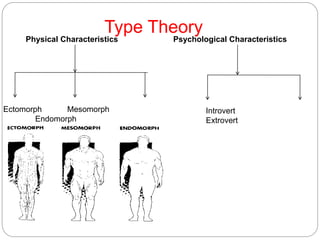
Type Theory
Physical Characteristics Psychological Characteristics
Ectomorph Mesomorph
Endomorph
Introvert
Extrovert
Psychoanalytic Theory
Personality comprises
a) Id- Meeting basic needs,creates tension if not
met.
- Pleasure Principle
- Involves primary process and reflex actions
a)Ego - Dealing with Reality
-Reality Principle
- makes decisions, controls actions and
allows thinking.
a) Superego- Adding morals
-
Social Learning Theory
 Learning through reinforcement and Learning
through observation.
 Situations determine human behaviour.
 Why do people behave differently in a particular
situation?
 Competencies
 Cognitive strategies
 Outcome expectations
 Subjective value outcome
 Self regulatory systems.
SHAPING OF PERSONALITY
 Freudian Stages
 Oral stage
 Anal stage
 Phallic stage
 Genital stage.
DETERMINANTS OF A PERSONALITY
Heredity
Environment
Situation
Social
Family
Personality Structure
THE BIG FIVE PERSONALITY TRAITS important traits of an individual’s total
personality :
Extraversion: refers to the extent to which a person is comfortable with other
people.
Agreeableness: refers to the extent to which a person subjugates for the
sake of the group.
 Conscientiousness: refers to the extent to which a person is responsible
and achievement oriented.
Emotional Stability: refers to the individual’s ability to withstand stress.
Openness to experience: refers to an individual’s range of interests and
indicates how innovative or how rigid he is in his beliefs.
.
The Self Concept: efforts made by an individual to understand his own self.
Self Esteem: refers to the self perceived competence and self image of people,
Self Efficacy refers to the person’s perception of his ability to cope with different
situations as they arise; measured along ‘level’, ‘strength’, and ‘generality’ dimensions
THE ATTRIBUTES THAT PREDICT THE INDIVIDUAL BEHAVIOUR
IN ORGANIZATIONS.
The Locus of Control: refers to an individual’s perception of what
controls his or her fate; believe that they are masters of their own
fate.; Internals Vs Externals.
Machiavellianism: refers to the degree to which an individual is
practical in his approach , maintains an emotional distance from
others and believes that end justifies means.
Self Esteem: The degree of liking an individual has for himself is
referred to as self esteem.
Self Monitoring: refers to the ability of an individual to adapt his
behaviour to the demands of the situations; High Self Monitors Vs
Low Self Monitors.
Risk taking: refers to the extent to which an individual is prepared to
take risks; High Risk taking people Vs Risk Averse People.
Type A and Type B Personality:
Maturation and Learning.
Levinson’s Theory of Adult Life Stages
Four periods of stability : 22 -28, 33-40, 45-50, 55-60.
The four transitional periods are : Age thirty transition( 28-33), Mid Life
transition( 40-45), Age fifty transition( 50-55) and Late adult transition( 60-65)
 Hall’s career Stage Model:
Exploration Stage, Establishment stage, Maintenance and Decline stage.
Argyris’ Immaturity to maturity Theory:
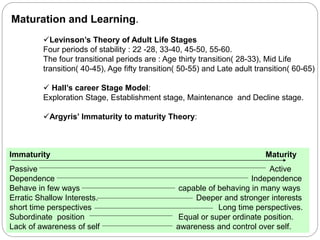
Immaturity Maturity
Passive Active
Dependence Independence
Behave in few ways capable of behaving in many ways
Erratic Shallow Interests. Deeper and stronger interests
short time perspectives Long time perspectives.
Subordinate position Equal or super ordinate position.
Lack of awareness of self awareness and control over self.
 Importance of matching personalities with Jobs.
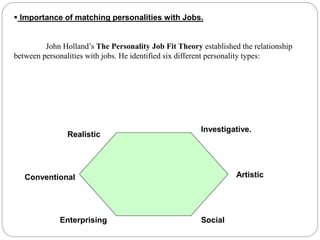
John Holland’s The Personality Job Fit Theory established the relationship
between personalities with jobs. He identified six different personality types:
Conventional
Enterprising Social
Artistic
Realistic
Investigative.
Personality 07042020

Personality 07042020

  • 1.
  • 2.
  • 3.
    WHAT IS PERSONALITY? Personality of a person is the sum total of ways in which an individual interacts with people and reacts to situations.  Elements of Personality:  It has both internal and external elements  An individual’s personality is relatively stable  It is inherited as well as shaped by the environment.  Each individual is unique.
  • 4.
    THEORIES OF PERSONALITY Type Theory  Trait Theory  Psychoanalytic  Social Learning  Humanistic
  • 5.
    Type Theory Physical CharacteristicsPsychological Characteristics Ectomorph Mesomorph Endomorph Introvert Extrovert
  • 6.
    Psychoanalytic Theory Personality comprises a)Id- Meeting basic needs,creates tension if not met. - Pleasure Principle - Involves primary process and reflex actions a)Ego - Dealing with Reality -Reality Principle - makes decisions, controls actions and allows thinking. a) Superego- Adding morals -
  • 7.
    Social Learning Theory Learning through reinforcement and Learning through observation.  Situations determine human behaviour.  Why do people behave differently in a particular situation?  Competencies  Cognitive strategies  Outcome expectations  Subjective value outcome  Self regulatory systems.
  • 8.
    SHAPING OF PERSONALITY Freudian Stages  Oral stage  Anal stage  Phallic stage  Genital stage.
  • 9.
    DETERMINANTS OF APERSONALITY Heredity Environment Situation Social Family
  • 10.
    Personality Structure THE BIGFIVE PERSONALITY TRAITS important traits of an individual’s total personality : Extraversion: refers to the extent to which a person is comfortable with other people. Agreeableness: refers to the extent to which a person subjugates for the sake of the group.  Conscientiousness: refers to the extent to which a person is responsible and achievement oriented. Emotional Stability: refers to the individual’s ability to withstand stress. Openness to experience: refers to an individual’s range of interests and indicates how innovative or how rigid he is in his beliefs. .
  • 11.
    The Self Concept:efforts made by an individual to understand his own self. Self Esteem: refers to the self perceived competence and self image of people, Self Efficacy refers to the person’s perception of his ability to cope with different situations as they arise; measured along ‘level’, ‘strength’, and ‘generality’ dimensions
  • 12.
    THE ATTRIBUTES THATPREDICT THE INDIVIDUAL BEHAVIOUR IN ORGANIZATIONS. The Locus of Control: refers to an individual’s perception of what controls his or her fate; believe that they are masters of their own fate.; Internals Vs Externals. Machiavellianism: refers to the degree to which an individual is practical in his approach , maintains an emotional distance from others and believes that end justifies means. Self Esteem: The degree of liking an individual has for himself is referred to as self esteem. Self Monitoring: refers to the ability of an individual to adapt his behaviour to the demands of the situations; High Self Monitors Vs Low Self Monitors. Risk taking: refers to the extent to which an individual is prepared to take risks; High Risk taking people Vs Risk Averse People. Type A and Type B Personality:
  • 13.
    Maturation and Learning. Levinson’sTheory of Adult Life Stages Four periods of stability : 22 -28, 33-40, 45-50, 55-60. The four transitional periods are : Age thirty transition( 28-33), Mid Life transition( 40-45), Age fifty transition( 50-55) and Late adult transition( 60-65)  Hall’s career Stage Model: Exploration Stage, Establishment stage, Maintenance and Decline stage. Argyris’ Immaturity to maturity Theory: Immaturity Maturity Passive Active Dependence Independence Behave in few ways capable of behaving in many ways Erratic Shallow Interests. Deeper and stronger interests short time perspectives Long time perspectives. Subordinate position Equal or super ordinate position. Lack of awareness of self awareness and control over self.
  • 14.
     Importance ofmatching personalities with Jobs. John Holland’s The Personality Job Fit Theory established the relationship between personalities with jobs. He identified six different personality types: Conventional Enterprising Social Artistic Realistic Investigative.