Personality
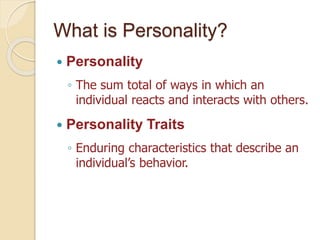
What is Personality?
 Personality
◦ The sum total of ways in which an
individual reacts and interacts with others.
 Personality Traits
◦ Enduring characteristics that describe an
individual’s behavior.
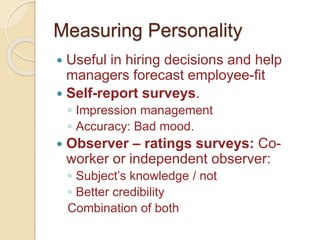
Measuring Personality
 Useful in hiring decisions and help
managers forecast employee-fit
 Self-report surveys.
◦ Impression management
◦ Accuracy: Bad mood.
 Observer – ratings surveys: Co-
worker or independent observer:
◦ Subject’s knowledge / not
◦ Better credibility
Combination of both
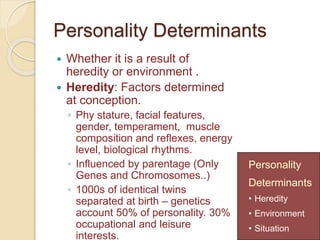
Personality Determinants
 Whether it is a result of
heredity or environment .
 Heredity: Factors determined
at conception.
◦ Phy stature, facial features,
gender, temperament, muscle
composition and reflexes, energy
level, biological rhythms.
◦ Influenced by parentage (Only
Genes and Chromosomes..)
◦ 1000s of identical twins
separated at birth – genetics
account 50% of personality. 30%
occupational and leisure
interests.
Personality
Determinants
• Heredity
• Environment
• Situation
 Personality is changeable in
adolescence and more stable among
adults.
 Characteristics in a large no of
situations - personality traits.
 Consistency over time and frequency
of expression indicate the trait
importance.
Personality Types
 Proactive Personality
◦ Identifies opportunities, shows initiative,
takes action, and perseveres until
meaningful change occurs.
◦ Creates positive change in the
environment, regardless or even in spite
of constraints or obstacles.
Locus of Control
 Locus of Control
◦ The degree to which people believe they are
masters of their own fate.
 Internals
Individuals who believe that they
control what happens to them.
 Externals
Individuals who believe that what
happens to them is controlled by
outside forces such as luck or chance.
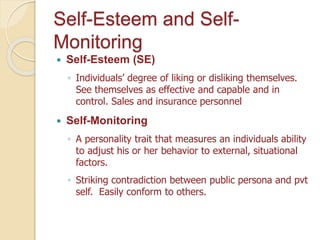
Self-Esteem and Self-
Monitoring
 Self-Esteem (SE)
◦ Individuals’ degree of liking or disliking themselves.
See themselves as effective and capable and in
control. Sales and insurance personnel
 Self-Monitoring
◦ A personality trait that measures an individuals ability
to adjust his or her behavior to external, situational
factors.
◦ Striking contradiction between public persona and pvt
self. Easily conform to others.
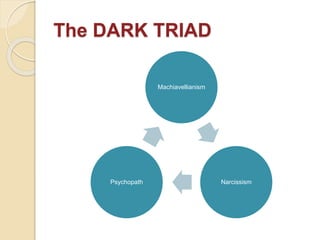
The DARK TRIAD
Machiavellianism
NarcissismPsychopath
Machiavellianism
 Machiavellianism (Mach)
◦ I do whatever I do to get ahead.
◦ Degree to which an individual is pragmatic,
maintains emotional distance, and believes
that ends can justify means.
◦ If it works use it
◦ Manipulate more and win more, persuaded
less.
◦ Engage in counter-productive activity
◦ Ethical leadership behavior less likely to
transalate to followers
Narcissism
 Tendency to be arrogant . Have a
grandiose sense of self –importance
 Require excessive admiration and have
a sense of entitlement.
 Greek myth of Narcissus.
 Higher levels of motivation and job
satisfaction
 Perceived as ineffective and unethical
leaders.
 It stresses them if they don’t get what
they want
Psychopath
 J.L. Koch – German Psychologist
 Lack of concern for others
 Lack of guilt or remorse while causing
harm
 Research suggests hard influence tactics
– threat, manipulations, bullying
 Right of person with disabilities bill, 2014
https://www.idrlabs.com/psychopathy/test.
php
The Myers-Briggs Type
Indicator:
 Most widely used
 100 questions – how they usually feel or
act in different situations.
◦ Extraverted: outgoing, sociable and
assertive.
VS
◦ Introverted: quiet and shy
◦ Sensing: practical, prefer routine and order.
Focus on details
VS
◦ Intuitive: unconscious processes and “Big
Picture”
 Thinking: use reason and logic to
handle problems.
VS
 Feeling: personal values and
emotions.
 Judging: want control and prefer
order and structure
VS
 Perceiving: flexible and spontaneous
INTJ – Visionaries,
ESTJ – Organizers
ENTP – Entrepreneurial Ideas
The Big Five Personality
Model
 Five basic dimensions
◦ Extraversion : comfort level with
relationships.
H-> Gregarious, assertive, and sociable.
L-> reserved, timid and quiet.
◦ Agreeableness: propensity to defer to
others
H-> co-operative, warm and trusting.
L-> cold, disagreeable and antagonistic.
◦ Conscientiousness : measure of
reliability:
H-> organized, dependable and
persistent
L-> distracted, disorganized and
unreliable
◦ Emotional Stability: inverse neuroticism
H->calm, self-confident and secure
L-> nervous, anxious, depressed and
insecure.
◦ Openness to experience: range of
interests and fascination with novelty
H-> creative, curious and artistically

Personality

  • 1.
  • 2.
    What is Personality? Personality ◦ The sum total of ways in which an individual reacts and interacts with others.  Personality Traits ◦ Enduring characteristics that describe an individual’s behavior.
  • 3.
    Measuring Personality  Usefulin hiring decisions and help managers forecast employee-fit  Self-report surveys. ◦ Impression management ◦ Accuracy: Bad mood.  Observer – ratings surveys: Co- worker or independent observer: ◦ Subject’s knowledge / not ◦ Better credibility Combination of both
  • 4.
    Personality Determinants  Whetherit is a result of heredity or environment .  Heredity: Factors determined at conception. ◦ Phy stature, facial features, gender, temperament, muscle composition and reflexes, energy level, biological rhythms. ◦ Influenced by parentage (Only Genes and Chromosomes..) ◦ 1000s of identical twins separated at birth – genetics account 50% of personality. 30% occupational and leisure interests. Personality Determinants • Heredity • Environment • Situation
  • 5.
     Personality ischangeable in adolescence and more stable among adults.  Characteristics in a large no of situations - personality traits.  Consistency over time and frequency of expression indicate the trait importance.
  • 6.
    Personality Types  ProactivePersonality ◦ Identifies opportunities, shows initiative, takes action, and perseveres until meaningful change occurs. ◦ Creates positive change in the environment, regardless or even in spite of constraints or obstacles.
  • 7.
    Locus of Control Locus of Control ◦ The degree to which people believe they are masters of their own fate.  Internals Individuals who believe that they control what happens to them.  Externals Individuals who believe that what happens to them is controlled by outside forces such as luck or chance.
  • 8.
    Self-Esteem and Self- Monitoring Self-Esteem (SE) ◦ Individuals’ degree of liking or disliking themselves. See themselves as effective and capable and in control. Sales and insurance personnel  Self-Monitoring ◦ A personality trait that measures an individuals ability to adjust his or her behavior to external, situational factors. ◦ Striking contradiction between public persona and pvt self. Easily conform to others.
  • 9.
  • 10.
    Machiavellianism  Machiavellianism (Mach) ◦I do whatever I do to get ahead. ◦ Degree to which an individual is pragmatic, maintains emotional distance, and believes that ends can justify means. ◦ If it works use it ◦ Manipulate more and win more, persuaded less. ◦ Engage in counter-productive activity ◦ Ethical leadership behavior less likely to transalate to followers
  • 11.
    Narcissism  Tendency tobe arrogant . Have a grandiose sense of self –importance  Require excessive admiration and have a sense of entitlement.  Greek myth of Narcissus.  Higher levels of motivation and job satisfaction  Perceived as ineffective and unethical leaders.  It stresses them if they don’t get what they want
  • 12.
    Psychopath  J.L. Koch– German Psychologist  Lack of concern for others  Lack of guilt or remorse while causing harm  Research suggests hard influence tactics – threat, manipulations, bullying  Right of person with disabilities bill, 2014 https://www.idrlabs.com/psychopathy/test. php
  • 13.
    The Myers-Briggs Type Indicator: Most widely used  100 questions – how they usually feel or act in different situations. ◦ Extraverted: outgoing, sociable and assertive. VS ◦ Introverted: quiet and shy ◦ Sensing: practical, prefer routine and order. Focus on details VS ◦ Intuitive: unconscious processes and “Big Picture”
  • 14.
     Thinking: usereason and logic to handle problems. VS  Feeling: personal values and emotions.  Judging: want control and prefer order and structure VS  Perceiving: flexible and spontaneous INTJ – Visionaries, ESTJ – Organizers ENTP – Entrepreneurial Ideas
  • 15.
    The Big FivePersonality Model  Five basic dimensions ◦ Extraversion : comfort level with relationships. H-> Gregarious, assertive, and sociable. L-> reserved, timid and quiet. ◦ Agreeableness: propensity to defer to others H-> co-operative, warm and trusting. L-> cold, disagreeable and antagonistic.
  • 16.
    ◦ Conscientiousness :measure of reliability: H-> organized, dependable and persistent L-> distracted, disorganized and unreliable ◦ Emotional Stability: inverse neuroticism H->calm, self-confident and secure L-> nervous, anxious, depressed and insecure. ◦ Openness to experience: range of interests and fascination with novelty H-> creative, curious and artistically