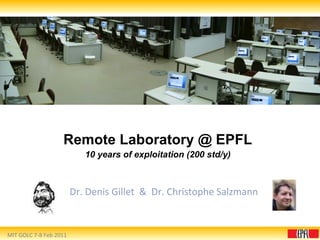
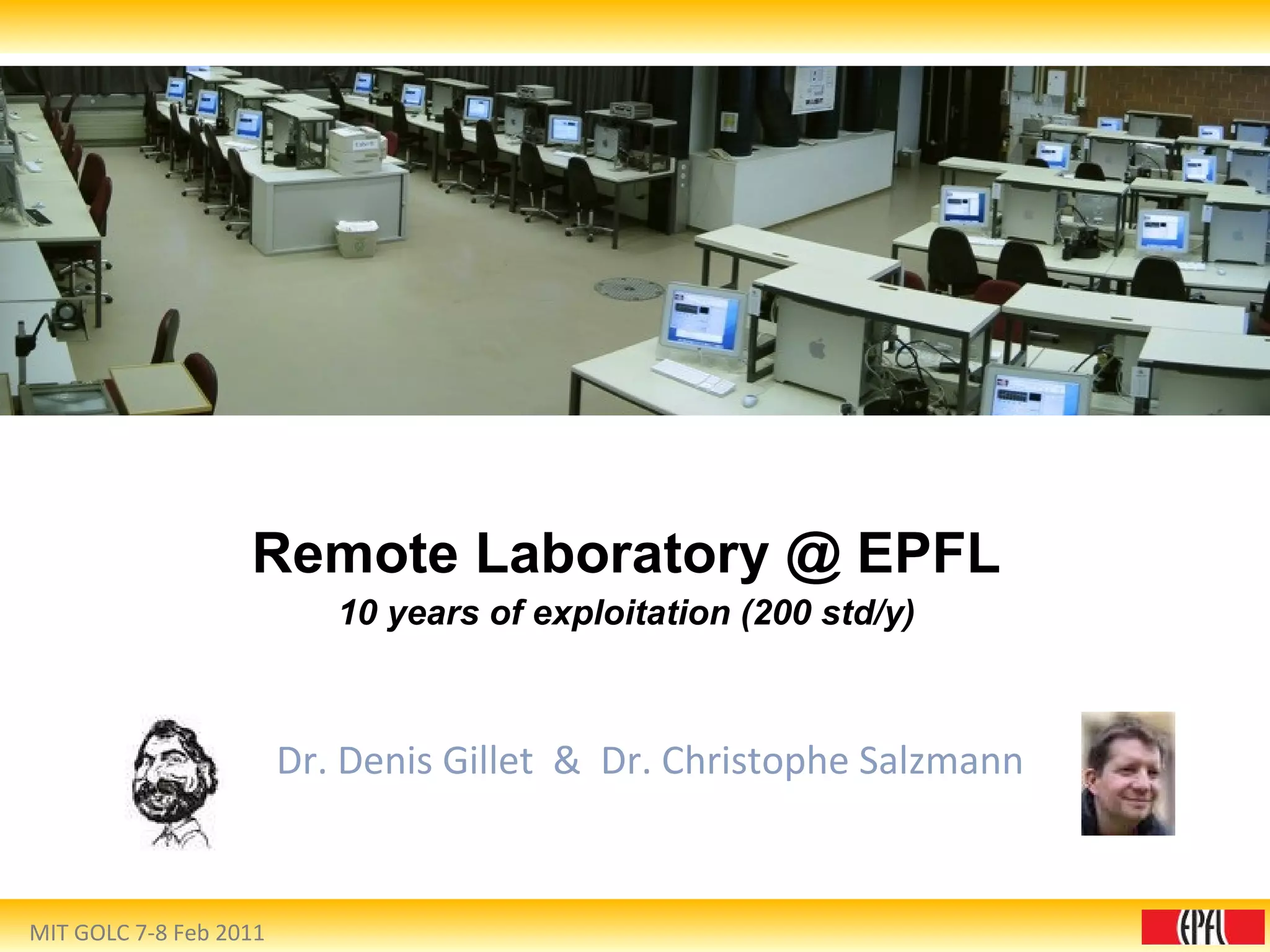
Remote Laboratory @ EPFL 10 years of exploitation (200 std/y) Dr. Denis Gillet  &  Dr. Christophe Salzmann MIT GOLC 7-8 Feb 2011
Research Context Swiss & European RTD research projects eMersion & Mentors 2001 : Hands-on Experimentation Modules and online Tutoring Services for Flexible Engineering Education ProLEARN 2004 : EU Research Network of Excellence in Professional Learning and Knowledge Management PALETTE 2006 : EU Pedagogically sustained Adaptive LEarning Through the exploitation of Tacit and Explicit knowledge (Online Learning Communities and Communities of Practice) ROLE 2009 : EU Integrated Project on Responsive Open Learning Environments (8M€) -  Leader Web 2.0 Service Bundles STELLAR 2009 : EU Research Network of Excellence in Technology Enhanced Learning (5M€) –  Executive
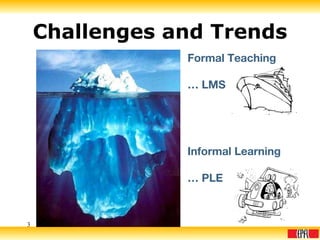
Challenges and Trends Formal Teaching …  LMS Informal Learning …  PLE
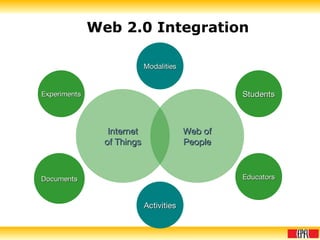
Web 2.0 Integration Internet of Things Web of People Experiments Students Educators Documents Activities Modalities
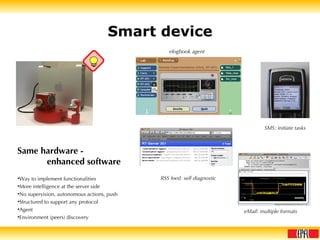
Smart device Same hardware -  enhanced software Way to implement functionalities More intelligence at the server side No supervision, autonomous actions, push Structured to support any protocol Agent Environment (peers) discovery elogbook agent SMS: initiate tasks eMail: multiple formats RSS feed: self diagnostic
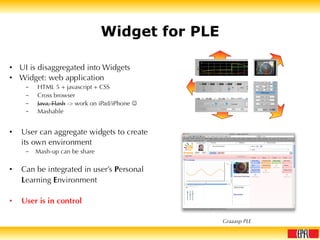
Widget for PLE Graaasp PLE
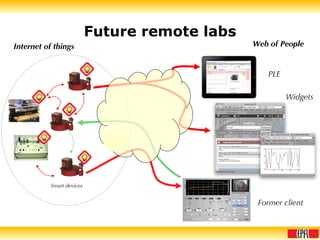
Future remote labs Internet of things PLE Widgets Former client Smart devices Web of People
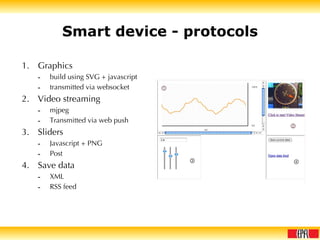
Smart device - protocols Graphics  build using SVG + javascript transmitted via websocket Video streaming mjpeg Transmitted via web push Sliders Javascript + PNG Post Save data XML RSS feed ① ② ③ ④
Challenges & constraints Pedagogical Appropriation by the students, provide added value  Appropriation by the educators Just work From everywhere, anytime, on any equipment Robust to students Does not require specific IT installation Should run on standard open-access computers No specific software need to be installed Firewall, blocking port Does not clog the Internet Follows Internet best practice, i.e. bandwidth adaptation Net neutrality

EPFL Remote Lab Framework

  • 1.
    Remote Laboratory @EPFL 10 years of exploitation (200 std/y) Dr. Denis Gillet & Dr. Christophe Salzmann MIT GOLC 7-8 Feb 2011
  • 2.
    Research Context Swiss& European RTD research projects eMersion & Mentors 2001 : Hands-on Experimentation Modules and online Tutoring Services for Flexible Engineering Education ProLEARN 2004 : EU Research Network of Excellence in Professional Learning and Knowledge Management PALETTE 2006 : EU Pedagogically sustained Adaptive LEarning Through the exploitation of Tacit and Explicit knowledge (Online Learning Communities and Communities of Practice) ROLE 2009 : EU Integrated Project on Responsive Open Learning Environments (8M€) - Leader Web 2.0 Service Bundles STELLAR 2009 : EU Research Network of Excellence in Technology Enhanced Learning (5M€) – Executive
  • 3.
    Challenges and TrendsFormal Teaching … LMS Informal Learning … PLE
  • 4.
    Web 2.0 IntegrationInternet of Things Web of People Experiments Students Educators Documents Activities Modalities
  • 5.
    Smart device Samehardware - enhanced software Way to implement functionalities More intelligence at the server side No supervision, autonomous actions, push Structured to support any protocol Agent Environment (peers) discovery elogbook agent SMS: initiate tasks eMail: multiple formats RSS feed: self diagnostic
  • 6.
    Widget for PLEGraaasp PLE
  • 7.
    Future remote labsInternet of things PLE Widgets Former client Smart devices Web of People
  • 8.
    Smart device -protocols Graphics build using SVG + javascript transmitted via websocket Video streaming mjpeg Transmitted via web push Sliders Javascript + PNG Post Save data XML RSS feed ① ② ③ ④
  • 9.
    Challenges & constraintsPedagogical Appropriation by the students, provide added value Appropriation by the educators Just work From everywhere, anytime, on any equipment Robust to students Does not require specific IT installation Should run on standard open-access computers No specific software need to be installed Firewall, blocking port Does not clog the Internet Follows Internet best practice, i.e. bandwidth adaptation Net neutrality

Editor's Notes

  • #4 Tip of the iceberg
  • #5 Optimal exploitation of resources and time for the acquisition of high-level engineering competences • Integration of Theory, computer-aided design and practice • Joint investment by faculty members and significant institutional support necessary to maintain such infrastructure