Dr Vijay David Raj R
Macrocytic Anemia
Size of RBC
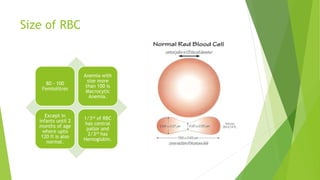
80 - 100
Femtolitres
Anemia with
size more
than 100 is
Macrocytic
Anemia.
Except in
infants until 2
months of age
where upto
120 fl is also
normal.
1/3rd of RBC
has central
pallor and
2/3rd has
Hemoglobin.
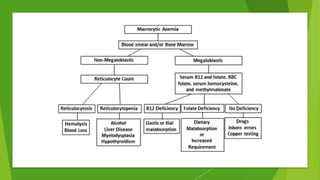
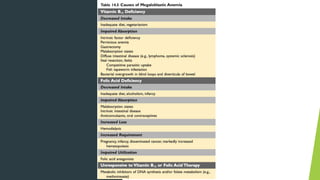
Classification of Macrocytic Anemias
Megaloblastic Anemia
Pernicious Anemia (B12 Deficiency)
Folate Deficiency
Non-Megaloblastic Anemias
Megaloblastic Anemia
Megaloblastic anemia has impairment of DNA
synthesis
that leads to ineffective hematopoiesis and
distinctive morphologic changes, including
abnormally large erythroid precursors and red cells.
Normal B12 Metabolism
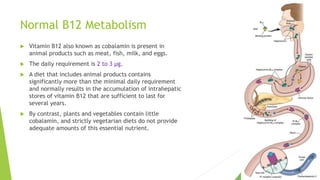
 Vitamin B12 also known as cobalamin is present in
animal products such as meat, fish, milk, and eggs.
 The daily requirement is 2 to 3 μg.
 A diet that includes animal products contains
significantly more than the minimal daily requirement
and normally results in the accumulation of intrahepatic
stores of vitamin B12 that are sufficient to last for
several years.
 By contrast, plants and vegetables contain little
cobalamin, and strictly vegetarian diets do not provide
adequate amounts of this essential nutrient.
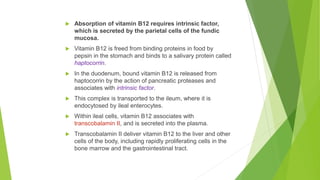
 Absorption of vitamin B12 requires intrinsic factor,
which is secreted by the parietal cells of the fundic
mucosa.
 Vitamin B12 is freed from binding proteins in food by
pepsin in the stomach and binds to a salivary protein called
haptocorrin.
 In the duodenum, bound vitamin B12 is released from
haptocorrin by the action of pancreatic proteases and
associates with intrinsic factor.
 This complex is transported to the ileum, where it is
endocytosed by ileal enterocytes.
 Within ileal cells, vitamin B12 associates with
transcobalamin II, and is secreted into the plasma.
 Transcobalamin II deliver vitamin B12 to the liver and other
cells of the body, including rapidly proliferating cells in the
bone marrow and the gastrointestinal tract.
Biochemical Use of
B12
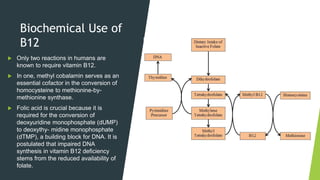
 Only two reactions in humans are
known to require vitamin B12.
 In one, methyl cobalamin serves as an
essential cofactor in the conversion of
homocysteine to methionine-by-
methionine synthase.
 Folic acid is crucial because it is
required for the conversion of
deoxyuridine monophosphate (dUMP)
to deoxythy- midine monophosphate
(dTMP), a building block for DNA. It is
postulated that impaired DNA
synthesis in vitamin B12 deficiency
stems from the reduced availability of
folate.
Pernicious Anemia
 Pernicious anemia is caused by an autoimmune gastritis that impairs
the production of Intrinsic factor, which is required for vitamin B12
uptake from the gut.
 It is a disease of older adults at around 60 years, and it is rare in people
younger than 30 years of age.
 A genetic predisposition is strongly suspected with many affected
individuals having a tendency to form antibodies against multiple self
antigens.
 Pernicious anemia is believed to result from an autoimmune attack on
the gastric mucosa.
Antibodies in Pernicious Anemia
 3 types of autoantibodies are present .
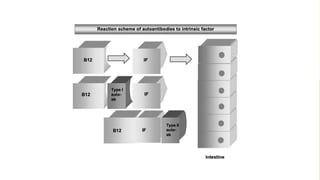
 Type I antibody blocks the binding of vitamin B12 to intrinsic factor.
 Type II antibodies prevent binding of the intrinsic factor–vitamin B12
complex by inhibiting absorption in ileum.
 Both type I and type II antibodies are found in plasma and gastric juice.
 Type III antibodies are present in 85% to 90% of patients and recognize
the α and β subunits of the gastric proton pump.Type III antibodies are
not specific, as they are found in as many as 50% of older adults with
idiopathic chronic gastritis.
B12 deficiency other than Pernicious Anemia
 Vitamin B12 deficiency also may arise from causes other than pernicious anemia.
 Achlorhydria and loss of pepsin secretion (which occurs in some older adults), vitamin
B12 is not readily released from proteins in food.
 With gastrectomy, intrinsic factor is lost.
 With insufficiency of the exocrine pancreas, vitamin B12 cannot be released from
haptocorrin-vitamin B12 complexes.
 Ileal resection or diffuse ileal disease may prevent adequate absorption of intrinsic
factor–vitamin B12 complex.
 Certain tapeworms (particularly those acquired by eating raw fish) compete with the
humans for B12 and can induce a deficiency state.
 In some settings, such as pregnancy, hyperthyroidism, disseminated cancer, and
chronic infection, an increased demand for vitamin B12 may produce a relative
deficiency, even with normal absorption.
Folate Deficiency
 The three major causes of folic acid deficiency are
 (1) decreased intake, (2) increased requirements, and (3) impaired utilization.
 Humans depend on dietary sources for folic acid.
 The richest sources are green vegetables such as lettuce, spinach, asparagus,
and broccoli. Certain fruits (e.g., lemons, bananas, melons) and animal sources
(e.g., liver) contain lesser amounts.
 Folate are sensitive to heat; boiling, steaming, or frying food for 5 to 10 minutes
destroys up to 95% of the folate content.
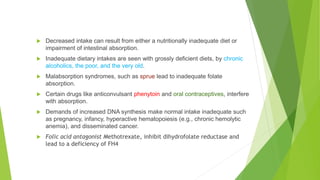
 Decreased intake can result from either a nutritionally inadequate diet or
impairment of intestinal absorption.
 Inadequate dietary intakes are seen with grossly deficient diets, by chronic
alcoholics, the poor, and the very old.
 Malabsorption syndromes, such as sprue lead to inadequate folate
absorption.
 Certain drugs like anticonvulsant phenytoin and oral contraceptives, interfere
with absorption.
 Demands of increased DNA synthesis make normal intake inadequate such
as pregnancy, infancy, hyperactive hematopoiesis (e.g., chronic hemolytic
anemia), and disseminated cancer.
 Folic acid antagonist Methotrexate, inhibit dihydrofolate reductase and
lead to a deficiency of FH4
Morphology In Megaloblastic Anemia
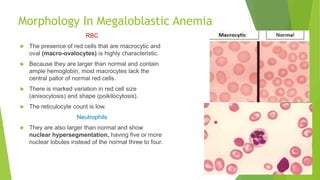
RBC
 The presence of red cells that are macrocytic and
oval (macro-ovalocytes) is highly characteristic.
 Because they are larger than normal and contain
ample hemoglobin, most macrocytes lack the
central pallor of normal red cells.
 There is marked variation in red cell size
(anisocytosis) and shape (poikilocytosis).
 The reticulocyte count is low.
Neutrophils
 They are also larger than normal and show
nuclear hypersegmentation, having five or more
nuclear lobules instead of the normal three to four.
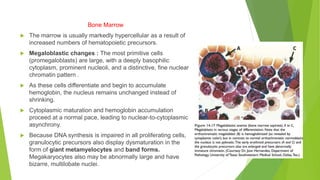
Bone Marrow
 The marrow is usually markedly hypercellular as a result of
increased numbers of hematopoietic precursors.
 Megaloblastic changes : The most primitive cells
(promegaloblasts) are large, with a deeply basophilic
cytoplasm, prominent nucleoli, and a distinctive, fine nuclear
chromatin pattern .
 As these cells differentiate and begin to accumulate
hemoglobin, the nucleus remains unchanged instead of
shrinking.
 Cytoplasmic maturation and hemoglobin accumulation
proceed at a normal pace, leading to nuclear-to-cytoplasmic
asynchrony.
 Because DNA synthesis is impaired in all proliferating cells,
granulocytic precursors also display dysmaturation in the
form of giant metamyelocytes and band forms.
Megakaryocytes also may be abnormally large and have
bizarre, multilobate nuclei.
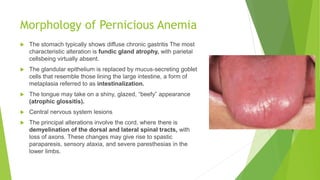
Morphology of Pernicious Anemia
 The stomach typically shows diffuse chronic gastritis The most
characteristic alteration is fundic gland atrophy, with parietal
cellsbeing virtually absent.
 The glandular epithelium is replaced by mucus-secreting goblet
cells that resemble those lining the large intestine, a form of
metaplasia referred to as intestinalization.
 The tongue may take on a shiny, glazed, “beefy” appearance
(atrophic glossitis).
 Central nervous system lesions
 The principal alterations involve the cord, where there is
demyelination of the dorsal and lateral spinal tracts, with
loss of axons. These changes may give rise to spastic
paraparesis, sensory ataxia, and severe paresthesias in the
lower limbs.
Non Megaloblastic Anemias

Macrocytic ANmeia.pptx

  • 1.
    Dr Vijay DavidRaj R Macrocytic Anemia
  • 2.
    Size of RBC 80- 100 Femtolitres Anemia with size more than 100 is Macrocytic Anemia. Except in infants until 2 months of age where upto 120 fl is also normal. 1/3rd of RBC has central pallor and 2/3rd has Hemoglobin.
  • 3.
    Classification of MacrocyticAnemias Megaloblastic Anemia Pernicious Anemia (B12 Deficiency) Folate Deficiency Non-Megaloblastic Anemias
  • 5.
    Megaloblastic Anemia Megaloblastic anemiahas impairment of DNA synthesis that leads to ineffective hematopoiesis and distinctive morphologic changes, including abnormally large erythroid precursors and red cells.
  • 7.
    Normal B12 Metabolism Vitamin B12 also known as cobalamin is present in animal products such as meat, fish, milk, and eggs.  The daily requirement is 2 to 3 μg.  A diet that includes animal products contains significantly more than the minimal daily requirement and normally results in the accumulation of intrahepatic stores of vitamin B12 that are sufficient to last for several years.  By contrast, plants and vegetables contain little cobalamin, and strictly vegetarian diets do not provide adequate amounts of this essential nutrient.
  • 8.
     Absorption ofvitamin B12 requires intrinsic factor, which is secreted by the parietal cells of the fundic mucosa.  Vitamin B12 is freed from binding proteins in food by pepsin in the stomach and binds to a salivary protein called haptocorrin.  In the duodenum, bound vitamin B12 is released from haptocorrin by the action of pancreatic proteases and associates with intrinsic factor.  This complex is transported to the ileum, where it is endocytosed by ileal enterocytes.  Within ileal cells, vitamin B12 associates with transcobalamin II, and is secreted into the plasma.  Transcobalamin II deliver vitamin B12 to the liver and other cells of the body, including rapidly proliferating cells in the bone marrow and the gastrointestinal tract.
  • 9.
    Biochemical Use of B12 Only two reactions in humans are known to require vitamin B12.  In one, methyl cobalamin serves as an essential cofactor in the conversion of homocysteine to methionine-by- methionine synthase.  Folic acid is crucial because it is required for the conversion of deoxyuridine monophosphate (dUMP) to deoxythy- midine monophosphate (dTMP), a building block for DNA. It is postulated that impaired DNA synthesis in vitamin B12 deficiency stems from the reduced availability of folate.
  • 10.
    Pernicious Anemia  Perniciousanemia is caused by an autoimmune gastritis that impairs the production of Intrinsic factor, which is required for vitamin B12 uptake from the gut.  It is a disease of older adults at around 60 years, and it is rare in people younger than 30 years of age.  A genetic predisposition is strongly suspected with many affected individuals having a tendency to form antibodies against multiple self antigens.  Pernicious anemia is believed to result from an autoimmune attack on the gastric mucosa.
  • 11.
    Antibodies in PerniciousAnemia  3 types of autoantibodies are present .  Type I antibody blocks the binding of vitamin B12 to intrinsic factor.  Type II antibodies prevent binding of the intrinsic factor–vitamin B12 complex by inhibiting absorption in ileum.  Both type I and type II antibodies are found in plasma and gastric juice.  Type III antibodies are present in 85% to 90% of patients and recognize the α and β subunits of the gastric proton pump.Type III antibodies are not specific, as they are found in as many as 50% of older adults with idiopathic chronic gastritis.
  • 13.
    B12 deficiency otherthan Pernicious Anemia  Vitamin B12 deficiency also may arise from causes other than pernicious anemia.  Achlorhydria and loss of pepsin secretion (which occurs in some older adults), vitamin B12 is not readily released from proteins in food.  With gastrectomy, intrinsic factor is lost.  With insufficiency of the exocrine pancreas, vitamin B12 cannot be released from haptocorrin-vitamin B12 complexes.  Ileal resection or diffuse ileal disease may prevent adequate absorption of intrinsic factor–vitamin B12 complex.  Certain tapeworms (particularly those acquired by eating raw fish) compete with the humans for B12 and can induce a deficiency state.  In some settings, such as pregnancy, hyperthyroidism, disseminated cancer, and chronic infection, an increased demand for vitamin B12 may produce a relative deficiency, even with normal absorption.
  • 14.
    Folate Deficiency  Thethree major causes of folic acid deficiency are  (1) decreased intake, (2) increased requirements, and (3) impaired utilization.  Humans depend on dietary sources for folic acid.  The richest sources are green vegetables such as lettuce, spinach, asparagus, and broccoli. Certain fruits (e.g., lemons, bananas, melons) and animal sources (e.g., liver) contain lesser amounts.  Folate are sensitive to heat; boiling, steaming, or frying food for 5 to 10 minutes destroys up to 95% of the folate content.
  • 15.
     Decreased intakecan result from either a nutritionally inadequate diet or impairment of intestinal absorption.  Inadequate dietary intakes are seen with grossly deficient diets, by chronic alcoholics, the poor, and the very old.  Malabsorption syndromes, such as sprue lead to inadequate folate absorption.  Certain drugs like anticonvulsant phenytoin and oral contraceptives, interfere with absorption.  Demands of increased DNA synthesis make normal intake inadequate such as pregnancy, infancy, hyperactive hematopoiesis (e.g., chronic hemolytic anemia), and disseminated cancer.  Folic acid antagonist Methotrexate, inhibit dihydrofolate reductase and lead to a deficiency of FH4
  • 16.
    Morphology In MegaloblasticAnemia RBC  The presence of red cells that are macrocytic and oval (macro-ovalocytes) is highly characteristic.  Because they are larger than normal and contain ample hemoglobin, most macrocytes lack the central pallor of normal red cells.  There is marked variation in red cell size (anisocytosis) and shape (poikilocytosis).  The reticulocyte count is low. Neutrophils  They are also larger than normal and show nuclear hypersegmentation, having five or more nuclear lobules instead of the normal three to four.
  • 17.
    Bone Marrow  Themarrow is usually markedly hypercellular as a result of increased numbers of hematopoietic precursors.  Megaloblastic changes : The most primitive cells (promegaloblasts) are large, with a deeply basophilic cytoplasm, prominent nucleoli, and a distinctive, fine nuclear chromatin pattern .  As these cells differentiate and begin to accumulate hemoglobin, the nucleus remains unchanged instead of shrinking.  Cytoplasmic maturation and hemoglobin accumulation proceed at a normal pace, leading to nuclear-to-cytoplasmic asynchrony.  Because DNA synthesis is impaired in all proliferating cells, granulocytic precursors also display dysmaturation in the form of giant metamyelocytes and band forms. Megakaryocytes also may be abnormally large and have bizarre, multilobate nuclei.
  • 19.
    Morphology of PerniciousAnemia  The stomach typically shows diffuse chronic gastritis The most characteristic alteration is fundic gland atrophy, with parietal cellsbeing virtually absent.  The glandular epithelium is replaced by mucus-secreting goblet cells that resemble those lining the large intestine, a form of metaplasia referred to as intestinalization.  The tongue may take on a shiny, glazed, “beefy” appearance (atrophic glossitis).  Central nervous system lesions  The principal alterations involve the cord, where there is demyelination of the dorsal and lateral spinal tracts, with loss of axons. These changes may give rise to spastic paraparesis, sensory ataxia, and severe paresthesias in the lower limbs.
  • 20.