Permanent Posterior
Teeth
MANDIBULAR FIRST, SECOND AND THIRD MOLARS
General Information
 Six mandibular molars
Three in each quadrant
Named for position in the arch, e.g. first, second and third molar
 Mandibular first molar is first permanent tooth to erupt
Its positioning in the arch is important for the appropriate
alignment of other permanent teeth
Considered the “keystone” of the dental arch
 Roots are bifurcated
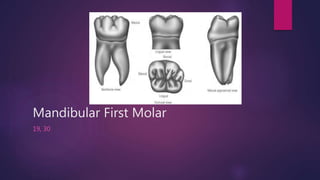
Mandibular First Molar
19, 30
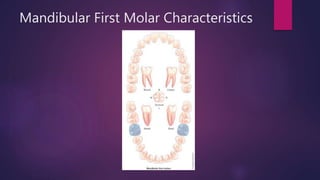
Mandibular First Molar Characteristics
Universal Number: R-#30 L-#19
Eruption Date: 6-7 years
First Evidence of Calcification: birth
Crown Completion: 2 ½ - 3 years
Root Completion: 9-10 years
Mandibular First Molar Characteristics
Function: mastication and comminution
Length of Crown: 7.5mm
Length of Root: 14mm
Antagonists: Maxillary second premolar and first
molar
Mandibular First Molar
Identifying Features
 Five cusps: mesiobuccal, distobuccal, distal, mesiolingual,
distolingual
 Mesial and distal roots
 Three pulp canals
Two in mesial root, one in distal root
 Largest mandibular tooth
 First permanent tooth to erupt
Mandibular First Molar Characteristics
Mandibular First Molar
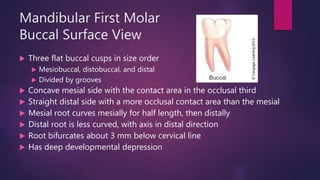
Buccal Surface View
 Three flat buccal cusps in size order
 Mesiobuccal, distobuccal, and distal
 Divided by grooves
 Concave mesial side with the contact area in the occlusal third
 Straight distal side with a more occlusal contact area than the mesial
 Mesial root curves mesially for half length, then distally
 Distal root is less curved, with axis in distal direction
 Root bifurcates about 3 mm below cervical line
 Has deep developmental depression
Mandibular First Molar
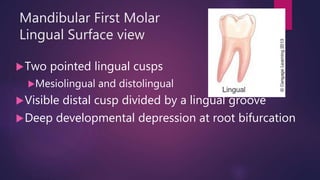
Lingual Surface view
Two pointed lingual cusps
Mesiolingual and distolingual
Visible distal cusp divided by a lingual groove
Deep developmental depression at root bifurcation
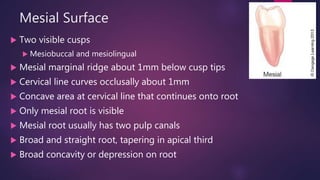
Mesial Surface
 Two visible cusps
 Mesiobuccal and mesiolingual
 Mesial marginal ridge about 1mm below cusp tips
 Cervical line curves occlusally about 1mm
 Concave area at cervical line that continues onto root
 Only mesial root is visible
 Mesial root usually has two pulp canals
 Broad and straight root, tapering in apical third
 Broad concavity or depression on root
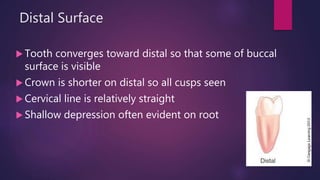
Distal Surface
 Tooth converges toward distal so that some of buccal
surface is visible
 Crown is shorter on distal so all cusps seen
 Cervical line is relatively straight
 Shallow depression often evident on root
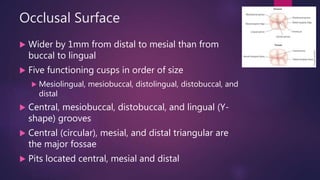
Occlusal Surface
 Wider by 1mm from distal to mesial than from
buccal to lingual
 Five functioning cusps in order of size
 Mesiolingual, mesiobuccal, distolingual, distobuccal, and
distal
 Central, mesiobuccal, distobuccal, and lingual (Y-
shape) grooves
 Central (circular), mesial, and distal triangular are
the major fossae
 Pits located central, mesial and distal
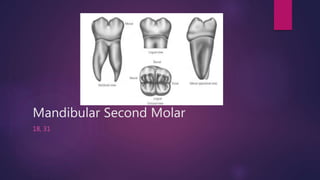
Mandibular Second Molar
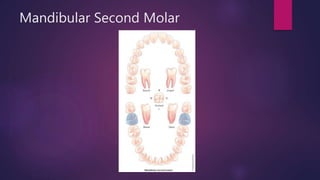
18, 31
Mandibular Second Molar
Universal Number: R-#31 L-#18
Eruption Date: 11-13 years
First Evidence of Calcification: 2½-3 years
Crown Completion: 7 – 8 years
Root Completion: 14 - 15 years
Mandibular Second Molar
Function: mastication and comminution
Length of Crown: 7mm
Length of Root: 13mm
Antagonists: maxillary first and second
molars
Mandibular Second Molar Identifying
Features
Four cusps: mesiobuccal, distobuccal, mesiolingual,
distolingual
Two roots: mesial and distal
Two pulp canals: one in each root
Mandibular Second Molar
Mandibular Second Molar Variations from
First Molar
 The mandibular second molar varies from the first molar
It’s smaller
There are only 4 cusps
The buccal groove divides the 2 buccal cusps
The lingual groove divides the two lingual cusps
 The mesial side is wider; only one pulp canal
 The occlusal has more supplementary grooves
Mandibular First and Second Molars
 Mandibular first molar has five cusps (3 buccal, 2 lingual)
 Mandibular second molars have four cusps (2 buccal, 2 lingual)
 Mandibular Molars have two roots, one mesial and one distal
 Maxillary molars have three roots, two buccal one lingual
 All teeth have one pulp canal in each root, but the mandibular first
molar is often an exception
 There are three pulp canals in the two roots: the mesial root has two pulp
canals, and the distal root has one
 The mandibular second molar has only on pulp canal in each root
Mandibular Third Molar
17, 32
General Information
Both maxillary and mandibular third molars
show considerable developmental variation
No standard structural description
Most likely tooth to have anomalies
Often crown displacement and
fused/malformed roots
Mandibular Third Molar
Universal Number: 17, 32
Eruption Date: 17-21 years old
First Evidence of Calcification: 8-10 years old
Crown Completion: 12-16 years old
Root Completion: 18-25 years old
Mandibular Third Molar
Function: mastication and comminution
Length of Crown: 7mm
Length of Root:11mm
Antagonists: Maxillary second and third
molar
Mandibular Third Molar
Identifying Features
Often the crown is atypical
Fused roots (two roots)
May resemble first or second molar
Mandibular Third Molar
Clinical Considerations
 Often crowns do not conform to normal size
 Often have fused roots
 When well-developed, will look like first or second molar
 Frequently, the maxillary third molar is heart-shaped, where
the mandibular third molar is often atypical.

Permanent posterior teeth mandibular first, second and third molars

  • 1.
  • 2.
    General Information  Sixmandibular molars Three in each quadrant Named for position in the arch, e.g. first, second and third molar  Mandibular first molar is first permanent tooth to erupt Its positioning in the arch is important for the appropriate alignment of other permanent teeth Considered the “keystone” of the dental arch  Roots are bifurcated
  • 3.
  • 4.
    Mandibular First MolarCharacteristics Universal Number: R-#30 L-#19 Eruption Date: 6-7 years First Evidence of Calcification: birth Crown Completion: 2 ½ - 3 years Root Completion: 9-10 years
  • 5.
    Mandibular First MolarCharacteristics Function: mastication and comminution Length of Crown: 7.5mm Length of Root: 14mm Antagonists: Maxillary second premolar and first molar
  • 6.
    Mandibular First Molar IdentifyingFeatures  Five cusps: mesiobuccal, distobuccal, distal, mesiolingual, distolingual  Mesial and distal roots  Three pulp canals Two in mesial root, one in distal root  Largest mandibular tooth  First permanent tooth to erupt
  • 7.
    Mandibular First MolarCharacteristics
  • 8.
    Mandibular First Molar BuccalSurface View  Three flat buccal cusps in size order  Mesiobuccal, distobuccal, and distal  Divided by grooves  Concave mesial side with the contact area in the occlusal third  Straight distal side with a more occlusal contact area than the mesial  Mesial root curves mesially for half length, then distally  Distal root is less curved, with axis in distal direction  Root bifurcates about 3 mm below cervical line  Has deep developmental depression
  • 9.
    Mandibular First Molar LingualSurface view Two pointed lingual cusps Mesiolingual and distolingual Visible distal cusp divided by a lingual groove Deep developmental depression at root bifurcation
  • 10.
    Mesial Surface  Twovisible cusps  Mesiobuccal and mesiolingual  Mesial marginal ridge about 1mm below cusp tips  Cervical line curves occlusally about 1mm  Concave area at cervical line that continues onto root  Only mesial root is visible  Mesial root usually has two pulp canals  Broad and straight root, tapering in apical third  Broad concavity or depression on root
  • 11.
    Distal Surface  Toothconverges toward distal so that some of buccal surface is visible  Crown is shorter on distal so all cusps seen  Cervical line is relatively straight  Shallow depression often evident on root
  • 12.
    Occlusal Surface  Widerby 1mm from distal to mesial than from buccal to lingual  Five functioning cusps in order of size  Mesiolingual, mesiobuccal, distolingual, distobuccal, and distal  Central, mesiobuccal, distobuccal, and lingual (Y- shape) grooves  Central (circular), mesial, and distal triangular are the major fossae  Pits located central, mesial and distal
  • 13.
  • 14.
    Mandibular Second Molar UniversalNumber: R-#31 L-#18 Eruption Date: 11-13 years First Evidence of Calcification: 2½-3 years Crown Completion: 7 – 8 years Root Completion: 14 - 15 years
  • 15.
    Mandibular Second Molar Function:mastication and comminution Length of Crown: 7mm Length of Root: 13mm Antagonists: maxillary first and second molars
  • 16.
    Mandibular Second MolarIdentifying Features Four cusps: mesiobuccal, distobuccal, mesiolingual, distolingual Two roots: mesial and distal Two pulp canals: one in each root
  • 17.
  • 18.
    Mandibular Second MolarVariations from First Molar  The mandibular second molar varies from the first molar It’s smaller There are only 4 cusps The buccal groove divides the 2 buccal cusps The lingual groove divides the two lingual cusps  The mesial side is wider; only one pulp canal  The occlusal has more supplementary grooves
  • 19.
    Mandibular First andSecond Molars  Mandibular first molar has five cusps (3 buccal, 2 lingual)  Mandibular second molars have four cusps (2 buccal, 2 lingual)  Mandibular Molars have two roots, one mesial and one distal  Maxillary molars have three roots, two buccal one lingual  All teeth have one pulp canal in each root, but the mandibular first molar is often an exception  There are three pulp canals in the two roots: the mesial root has two pulp canals, and the distal root has one  The mandibular second molar has only on pulp canal in each root
  • 20.
  • 21.
    General Information Both maxillaryand mandibular third molars show considerable developmental variation No standard structural description Most likely tooth to have anomalies Often crown displacement and fused/malformed roots
  • 22.
    Mandibular Third Molar UniversalNumber: 17, 32 Eruption Date: 17-21 years old First Evidence of Calcification: 8-10 years old Crown Completion: 12-16 years old Root Completion: 18-25 years old
  • 23.
    Mandibular Third Molar Function:mastication and comminution Length of Crown: 7mm Length of Root:11mm Antagonists: Maxillary second and third molar
  • 24.
    Mandibular Third Molar IdentifyingFeatures Often the crown is atypical Fused roots (two roots) May resemble first or second molar
  • 25.
    Mandibular Third Molar ClinicalConsiderations  Often crowns do not conform to normal size  Often have fused roots  When well-developed, will look like first or second molar  Frequently, the maxillary third molar is heart-shaped, where the mandibular third molar is often atypical.