1
MANDIBULAR CENTRAL
INCISOR
2
3
1/11/2024 Free Template from
www.brainybetty.com
4
INTRODUCTION
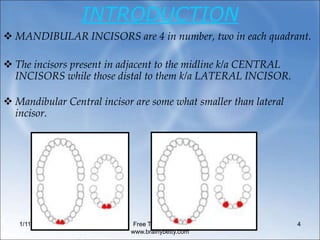
๏ถ MANDIBULAR INCISORS are 4 in number, two in each quadrant.
๏ถ The incisors present in adjacent to the midline k/a CENTRAL
INCISORS while those distal to them k/a LATERAL INCISOR.
๏ถ Mandibular Central incisor are some what smaller than lateral
incisor.
PECULIAR FEATURES
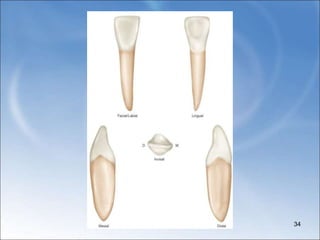
โ€ข It is the smallest tooth in both permanent and primary
dentition
โ€ข The tooth is bilaterally symmetrical so it is very difficult to
tell which side it is
โ€ข It is smallest mesio-distally by dimension than any other
tooth in dentition
โ€ข The incisal ridge is at right angle to tooth central axis
which is a distinguishing feature between mandibular
central and lateral incisor
5
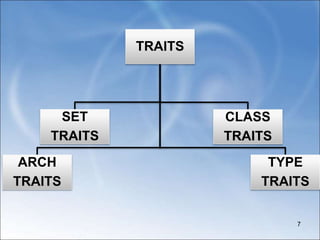
TRAITS
A trait is distinguishing characteristic ,quality ,pecularity ,or attribute.
6
TRAITS
SET
TRAITS
ARCH
TRAITS
CLASS
TRAITS
TYPE
TRAITS
7
1. SET TRAITS
โ€ข Also known as โ€œDENTITION TRAITSโ€.
โ€ข Distinguish the teeth in primary dentition from
permanent dentition.
โ€ข For eg.in primary dentition set of 20 teeth is
present whereas in permanent dentition 32 teeth is
present.
8
2. ARCH TRAITS
โ€ข Distinguish the maxillary arch teeth from
mandibular arch teeth.
โ€ข For eg. maxillary has โ€˜Uโ€™ shaped arch and
in mandible its โ€˜Vโ€™ shape arch.
9
3. CLASS TRAITS
โ€ข It distinguish four categories of teeth found in both
arches.
โ€ข Eg:- incisors have crown compressed labiolingually for
efficient cutting.
โ€ข Canine have single pointed cusp for piercing food.
10
โ€ข Premolars have two or three cusp for
shearing and grinding.
โ€ข Molars have three to five somewhat
flattened cusps, ideally suited for grinding
food morsels
11
4. TYPE TRAITS
โ€ข Differentiate teeth within one class.
โ€ข Eg:- between central and lateral incisors
โ€ข Or between 1st and 2nd pre molars.
12
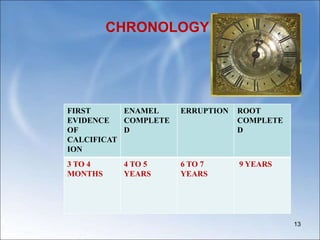
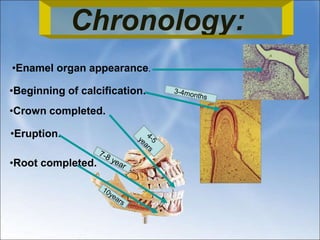
CHRONOLOGY
FIRST
EVIDENCE
OF
CALCIFICAT
ION
ENAMEL
COMPLETE
D
ERRUPTION ROOT
COMPLETE
D
3 TO 4
MONTHS
4 TO 5
YEARS
6 TO 7
YEARS
9 YEARS
13
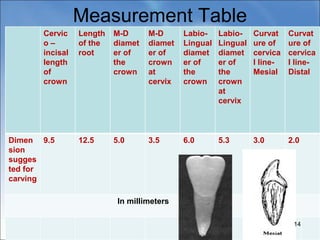
Measurement Table
Cervic
o โ€“
incisal
length
of
crown
Length
of the
root
M-D
diamet
er of
the
crown
M-D
diamet
er of
crown
at
cervix
Labio-
Lingual
diamet
er of
the
crown
Labio-
Lingual
diamet
er of
the
crown
at
cervix
Curvat
ure of
cervica
l line-
Mesial
Curvat
ure of
cervica
l line-
Distal
Dimen
sion
sugges
ted for
carving
9.5 12.5 5.0 3.5 6.0 5.3 3.0 2.0
In millimeters
14
BRIEF STUDY
โ€ข LABIAL ASPECT
โ€ข LINGUAL ASPECT
โ€ข PROXIMAL ASPECT
โ€ข INCISAL ASPECT
โ€ข ROOT 15
LABIAL SURFACE
16
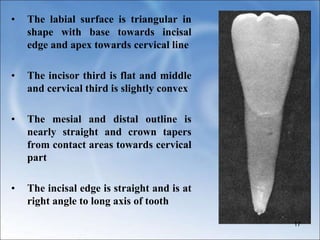
โ€ข The labial surface is triangular in
shape with base towards incisal
edge and apex towards cervical line
โ€ข The incisor third is flat and middle
and cervical third is slightly convex
โ€ข The mesial and distal outline is
nearly straight and crown tapers
from contact areas towards cervical
part
โ€ข The incisal edge is straight and is at
right angle to long axis of tooth
17
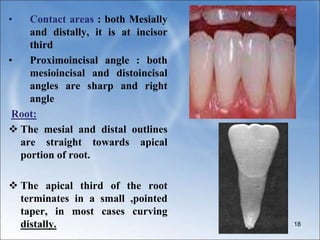
โ€ข Contact areas : both Mesially
and distally, it is at incisor
third
โ€ข Proximoincisal angle : both
mesioincisal and distoincisal
angles are sharp and right
angle
Root:
๏ถ The mesial and distal outlines
are straight towards apical
portion of root.
๏ถ The apical third of the root
terminates in a small ,pointed
taper, in most cases curving
distally. 18
LINGUAL SURFACE
19
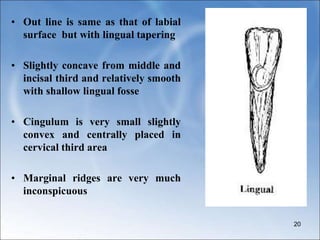
โ€ข Out line is same as that of labial
surface but with lingual tapering
โ€ข Slightly concave from middle and
incisal third and relatively smooth
with shallow lingual fosse
โ€ข Cingulum is very small slightly
convex and centrally placed in
cervical third area
โ€ข Marginal ridges are very much
inconspicuous
20
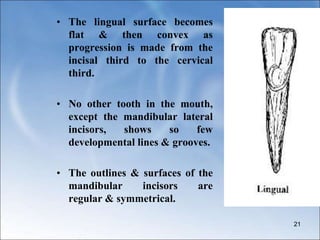
โ€ข The lingual surface becomes
flat & then convex as
progression is made from the
incisal third to the cervical
third.
โ€ข No other tooth in the mouth,
except the mandibular lateral
incisors, shows so few
developmental lines & grooves.
โ€ข The outlines & surfaces of the
mandibular incisors are
regular & symmetrical.
21
MESIAL ASPECT
22
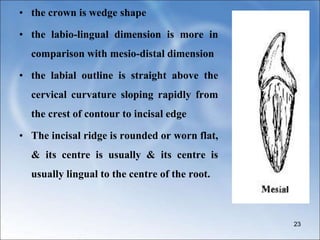
โ€ข the crown is wedge shape
โ€ข the labio-lingual dimension is more in
comparison with mesio-distal dimension
โ€ข the labial outline is straight above the
cervical curvature sloping rapidly from
the crest of contour to incisal edge
โ€ข The incisal ridge is rounded or worn flat,
& its centre is usually & its centre is
usually lingual to the centre of the root.
23
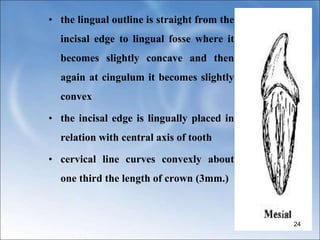
โ€ข the lingual outline is straight from the
incisal edge to lingual fosse where it
becomes slightly concave and then
again at cingulum it becomes slightly
convex
โ€ข the incisal edge is lingually placed in
relation with central axis of tooth
โ€ข cervical line curves convexly about
one third the length of crown (3mm.)
24
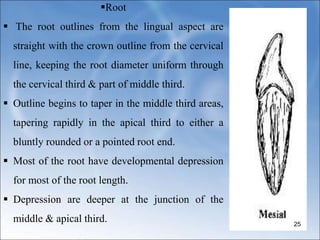
๏‚งRoot
๏‚ง The root outlines from the lingual aspect are
straight with the crown outline from the cervical
line, keeping the root diameter uniform through
the cervical third & part of middle third.
๏‚ง Outline begins to taper in the middle third areas,
tapering rapidly in the apical third to either a
bluntly rounded or a pointed root end.
๏‚ง Most of the root have developmental depression
for most of the root length.
๏‚ง Depression are deeper at the junction of the
middle & apical third. 25
DISTAL SURFACE
26
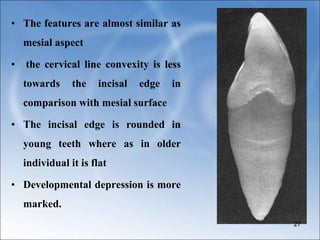
โ€ข The features are almost similar as
mesial aspect
โ€ข the cervical line convexity is less
towards the incisal edge in
comparison with mesial surface
โ€ข The incisal edge is rounded in
young teeth where as in older
individual it is flat
โ€ข Developmental depression is more
marked.
27
INCISAL SURFACE
28
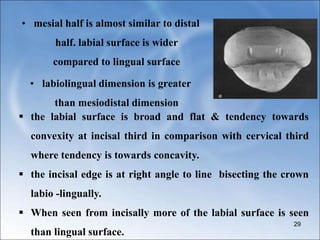
โ€ข mesial half is almost similar to distal
half. labial surface is wider
compared to lingual surface
โ€ข labiolingual dimension is greater
than mesiodistal dimension
๏‚ง the labial surface is broad and flat & tendency towards
convexity at incisal third in comparison with cervical third
where tendency is towards concavity.
๏‚ง the incisal edge is at right angle to line bisecting the crown
labio -lingually.
๏‚ง When seen from incisally more of the labial surface is seen
than lingual surface.
29
ROOT
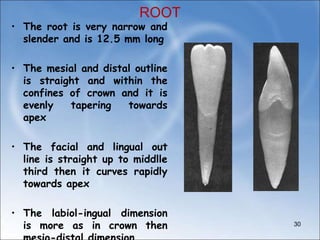
โ€ข The root is very narrow and
slender and is 12.5 mm long
โ€ข The mesial and distal outline
is straight and within the
confines of crown and it is
evenly tapering towards
apex
โ€ข The facial and lingual out
line is straight up to middlle
third then it curves rapidly
towards apex
โ€ข The labiol-ingual dimension
is more as in crown then 30
MANDIBULAR LATERAL
INCISOR
31
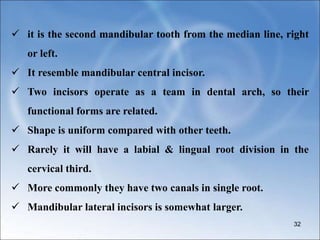
๏ƒผ it is the second mandibular tooth from the median line, right
or left.
๏ƒผ It resemble mandibular central incisor.
๏ƒผ Two incisors operate as a team in dental arch, so their
functional forms are related.
๏ƒผ Shape is uniform compared with other teeth.
๏ƒผ Rarely it will have a labial & lingual root division in the
cervical third.
๏ƒผ More commonly they have two canals in single root.
๏ƒผ Mandibular lateral incisors is somewhat larger.
32
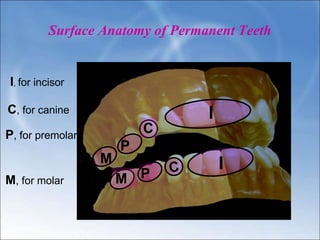
Surface Anatomy of Permanent Teeth
I
I
C
P
P
M
M
I, for incisor
C, for canine
P, for premolar
M, for molar
34
โ€ขEnamel organ appearance.
โ€ขBeginning of calcification.
โ€ขCrown completed.
โ€ขEruption.
โ€ขRoot completed.
Chronology:
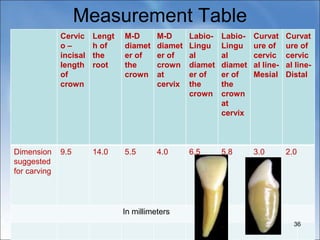
Measurement Table
Cervic
o โ€“
incisal
length
of
crown
Lengt
h of
the
root
M-D
diamet
er of
the
crown
M-D
diamet
er of
crown
at
cervix
Labio-
Lingu
al
diamet
er of
the
crown
Labio-
Lingu
al
diamet
er of
the
crown
at
cervix
Curvat
ure of
cervic
al line-
Mesial
Curvat
ure of
cervic
al line-
Distal
Dimension
suggested
for carving
9.5 14.0 5.5 4.0 6.5 5.8 3.0 2.0
In millimeters
36
LABIAL SURFACE
&
LINGUAL SURFACE
37
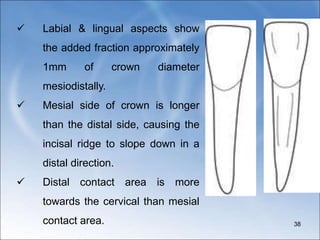
๏ƒผ Labial & lingual aspects show
the added fraction approximately
1mm of crown diameter
mesiodistally.
๏ƒผ Mesial side of crown is longer
than the distal side, causing the
incisal ridge to slope down in a
distal direction.
๏ƒผ Distal contact area is more
towards the cervical than mesial
contact area. 38
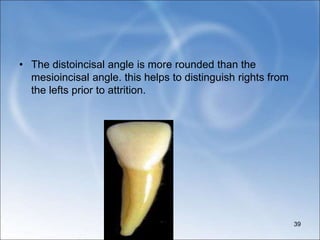
โ€ข The distoincisal angle is more rounded than the
mesioincisal angle. this helps to distinguish rights from
the lefts prior to attrition.
39
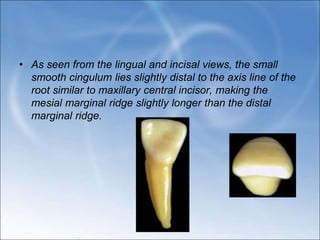
โ€ข As seen from the lingual and incisal views, the small
smooth cingulum lies slightly distal to the axis line of the
root similar to maxillary central incisor, making the
mesial marginal ridge slightly longer than the distal
marginal ridge.
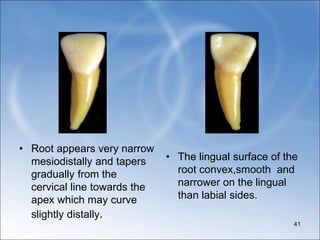
โ€ข Root appears very narrow
mesiodistally and tapers
gradually from the
cervical line towards the
apex which may curve
slightly distally.
โ€ข The lingual surface of the
root convex,smooth and
narrower on the lingual
than labial sides.
41
MESIAL SURFACE
&
DISTAL SURFACE
42
MESIAL DISTAL 43
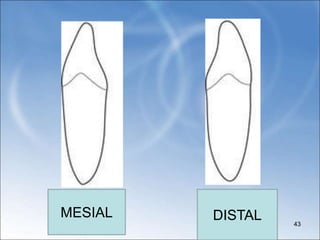
โ€ข The incisal edge is on or lingual to the mid-root axis. the
distolingual twist of the incisal ridge places the incisal distal
portion of the ridge somewhat more lingual than on the mesial.
โ€ข Mesially the cervical line has deep curvature[2mm].extending
incisally over one fourth of the crown length. the curvature
averaged 0.6 mm greater on the mesial surface than distal
surface.
โ€ข The labial crest is near the cervical line in the cervical third, the
lingual crest is on the cingulum.
44
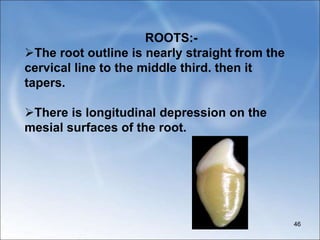
ROOTS:-
๏ƒ˜The root outline is nearly straight from the
cervical line to the middle third. then it
tapers.
๏ƒ˜There is longitudinal depression on the
mesial surfaces of the root.
46
INCISAL SURFACE
47
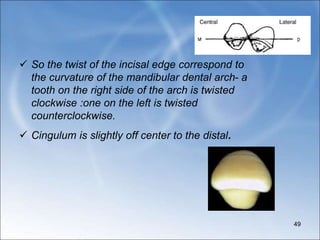
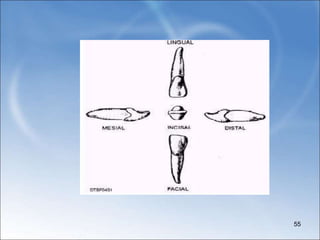
๏ƒผ Crown is broader faciolingually than mesio-
distally[by 0.4mm]
๏ƒผ Incisal edge not follow a straight line
mesiodistally , but rather it has a
distolingual twist: that is the distal half of
the incisal edge is bent lingually so that the
distolingual is more lingual in position than
the mesioincisal angle.
๏ƒผ So the twist of the incisal edge correspond to
the curvature of the mandibular dental arch- a
tooth on the right side of the arch is twisted
clockwise :one on the left is twisted
counterclockwise.
๏ƒผ Cingulum is slightly off center to the distal.
49
Lateral incisor
Distinguish features between mandibular central
and lateral incisor
Central incisor
๏ƒ˜ More symmetrical
๏ƒ˜ Smaller overall and shorter root
๏ƒ˜ Crown is 0.6mm shorter, root is
0.9 mm shorter in same mouth
๏ƒ˜ .
๏ƒ˜ Labial and lingual view-
o Same level contacts
o Crown not bent distally on root
o No distal side bulge on crown.
๏ƒ˜ Less symmetrical[labial, lingual,
incisal views]
o Crown larger overall[especially
mesiodistallyby 0.4mm]with longer
root [0.9mm longer]
๏ƒ˜ Labial and lingual view-
o Lower distal contact.
o Crown tipped distally on root.
o Distal side bulge on crown.
50
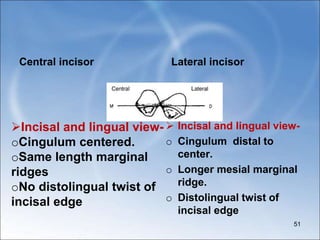
Central incisor Lateral incisor
๏ƒ˜ Incisal and lingual view-
o Cingulum distal to
center.
o Longer mesial marginal
ridge.
o Distolingual twist of
incisal edge
51
๏ƒ˜Incisal and lingual view-
oCingulum centered.
oSame length marginal
ridges
oNo distolingual twist of
incisal edge
CLINICAL CONSIDERATION
52
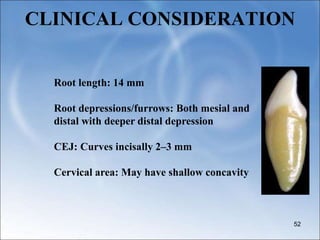
Root length: 14 mm
Root depressions/furrows: Both mesial and
distal with deeper distal depression
CEJ: Curves incisally 2โ€“3 mm
Cervical area: May have shallow concavity
Summary of the Mandibular Lateral Incisor
53
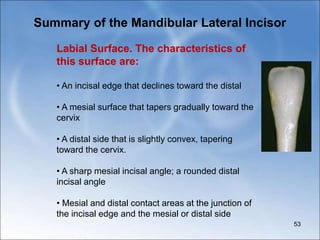
Labial Surface. The characteristics of
this surface are:
โ€ข An incisal edge that declines toward the distal
โ€ข A mesial surface that tapers gradually toward the
cervix
โ€ข A distal side that is slightly convex, tapering
toward the cervix.
โ€ข A sharp mesial incisal angle; a rounded distal
incisal angle
โ€ข Mesial and distal contact areas at the junction of
the incisal edge and the mesial or distal side
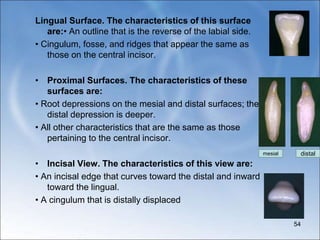
Lingual Surface. The characteristics of this surface
are:โ€ข An outline that is the reverse of the labial side.
โ€ข Cingulum, fosse, and ridges that appear the same as
those on the central incisor.
โ€ข Proximal Surfaces. The characteristics of these
surfaces are:
โ€ข Root depressions on the mesial and distal surfaces; the
distal depression is deeper.
โ€ข All other characteristics that are the same as those
pertaining to the central incisor.
โ€ข Incisal View. The characteristics of this view are:
โ€ข An incisal edge that curves toward the distal and inward
toward the lingual.
โ€ข A cingulum that is distally displaced
54
mesial distal
55
SUMMARY
56
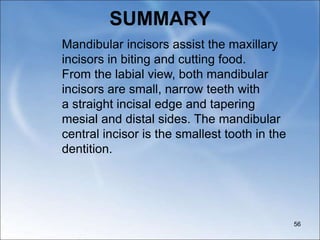
Mandibular incisors assist the maxillary
incisors in biting and cutting food.
From the labial view, both mandibular
incisors are small, narrow teeth with
a straight incisal edge and tapering
mesial and distal sides. The mandibular
central incisor is the smallest tooth in the
dentition.
THANK YOU
57

MANDIBULAR CENTRAL AND LATERAL INCISOR.ppt

  • 1.
  • 2.
  • 3.
  • 4.
    1/11/2024 Free Templatefrom www.brainybetty.com 4 INTRODUCTION ๏ถ MANDIBULAR INCISORS are 4 in number, two in each quadrant. ๏ถ The incisors present in adjacent to the midline k/a CENTRAL INCISORS while those distal to them k/a LATERAL INCISOR. ๏ถ Mandibular Central incisor are some what smaller than lateral incisor.
  • 5.
    PECULIAR FEATURES โ€ข Itis the smallest tooth in both permanent and primary dentition โ€ข The tooth is bilaterally symmetrical so it is very difficult to tell which side it is โ€ข It is smallest mesio-distally by dimension than any other tooth in dentition โ€ข The incisal ridge is at right angle to tooth central axis which is a distinguishing feature between mandibular central and lateral incisor 5
  • 6.
    TRAITS A trait isdistinguishing characteristic ,quality ,pecularity ,or attribute. 6
  • 7.
  • 8.
    1. SET TRAITS โ€ขAlso known as โ€œDENTITION TRAITSโ€. โ€ข Distinguish the teeth in primary dentition from permanent dentition. โ€ข For eg.in primary dentition set of 20 teeth is present whereas in permanent dentition 32 teeth is present. 8
  • 9.
    2. ARCH TRAITS โ€ขDistinguish the maxillary arch teeth from mandibular arch teeth. โ€ข For eg. maxillary has โ€˜Uโ€™ shaped arch and in mandible its โ€˜Vโ€™ shape arch. 9
  • 10.
    3. CLASS TRAITS โ€ขIt distinguish four categories of teeth found in both arches. โ€ข Eg:- incisors have crown compressed labiolingually for efficient cutting. โ€ข Canine have single pointed cusp for piercing food. 10
  • 11.
    โ€ข Premolars havetwo or three cusp for shearing and grinding. โ€ข Molars have three to five somewhat flattened cusps, ideally suited for grinding food morsels 11
  • 12.
    4. TYPE TRAITS โ€ขDifferentiate teeth within one class. โ€ข Eg:- between central and lateral incisors โ€ข Or between 1st and 2nd pre molars. 12
  • 13.
  • 14.
    Measurement Table Cervic o โ€“ incisal length of crown Length ofthe root M-D diamet er of the crown M-D diamet er of crown at cervix Labio- Lingual diamet er of the crown Labio- Lingual diamet er of the crown at cervix Curvat ure of cervica l line- Mesial Curvat ure of cervica l line- Distal Dimen sion sugges ted for carving 9.5 12.5 5.0 3.5 6.0 5.3 3.0 2.0 In millimeters 14
  • 15.
    BRIEF STUDY โ€ข LABIALASPECT โ€ข LINGUAL ASPECT โ€ข PROXIMAL ASPECT โ€ข INCISAL ASPECT โ€ข ROOT 15
  • 16.
  • 17.
    โ€ข The labialsurface is triangular in shape with base towards incisal edge and apex towards cervical line โ€ข The incisor third is flat and middle and cervical third is slightly convex โ€ข The mesial and distal outline is nearly straight and crown tapers from contact areas towards cervical part โ€ข The incisal edge is straight and is at right angle to long axis of tooth 17
  • 18.
    โ€ข Contact areas: both Mesially and distally, it is at incisor third โ€ข Proximoincisal angle : both mesioincisal and distoincisal angles are sharp and right angle Root: ๏ถ The mesial and distal outlines are straight towards apical portion of root. ๏ถ The apical third of the root terminates in a small ,pointed taper, in most cases curving distally. 18
  • 19.
  • 20.
    โ€ข Out lineis same as that of labial surface but with lingual tapering โ€ข Slightly concave from middle and incisal third and relatively smooth with shallow lingual fosse โ€ข Cingulum is very small slightly convex and centrally placed in cervical third area โ€ข Marginal ridges are very much inconspicuous 20
  • 21.
    โ€ข The lingualsurface becomes flat & then convex as progression is made from the incisal third to the cervical third. โ€ข No other tooth in the mouth, except the mandibular lateral incisors, shows so few developmental lines & grooves. โ€ข The outlines & surfaces of the mandibular incisors are regular & symmetrical. 21
  • 22.
  • 23.
    โ€ข the crownis wedge shape โ€ข the labio-lingual dimension is more in comparison with mesio-distal dimension โ€ข the labial outline is straight above the cervical curvature sloping rapidly from the crest of contour to incisal edge โ€ข The incisal ridge is rounded or worn flat, & its centre is usually & its centre is usually lingual to the centre of the root. 23
  • 24.
    โ€ข the lingualoutline is straight from the incisal edge to lingual fosse where it becomes slightly concave and then again at cingulum it becomes slightly convex โ€ข the incisal edge is lingually placed in relation with central axis of tooth โ€ข cervical line curves convexly about one third the length of crown (3mm.) 24
  • 25.
    ๏‚งRoot ๏‚ง The rootoutlines from the lingual aspect are straight with the crown outline from the cervical line, keeping the root diameter uniform through the cervical third & part of middle third. ๏‚ง Outline begins to taper in the middle third areas, tapering rapidly in the apical third to either a bluntly rounded or a pointed root end. ๏‚ง Most of the root have developmental depression for most of the root length. ๏‚ง Depression are deeper at the junction of the middle & apical third. 25
  • 26.
  • 27.
    โ€ข The featuresare almost similar as mesial aspect โ€ข the cervical line convexity is less towards the incisal edge in comparison with mesial surface โ€ข The incisal edge is rounded in young teeth where as in older individual it is flat โ€ข Developmental depression is more marked. 27
  • 28.
  • 29.
    โ€ข mesial halfis almost similar to distal half. labial surface is wider compared to lingual surface โ€ข labiolingual dimension is greater than mesiodistal dimension ๏‚ง the labial surface is broad and flat & tendency towards convexity at incisal third in comparison with cervical third where tendency is towards concavity. ๏‚ง the incisal edge is at right angle to line bisecting the crown labio -lingually. ๏‚ง When seen from incisally more of the labial surface is seen than lingual surface. 29
  • 30.
    ROOT โ€ข The rootis very narrow and slender and is 12.5 mm long โ€ข The mesial and distal outline is straight and within the confines of crown and it is evenly tapering towards apex โ€ข The facial and lingual out line is straight up to middlle third then it curves rapidly towards apex โ€ข The labiol-ingual dimension is more as in crown then 30
  • 31.
  • 32.
    ๏ƒผ it isthe second mandibular tooth from the median line, right or left. ๏ƒผ It resemble mandibular central incisor. ๏ƒผ Two incisors operate as a team in dental arch, so their functional forms are related. ๏ƒผ Shape is uniform compared with other teeth. ๏ƒผ Rarely it will have a labial & lingual root division in the cervical third. ๏ƒผ More commonly they have two canals in single root. ๏ƒผ Mandibular lateral incisors is somewhat larger. 32
  • 33.
    Surface Anatomy ofPermanent Teeth I I C P P M M I, for incisor C, for canine P, for premolar M, for molar
  • 34.
  • 35.
    โ€ขEnamel organ appearance. โ€ขBeginningof calcification. โ€ขCrown completed. โ€ขEruption. โ€ขRoot completed. Chronology:
  • 36.
    Measurement Table Cervic o โ€“ incisal length of crown Lengt hof the root M-D diamet er of the crown M-D diamet er of crown at cervix Labio- Lingu al diamet er of the crown Labio- Lingu al diamet er of the crown at cervix Curvat ure of cervic al line- Mesial Curvat ure of cervic al line- Distal Dimension suggested for carving 9.5 14.0 5.5 4.0 6.5 5.8 3.0 2.0 In millimeters 36
  • 37.
  • 38.
    ๏ƒผ Labial &lingual aspects show the added fraction approximately 1mm of crown diameter mesiodistally. ๏ƒผ Mesial side of crown is longer than the distal side, causing the incisal ridge to slope down in a distal direction. ๏ƒผ Distal contact area is more towards the cervical than mesial contact area. 38
  • 39.
    โ€ข The distoincisalangle is more rounded than the mesioincisal angle. this helps to distinguish rights from the lefts prior to attrition. 39
  • 40.
    โ€ข As seenfrom the lingual and incisal views, the small smooth cingulum lies slightly distal to the axis line of the root similar to maxillary central incisor, making the mesial marginal ridge slightly longer than the distal marginal ridge.
  • 41.
    โ€ข Root appearsvery narrow mesiodistally and tapers gradually from the cervical line towards the apex which may curve slightly distally. โ€ข The lingual surface of the root convex,smooth and narrower on the lingual than labial sides. 41
  • 42.
  • 43.
  • 44.
    โ€ข The incisaledge is on or lingual to the mid-root axis. the distolingual twist of the incisal ridge places the incisal distal portion of the ridge somewhat more lingual than on the mesial. โ€ข Mesially the cervical line has deep curvature[2mm].extending incisally over one fourth of the crown length. the curvature averaged 0.6 mm greater on the mesial surface than distal surface. โ€ข The labial crest is near the cervical line in the cervical third, the lingual crest is on the cingulum. 44
  • 45.
    ROOTS:- ๏ƒ˜The root outlineis nearly straight from the cervical line to the middle third. then it tapers. ๏ƒ˜There is longitudinal depression on the mesial surfaces of the root. 46
  • 46.
  • 47.
    ๏ƒผ Crown isbroader faciolingually than mesio- distally[by 0.4mm] ๏ƒผ Incisal edge not follow a straight line mesiodistally , but rather it has a distolingual twist: that is the distal half of the incisal edge is bent lingually so that the distolingual is more lingual in position than the mesioincisal angle.
  • 48.
    ๏ƒผ So thetwist of the incisal edge correspond to the curvature of the mandibular dental arch- a tooth on the right side of the arch is twisted clockwise :one on the left is twisted counterclockwise. ๏ƒผ Cingulum is slightly off center to the distal. 49
  • 49.
    Lateral incisor Distinguish featuresbetween mandibular central and lateral incisor Central incisor ๏ƒ˜ More symmetrical ๏ƒ˜ Smaller overall and shorter root ๏ƒ˜ Crown is 0.6mm shorter, root is 0.9 mm shorter in same mouth ๏ƒ˜ . ๏ƒ˜ Labial and lingual view- o Same level contacts o Crown not bent distally on root o No distal side bulge on crown. ๏ƒ˜ Less symmetrical[labial, lingual, incisal views] o Crown larger overall[especially mesiodistallyby 0.4mm]with longer root [0.9mm longer] ๏ƒ˜ Labial and lingual view- o Lower distal contact. o Crown tipped distally on root. o Distal side bulge on crown. 50
  • 50.
    Central incisor Lateralincisor ๏ƒ˜ Incisal and lingual view- o Cingulum distal to center. o Longer mesial marginal ridge. o Distolingual twist of incisal edge 51 ๏ƒ˜Incisal and lingual view- oCingulum centered. oSame length marginal ridges oNo distolingual twist of incisal edge
  • 51.
    CLINICAL CONSIDERATION 52 Root length:14 mm Root depressions/furrows: Both mesial and distal with deeper distal depression CEJ: Curves incisally 2โ€“3 mm Cervical area: May have shallow concavity
  • 52.
    Summary of theMandibular Lateral Incisor 53 Labial Surface. The characteristics of this surface are: โ€ข An incisal edge that declines toward the distal โ€ข A mesial surface that tapers gradually toward the cervix โ€ข A distal side that is slightly convex, tapering toward the cervix. โ€ข A sharp mesial incisal angle; a rounded distal incisal angle โ€ข Mesial and distal contact areas at the junction of the incisal edge and the mesial or distal side
  • 53.
    Lingual Surface. Thecharacteristics of this surface are:โ€ข An outline that is the reverse of the labial side. โ€ข Cingulum, fosse, and ridges that appear the same as those on the central incisor. โ€ข Proximal Surfaces. The characteristics of these surfaces are: โ€ข Root depressions on the mesial and distal surfaces; the distal depression is deeper. โ€ข All other characteristics that are the same as those pertaining to the central incisor. โ€ข Incisal View. The characteristics of this view are: โ€ข An incisal edge that curves toward the distal and inward toward the lingual. โ€ข A cingulum that is distally displaced 54 mesial distal
  • 54.
  • 55.
    SUMMARY 56 Mandibular incisors assistthe maxillary incisors in biting and cutting food. From the labial view, both mandibular incisors are small, narrow teeth with a straight incisal edge and tapering mesial and distal sides. The mandibular central incisor is the smallest tooth in the dentition.
  • 56.