Introduction
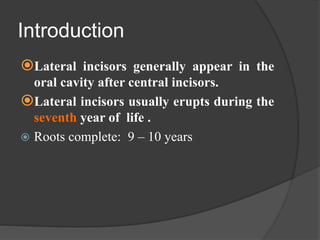
Lateral incisors generally appear in the
oral cavity after central incisors.
Lateral incisors usually erupts during the
seventh year of life .
 Roots complete: 9 – 10 years
CHRONOLOGY
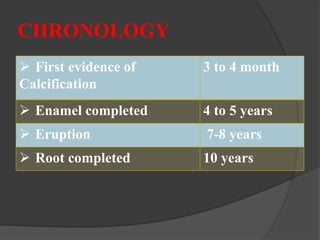
 First evidence of
Calcification
3 to 4 month
 Enamel completed 4 to 5 years
 Eruption 7-8 years
 Root completed 10 years
MEASUREMENTS
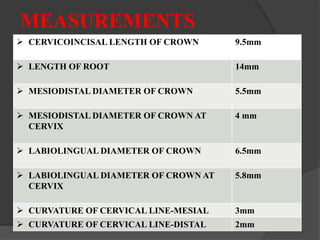
 CERVICOINCISAL LENGTH OF CROWN 9.5mm
 LENGTH OF ROOT 14mm
 MESIODISTAL DIAMETER OF CROWN 5.5mm
 MESIODISTAL DIAMETER OF CROWN AT
CERVIX
4 mm
 LABIOLINGUAL DIAMETER OF CROWN 6.5mm
 LABIOLINGUAL DIAMETER OF CROWN AT
CERVIX
5.8mm
 CURVATURE OF CERVICAL LINE-MESIAL 3mm
 CURVATURE OF CERVICAL LINE-DISTAL 2mm
TOOTH NUMBERING
SYSTEM
 FDI SYSTEM (Federation Dentaire
Internationalae)-
 Mandibular RIGHT lateral incisor- 42
 Mandibular LEFT lateral incisor- 32
 UNIVERSAL SYSTEM-
 Mandibular RIGHT lateral incisor- 26
 Mandibular LEFT lateral incisor- 23
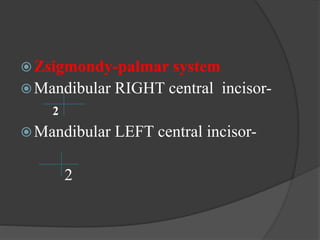
Zsigmondy-palmar system
Mandibular RIGHT central incisor-
2
Mandibular LEFT central incisor-
2
 ARCH TRAITS
 Lingual fossa are less pronounced on
mandibular incisors.
 Mandibular lateral incisors have
roots that are more triangular in cross
section.
 Labio-lingual diameter is wider than
mesio-distal diameter.
CLASS TRAITS-
Crown shapes are rectangular,
longer inciso-gingivally than
mesio-distally.
Mesial & distal marginal ridge
converge toward the lingual
cingulum.
SET TRAIT
There are depression or perikymata
on the labial surface of the crown of
the incisors.
Mammelons are seen on the incisal
edge of newly erupted incisors.
Cervical ridges of anterior
permanant teeth are prominent than
primary teeth.
 TYPE TRAIT
 Lateral incisors have distal proximal
contact more apical than the mesial
contact.
 Lateral incisors have disto-incisal
angle more rounded than the mesio-
incisal angle.
Morphology
Labial Aspect
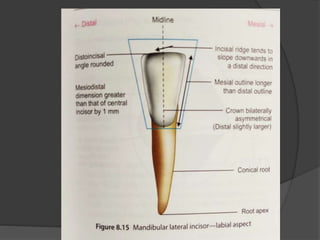
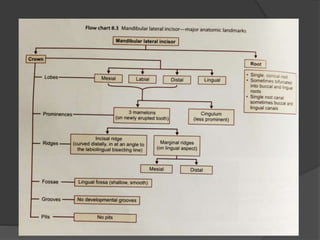
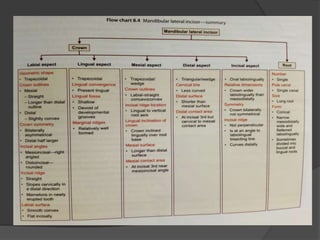
 Crown is trapezoidal from labial aspect.
 Mesial outline is almost straight in line with mesial
outline of root.
 Distal outline is straight near cervix and become
slightly convex as it reaches distoincisal angle.
 Distoincisal angle more rounded than mesioincisal
angle
 Incisal outline formed by incisal ridge is straight but
has tendency to slope cervically in distal direction.
 Cervical line is curved apically.
 Crown is not bilaterally symmetrical
 Distal half is slightly larger.
Lingual Aspect
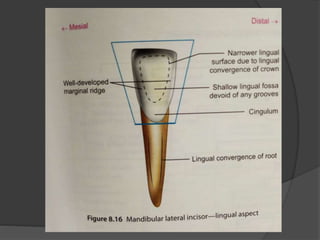
 Its shape is trapezoidal like labial surface.
 Crown tapers lingually making lingual surface
narrower than labial surface.
 Shallow lingual fossa
 Lingual surface is smooth devioid of
developmental grooves, and is convex near
cingulum.
 Distal surface bulges from the incisal view
Incisal Aspect
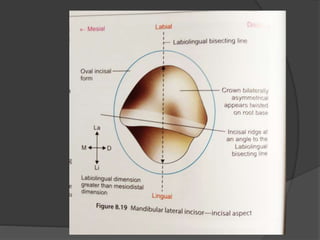
 It is oval labiolingually.
 Labiolingual dimension is greater than
mesiodistal.
 Incisal ridge is at an angle to the line bisecting
the tooth labiolingually rather than being
perpendicular.
 Slightly twisted on its root base from this aspect.
 Cingulum twisted (off-center) to the distal
Mesial Aspect
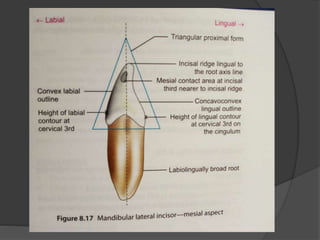
 Mesial aspect is triangular
 Labial outline is convex near cervical line
 Lingual outline is straight in incisal 3rd
 Incisal edge lingual to root axis line
 CEJ is curved more on the mesial than the distal
 Mesial contact area is at incisal 3rd of crown
 Mesial surface is longer than distal surface
Distal View
 Distal aspect is similar to mesial aspect
except
 Cervical line on distal surface is less curved
 Distal contact area is within incisal 3rd
Contact Areas
 Mesial and distal contact areas in incisal
1/3
Root Anatomy
 Mesial and distal root
depressions
 Apex may curve slightly to
the distal
Variations
 2 canals in single root
 Long root
 Small size of tooth
 Bifurcation of root into labial and lingual
divisions
ENDODONTIC ANATOMY
 The pulp chamber is small & flat
mesiodistally
 The access opening of mand. Incisor is a
long oval in shape with its greatest
dimensions oriented incisogingivally.
Thank you

MANDIBULAR LATERAL INCISOR.pptx

  • 2.
    Introduction Lateral incisors generallyappear in the oral cavity after central incisors. Lateral incisors usually erupts during the seventh year of life .  Roots complete: 9 – 10 years
  • 3.
    CHRONOLOGY  First evidenceof Calcification 3 to 4 month  Enamel completed 4 to 5 years  Eruption 7-8 years  Root completed 10 years
  • 4.
    MEASUREMENTS  CERVICOINCISAL LENGTHOF CROWN 9.5mm  LENGTH OF ROOT 14mm  MESIODISTAL DIAMETER OF CROWN 5.5mm  MESIODISTAL DIAMETER OF CROWN AT CERVIX 4 mm  LABIOLINGUAL DIAMETER OF CROWN 6.5mm  LABIOLINGUAL DIAMETER OF CROWN AT CERVIX 5.8mm  CURVATURE OF CERVICAL LINE-MESIAL 3mm  CURVATURE OF CERVICAL LINE-DISTAL 2mm
  • 5.
    TOOTH NUMBERING SYSTEM  FDISYSTEM (Federation Dentaire Internationalae)-  Mandibular RIGHT lateral incisor- 42  Mandibular LEFT lateral incisor- 32
  • 6.
     UNIVERSAL SYSTEM- Mandibular RIGHT lateral incisor- 26  Mandibular LEFT lateral incisor- 23
  • 7.
    Zsigmondy-palmar system Mandibular RIGHTcentral incisor- 2 Mandibular LEFT central incisor- 2
  • 8.
     ARCH TRAITS Lingual fossa are less pronounced on mandibular incisors.  Mandibular lateral incisors have roots that are more triangular in cross section.  Labio-lingual diameter is wider than mesio-distal diameter.
  • 9.
    CLASS TRAITS- Crown shapesare rectangular, longer inciso-gingivally than mesio-distally. Mesial & distal marginal ridge converge toward the lingual cingulum.
  • 10.
    SET TRAIT There aredepression or perikymata on the labial surface of the crown of the incisors. Mammelons are seen on the incisal edge of newly erupted incisors. Cervical ridges of anterior permanant teeth are prominent than primary teeth.
  • 11.
     TYPE TRAIT Lateral incisors have distal proximal contact more apical than the mesial contact.  Lateral incisors have disto-incisal angle more rounded than the mesio- incisal angle.
  • 12.
    Morphology Labial Aspect  Crownis trapezoidal from labial aspect.  Mesial outline is almost straight in line with mesial outline of root.  Distal outline is straight near cervix and become slightly convex as it reaches distoincisal angle.  Distoincisal angle more rounded than mesioincisal angle  Incisal outline formed by incisal ridge is straight but has tendency to slope cervically in distal direction.  Cervical line is curved apically.  Crown is not bilaterally symmetrical  Distal half is slightly larger.
  • 14.
    Lingual Aspect  Itsshape is trapezoidal like labial surface.  Crown tapers lingually making lingual surface narrower than labial surface.  Shallow lingual fossa  Lingual surface is smooth devioid of developmental grooves, and is convex near cingulum.  Distal surface bulges from the incisal view
  • 16.
    Incisal Aspect  Itis oval labiolingually.  Labiolingual dimension is greater than mesiodistal.  Incisal ridge is at an angle to the line bisecting the tooth labiolingually rather than being perpendicular.  Slightly twisted on its root base from this aspect.  Cingulum twisted (off-center) to the distal
  • 18.
    Mesial Aspect  Mesialaspect is triangular  Labial outline is convex near cervical line  Lingual outline is straight in incisal 3rd  Incisal edge lingual to root axis line  CEJ is curved more on the mesial than the distal  Mesial contact area is at incisal 3rd of crown  Mesial surface is longer than distal surface
  • 20.
    Distal View  Distalaspect is similar to mesial aspect except  Cervical line on distal surface is less curved  Distal contact area is within incisal 3rd
  • 21.
    Contact Areas  Mesialand distal contact areas in incisal 1/3 Root Anatomy  Mesial and distal root depressions  Apex may curve slightly to the distal
  • 22.
    Variations  2 canalsin single root  Long root  Small size of tooth  Bifurcation of root into labial and lingual divisions
  • 25.
    ENDODONTIC ANATOMY  Thepulp chamber is small & flat mesiodistally  The access opening of mand. Incisor is a long oval in shape with its greatest dimensions oriented incisogingivally.
  • 26.