Permanent Canines
DR. FAIZA GULFAM
Permanent Mandibular Canines
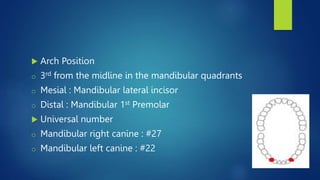
 Arch Position
o 3rd from the midline in the mandibular quadrants
o Mesial : Mandibular lateral incisor
o Distal : Mandibular 1st Premolar
 Universal number
o Mandibular right canine : #27
o Mandibular left canine : #22
 General form and function
o Similar to maxillary canine
 Eruption age : 9 -10 years
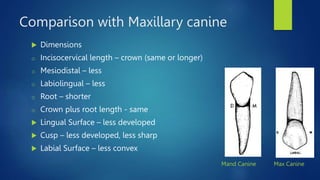
Comparison with Maxillary canine
 Dimensions
o Incisocervical length – crown (same or longer)
o Mesiodistal – less
o Labiolingual – less
o Root – shorter
o Crown plus root length - same
 Lingual Surface – less developed
 Cusp – less developed, less sharp
 Labial Surface – less convex
Mand Canine Max Canine
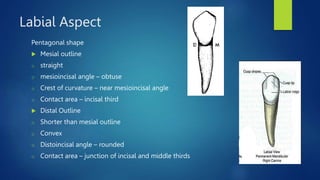
Labial Aspect
Pentagonal shape
 Mesial outline
o straight
o mesioincisal angle – obtuse
o Crest of curvature – near mesioincisal angle
o Contact area – incisal third
 Distal Outline
o Shorter than mesial outline
o Convex
o Distoincisal angle – rounded
o Contact area – junction of incisal and middle thirds
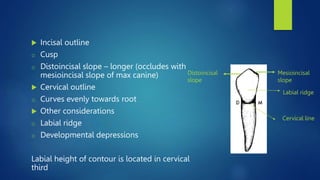
 Incisal outline
o Cusp
o Distoincisal slope – longer (occludes with
mesioincisal slope of max canine)
 Cervical outline
o Curves evenly towards root
 Other considerations
o Labial ridge
o Developmental depressions
Labial height of contour is located in cervical
third
Mesioincisal
slope
Distoincisal
slope
Cervical line
Labial ridge
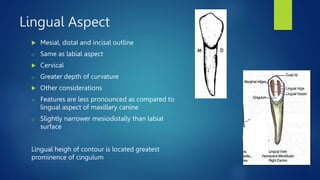
Lingual Aspect
 Mesial, distal and incisal outline
o Same as labial aspect
 Cervical
o Greater depth of curvature
 Other considerations
o Features are less pronounced as compared to
lingual aspect of maxillary canine
o Slightly narrower mesiodistally than labial
surface
Lingual heigh of contour is located greatest
prominence of cingulum
Mesial Aspect
 Labial Margin
o Convex
o Height of contour – cervical third
 Lingual Margin
o Similar to maxillary canine except less cingulum
convexity
 Incisal Margin
o Incisal ridge thinner labiolingually
Labial Lingual
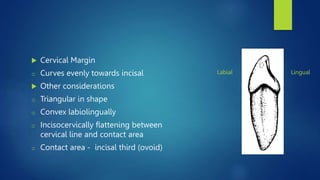
 Cervical Margin
o Curves evenly towards incisal
 Other considerations
o Triangular in shape
o Convex labiolingually
o Incisocervically flattening between
cervical line and contact area
o Contact area - incisal third (ovoid)
Labial Lingual
Distal Aspect
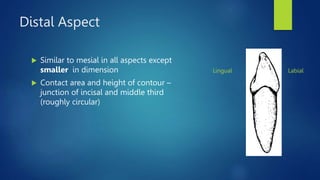
 Similar to mesial in all aspects except
smaller in dimension
 Contact area and height of contour –
junction of incisal and middle third
(roughly circular)
Labial
Lingual
Incisal Aspect
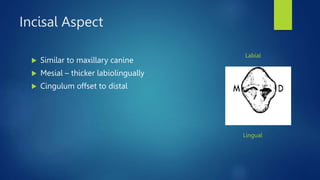
 Similar to maxillary canine
 Mesial – thicker labiolingually
 Cingulum offset to distal
Lingual
Labial
Root
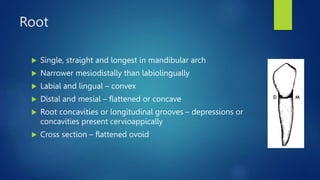
 Single, straight and longest in mandibular arch
 Narrower mesiodistally than labiolingually
 Labial and lingual – convex
 Distal and mesial – flattened or concave
 Root concavities or longitudinal grooves – depressions or
concavities present cervioappically
 Cross section – flattened ovoid
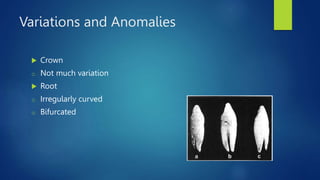
Variations and Anomalies
 Crown
o Not much variation
 Root
o Irregularly curved
o Bifurcated
Questions

RAWAL Mandibular Canine tooth morpholo.pptx

  • 1.
  • 2.
  • 3.
     Arch Position o3rd from the midline in the mandibular quadrants o Mesial : Mandibular lateral incisor o Distal : Mandibular 1st Premolar  Universal number o Mandibular right canine : #27 o Mandibular left canine : #22
  • 4.
     General formand function o Similar to maxillary canine  Eruption age : 9 -10 years
  • 5.
    Comparison with Maxillarycanine  Dimensions o Incisocervical length – crown (same or longer) o Mesiodistal – less o Labiolingual – less o Root – shorter o Crown plus root length - same  Lingual Surface – less developed  Cusp – less developed, less sharp  Labial Surface – less convex Mand Canine Max Canine
  • 6.
    Labial Aspect Pentagonal shape Mesial outline o straight o mesioincisal angle – obtuse o Crest of curvature – near mesioincisal angle o Contact area – incisal third  Distal Outline o Shorter than mesial outline o Convex o Distoincisal angle – rounded o Contact area – junction of incisal and middle thirds
  • 7.
     Incisal outline oCusp o Distoincisal slope – longer (occludes with mesioincisal slope of max canine)  Cervical outline o Curves evenly towards root  Other considerations o Labial ridge o Developmental depressions Labial height of contour is located in cervical third Mesioincisal slope Distoincisal slope Cervical line Labial ridge
  • 8.
    Lingual Aspect  Mesial,distal and incisal outline o Same as labial aspect  Cervical o Greater depth of curvature  Other considerations o Features are less pronounced as compared to lingual aspect of maxillary canine o Slightly narrower mesiodistally than labial surface Lingual heigh of contour is located greatest prominence of cingulum
  • 9.
    Mesial Aspect  LabialMargin o Convex o Height of contour – cervical third  Lingual Margin o Similar to maxillary canine except less cingulum convexity  Incisal Margin o Incisal ridge thinner labiolingually Labial Lingual
  • 10.
     Cervical Margin oCurves evenly towards incisal  Other considerations o Triangular in shape o Convex labiolingually o Incisocervically flattening between cervical line and contact area o Contact area - incisal third (ovoid) Labial Lingual
  • 11.
    Distal Aspect  Similarto mesial in all aspects except smaller in dimension  Contact area and height of contour – junction of incisal and middle third (roughly circular) Labial Lingual
  • 12.
    Incisal Aspect  Similarto maxillary canine  Mesial – thicker labiolingually  Cingulum offset to distal Lingual Labial
  • 13.
    Root  Single, straightand longest in mandibular arch  Narrower mesiodistally than labiolingually  Labial and lingual – convex  Distal and mesial – flattened or concave  Root concavities or longitudinal grooves – depressions or concavities present cervioappically  Cross section – flattened ovoid
  • 14.
    Variations and Anomalies Crown o Not much variation  Root o Irregularly curved o Bifurcated
  • 15.